
In the Bighorn Basin of southern Montana and northern Wyoming, the clay-rich layers of the Cloverly Formation hold the bones of a heavily armored herbivore. Paleontologist John Ostrom named it Sauropelta edwardsi in 1970, although several later studies spell it S. edwardsorum. He judged its rocks most probably late Aptian to early Albian, in the Early Cretaceous. However, later dating stretches the possible window to roughly 124 to 98 million years ago. Like other ankylosaurs—the armored dinosaurs—it carried a mosaic of plates on its back, while hollow-based spines jutted from its flanks.
The type specimen came from a site near Push Creek, Montana, that an American Museum of Natural History party found in 1932. Ostrom knew of no complete skeleton, and the skull survives only in part. Still, its armor—partly preserved in place on two skeletons—offers a rare glimpse of how an early ankylosaur’s defenses were arranged.
Sauropelta Key Facts
| Keyword | Fact |
|---|---|
| Pronunciation | Not specified |
| Meaning of name | Lizard Shield |
| Group | Ankylosauria |
| Type Species | Sauropelta edwardsi (also spelled S. edwardsorum) |
| Diet | Herbivore |
| When it Lived | About 124 to 98 MYA (full span of its host members, with most finds near the Little Sheep–Himes boundary, roughly 109 MYA) |
| Period | Cretaceous |
| Epoch | Early Cretaceous (Aptian to Albian stages) |
| Length | Not specified |
| Height | Not specified |
| Weight | About 1,990 pounds (902.9 kilograms), indirect estimate |
| Mobility | Moved on all four legs (quadrupedal) |
| First Discovery | 1932 by an American Museum of Natural History party (collector: Barnum Brown) |
| Described by | 1970 by J.H. Ostrom |
| Holotype | AMNH 3032 |
| Location of first find | AMNH locality 32-3, Cloverly Formation, Push Creek area, Big Horn County, Montana, USA |
Sauropelta Origins, Taxonomy and Timeline
The name Sauropelta joins two Greek words, sauros, “lizard,” and pelta, “small shield”—a reference to the animal’s dermal armor, or bony skin plates. Its species name honors Nell and Tom Edwards of Bridger, Montana, for the hospitality and help they gave Yale field crews. Together, the name pairs armor with hospitality.
Sauropelta belongs to Ankylosauria, and Ostrom placed it in the family Acanthopholidae. His reasons included a very long lower tooth row, unfused first neck bones and ribs, a long thigh bone, and thin armor. Even so, he stressed that this assignment “must be considered as tentative.” He saw Silvisaurus from Kansas as distinct but probably closely related—both, in his view, primitive. Sauropelta edwardsi is the type and only known species of its genus.
In 2013, Kirkland and colleagues placed the lower part of its range in the Little Sheep Mudstone Member. An ash bed near the top of that member gives a date of 108.5 million years. In 2019, D’Emic and colleagues revised the Little Sheep Mudstone to about 124 to 109 million years old. The overlying Himes Member spans about 109 to 98 million years—the mid to late Albian and early Cenomanian. Because Sauropelta occurs in both members, it falls somewhere within that span. The revised ages could therefore extend its possible range slightly into the late Barremian and the earliest Cenomanian, the opening stage of the Late Cretaceous. Even so, Ostrom found it most common in his upper Unit V (Little Sheep) and lower Unit VII (Himes).
Discovery & Fossil Evidence
The holotype, AMNH 3032, came from locality AM 32-3, about 1.5 miles (2.4 kilometers) west of a ranch on Push Creek. Ostrom’s locality numbers begin with the year of discovery, dating the find to 1932. Although Ostrom drew on Barnum Brown’s field records, he never named the collector. Kirkland and colleagues, however, cite a note “from the collector, Barnum Brown.” Its exact level is unknown—somewhere within Units V to VII.
AMNH 3032 is a partial skeleton that lacks most of the skull. Only fragments of the eye region and upper jaw survive, plus an imperfect right lower jaw. It preserves 13 dorsal (back) vertebrae, seven fused hip vertebrae, and 39 caudal (tail) vertebrae from an incomplete series. The type also includes both humeri, ulnae, and radii (arm bones) and a left hand. Its hindquarters keep both ilia and ischia, both femora (thigh bones), a tibia, both fibulae, and both feet. In 2023, Wang and colleagues found an “uncinate scar” on one rib, tied to uncinate processes—the rib prongs that help birds breathe.
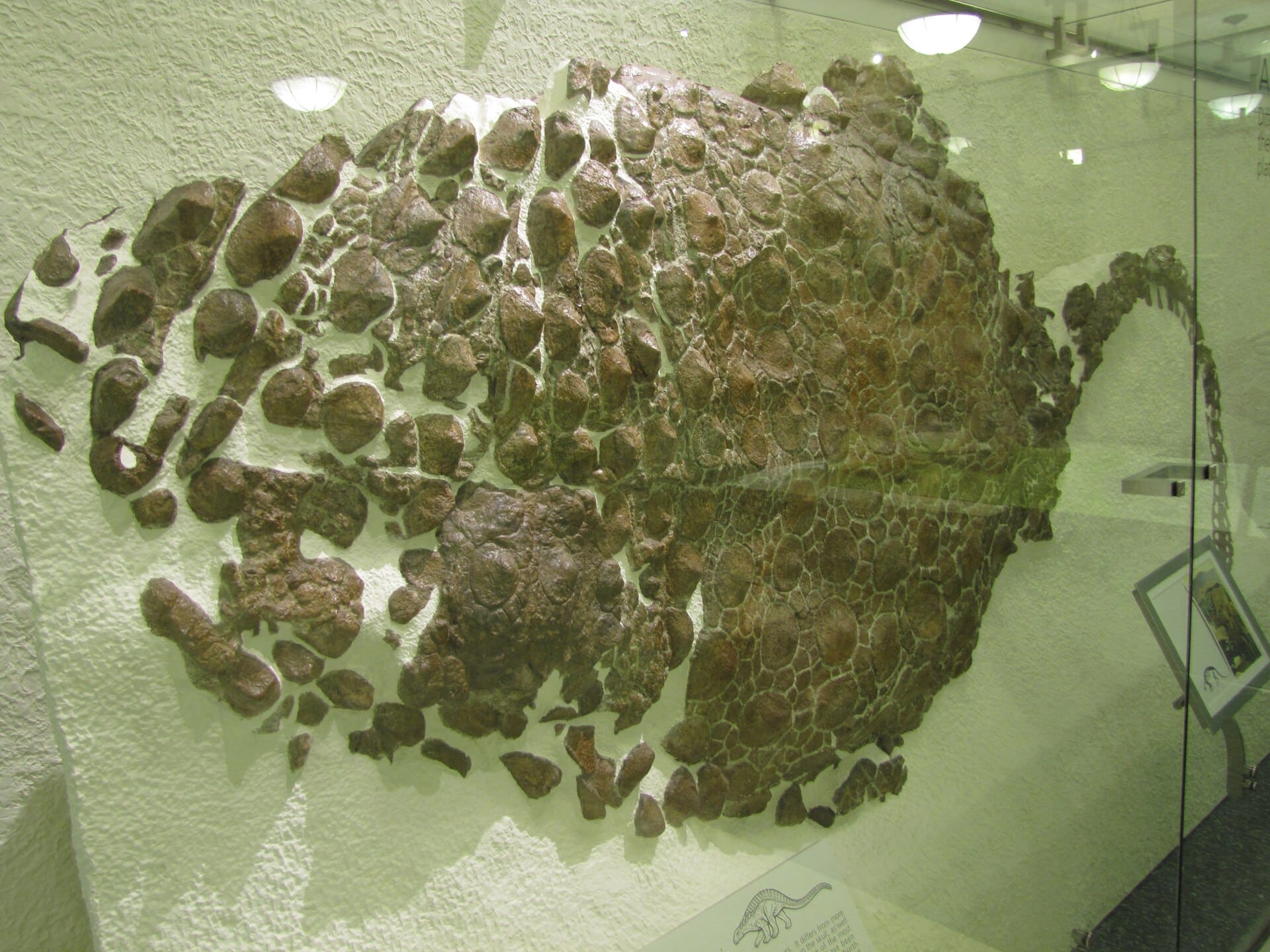

Ostrom referred further partial skeletons—AMNH 3016, 3033, 3035, 3036, 5833, and 5853—plus many isolated bones at Yale. He listed AMNH 5853 and 5833, from sites found in 1903 and 1904, only tentatively. Yale’s Crooked Creek quarries in northern Wyoming added scattered bones of at least five individuals. Where their levels are known, the referred specimens come from Units V to VII of the Cloverly.
Sauropelta Size and Description
Ostrom saw Sauropelta as a primitive ankylosaur, and its skeleton shows why.
Short description of Sauropelta
Ostrom judged the skull apparently long and deep, perhaps narrower than in other ankylosaurs. Dermal bone seems to have covered its flat roof so completely that the sutures between bones are hidden. The partial skull in AMNH 3035 measures about 35 centimeters (13.8 inches) at its widest, just behind the eye sockets. The long lower jaw bore a fused dermal plate, and its curved tooth row reached close to the symphysis—the joint where the two jaw halves meet.
Its ribs were not fused to the back vertebrae, “contrary to the usual condition in nodosaurs.” Each ilium (upper hip bone) spread into a broad, nearly horizontal plate, while the pubis shrank to a small hook. In Ostrom’s view, the forelimb could not sprawl like a lizard’s but stood nearly upright. The feet ended in broad, hoof-like unguals (toe claws), and the foot “almost certainly was not plantigrade”—it did not rest flat.
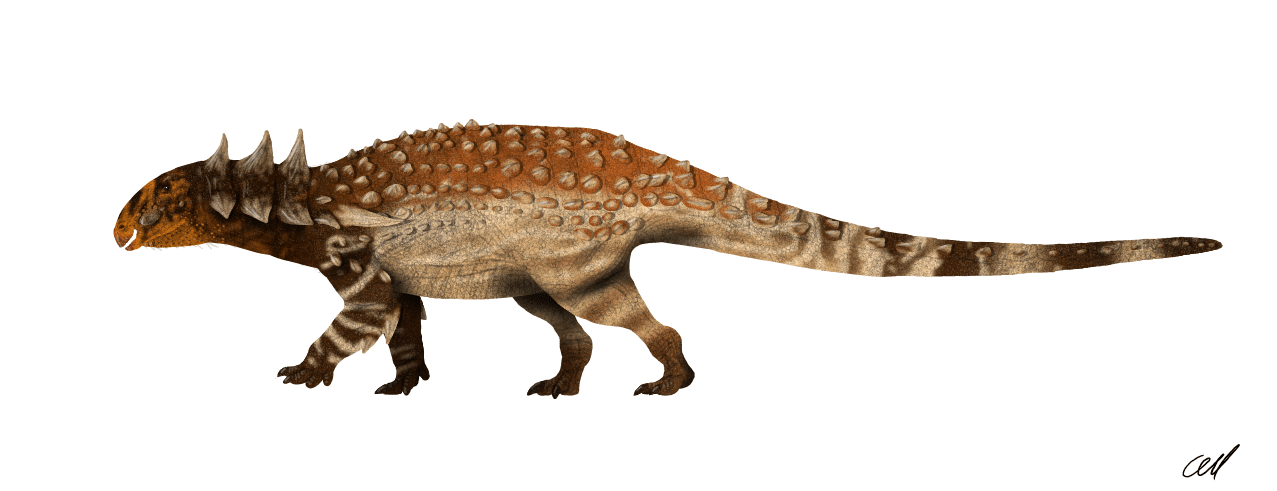
Plates seem to have run in rows across the body, flatter near the midline and more strongly keeled and spined toward the sides. Smaller plates down to about 1 centimeter (0.4 inch) and bony ossicles filled the gaps. Rugose plate surfaces led Ostrom to suggest that horny scutes covered them in life. Its coloration is unknown, so any picture of its skin tone is speculative.

Size and Weight of Type Species
Ostrom called Sauropelta a “medium-sized” ankylosaur but gave no total length or hip height, so both figures remain open.
The bones, however, offer direct measurements. In the type, each femur measures 76 to 77 centimeters (about 30 inches), and the tibia 57.5 centimeters (22.6 inches). The right ilium reaches 129 centimeters (about 4.2 feet), while the humerus is roughly three quarters as long as the femur.
In 2012, O’Gorman and Hone listed 902.9 kilograms (about 1,990 pounds) for AMNH 3036. This figure is indirect—it comes from a polynomial method that Seebacher published in 2001, applied to Carpenter’s 1984 reconstruction. That skeleton’s unusual armor also once made Ostrom wonder whether it represented a second species.
The Dinosaur in Detail
What sets this dinosaur apart is its armor—a mosaic of large flat and keeled plates, with small plates and ossicles between. Along the flanks, hollow-based plates projected outward and backward “as long triangular spines.” Compared with Nodosaurus, Edmontonia, and Polacanthus, its plates were less massive and more deeply hollowed underneath. In AMNH 3035, the shoulder spines point outward, or backward and outward, but none point forward. Ostrom argued that forward-facing spikes “surely would have snagged on brush and tree trunks.”
The type lower jaw holds 27 tooth sockets along a 23-centimeter (9-inch) row, while Yale specimen YPM 5502 has 25. Each tooth was laterally compressed and triangular, with denticulate (finely serrated) front and back edges. Unlike the nodosaur teeth Ostrom compared, they lack vertical ridges—a trait he found shared only with Silvisaurus.
The neck shows another early trait: “In contrast to all nodosaurs,” Ostrom wrote, only the odontoid, a peg-like process, was fused to the axis.
Ostrom called it an acanthopholid, but later workers, including Carpenter in 1984, treated it as a nodosaurid. Several analyses placed it earlier than Edmontonia and Panoplosaurus on the family tree. Kirkland and colleagues called it the oldest nodosaurid from western North America. In 2023, however, Raven and colleagues found the traditional Nodosauridae paraphyletic—not a single natural group. They recovered Sauropelta as the sister taxon of Tatankacephalus, also from the Cloverly, outside all four of their ankylosaur clades. Calling its position uncertain, they asked for more skull material and left open whether the two are one taxon. Taken together, Sauropelta remains an armored dinosaur whose family tree paleontologists are still redrawing.
Interesting Points about Sauropelta
- Its type skeleton came from a site found in 1932, yet waited 38 years for formal description in Ostrom’s 1970 monograph.
- A note from collector Barnum Brown, kept with the type skeleton, says two flat osteoderms lay with its forelimbs.
- In 1984, Carpenter suggested that Sauropelta may have made the fossil footprints called Tetrapodosaurus borealis, from British Columbia’s Gething Formation.
- Carpenter also proposed that bloating after death explains why most ankylosaur skeletons turn up on their backs.
Contemporary Dinosaurs
Sharing the Cloverly landscape in even greater numbers was Tenontosaurus, which Ostrom described as a new iguanodontid ornithopod. Its remains appear to occur at every level of Units V to VII. In fact, it seems the only animal more abundant than Sauropelta in Cloverly collections. No study records a direct interaction, so the two are best pictured as neighbors.
Prowling the same beds was Deinonychus, a theropod Ostrom placed in the family Dromaeosauridae. Its fossils come from the upper 30 feet (9 meters) of Unit V through lower Unit VII—overlapping Sauropelta‘s commonest levels. Ostrom found its teeth with a Tenontosaurus skeleton, but nothing links it to Sauropelta.
Far smaller was Microvenator celer, a theropod Ostrom described as “about the size of a small turkey.” In 1998, Makovicky and Sues placed it in or beside Oviraptorosauria and identified the holotype as a juvenile. That specimen, AMNH 3041, came from Middle Dome in Wheatland County, Montana. Ostrom tentatively matched its beds with Unit VII but called them only “purportedly” Cloverly, since most central Montana workers assign them to the Kootenai Formation. Only a questionable Sauropelta specimen comes from that area, so nothing places them together.
Named much later, Aquilops was an early neoceratopsian known from a skull and lower jaw. Its holotype, OMNH 34557, came from the base of Unit VII in Carbon County, Montana. Its describers provisionally dated it to the middle or late Albian, about 109 to 104 million years ago. That level matches lower Unit VII, where Sauropelta is common, though no record links the two.
Sauropelta in its Natural Habitat
The world Sauropelta roamed survives largely as mud turned to stone. Unit V, the Little Sheep Mudstone, is a mostly unlayered, bentonitic claystone (rich in altered volcanic ash) studded with chalcedony, calcite, and barite nodules. Occasional channel sands cut through it, while above lie the channel sandstones and mottled claystones of the Himes Member (Ostrom’s Units VI and VII). D’Emic and colleagues tied the Little Sheep to a time of low sediment supply. Ostrom also recorded lungfish, an amioid fish, turtles, and crocodilians, plus sauropod remains, an indeterminate Ornithomimus, and a large unnamed theropod.
As a herbivore, Sauropelta fed on plants, although which ones remains unknown. In 2023, Ballell and colleagues found high mechanical advantage at the front of its jaws—an efficient front bite. Yet the species also had full tooth occlusion and a complex jaw mechanism. Ostrom read its shallow, pitted symphysis as a ligament or cartilage joint “that may have been somewhat mobile.”
While there is no direct evidence of herding, the Crooked Creek quarries held at least five individuals. Their bones lay scattered, however, with no way to tell which belonged together. With ankylosaurs second only to Tenontosaurus in Cloverly collections, Sauropelta was likely among its ecosystem’s commonest plant-eaters.
Frequently Asked Questions
It combines the Greek sauros, “lizard,” and pelta, “small shield,” a reference to its bony armor.
It lived in the Early Cretaceous, and Ostrom dated its rocks to the late Aptian and early Albian. A 2019 revision widens its host members to about 124 to 98 million years ago. Most finds, however, come from levels near 109 million years ago.
Ostrom called it medium-sized, but its length remains unverified. An indirect estimate puts one specimen at about 1,990 pounds (902.9 kilograms).
It was a herbivore, and a 2023 study found an efficient front bite in its jaws.
Its fossils come from the Cloverly Formation of southern Montana and northern Wyoming, and the type from Big Horn County, Montana.
Long, hollow-based spines lined its flanks, and its unfused atlas and axis and free ribs set it apart from most later nodosaurs.
Sources
The information in this article is based on various sources, drawing on scientific research, fossil evidence, and expert analysis. The aim is to provide a comprehensive and accurate overview of Sauropelta. However, please be aware that our understanding of dinosaurs and their world is constantly evolving as new discoveries are made.
- https://archive.org/details/mobot31753003646368
- https://elischolar.library.yale.edu/peabody_museum_natural_history_bulletin/35
- https://doi.org/10.1139/e84-154
- https://doi.org/10.1371/journal.pone.0080405
- https://doi.org/10.1080/14772019.2023.2205433
- https://doi.org/10.3374/014.060.0101
- https://doi.org/10.1371/journal.pone.0112055
- http://hdl.handle.net/2246/3239
- https://doi.org/10.1371/journal.pone.0051925
- https://doi.org/10.1038/s41598-023-45444-1
- https://doi.org/10.1038/s42003-022-04301-z
- https://doi.org/10.7717/peerj.5435
- https://paleobiodb.org/classic/basicTaxonInfo?taxon_no=38827
This article was last fact checked: TheDinosaurs Team, 06-11-2026
Featured Image Credit: Emily Willoughby, CC BY-SA 3.0, via Wikimedia Commons
