
In the lake-laid rocks of the Yixian Formation in Liaoning, China, lies an armored dinosaur whose first skeleton was little longer than a school ruler. Named Liaoningosaurus paradoxus in 2001, it lived in the Barremian stage of the Early Cretaceous—about 125 million years ago. Its describers called it the smallest known ankylosaur specimen. No adult has turned up, and a 2025 study recognized one specimen as the only definitive hatchling ankylosaur currently known.
In 2001, paleontologists Xing Xu, Xiao-Lin Wang, and Hai-Lu You described the genus in the journal Naturwissenschaften. They based it on a beautifully preserved juvenile and, despite several ankylosaurid features, placed it among the nodosaurids. Later analyses moved it toward the ankylosaurids instead, while a separate 2016 study proposed that it ate fish. Its story shows how much one small skeleton can unsettle the family tree of armored dinosaurs.
Liaoningosaurus Key Facts
| Keyword | Fact |
|---|---|
| Pronunciation | lee-OW-ning-oh-SORE-us |
| Meaning of name | Liaoning Lizard, while paradoxus refers to “the paradox the fossil represented” |
| Group | Ankylosauria |
| Type Species | Liaoningosaurus paradoxus |
| Diet | Probably herbivore (fish-eating proposed in 2016, disputed) |
| When it Lived | About 125 MYA |
| Period | Cretaceous |
| Epoch | Early Cretaceous (Barremian stage) |
| Length | About 13.4 inches (34 centimeters) for the holotype, per a 2016 blog report. A 2025 museum press release puts all specimens under about 15.7 inches (40 centimeters), though the largest specimen’s femur is about double the holotype’s |
| Height | Not specified |
| Weight | Not specified |
| Mobility | Moved on all four legs (quadrupedal) |
| First Discovery | Year not specified |
| Described by | 2001 by X. Xu, X.-L. Wang, and H.-L. You |
| Holotype | IVPP V12560 |
| Location of first find | Dakangpu Bed (equivalent to the Dawangzhangzi Bed), Yixian Formation, Yixian County, western Liaoning, China |
Liaoningosaurus Origins, Taxonomy and Timeline
According to the Everything Dinosaur blog, paradoxus nods to the paradox the fossil represented—its place within Ankylosauria was hard to pin down. Meanwhile, the genus name pairs Liaoning Province, where the fossils come from, with the Greek sauros, “lizard.” Together, the name—”Liaoning lizard”—points to a place and a puzzle.
Liaoningosaurus belongs to Ankylosauria, the four-legged, plant-eating armored ankylosaurs of the ornithischian (bird-hipped) lineage. Scientists traditionally divide the group into two families, Ankylosauridae and Nodosauridae. Although Xu and colleagues noted several distinct ankylosaurid features, their cladistic analysis—a method that groups animals by shared derived traits—placed it in the sister family Nodosauridae. They also argued that its “intermediate” status between the two families supported Ankylosauria as a natural group. Liaoningosaurus paradoxus is the type and only known species.
In 2021, Zhong and colleagues used high-precision uranium-lead zircon dates to bracket the Yixian Formation at about 125.8 to 124.1 million years ago. On that scale, it lasted only about 1.6 million years—far shorter than earlier estimates of 2 to 7 million years. However, older dates shown by Han’s team in 2014 sit near 122 to 123 million years at the Liaoningosaurus level. Zhong’s team doubted such ages, since they come out younger than the overlying Jiufotang Formation. In 2025, Qiu and colleagues placed the equivalent Dawangzhangzi Bed at about 125 million years ago. That falls within the Barremian stage of the Early Cretaceous, though older papers call this level early Aptian.
Discovery & Fossil Evidence
The holotype came from the Dakangpu Bed, an equivalent of the Dawangzhangzi Bed, in Yixian County, western Liaoning. Drawing on the original paper, the Paleobiology Database names the site Wangjiagou, which may be the same as Baicaigou. Accessible sources do not say who found the fossil, or when. However, the database lists Beijing’s Institute of Vertebrate Paleontology and Paleoanthropology (IVPP) as holding the material.
Today, the institute houses the holotype, IVPP V12560. In 2014, paleontologist Fenglu Han and colleagues examined it firsthand while describing a related ankylosaur. Its scapula and coracoid (the shoulder girdle bones) are still separate—as in all known juvenile ankylosaurs. Its ankle bones also stayed unfused to the tibia (shin bone), a trait seen in some other juveniles. In 2022, Bell and colleagues saw no sign of an umbilical scar on its preserved belly skin. However, that skin does not fully cross the midline, so a scar may simply not have survived.
Since 2001, numerous further specimens have come to light. In 2025, paleontologist Wen-Jie Zheng and colleagues studied two of them, including IVPP V 20798, the largest known specimen. In 2016, Ji and colleagues described another that contains a number of fish skeletons.
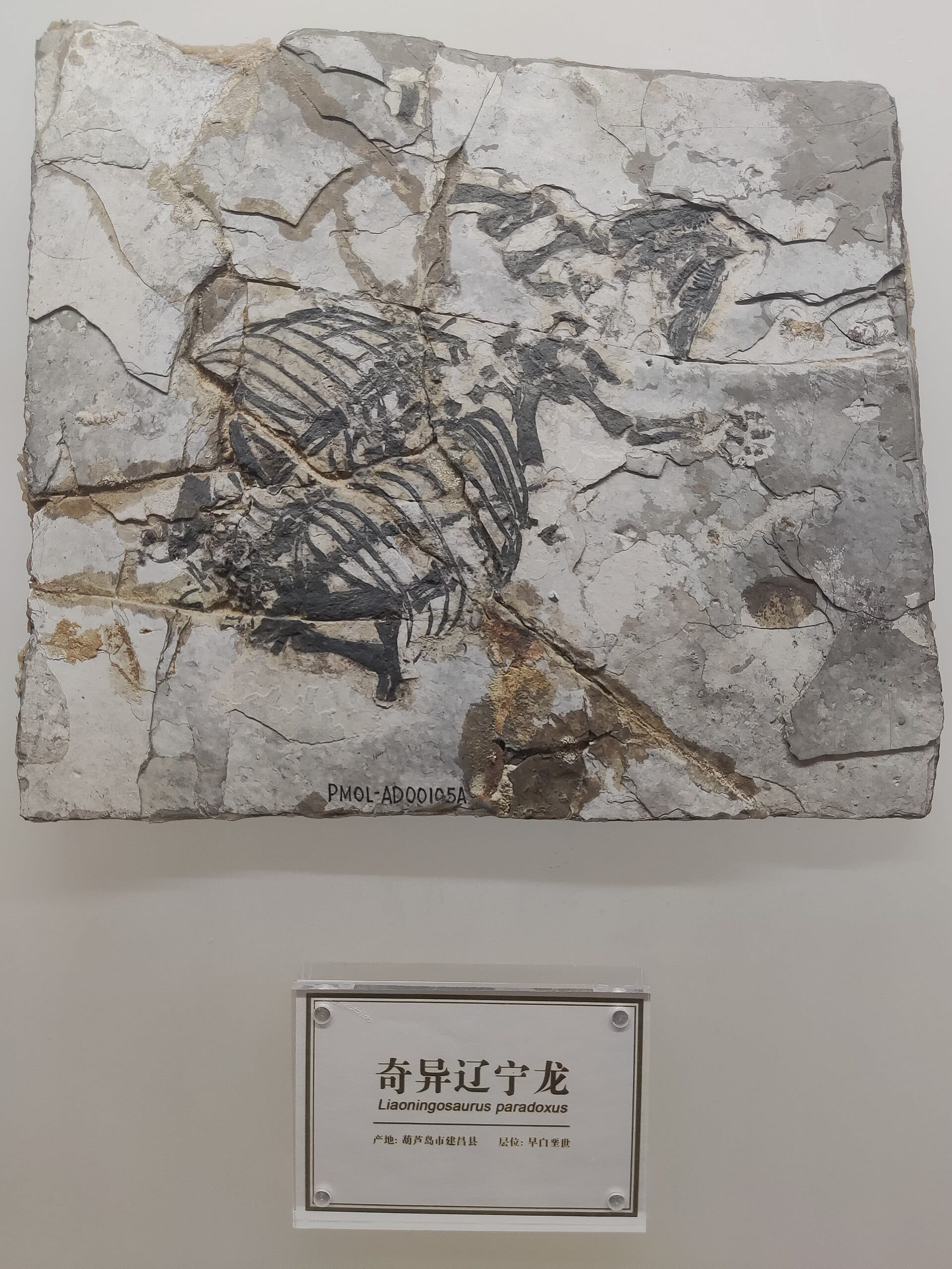

Liaoningosaurus Size and Description
Liaoningosaurus is known only from young animals, so its portrait is that of a baby rather than a grown ankylosaur.
Short description of Liaoningosaurus
The skull kept an antorbital fenestra—an opening in front of the eye socket—as in juvenile Pinacosaurus. Xu and colleagues linked its low count of about 10 upper jaw teeth to youth, although Han’s team doubted that growth alone explains it. These cheek teeth were large for the skull, each with about seven big, cusp-like denticles (small serrations). In contrast, Ji’s team described the denticles as elongate and fork-like.
Behind the head, the humerus (upper arm bone) matched the femur (thigh bone) in length. Its toe claws were sub-triangular, widest at the base, and sharp at the tips. Armor had already formed, too, including a cervical half-ring—a band of fused bony plates over the neck.
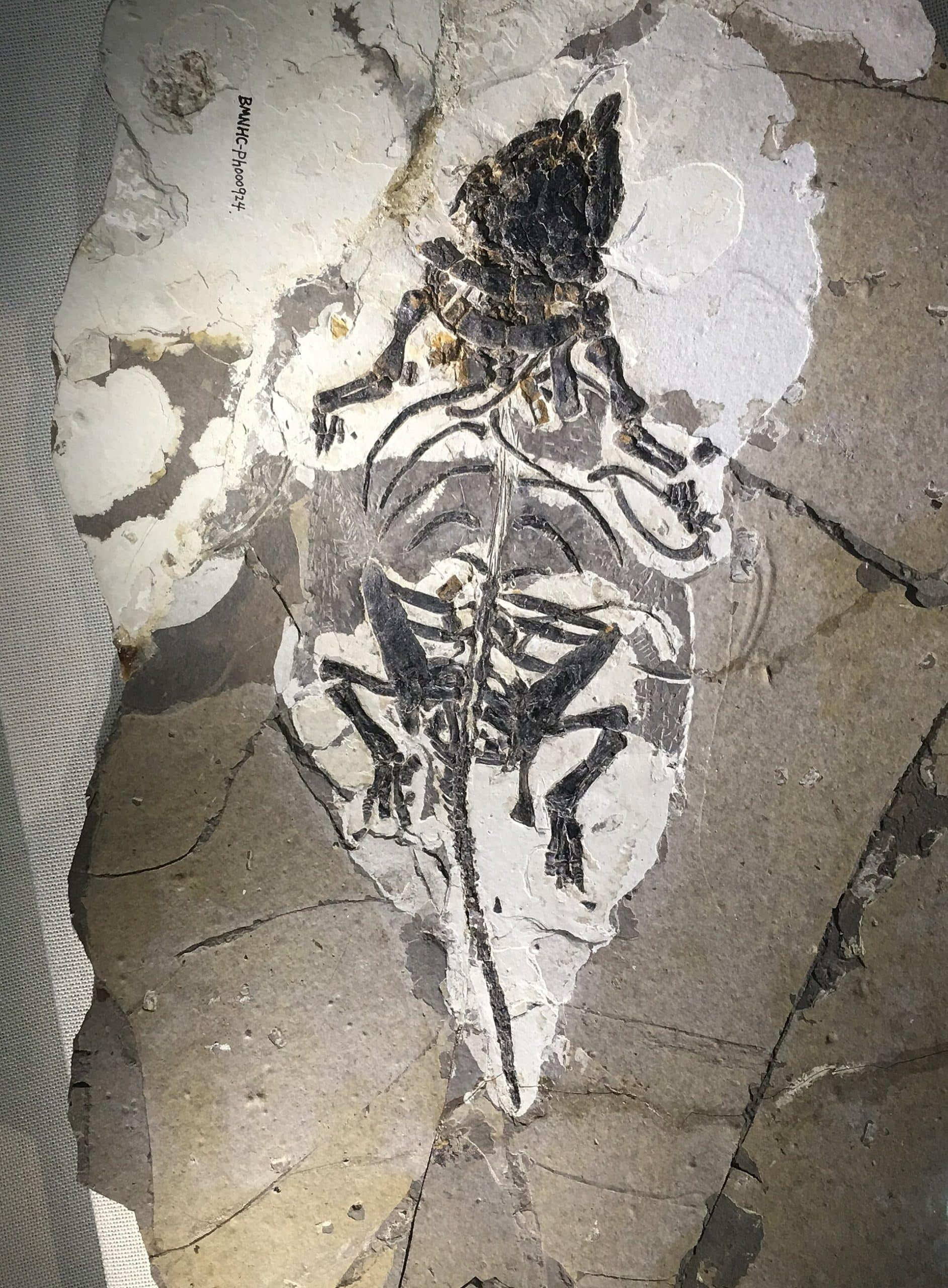

Most striking of all, the original paper described a large, somewhat shell-like bony plate shielding the abdomen. Xu and colleagues called it the first record of such a structure among dinosaurs. In 2014, however, Victoria Arbour and colleagues reassessed the fossil and, as Everything Dinosaur reported, judged this “plate” more likely fossilized skin. Beyond this, its outer covering remains poorly understood, so any reconstruction of its appearance is speculative.
Size and Weight of Type Species
The Everything Dinosaur blog gives the 2001 specimen a length of about 13.4 inches (34 centimeters). In 2025, a press release from the Natural History Museum, London, added that no known Liaoningosaurus fossil exceeds about 15.7 inches (40 centimeters). Neither figure comes from a peer-reviewed paper. By comparison, fully grown ankylosaurs normally reached about 9.8 feet (3 meters) or more.
Femur lengths give a clearer sense of growth. Zheng’s team gave the holotype femur as 28.5 millimeters (about 1.1 inches). A table in Han’s 2014 paper, credited to the original description, lists 2.5 centimeters instead. ELDM V1121 has a 31.5-millimeter femur, about 10% longer. That of IVPP V 20798 roughly doubles the holotype’s, at 56.5 millimeters (about 2.2 inches). This sits awkwardly with the 40-centimeter ceiling and suggests a noticeably bigger animal.
No one has published a height or weight estimate, and adult size is unknown. In 2016, Ji and colleagues called it the smallest ornithischian species so far known. They also argued that open sutures in the vertebrae cannot show that the type specimen was juvenile. Bone histology—the study of bone tissue—now indicates, however, that these were babies rather than small adults.
The Dinosaur in Detail
What sets this dinosaur apart is its mix of traits from both families. Its humerus has a deltopectoral crest (a muscle ridge) that stops short of mid-length, as in nodosaurids. Yet in 2014, Han’s team recovered it as the sister taxon of Chuanqilong, near the base of Ankylosauridae, on just two unambiguous shared traits.
Other analyses struggle to place it. In 2022, Frauenfelder and colleagues removed it as one of 16 wildcard taxa—animals whose position jumps around a family tree. In a second data set, it grouped with Cedarpelta and Chuanqilong in an unresolved split alongside both families. By contrast, a 2021 review by Madzia and colleagues listed it within Ankylosauridae, and Zheng’s team found its neck armor closer in structure to that of ankylosaurids.
The liveliest debate concerns how it lived. In 2016, Ji’s team read the fish in their specimen as stomach or gut contents and “strong evidence” for a meat-eating diet. Their abstract states flatly that it is the first carnivorous ornithischian, and they linked its belly plate and loose sacrum-pelvis connection to an aquatic life. However, Riley Black noted on Scientific American’s “Laelaps” blog that the fish were scattered through the body cavity rather than confined to the gut. Black called for acid-etching checks and a CT scan.
Histology has since weighed in. Zheng’s team found no growth lines in two referred specimens and judged both under a year old at death, while a hatching line marks ELDM V1121 as a hatchling. Coauthor Paul Barrett of the Natural History Museum said these are babies rather than small adults—a result the museum framed as overturning the miniature-adult and semi-aquatic ideas. Together, the fossils offer a rare glimpse of ankylosaur infancy, though the fish, which Zheng’s abstract does not address, remain a puzzle.
Interesting Points about Liaoningosaurus
- In 2025, Zheng and colleagues called one specimen, ELDM V1121, the only definitive hatchling ankylosaur known worldwide, though Han’s team had earlier cited hatchling nodosaurids.
- According to Han and colleagues, its upper jaw held the fewest teeth reported for any ankylosaur—about 10, against 34 to 35 in Ankylosaurus.
- The original 2001 paper hailed it as the first complete nodosaurid specimen from Asia, a label that later ankylosaurid placements have called into question.
- Despite its tiny size, it already carried armor, and Paul Barrett said such features came in quite early during growth.
- Its metatarsus (upper foot) was more than twice as long as its metacarpus (palm), a trait Han’s team, following the original paper, considered probably unique.
Contemporary Dinosaurs
Sharing the same rock unit was Jinzhousaurus yangi, an iguanodontoid ornithopod known from a largely complete skeleton. Its type locality, Baicaigou in Toutai, Yixian County, lies within the Dakangpu Member—the same level as Liaoningosaurus. In 2009, Barrett and colleagues called it the only large ornithischian in this mostly small-bodied fauna. No fossil links the two directly.
Adding further diversity was Xingtianosaurus ganqi, a caudipterid oviraptorosaur known from a skull-less partial skeleton. In 2019, Rui Qiu and colleagues reported it from Wangjiagou in Yixian County, in the Dakangpu Bed—the locality and bed recorded for the Liaoningosaurus holotype. How the two may have interacted is unknown.
Among the feathered members of the fauna was Jianianhualong tengi, a troodontid with asymmetrical feathers. In 2017, Xing Xu and colleagues described it from Baicai Gou in Yixian County, giving only the Yixian Formation as its horizon. The Paleobiology Database assigns the site to the Dakangpu level. Any contact between them goes unrecorded.
In the equivalent Dawangzhangzi Bed lived Huadanosaurus, a compsognathid-like theropod about 3.3 feet (1 meter) long. Qiu and colleagues named it in 2025 from Lingyuan, rather than the Liaoningosaurus site, and dated it to about 125 million years ago. In a 2025 commentary, paleontologist Christophe Hendrickx suggested it could instead be a juvenile tyrannosauroid—the group that includes the Jehol Biota’s Yutyrannus. No formal synonymy has followed.
Liaoningosaurus in its Natural Habitat
Lakes, rivers, and volcanoes shaped the world Liaoningosaurus knew. Its fossils come from lake and occasionally river sediments, frozen in time by multiple eruptions. A 2011 study by Amiot and colleagues points to a cool temperate climate at roughly 42° north, with mean air temperatures near 50 °F (10 °C). Together with the Huajiying and Jiufotang formations, these beds have yielded over 60 plant, thousands of invertebrate, and over 90 vertebrate species.
As an ankylosaur, Liaoningosaurus belongs to a group of four-legged herbivores. In 2021, Kubo and colleagues noted that earlier studies saw little to no wear on its teeth. The fish-eating proposal remains unconfirmed and has been challenged mainly in blogs and a museum press release.
While there is no direct evidence of how it lived, Liaoningosaurus belonged to what Barrett and colleagues called a fauna dominated by small-bodied dinosaurs under about 9.8 feet (3 meters) long, such as the basal ornithopod Jeholosaurus. Birds shared that world too, with Shenzhouraptor (often considered the same as Jeholornis), Sapeornis, Jixiangornis, and enantiornithines recorded from the Dakangpu level at Baicaigou. Until an adult turns up, its full role in this ecosystem may remain unclear.
Frequently Asked Questions
It means “Liaoning lizard,” after the province where it was found, while paradoxus refers to the paradox the fossil represented.
It lived during the Barremian stage of the Early Cretaceous, about 125 million years ago.
A 2016 blog report put the holotype at about 13.4 inches (34 centimeters). The largest known specimen has a femur about twice as long, and adult size is unknown.
Like other ankylosaurs, it was probably a herbivore, although a 2016 study proposed a fish-eating diet that remains disputed.
Its holotype comes from the Yixian Formation in Yixian County, western Liaoning, China.
A 2025 study identified one specimen as the only definitive ankylosaur hatchling known, and no adult has yet been found.
Sources
The information in this article is based on various sources, drawing on scientific research, fossil evidence, and expert analysis. The aim is to provide a comprehensive and accurate overview of Liaoningosaurus. However, please be aware that our understanding of dinosaurs and their world is constantly evolving as new discoveries are made.
- https://doi.org/10.1007/s001140100233
- https://pubmed.ncbi.nlm.nih.gov/11544897/
- https://paleobiodb.org/data1.2/colls/single.json?id=55683
- https://pmc.ncbi.nlm.nih.gov/articles/PMC4131922/
- https://doi.org/10.1080/02724634.2025.2566325
- https://doi.org/10.3969/j.issn.1674-3636.2016.02.183
- https://pmc.ncbi.nlm.nih.gov/articles/PMC9172161/
- https://www.frontiersin.org/journals/earth-science/articles/10.3389/feart.2022.803505/full
- https://pmc.ncbi.nlm.nih.gov/articles/PMC8667728/
- https://pmc.ncbi.nlm.nih.gov/articles/PMC7946176/
- https://pmc.ncbi.nlm.nih.gov/articles/PMC8288181/
- https://doi.org/10.1073/pnas.1011369108
- https://www.app.pan.pl/archive/published/app54/app54-035.pdf
- https://pmc.ncbi.nlm.nih.gov/articles/PMC6483983/
- https://pmc.ncbi.nlm.nih.gov/articles/PMC5418581/
- https://pmc.ncbi.nlm.nih.gov/articles/PMC11970238/
- https://pmc.ncbi.nlm.nih.gov/articles/PMC12057692/
- https://stratigraphy.org/chart
- https://www.nhm.ac.uk/discover/news/2025/december/first-armoured-dinosaur-hatchling-discovered-in-china.html
- https://sciencedaily.com/releases/2026/04/260417224501.htm
- https://blog.everythingdinosaur.com/?p=32157
- https://www.scientificamerican.com/blog/laelaps/this-tiny-ankylosaur-ate-fish/
- http://dml.reptilis.net/2016Aug/msg00062.html
This article was last fact checked: TheDinosaurs Team, 06-11-2026
Featured Image Credit: Jonathan Chen, CC BY-SA 4.0, via Wikimedia Commons
