
On Fazenda Roncador, a farm north of Cuiabá in Mato Grosso, Brazil, red sandstone held the bones of a large predator. Named Pycnonemosaurus nevesi in 2002, this abelisaurid theropod probably lived late in the Cretaceous. Its likeliest window is the Campanian or Maastrichtian stages—roughly 83.6 to 66 million years ago. Its rocks are poorly dated, though, and are no older than the Santonian. Although only a handful of tail, hip, and leg bones survive, a 2017 study estimated it to be the largest abelisaurid yet found.
The farm’s owner, Max de Barros Erhart, and his workers found the remains, and paleontologist Llewellyn Ivor Price collected them in 1952 and 1953. Fifty years later, Alexander Kellner and Diógenes de Almeida Campos described them as the first abelisaurid recorded from Brazil. Later work has since raised its size estimate, revised its holotype, and reopened the question of its rock unit. Its story shows how much a few weathered bones can reveal—and how much they leave open.
Pycnonemosaurus Key Facts
| Keyword | Fact |
|---|---|
| Pronunciation | Not specified |
| Meaning of name | Dense Pasture Reptile |
| Group | Theropoda (Abelisauridae) |
| Type Species | Pycnonemosaurus nevesi |
| Diet | Carnivore |
| When it Lived | About 83.6 to 66 MYA (poorly constrained) |
| Period | Cretaceous |
| Epoch | Late Cretaceous (Campanian to Maastrichtian stages) |
| Length | About 19.7 to 23.0 feet (6 to 7 meters) in 2002, revised to about 29.2 feet (8.9 meters) in 2017 |
| Height | Not specified |
| Weight | Not specified |
| Mobility | Moved on two legs (bipedal) |
| First Discovery | Found by Max de Barros Erhart and his workers on an unrecorded date, and collected by Llewellyn Ivor Price in 1952 to 1953 |
| Described by | 2002 by A.W.A. Kellner and D.A. Campos |
| Holotype | DGM 859-R |
| Location of first find | Fazenda Roncador, near Paulo Creek (beds referred to the Bauru Group), Chapada dos Guimarães area, Mato Grosso, Brazil |
Pycnonemosaurus Origins, Taxonomy and Timeline
The name Pycnonemosaurus joins three Greek roots—pycnós (“dense”), némos (“pasture” or “wood”), and saurus (“reptile”). According to its describers, the name alludes to Mato Grosso, where the fossil came to light. The species name nevesi honors Dr. Iedo Batista Neves, who died in 2000 and had encouraged Kellner’s paleontological studies. Together, the name ties the animal to its home state and to an early supporter of its science.
Kellner and Campos judged it most likely an abelisaurid, mainly because some tail vertebrae have transverse processes—sideways bony struts—with flared tips. However, they called its exact position “difficult to establish,” because most telltale theropod features lie in the skull. In 2017, paleontologist Rafael Delcourt found a strong link with derived abelisaurids such as Carnotaurus and Aucasaurus. Later studies place it in Furileusauria, a South American subgroup whose internal relationships remain debated. Pycnonemosaurus nevesi is the type and only known species.
The 2002 paper gave no firm stage, since experts disputed the age of related Bauru Group beds in São Paulo. In 2011, paleontologists Jonathas Bittencourt and Max Langer pointed to 83.9-million-year-old basalts at the base of the Parecis Group. Those late Santonian rocks give only a maximum age. Along with other evidence, they suggest a Campanian to Maastrichtian age, late in the Cretaceous. By then, according to Delcourt, abelisaurids had replaced carcharodontosaurids as the main predators of the Southern Hemisphere.
Discovery & Fossil Evidence
The bones came from near Paulo Creek, about 0.6 miles (1 kilometer) from the farm’s main building. At first, Kellner and Campos referred the sandstone to the Bauru Group but named no formation. Later authors assigned the beds to the Cambambe Formation, the Parecis Group, or the Cachoeira do Bom Jardim Formation. In 2018, however, paleontologist Marcos Sales and colleagues argued that these formation names were never validly established. They also questioned moving the beds into the Parecis Group. Since the local stratigraphy “remains undefined,” they adopted the informal name “Cambambe Unit.”
The Museu de Ciências da Terra in Rio de Janeiro houses the holotype, DGM 859-R. As first described, it held five incomplete teeth, parts of seven caudal (tail) vertebrae, and rib fragments. It also included a partial right pubis (a forward-pointing hip bone), a right tibia (shinbone), and the lower end of the right fibula. None of the bones survives in good condition, and abraded surfaces suggest most lay partly exposed at the outcrop before collection. The museum catalog also listed part of a scapula, a metatarsal, and a large claw—none of which matches any surviving bone.
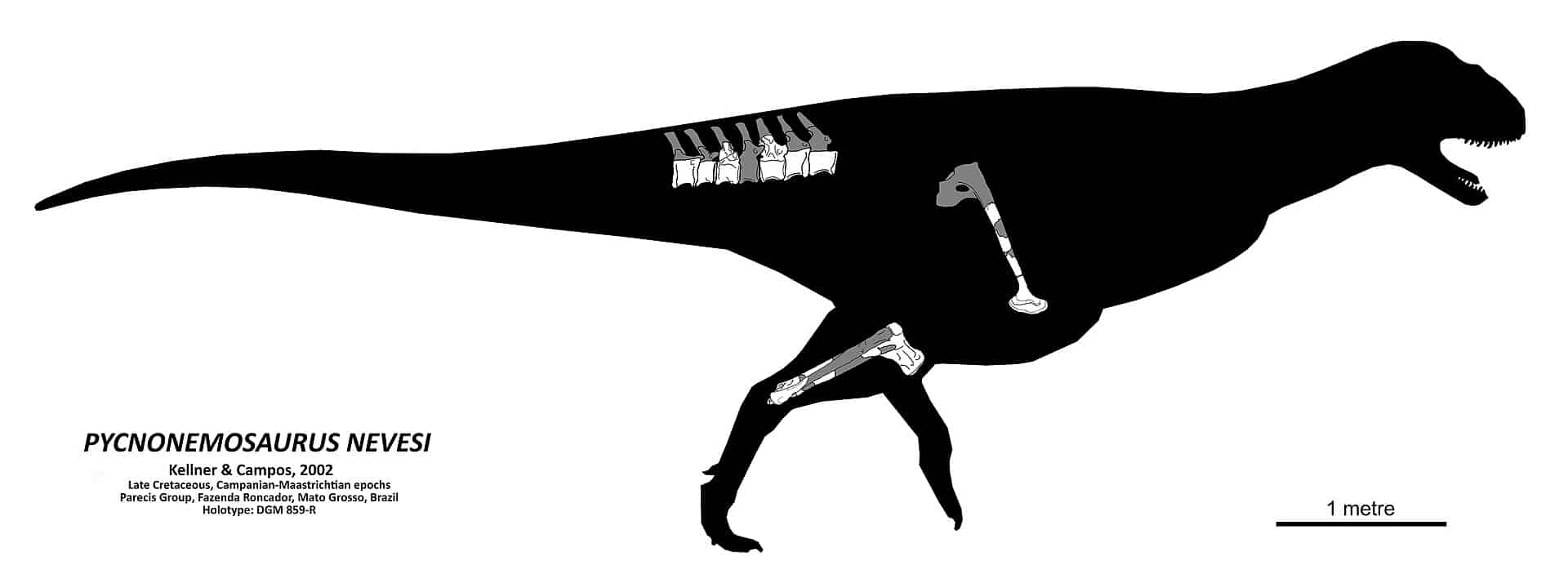

Delcourt’s 2017 restudy reshaped this inventory, adding three tail transverse processes to the animal. Because the teeth lay apart from any jaw bone, he reassigned them to an indeterminate abelisaurid. He also traced a neural spine under the same number to an indeterminate sauropod and a procoelous (front-cupped) tail centrum to a titanosaur. That leaves a skeleton without a skull, built from tail, hip, and leg bones.
Pycnonemosaurus Size and Description
Reconstructing Pycnonemosaurus means working from a shinbone, a partial hip bone, and pieces of tail—the rest must come from relatives.
Short description of Pycnonemosaurus
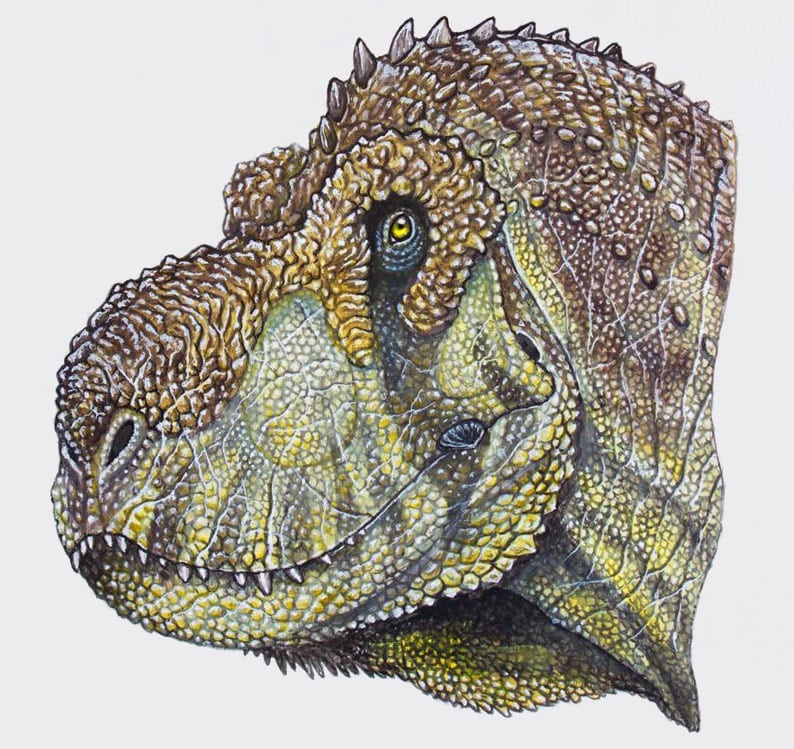
Without any skull bones, every picture of its head is hypothetical. The teeth once linked to it were large, the best preserving 3.3 inches (84.3 millimeters) of length. The two most complete front tail vertebrae have spool-shaped centra (vertebral bodies) about 6 inches (15 centimeters) long. Extra interlocking joints, the hyposphene and hypantrum, linked them to their neighbors.
The hindlimb centers on a massive tibia. Its hatchet-shaped cnemial crest—a ridge at the front of the knee—projected strongly forward and upward. By contrast, the fibula was far more slender than the tibia. Like other theropods, Pycnonemosaurus walked on two legs. No skin impressions survive, so its body covering remains speculative.

Size and Weight of Type Species
Working from the tibia, Kellner and Campos estimated 19.7 to 23.0 feet (6 to 7 meters) without detailing their method.
In 2017, paleontologists Orlando Grillo and Rafael Delcourt took a different route. First, they re-estimated body length in the seven most complete abelisauroids, then used those results for 30 less complete specimens. For Pycnonemosaurus, the answer was about 29.2 feet (8.9 meters)—an indirect estimate, not a measured skeleton. That ranked it as the largest abelisaurid known, well above the 23.3-foot (7.1-meter) average for Furileusauria. A 2025 study of ceratosaur body size likewise found Late Cretaceous abelisaurids peaking at about 29.5 feet (9 meters) in this genus. Yet it reused Grillo and Delcourt’s length data, so it repeats their estimate rather than confirming it.
However, the peer-reviewed studies behind this profile give no hip height or body mass. Instead, the tibia gives the best sense of scale—about 33.3 inches (845 millimeters) long, including its crest. According to Delcourt, it rivals the tibiae of large theropods such as Mapusaurus, Allosaurus, and Tarbosaurus.
The Dinosaur in Detail
What sets this dinosaur apart, in its original description, is a trio of traits. Kellner and Campos cited the hatchet-shaped crest, a small pubic foot (the pubis’s expanded lower end), and moderately flared tips on the tail’s transverse processes. In fact, they found its pubic foot the smallest among abelisaurs with a known pubis, namely Carnotaurus and Aucasaurus.
Delcourt revisited this list in 2017. Because the crest and the flare also occur in other abelisaurids, he amended the diagnosis. His version stresses a small, rounded pubic foot and hook-shaped transverse processes toward the back of the tail. It also highlights a well-developed lateral malleolus—the outer knob at the ankle end of the tibia. This knob angles downward at nearly 45 degrees and is more pronounced than in other abelisaurs.
Size shows up in the details too. According to Delcourt, all its caudal centra are larger than those of other known abelisaurids. In 2023, paleontologist Mattia Baiano and colleagues found that its front tail vertebrae share a ventral groove and a prominent hyposphene with Aucasaurus. Yet its transverse processes rise less steeply.
Its age at death is less clear. Partly closed sutures on the tail vertebrae suggested to Kellner and Campos that fusion “was in progress.” In 2018, Delcourt described the holotype as a subadult, even while cautioning that fusion alone is no safe guide to maturity. Taken together, the bones describe a heavily built furileusaurian, likely close to Carnotaurus and Aucasaurus, whose head and arms remain unknown.
Interesting Points about Pycnonemosaurus
- Its describers called Pycnonemosaurus Brazil’s first abelisaurid and the first formally described theropod from the Paraná, or Bauru, Basin—though its rocks’ basin is now disputed.
- Price collected its bones in 1952 and 1953, but apart from brief mentions in 1996 and 2000, they went undescribed until 2002.
- In 1996, Bertini had already suggested that the specimen was an abelisaurid, though the 2002 paper says he gave a completely different locality.
- Grillo and Delcourt’s 2017 study carried the subtitle “Pycnonemosaurus nevesi is the new king,” reflecting its estimate as the largest abelisaurid.
- In 2017, Delcourt removed the teeth from the species because they lay apart from any tooth-bearing jaw bone.
Contemporary Dinosaurs
Every other dinosaur from the Pycnonemosaurus beds lacks a species name—even a Gondwanatitan record is doubtful, Sales and colleagues say. The three below therefore come from the Bauru Basin of southeastern Brazil, a neighboring region. The same team found the Mato Grosso fauna similar to Bauru Group assemblages, consistent with deposits of close age on one landmass. All three are Maastrichtian, within its possible age range, but nothing places them in its landscape.
From the neighboring Bauru Basin region, at Peirópolis near Uberaba in Minas Gerais, comes Baurutitan. This titanosaur sauropod is founded on its last hip vertebra and 18 tail vertebrae—one of the few articulated titanosaurid tails on record. In 2022, Julian Silva Junior and colleagues sank Trigonosaurus into it, adding that animal’s neck, back, and hip bones. Its describers placed the quarry in the Marília Formation, now the Serra da Galga Formation, regarded as Maastrichtian.
Peirópolis, in the same neighboring region, also yielded Caieiria allocaudata. In 2022, Silva Junior and colleagues named it from ten front-to-middle tail vertebrae once assigned to Trigonosaurus pricei. That old name honored Price—the same collector who recovered Pycnonemosaurus. Its genus name comes from Caieira, the quarry where the bones were found, in Maastrichtian Serra da Galga beds.
From the same neighboring region comes Kurupi itaata, found in the Marília Formation at Monte Alto, western São Paulo State. This abelisaurid theropod reached about 16.4 feet (5 meters) and survives as three tail vertebrae and part of the hips. Its describers presented it as part of Brazil’s Maastrichtian continental fauna. Nothing suggests this smaller relative ever met Pycnonemosaurus.
Pycnonemosaurus in its Natural Habitat
The world Pycnonemosaurus roamed was a dry one. Bittencourt and Langer picture rivers and lakes at the far edges of alluvial fans, under a semi-arid to extremely arid climate. The local beds hold turtles, several kinds of theropods, and titanosaur sauropods. Among the unnamed finds is the first megaraptoran from Mato Grosso—a relative of Megaraptor known from one tail centrum. Titanosaur remains also come from the area, including bones once referred to Gondwanatitan, though Sales and colleagues doubted that identification.
No direct evidence, such as gut contents, reveals what Pycnonemosaurus ate. Its holotype lay among isolated titanosaur bones, including procoelous tail vertebrae, but that association shows only that the bones came to rest together. At the group level, Delcourt cited earlier analyses suggesting that carnotaurines such as Majungasaurus might have ambushed large prey. He also proposed that brachyrostrans, the South American abelisaurid branch, may have been powerful runners, judging by their legs and tails.
While there is no direct evidence of its daily life, it may have coped well with lean conditions. Indeed, Delcourt listed life in semi-arid, low-resource settings, like those of Pycnonemosaurus, among the reasons for ceratosaur success. Meanwhile, a differently shaped tooth led Sales and colleagues to suggest a second abelisaurid in Mato Grosso—an idea they called speculative.
Frequently Asked Questions
It means roughly “dense pasture reptile,” an allusion to Mato Grosso, and nevesi honors Dr. Iedo Batista Neves.
It probably lived in the Campanian or Maastrichtian stages, roughly 83.6 to 66 million years ago, though its Late Cretaceous rocks are poorly dated.
Its describers estimated 19.7 to 23.0 feet (6 to 7 meters) long. A 2017 study raised that to about 29.2 feet (8.9 meters), and its weight remains unknown.
It was a carnivorous theropod in the family Abelisauridae, probably close to Carnotaurus and Aucasaurus.
Its bones come from Fazenda Roncador in Mato Grosso, Brazil, in sandstone originally referred to the Bauru Group.
A 2017 study estimated it as the largest abelisaurid known, and its tibia has an unusually prominent lateral malleolus.
Sources
The information in this article is based on various sources, drawing on scientific research, fossil evidence, and expert analysis. The aim is to provide a comprehensive and accurate overview of Pycnonemosaurus. However, please be aware that our understanding of dinosaurs and their world is constantly evolving as new discoveries are made.
- https://www.biodiversitylibrary.org/part/279719
- https://archive.org/download/biostor-248618/biostor-248618.pdf
- https://doi.org/10.11646/zootaxa.4276.1.1
- https://pubmed.ncbi.nlm.nih.gov/28610214/
- https://zenodo.org/records/6022154
- https://doi.org/10.1016/j.cretres.2016.09.001
- https://ui.adsabs.harvard.edu/abs/2017CrRes..69…71G
- https://www.scielo.br/j/aabc/a/z6S85ZQtbtQgnDSCZnHfxmj/?lang=en
- https://doi.org/10.1080/08912963.2017.1315414
- https://ri.conicet.gov.ar/handle/11336/93956
- https://doi.org/10.1038/s41598-018-28154-x
- https://pmc.ncbi.nlm.nih.gov/articles/PMC6021374/
- https://pmc.ncbi.nlm.nih.gov/articles/PMC10655716/
- https://pmc.ncbi.nlm.nih.gov/articles/PMC11994025/
- https://archive.org/download/biostor-248698/biostor-248698.pdf
- https://revistas.ufrj.br/index.php/amn/article/download/48842/26467/136850
- https://ri.conicet.gov.ar/handle/11336/172583
- https://paleobiodb.org/classic/basicTaxonInfo?taxon_no=53941
- https://agencia.fapesp.br/the-king-of-the-abelisaurids-is-brazilian/24848
- https://stratigraphy.org/chart
- https://pmc.ncbi.nlm.nih.gov/articles/PMC9673870/
- https://doi.org/10.7717/peerj.14333
- https://doi.org/10.1002/gj.3987
- https://eprints.whiterose.ac.uk/165154
This article was last fact checked: TheDinosaurs Team, 06-11-2026
Featured Image Credit: Mario Lanzas, CC BY-SA 4.0, via Wikimedia Commons
