
In the lake shales of the Daohugou Beds in Ningcheng County, Inner Mongolia, paleontologists uncovered one of the most bizarre feathered animals of the Jurassic. Named Epidexipteryx hui in 2008, this pigeon-sized theropod lived roughly 168 to 164 million years ago. It carried four long, ribbon-like feathers on a short tail—yet it had no feathers suited for flight. Its describers called it the oldest and most basal theropod then known to bear display feathers.
Everything we know of it comes from a single skeleton split across two slabs, now in Beijing. Paleontologist Fucheng Zhang and four colleagues first posted its description as a preprint in September 2008, then published it in Nature that October. Since then, it has shifted around the family tree more than once. A 2024 study even argues, provisionally, that it is not a separate genus at all. Its story shows how much one well-preserved fossil can reveal—and how much it still leaves open.
Epidexipteryx Key Facts
| Keyword | Fact |
|---|---|
| Pronunciation | ep-id-ecks-IP-ter-icks |
| Meaning of name | Display Feather |
| Group | Theropoda (Maniraptora, Scansoriopterygidae) |
| Type Species | Epidexipteryx hui |
| Diet | Possibly a carnivore (proposed 2021, from 2020 jaw-mechanics data) |
| When it Lived | About 168 to 164 MYA |
| Period | Jurassic |
| Epoch | Middle Jurassic (Bathonian to Callovian stages) |
| Length | Not specified |
| Height | Not specified |
| Weight | About 5.8 ounces (164 grams) in 2008, or about 0.9 pounds (0.4 kilograms) in 2014, both indirect estimates |
| Mobility | Probably could not fly (non-volant), according to its describers |
| First Discovery | Year not specified (first published in 2008) |
| Described by | 2008 by F. Zhang, Z. Zhou, X. Xu, X. Wang, and C. Sullivan |
| Holotype | IVPP V15471 |
| Location of first find | Daohugou Beds (formation disputed), Daohugou, Ningcheng County, Inner Mongolia, China |
Epidexipteryx Origins, Taxonomy and Timeline
The name Epidexipteryx joins two Greek words. “Epidexi” means “display,” while “pteryx” means “wing” or “feather.” The species name hui honors the late young paleontologist Yaoming Hu, who studied the Mesozoic mammals of China. Together, the name points straight at the animal’s most eye-catching feature, its tail plumes.
In the 2008 paper, Zhang and colleagues placed Epidexipteryx within Theropoda, Coelurosauria, and Maniraptora, then within Avialae—the lineage that leads to birds. Their analysis found it to be the sister taxon of Epidendrosaurus, a juvenile coelurosaur from the same region named in 2002. Together, the two formed a natural group, Scansoriopterygidae, which the authors called “a bizarre lineage at the base of the Avialae.” Even so, they noted a short, high skull, a downturned lower jaw, and enlarged front teeth reminiscent of oviraptorosaurs such as Oviraptor and, less strongly, therizinosauroids. Czerkas and Yuan had named the family in 2002, the same year they named Scansoriopteryx heilmanni. Following Padian (2004), several researchers treat Scansoriopteryx as a junior synonym—a later name for an animal already named—of Epidendrosaurus. The 2008 team, too, counted its specimen as Epidendrosaurus. Epidexipteryx hui is the type and only known species.
The original paper called the age of the Daohugou rocks contentious, with estimates ranging from the Middle Jurassic to the Early Cretaceous. However, it added that radioisotopic dates spanned a narrower window of 168 to 152 million years ago. Later, Xu and colleagues (2016) assigned the Daohugou phase of the Yanliao Biota—a fossil assemblage of northeast China—to the Bathonian and Callovian stages, roughly 168 to 164 million years ago. A 2025 study repeated that range, while a 2026 study gave about 167 to 163 million years. Either way, Epidexipteryx lived in the later part of the Middle Jurassic.
Discovery & Fossil Evidence
The fossil comes from Daohugou, in Ningcheng County of Inner Mongolia, north China. No source consulted names its finder or the date it was collected. The describers referred only to the “Daohugou sediments” and named no formation, which has left room for disagreement. The Paleobiology Database assigns the site to the Tiaojishan Formation. In contrast, Yang and colleagues (2025) link the Yanliao Biota as a whole to the Jiulongshan and Tiaojishan Formations. This article therefore uses “Daohugou Beds,” the name paleontologist Andrea Cau also applied in 2024.
The holotype (the name-bearing specimen), IVPP V15471, is a feathered skeleton preserved on part and counterpart slabs—the two faces of a split rock. It belongs to the Institute of Vertebrate Paleontology and Paleoanthropology of the Chinese Academy of Sciences in Beijing. Its bones include the skull and lower jaws, vertebrae from neck to tail, the synsacrum (fused hip vertebrae), part of the breastbone, the shoulder and hip bones, and the limbs. Because some long-bone ends appear imperfectly ossified—not yet fully turned to bone—the animal was probably a subadult.
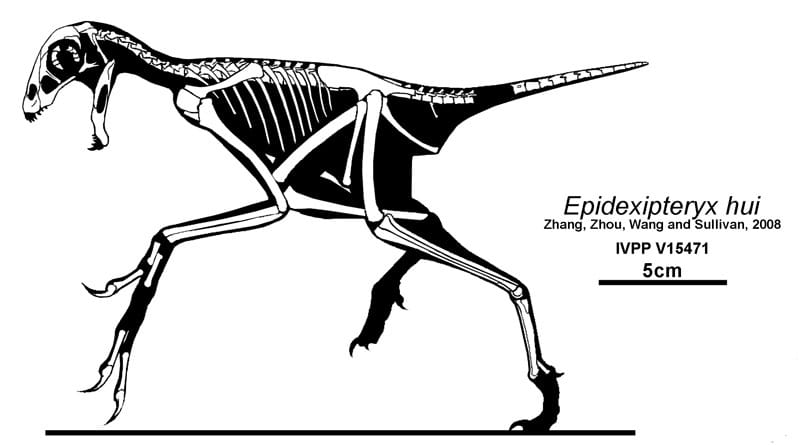

As of 2024, Cau described the holotype as the only known specimen of Epidexipteryx. Every detail of this animal therefore rests on a single individual. So far, no other specimen of Epidexipteryx has been reported.
Epidexipteryx Size and Description
Epidexipteryx was small even among early bird relatives, and much of its skeleton breaks the usual theropod pattern.
Short description of Epidexipteryx
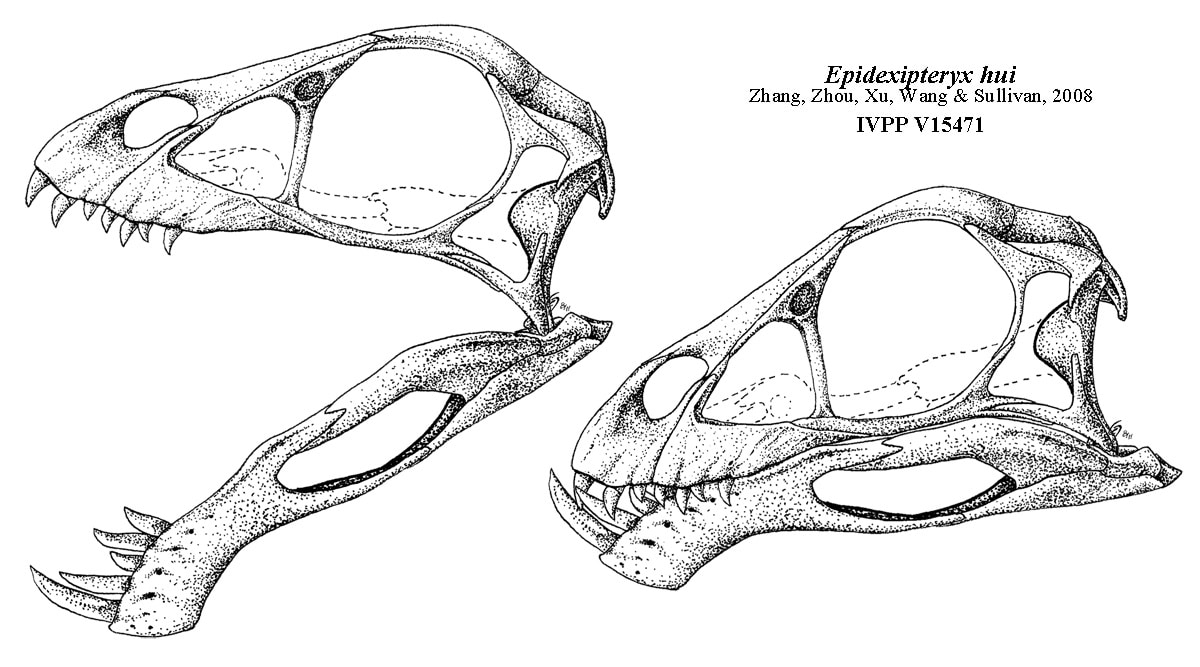
Its skull was high in side view, with a height about 60 percent of its length. The naris (nostril opening) sat high on the snout, and the lower jaw curved downward and carried a large opening in its side. Both upper and lower teeth were highly procumbent—tilted sharply forward—and the front ones were much larger than those behind. According to the describers, only Masiakasaurus had previously shown such strongly forward-tilted teeth among theropods. Behind the head came probably 9 neck vertebrae, 14 back vertebrae, a seven-vertebra synsacrum, and 16 tail vertebrae. The tail itself was short, less than 70 percent of the trunk’s length.
In the chest, a small breastbone seems to comprise two incompletely fused plates, as in the early bird Jeholornis. The humerus (upper arm bone) was about as long as the femur (thigh bone), and the hand was markedly elongated. The hips broke the theropod mold as well. Its straight, short pubis lacked a pubic boot (expanded tip), while the ischium curved backward and widened toward its end. According to the describers, a pubis this short and an ischium that widens toward its tip are not known in any theropod outside the scansoriopterygids. Although feathers cover the skeleton, none are the vaned kind suited for flight.
Size and Weight of Type Species
No peer-reviewed source we consulted gives a total length for Epidexipteryx, only measurements of its parts. In 2021, a team led by paleontologist David Hone used a snout-to-hip length of 158 millimeters (about 6.2 inches) for the holotype. According to the 2008 measurements, its tail vertebrae measured about 60 millimeters (2.4 inches). The incomplete tail feathers stretched a further 185 millimeters (7.3 inches).
Weight estimates differ by more than double, and both are indirect. Zhang and colleagues applied a femur-length equation to the 51-millimeter femur and reached about 5.8 ounces (164 grams). In 2014, paleontologist Roger Benson and colleagues scaled from limb-bone circumference instead, arriving at about 0.9 pounds (0.4 kilograms). By the same method, the Chinese paravian Anchiornis came out at about 1.5 pounds (0.7 kilograms). For the largest Archaeopteryx specimen, itself a subadult, they found about 2.1 to 2.2 pounds (0.97 to 0.99 kilograms).
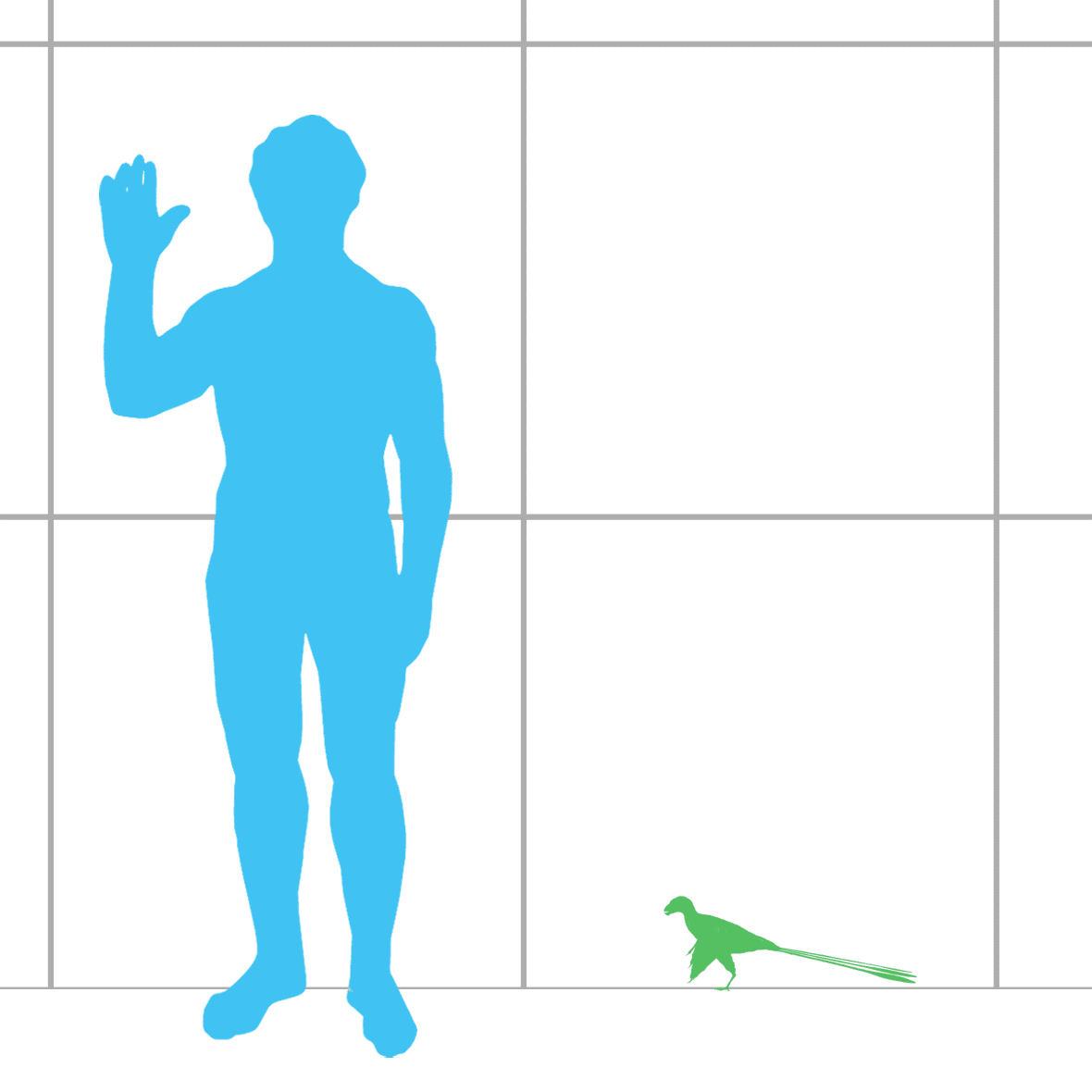

The describers called the specimen pigeon-sized and smaller than most other basal avialans. Because the only specimen was probably a subadult, these figures describe one young individual, not a grown adult.
The Dinosaur in Detail
One of its most distinctive features is the tail. Its last ten vertebrae lacked transverse processes (side projections) and formed a structure like an incipient pygostyle—the bony tail tip of birds. Four ribbon-like feathers attached along them, each with a central rachis (shaft) and unbranched vanes. The describers found these vertebrae unfused, though Cau (2024) saw early signs of fusion.

Just as unusual were the body feathers, with free barbs arising from the edge of a membranous base—an arrangement never reported before, according to the team. The describers judged it “highly probable” that the tail plumes served mainly for display. Unless it had lost flight secondarily, they suggested, display feathers appeared before flight feathers in early avialans.
Its place in the family tree remains disputed. Foth and Rauhut (2017) recovered it as a basal avialan, noting that others had placed it among basal paravians or oviraptorosaurs. In 2019, Rauhut, Tischlinger, and Foth instead found it a basal oviraptorosaur, while Hartman and colleagues placed scansoriopterygids at the base of Avialae. Dececchi and colleagues (2020) treated the group as non-avialan, and Miller and Pittman (2021) called its avialan status controversial. Cau’s 2024 analysis again placed scansoriopterygids within Avialae.
Even the name is in question. The 2008 describers separated it from Epidendrosaurus by tail length and by 16 rather than more than 40 tail vertebrae. In 2024, however, Cau argued, provisionally, that Epidexipteryx is itself a junior synonym of Epidendrosaurus. In his view, the differences reflect growth, since the holotype is “a much larger and more mature individual.” He also counted at least 22 tail vertebrae in Epidendrosaurus against at least 16—a gap “less dramatic than claimed”—and noted that part of the Epidexipteryx tail may be missing. Taken together, it remains a mosaic of primitive and derived traits with no settled home.
Interesting Points about Epidexipteryx
- Its describers printed a pronunciation guide in the original paper, rendering the name as ep-id-ecks-IP-ter-icks.
- The study first appeared as an openly licensed preprint on 24 September 2008, about a month before its Nature publication.
- The describers marked eight bean-sized conchostracans, small crustaceans also called clam shrimp, on each slab of the holotype.
- By the describers’ comparison, the curvature of its hand claws falls within the range seen in the toe claws of ground-foraging birds.
- Its describers put its tail at less than 70 percent of its trunk length and that of Epidendrosaurus at over 300 percent, a comparison Cau (2024) disputed.
Epidexipteryx in its Natural Habitat
The world Epidexipteryx inhabited centered on a large freshwater lake, its shales layered with tuffs (volcanic ash layers). Across the region, converging tectonic plates had raised high, complex terrain with vertically zoned micro-environments. A 2026 study estimated a cool to cold-temperate regional climate. Even so, Yanliao insects and plant fossils often suggest warmer, seasonal conditions, probably reflecting climates at different elevations. In the water lived clam shrimp, fairy shrimp, and water boatmen that carried egg clutches, along with flies that were probably aquatic or amphibious as adults. The locality has also yielded pterosaurs such as Jeholopterus, salamanders such as Chunerpeton, and mammal relatives such as Castorocauda.
Dinosaur neighbors are scarce. Cau places all Epidendrosaurus specimens in the Daohugou Beds too, but that animal may be Epidexipteryx itself. No other named non-avian dinosaur is confirmed from these beds. Most Yanliao non-avian dinosaurs are small theropods. Until 2025, the biota’s only known ornithischian (bird-hipped dinosaur) may have come from the younger Jehol Biota. That year, Yang and colleagues described a second, Pulaosaurus qinglong, from the Late Jurassic Tiaojishan Formation of Hebei.
No direct evidence shows what Epidexipteryx ate. However, Miller and Pittman (2021), citing Ma and colleagues, wrote that its jaws appear adapted for carnivory because of their low mechanical advantage (leverage).
Dececchi and colleagues described its nature as “seemingly terrestrial,” pointing to reduced feathering, a long shin, and low claw curvature. Its curial index (shin-to-thigh ratio) of 1.25 exceeded the 1.17 of Epidendrosaurus, which its 2002 describers saw as a tree-dweller. Similarly, its claws curved less than those of Yi and Ambopteryx, which the team saw as tree-dwellers. The team added that no definitive scansoriopterygids yet come from outside the Yanliao biota. While there is no direct evidence of social behavior, its ribbon-like tail feathers were likely used for display.
Frequently Asked Questions
It means “display feather,” and the species name hui honors the late paleontologist Yaoming Hu.
It lived in the Bathonian to Callovian stages of the Middle Jurassic, about 168 to 164 million years ago.
It was pigeon-sized. Indirect estimates put its weight at about 5.8 ounces in 2008 or about 0.9 pounds in 2014.
No direct evidence exists, but a 2021 review suggested its jaws appear adapted for carnivory.
Its only known fossil comes from the Daohugou Beds in Ningcheng County, Inner Mongolia, China.
It combined forward-tilted front teeth with four long, ribbon-like tail feathers, and it apparently could not fly.
Sources
The information in this article is based on various sources, drawing on scientific research, fossil evidence, and expert analysis. The aim is to provide a comprehensive and accurate overview of Epidexipteryx. However, please be aware that our understanding of dinosaurs and their world is constantly evolving as new discoveries are made.
- https://doi.org/10.1038/nature07447
- https://treatment.plazi.org/id/7670974E-8624-FFAD-FC6A-5340BC82D952
- https://doi.org/10.1038/npre.2008.2326.1
- https://static-content.springer.com/esm/art%3A10.1038%2Fnature07447/MediaObjects/41586_2008_BFnature07447_MOESM287_ESM.pdf
- https://pubmed.ncbi.nlm.nih.gov/18948955/
- https://doi.org/10.1111/1755-6724.13033
- https://doi.org/10.7717/peerj.19664
- https://doi.org/10.1093/nsr/nwag100
- https://doi.org/10.1186/s12862-017-1076-y
- https://doi.org/10.7554/eLife.43789
- https://doi.org/10.7717/peerj.7247
- https://pmc.ncbi.nlm.nih.gov/articles/PMC7756141/
- https://doi.org/10.1111/brv.12743
- https://doi.org/10.1371/journal.pbio.1001853
- https://doi.org/10.7717/peerj.10721
- https://www.paleoitalia.it/wp-content/uploads/2024/05/01_Cau_2024_BSPI_631.pdf
- https://pubmed.ncbi.nlm.nih.gov/12435090/
- https://pubmed.ncbi.nlm.nih.gov/23426262/
- https://pubmed.ncbi.nlm.nih.gov/35858065/
- https://pubmed.ncbi.nlm.nih.gov/19656798/
- https://pubmed.ncbi.nlm.nih.gov/31068719/
- https://paleobiodb.org/classic/basicCollectionSearch?collection_no=27891
- https://doi.org/10.7717/peerj.16960
This article was last fact checked: TheDinosaurs Team, 06-11-2026
Featured Image Credit: Jonathan Chen, CC BY-SA 4.0, via Wikimedia Commons
