
In Qinglong County, Hebei Province, the volcanic Tiaojishan Formation holds one of the oddest theropods ever described. Named Yi qi in 2015, this small feathered dinosaur lived during the Callovian to Oxfordian stages—around 160 million years ago. Its describers reported a long, rod-like bone at each wrist and sheets of membrane-like tissue around its fingers. They read these as signs of a membranous wing, built around a wrist rod unlike anything in other known dinosaurs.
Paleontologist Xing Xu and nine colleagues described the animal in Nature from a single specimen collected by a local farmer. In 2019, the team describing its close relative Ambopteryx noted that not everyone accepted this membranous-wing reading, but found new support for it. A 2020 aerodynamic study, by contrast, judged Yi a poor glider at best. For its describers, this dino highlighted how broadly early paravians experimented with flight-related anatomy.
Yi Key Facts
| Keyword | Fact |
|---|---|
| Pronunciation | ee chee (roughly, per the describers) |
| Meaning of name | Strange Wing |
| Group | Theropoda (Scansoriopterygidae) |
| Type Species | Yi qi |
| Diet | Not specified (Wang and colleagues suggested in 2019 that scansoriopterygids as a group may have been omnivorous) |
| When it Lived | Around 160 MYA |
| Period | Jurassic |
| Epoch | Middle to Late Jurassic (Callovian to Oxfordian stages) |
| Length | Not specified |
| Height | Not specified |
| Weight | About 0.84 pounds (380 grams), describers’ estimate |
| Mobility | Interpreted in 2015 as having some aerial ability on membranous wings, with the mode uncertain. A 2020 study found powered flight highly unlikely and gliding ability limited |
| First Discovery | Year not specified, collected by a local farmer (the Paleobiology Database records a museum purchase in 2007) |
| Described by | 2015 by X. Xu, X. Zheng, C. Sullivan, X. Wang, L. Xing, Y. Wang, X. Zhang, J.K. O’Connor, F. Zhang, and Y. Pan |
| Holotype | STM 31-2 |
| Location of first find | Mutoudeng, Tiaojishan Formation, Qinglong County, Hebei Province, China |
Yi Origins, Taxonomy and Timeline
The name Yi qi comes from Mandarin, where yi means “wing” and qi means “strange”—a nod to the bizarre wings described in 2015. According to its describers, the intended pronunciation is roughly “ee chee.” Together, the two syllables sum up the very feature that made the fossil famous.
Xu and colleagues ran a numerical phylogenetic analysis that placed Yi within Scansoriopterygidae, an enigmatic family of small maniraptoran theropods. In their tree, the family sat as the sister group to all other paravians—birds and their closest theropod relatives. They also argued that the family, nested within Pennaraptora, had secondarily lost the pinnate (vaned) feathers of its kin. Later studies, however, have disagreed on the family’s position. In 2020, paleontologist T.A. Dececchi and colleagues noted that other analyses had placed the family beside oviraptorosaurs, at the base of the paravians, or among early avialans. Meanwhile, in 2019, paleontologist M. Wang and colleagues recovered the newly named Ambopteryx longibrachium as the sister taxon of Yi. Yi qi remains the type and only known species.
The rocks that yielded Yi belong to the Callovian stage of the Middle Jurassic through the Oxfordian stage of the Late Jurassic. The Paleobiology Database brackets that span at roughly 165 to 155 million years ago. Radiometric dates for the formation as a whole run from about 166 to 153 million years ago. However, the Mutoudeng site itself lacks direct geochemical dating, so its age rests on correlation with other beds.
Discovery & Fossil Evidence
A local farmer collected the fossil near Mutoudeng, in Qinglong County. Xu and colleagues then confirmed its origin and authenticity using sedimentology, taphonomy (the study of how remains become fossils), and CT scans. The Paleobiology Database names the farmer as Jianrong Wang and records that the Shandong Tianyu Museum of Nature bought the specimen in 2007, reportedly from a quarry near Mutoudeng Village.
The holotype, STM 31-2, remains at that museum. It is an articulated partial skeleton with soft tissue, split across a slab and counter slab—the two opened halves of the rock. Described parts include the skull, teeth, scapula (shoulder blade), humerus (upper arm bone), and fingers, plus feathers and membranes. Closed neurocentral sutures—seams where each vertebra’s body meets its arch—suggest an adult, although the authors caution that this test is not universal.
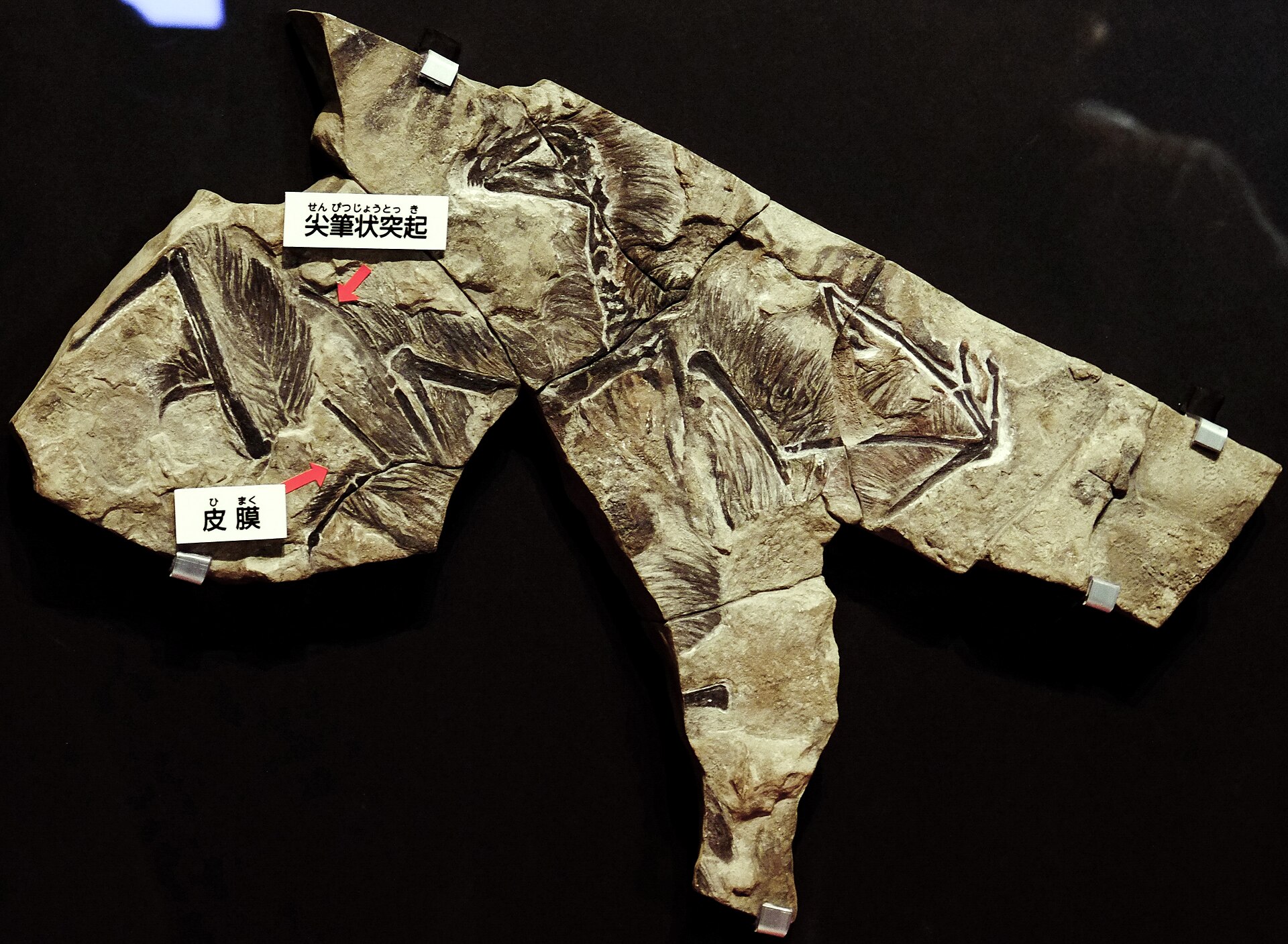

To this day, no second specimen has been reported, so STM 31-2 remains what its describers called “the only known specimen.” The team also deposited raw CT data in the Dryad data repository. In 2020, Dececchi and colleagues re-examined STM 31-2 with laser-stimulated fluorescence, a method that uses laser light to reveal faint soft tissue.
Yi Size and Description
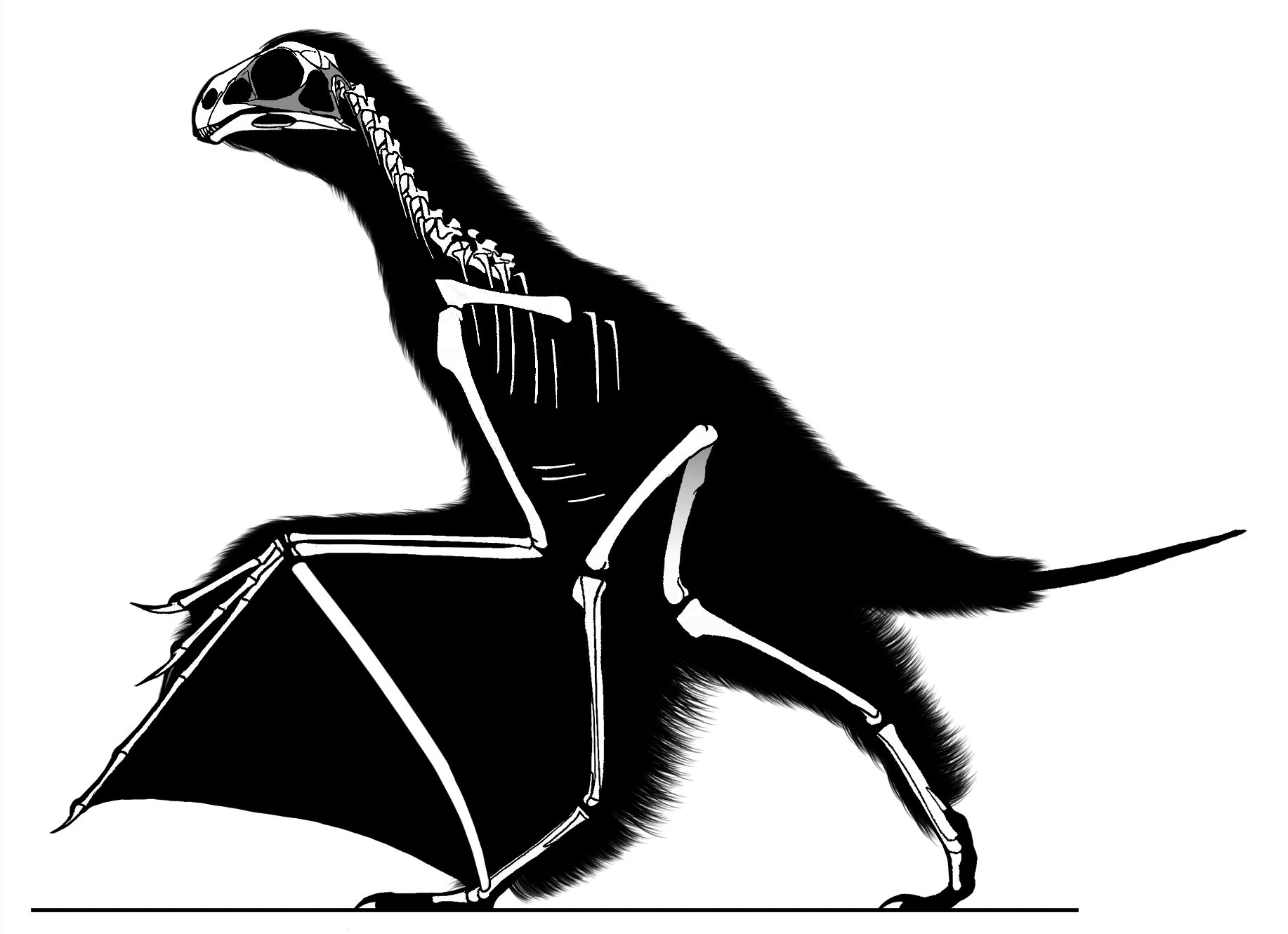
Yi combined a stubby-snouted head, a coat of filament-like feathers, and a wrist unlike any other dinosaur’s.
Short description of Yi
The skull was relatively robust, with a short snout making up about 40 percent of skull length. At the front, the lower jaw turned downward. Each premaxilla, the bone at the tip of the upper jaw, held four slightly procumbent (forward-leaning) teeth, and the first was the largest. Even more strongly procumbent were the front teeth of the dentary, or lower jaw. Unusually, the tooth crowns were symmetrical and wider than their roots.
Farther back, the scapula was short, while the humerus was long and robust. In fact, its arms were long for its legs—the humerus and ulna (forearm bone) measured 1.16 and 1.08 times the length of the tibiotarsus (shin bone). In the hand, metacarpal IV was longer than III, and the outer finger had greatly elongated bones. Xu’s team numbered the fingers II to IV, following the bird convention, whereas most dinosaur workers count them I to III.
Thin, stiff filamentous feathers covered the head and neck, measuring 15 to 20 millimeters around the skull and about 30 millimeters on the neck. Limb feathers reached up to 60 millimeters, and most had a broad, shaft-like base ending in near-parallel filaments—a paintbrush-like shape. Pinnate feathers, by contrast, were absent.

Size and Weight of Type Species
Neither the 2015 description nor the 2020 restudy gives a body length or height in its main text, so weight is the best size guide. Xu and colleagues estimated a body mass of approximately 380 grams (about 0.84 pounds) using an empirical equation rather than a direct measurement.
For their 2020 aerodynamic models, Dececchi and colleagues tested masses of 0.38, 0.45, and 0.7 kilograms (about 0.84, 0.99, and 1.54 pounds). They also noted that the lower masses had been “previously challenged as too light” by Wang and colleagues in 2019.
For comparison, the same team set Yi beside the similarly sized paravians Archaeopteryx and Microraptor. Its closest relative, Ambopteryx, cannot fill the gap, because its published body measurements belong to a different animal. So 380 grams remains the only mass the describers gave, while the 2020 models add heavier values of 0.45 and 0.7 kilograms.
The Dinosaur in Detail
Its standout feature is the styliform element—a slightly curved, tapering rod at each wrist, longer than the ulna. It appears to extend from the ulnar side of the carpus (wrist). Chemical tests suggested bone or calcified cartilage. Around the rods and fingers of both hands lay sheet-like patches of tissue, some with ripple-like striations.
As of 2015, no equivalent was known in any dinosaur. Instead, similar rods occur in gliding mammals, in bat ankles, and as the pterosaur pteroid. The closest match, the describers wrote, is the wrist element of flying squirrels such as the Japanese giant flying squirrel. Accordingly, they read the rod as “a strong indication” of membranous aerodynamic surfaces—a striking case of convergent evolution.
Still, Xu and colleagues could not confidently reconstruct the wing, since the membrane is incomplete and the rod’s angle uncertain. Muscle attachments that were not strongly expanded hinted at gliding more than flapping, yet they called the flight mode uncertain. If not flight, they argued, the rods and membranes implied some “equally distinctive forelimb function.”
Later work kept the membrane but questioned the flight. With Ambopteryx, Wang and colleagues backed the styliform element and membranous wings across the family, while noting that uses such as display are also possible. In 2020, Dececchi’s team identified a claw sheath that makes the claws more recurved, and a rod that appears tightly integrated into the wrist. They asked whether the patches were membranes at all, then rejected that idea as unrealistic. Still, they concluded the wing had “a more restricted patagial extent than originally modeled”—a smaller membrane. Their models found powered flight highly unlikely and allowed only fast, poorly maneuverable gliding. Together, these studies point to a likely arboreal animal whose wings Wang’s team saw as a short-lived experiment—yet how Yi used them remains open.
Interesting Points about Yi
- Some of the structures interpreted as melanosomes (tiny pigment-bearing bodies) in Yi reach 2,100 nanometers long, among the largest known.
- In the 2020 study, the styliform element made up 42 percent of forelimb length in Yi, compared with 32 percent in Ambopteryx.
- The largest membrane patch mapped in 2020 covers about 10.33 square centimeters (1.6 square inches).
- Under laser light in 2020, all five membrane patches barely glowed, though the team’s table lists the striations of one patch as visible. Feather filaments also ran across some patches.
Contemporary Dinosaurs
Within the same county lived Pulaosaurus qinglong, an early-diverging neornithischian whose gut may hold impressions of plant seeds. Its holotype, interpreted as immature, measures about 722 millimeters (28 inches) in total length. It comes from Southern Shimen Gou, in the same formation and Callovian–Oxfordian range as Yi. Any contact between the two, however, goes unrecorded.
Elsewhere in Qinglong County, at Gangou Township, lived Caihong juji, a paravian with bony skull crests and feathers estimated to be iridescent. Its Tiaojishan rocks date to the early Late Jurassic, about 161 million years ago.
Farther afield, in western Liaoning, the Tiaojishan Formation also yielded Anchiornis huxleyi. This small feathered theropod bore long pennaceous (vaned) feathers on its feet. In 2009, it was described once as an early bird relative and once as a troodontid. Today it is often placed in its own family, Anchiornithidae, though its position is still debated. Its rocks date to the earliest Late Jurassic, overlapping the Oxfordian part of the range of Yi. Living in a different region, it was a regional contemporary rather than a close neighbor.
Yi in its Natural Habitat
The world Yi knew had a volcanic backdrop, since the Tiaojishan Formation as a whole is classed as a volcanic unit. At Mutoudeng, though, the fossil came from gray sandy shale recorded as a lake deposit. Across the wider Yanliao Biota, lake beds preserve ferns, cycadophytes, ginkgophytes, and conifers, along with insects, salamanders, pterosaurs, dinosaurs, and mammaliaforms.
The original description proposed no diet for Yi. In 2019, Wang and colleagues suggested that scansoriopterygids as a group may have been omnivorous. That idea, however, rests mainly on stomach stones and possible bone found with Ambopteryx, along with the unusual teeth of the whole family, Yi‘s included.
While there is no direct evidence of how Yi lived day to day, later researchers have pictured it in the trees. In 2020, Dececchi and colleagues described scansoriopterygids as “obligate gliding organisms, likely to be arboreal.” Though they called it speculative, the team floated the idea of forest specialists suited to small canopy gaps. Beyond that, they named mammalian gliders and pterosaurs as potential competitors or predators—crowded skies for such strange wings.
Frequently Asked Questions
It comes from the Mandarin words yi, “wing,” and qi, “strange,” and its describers pronounce it roughly “ee chee.”
It lived in the Callovian to Oxfordian stages of the Middle to Late Jurassic, around 160 million years ago.
The main scientific descriptions give no length or height, but its describers estimated a body mass of about 0.84 pounds (380 grams).
The describers gave no diet for Yi, though a 2019 study suggested that its family may have been omnivorous.
Its describers proposed membranous wings, possibly used more for gliding than flapping. A 2020 study found powered flight highly unlikely and judged it a poor glider at best.
Its only known specimen comes from Mutoudeng in Qinglong County, Hebei Province, China.
Sources
The information in this article is based on various sources, drawing on scientific research, fossil evidence, and expert analysis. The aim is to provide a comprehensive and accurate overview of Yi. However, please be aware that our understanding of dinosaurs and their world is constantly evolving as new discoveries are made.
- https://doi.org/10.1038/nature14423
- https://treatment.plazi.org/id/03AB87A99F1FE0493333FB3BFEEF5FFA
- https://pubmed.ncbi.nlm.nih.gov/25924069/
- https://doi.org/10.5061/dryad.fp060
- https://doi.org/10.1038/s41586-019-1137-z
- https://treatment.plazi.org/id/5E0C87B17643696AFF5CFA60FE65DCC4
- https://pubmed.ncbi.nlm.nih.gov/31068719/
- https://doi.org/10.1016/j.isci.2020.101574
- https://doi.org/10.1016/j.palaeo.2018.09.030
- https://peerj.com/articles/19664/
- https://peerj.com/articles/11161/
- https://doi.org/10.1038/s41467-017-02515-y
- https://doi.org/10.1038/nature08322
- https://doi.org/10.1007/s11434-009-0009-6
- https://paleobiodb.org/classic/displayCollResults?collection_no=168798
This article was last fact checked: TheDinosaurs Team, 29-10-2026
Featured Image Credit: Nobu Tamura, CC BY-SA 4.0, via Wikimedia Commons
