
South of General Carrera Lake, in Chile’s Aysén Region, the volcanic rocks of the Toqui Formation hold one of the most puzzling dinosaurs yet described. Named Chilesaurus diegosuarezi in 2015, this small herbivore lived during the Tithonian stage of the Late Jurassic, around 147 million years ago. Its describers placed it among the theropods, yet it had leaf-shaped teeth and stout limb bones. Later researchers, however, have argued that it sits on a different branch of the family tree.
The first bones were found in February 2004 by seven-year-old Diego Suárez, the son of geologists Rita de la Cruz and Manuel Suárez. Then, in 2015, paleontologist Fernando E. Novas and nine colleagues named the animal in the journal Nature. They called it an extreme case of mosaic evolution—a body that seems assembled from parts of very different dinosaurs. A decade later, its true place among dinosaurs remains an open question.
Chilesaurus Key Facts
| Keyword | Fact |
|---|---|
| Pronunciation | Not specified |
| Meaning of name | Named for Chile, Honoring Diego Suárez |
| Group | Theropoda (as originally described), later proposed as Ornithischia |
| Type Species | Chilesaurus diegosuarezi |
| Diet | Herbivore |
| When it Lived | Around 147 MYA |
| Period | Jurassic |
| Epoch | Late Jurassic (Tithonian stage) |
| Length | About 5.2 feet (1.6 meters) for the holotype, with paratypes ranging from about 3.9 to 10.5 feet (1.2 to 3.2 meters) |
| Height | Not specified |
| Weight | About 29 to 33 pounds (13 to 15 kilograms) for the holotype, up to about 187 pounds (85 kilograms) for the largest specimen (doctoral thesis estimates) |
| Mobility | Moved on two legs (bipedal) |
| First Discovery | 2004 by Diego Suárez |
| Described by | 2015 by F.E. Novas, L. Salgado, M. Suárez, F.L. Agnolín, M.D. Ezcurra, N.R. Chimento, R. de la Cruz, M.P. Isasi, A.O. Vargas, and D. Rubilar-Rogers |
| Holotype | SNGM-1935 |
| Location of first find | Toqui Formation, south of General Carrera Lake, Aysén Region, Chile |
Chilesaurus Origins, Taxonomy and Timeline
The name Chilesaurus is a simple nod to Chile, the country that yielded its bones. Its species name, diegosuarezi, honors Diego Suárez, who spotted the first fossils at age seven. Together, the name ties the animal to its homeland and to the young discoverer who first brought it to light.
In 2015, Novas and colleagues placed Chilesaurus near the base of Tetanurae, a major branch of theropods. They reported that all four data sets they tested placed it within Theropoda, though one even paired it with Velociraptor. Two of them placed it near the base of Tetanurae. In one modified matrix, it came out as the most basal tetanuran of all, sister to a group uniting Piatnitzkysaurus, Condorraptor, and Neotetanurae. In 2017, however, paleontologists M.G. Baron and P.M. Barrett recovered it as the earliest-diverging member of Ornithischia, the “bird-hipped” dinosaurs. Chilesaurus diegosuarezi is the type and only known species, and the debate concerns where it belongs, not whether it is valid.
The original paper dated the Toqui beds to the Tithonian, the final stage of the Jurassic. That age rested on a uranium-lead date of 147 million years, give or take one million, from zircon crystals in the volcanic layer directly beneath the fossil levels. In 2016, Manuel Suárez and colleagues published full data for three dated tuffs (hardened volcanic ash). Dated at about 148.7, 147.9, and 147.0 million years—the last being the date used in 2015—all fall within the Tithonian. Some later papers loosely called the beds late or latest Tithonian. However, the radiometric dates point to the earlier part of the stage, a few million years before the close of the Jurassic period.
Discovery & Fossil Evidence
The first Chilesaurus bones surfaced in February 2004, about 1,400 meters (4,600 feet) above sea level in mountains south of the village of Mallín Grande. Some early finds were reported in 2008 as indeterminate theropods and tetanurans, and only in 2015 did Novas and colleagues refer them to Chilesaurus. Joint field seasons with the MACN museum in Buenos Aires began in January 2010, and that first expedition found several articulated skeletons.
The holotype, SNGM-1935, belongs to Chile’s Servicio Nacional de Geología y Minería (national geology and mining service). It is a nearly complete, articulated skeleton, photographed in the field as it lay. Incomplete fusion of its neurocentral sutures—the seams joining each vertebra’s body to its arch—shows that this animal was not fully grown. The skull, by contrast, is known only from disarticulated bones, most of them belonging to the holotype. They include a premaxilla (front upper jaw bone), maxillae, frontals, a postorbital, a squamosal, the basicranium (base of the braincase), an ectopterygoid, and a dentary (lower jaw bone).
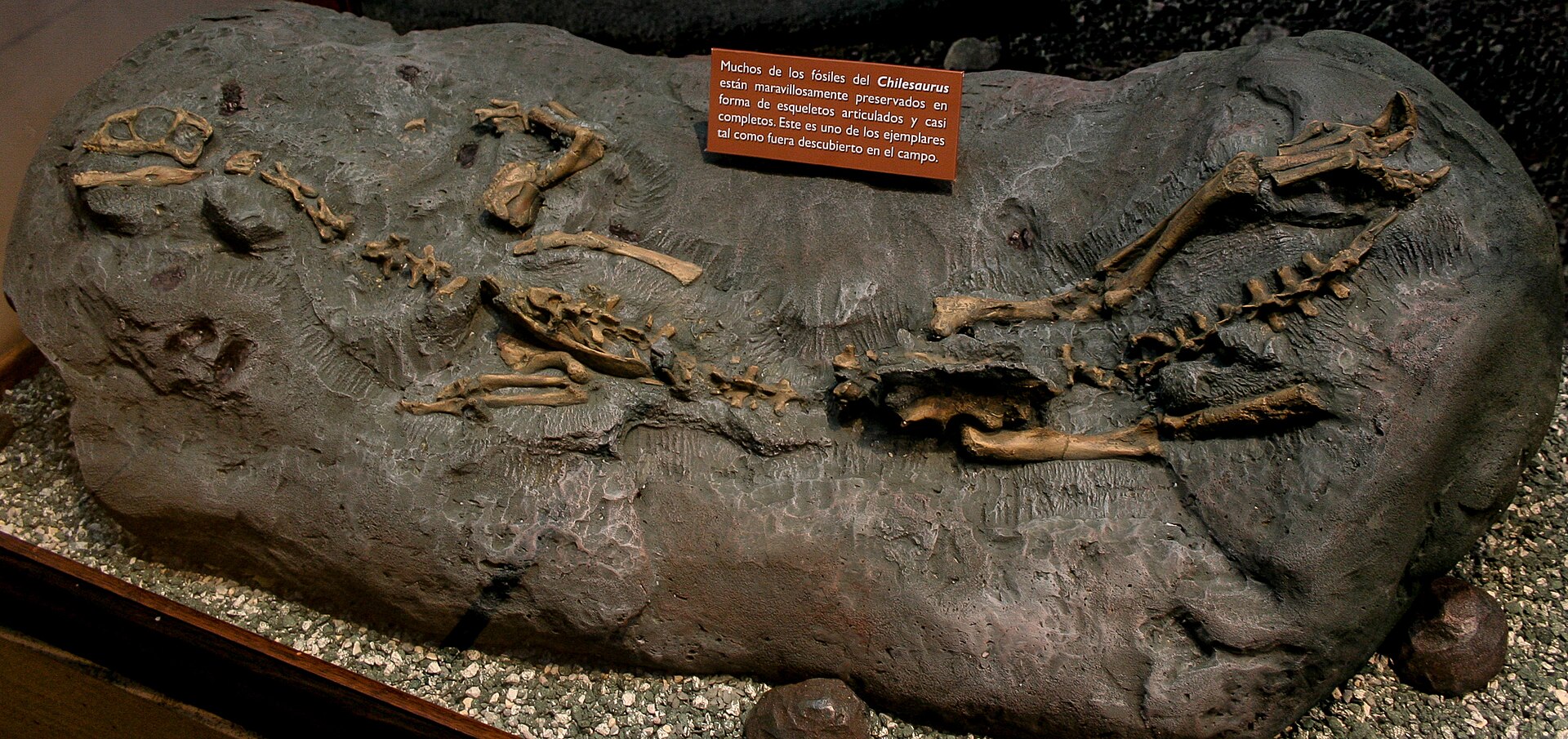

Four further individuals at different growth stages, known from partial postcranial (below-the-skull) skeletons, serve as paratypes. Altogether, the supplementary material lists twelve specimens besides the holotype, from partial skeletons down to isolated vertebrae. Because several specimens, including the holotype, lay in natural articulation, the describers ruled out a mix of species in the hypodigm—the full set of referred fossils.
Chilesaurus Size and Description
Short description of Chilesaurus
The skull material suggests a proportionally small head, with a short, deep premaxilla. A rough front margin on that bone suggests a ramphotheca, a horny beak-like sheath, although no such tissue is preserved. The dentary was also short and deep, turning downward at the chin. That jaw carried tall, leaf-shaped teeth that tilted forward and bore tiny serrations only at the crown tip.
Long, low neck vertebrae formed a slender neck, and paired hollows called pleurocoels pierced the neck and front back vertebrae. The arms were 56 percent the length of the legs, and the hand was unusual. Although three metacarpals (palm bones) were present, only the first two fingers were well developed—the third carried a single minute bone.
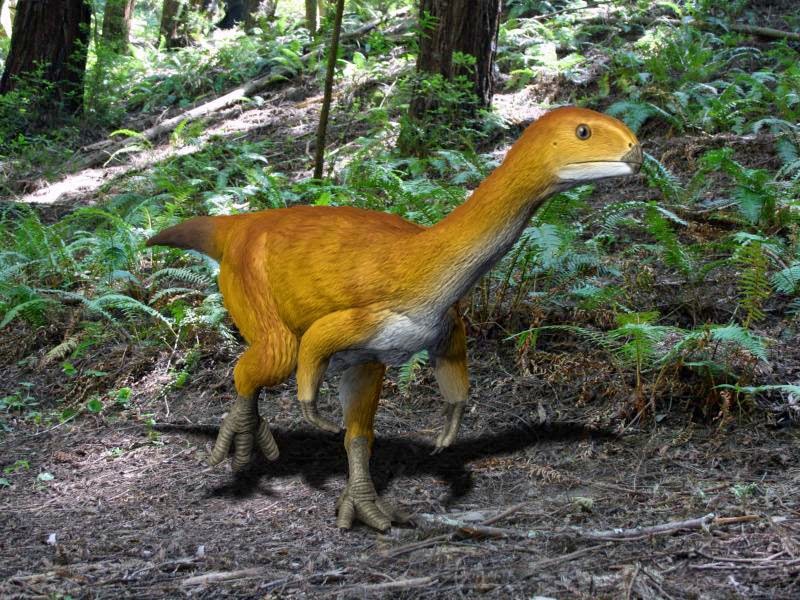

Its limb bones were stout, as in sauropodomorphs (the long-necked dinosaurs and their early relatives). The foot was short and wide, and its first toe was large, only slightly shorter than the second. Chilesaurus walked on two legs, although Novas and colleagues suggested that certain hindlimb features might reflect a less-cursorial, or less running-adapted, way of moving.
Size and Weight of Type Species
Novas and colleagues gave the holotype a length of about 5.2 feet (1.6 meters), but that individual was still growing. It measures only 50 percent of the length of the larger specimen SNGM-1888. Across the four paratypes, total length ranges from about 3.9 to 10.5 feet (1.2 to 3.2 meters). No source reviewed gives a height estimate.
Body mass comes not from a journal article but from a doctoral thesis by Nicolás R. Chimento, one of the describers, dated 2017 and published in 2018. Using regressions on leg bones, it put the holotype and one other specimen at about 13 to 15 kilograms (29 to 33 pounds). The smallest specimen averaged 8.15 kilograms (18 pounds). Since larger individuals lack a femur or tibia, their figures were scaled, giving about 30, almost 70, and almost 85 kilograms (66, 154, and 187 pounds). By this indirect reckoning, Chilesaurus did not exceed 100 kilograms (220 pounds), but these figures remain estimates, not measurements.
The Dinosaur in Detail
A Skeleton Built from Many Plans
What sets this dinosaur apart is how its body seems to belong to several groups at once. Novas and colleagues compared each part of the skeleton in a morphospace analysis—a way of plotting anatomy against that of other theropods. The backbone resembled that of ceratosaurs, and the forelimbs and shoulders those of basal tetanurans. Meanwhile, the pelvis looked like a coelurosaur’s and the hindlimbs like a tetanuran’s.
The hip is the sharpest puzzle. A long, theropod-style ilium sat above a pubis rotated fully backward—a condition also seen in basal ornithischians, therizinosaurs, and dromaeosaurids. The describers proposed that this retroverted pubis may relate to an increased gut capacity. Still, they counted pleurocoels, a strap-like shoulder blade, and a semilunate (half-moon-shaped) wrist bone as signs of theropod and tetanuran ancestry.
Similarly, they read the sauropodomorph-like ankle and foot as evolutionary reversals. Jaw and tooth features shared with sauropodomorphs and therizinosaurs, in their view, were homoplasies—similar features evolved independently—linked to plant-eating. Across their analyses, forcing Chilesaurus into Ornithischia cost 11 to 14 extra steps, and into Sauropodomorpha 5 to 16. Pairing it with Falcarius cost 11 steps, and with Plateosaurus 16.
A Contested Place on the Family Tree
Although originally described as a tetanuran theropod, Chilesaurus was later recovered by Baron and Barrett (2017) as the earliest-diverging ornithischian. In their tree, it branched off before Pisanosaurus and the heterodontosaurids. They cited a toothless front premaxilla, teeth without recurvature, and the backward-pointing pubis, among other traits. In their data set, forcing it back into Tetanurae cost 10 extra steps, and into Theropoda 13. If they are right, its Late Jurassic age implies a long ghost lineage—a stretch of evolutionary history with no fossils.
In 2018, Müller and colleagues found that the data set first supplied placed it among sauropodomorphs. A corrected version, however, returned it to Ornithischia, and they judged its position unstable. They also noted that the Baron and Barrett data set included no tetanurans, so it could not test the original placement. Baron and Barrett replied that an outdated file with errors had been shared.
In 2019, Müller and Dias-da-Silva also recovered it within Ornithischia, using another version of the Baron data set. Yet ornithischian supporters disagree among themselves. In 2022, paleontologist David B. Norman and colleagues, Baron among them, recovered it as a heterodontosaurid rather than near the base of Ornithischia. In their constrained runs, though, it fell at the base of Theropoda, and they noted several diagnostic theropod features.
Meanwhile, its describers kept it among tetanurans in 2017, and a broad 2024 analysis by paleontologist A. Cau agreed. In a study of outgroup choice, published in print in 2024, Baron’s results again suggested an early-diverging ornithischian. Even so, he acknowledged that Theropoda remains the most prevalent hypothesis. Taken together, the evidence still points two main ways—theropod or ornithischian—and even ornithischian supporters disagree over where in that group it belongs.
Interesting Points about Chilesaurus
- Diego Suárez was only seven years old when he found the first bones, and the species name diegosuarezi honors him.
- Its hand had three metacarpals but only two well-developed fingers, with the third reduced to a single minute bone.
- According to its describers, Chilesaurus is the numerically dominant tetrapod (four-limbed vertebrate) in the Aysén fossil assemblage, so it was far from a rare find.
- In a 2017 study, four articulated specimens showed strongly flexed arms with backward-facing hands, a pose compared with the resting posture of Mei long and Sinornithoides.
Chilesaurus in its Natural Habitat
The world Chilesaurus roamed was shaped by volcanoes. The original description reports about 100 meters (330 feet) of green volcanic sandstones and breccias, with ash layers and red ignimbrites—rocks laid down by hot volcanic flows. To Novas and colleagues, the beds resembled braided river deposits. In 2016, however, Suárez and colleagues interpreted the setting as a volcanic fan delta reaching a shallow sea. Some beds contain glauconite, a mineral pointing to marine conditions. They also reported fossil tree trunks of Podocarpoxylon and fern spores that indicate humid conditions.
Novas and colleagues linked its teeth and jaw to plant-eating, placing it beside Limusaurus as a non-coelurosaurian theropod turned herbivore. Baron and Barrett, viewing it as an early ornithischian, instead considered an omnivorous, low-fiber diet likely. In the describers’ view, it was a leading small-to-medium herbivore in its fauna, a role that ornithischians filled at Tendaguru and in the Morrison.
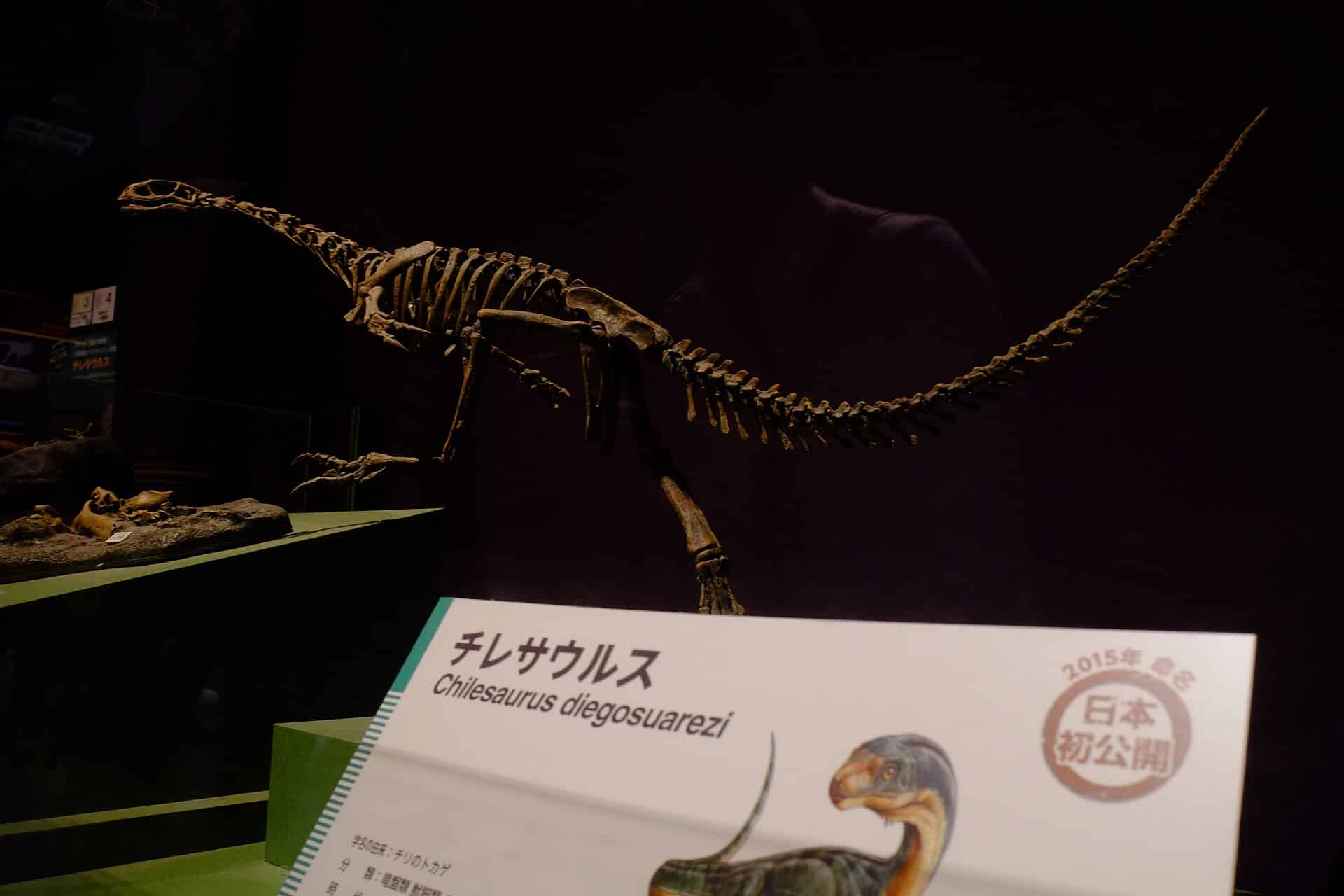

It shared these beds with at least three lineages of sauropods. Among them were diplodocines, relatives of Diplodocus—the first unequivocal Late Jurassic record of that group in South America. The same levels yielded Burkesuchus mallingrandensis, a crocodile-line reptile an estimated 70 centimeters (28 inches) long. While there is no direct evidence of herd behavior, four articulated individuals seem to have been feeding or resting when they were quickly buried. Its describers also saw it as an outstanding case of endemism—a lineage known only from southern South America.
Frequently Asked Questions
The genus is named for Chile, and the species name diegosuarezi honors Diego Suárez, who found the first bones at age seven.
It lived in the Tithonian stage of the Late Jurassic, around 147 million years ago.
The holotype was about 5.2 feet long, and the largest specimens reached about 10.5 feet. A doctoral thesis estimated the largest at about 187 pounds.
Its describers considered it a herbivore, while Baron and Barrett suggested a likely omnivorous, low-fiber diet.
It was described in 2015 as a basal tetanuran theropod, still the most prevalent view. Some later analyses place it among ornithischians instead, usually near the base of that group.
Its fossils come from the Toqui Formation, south of General Carrera Lake in Chile’s Aysén Region.
Sources
The information in this article is based on various sources, drawing on scientific research, fossil evidence, and expert analysis. The aim is to provide a comprehensive and accurate overview of Chilesaurus. However, please be aware that our understanding of dinosaurs and their world is constantly evolving as new discoveries are made.
- https://doi.org/10.1038/nature14307
- https://ri.conicet.gov.ar/handle/11336/127416
- https://static-content.springer.com/esm/art%3A10.1038%2Fnature14307/MediaObjects/41586_2015_BFnature14307_MOESM208_ESM.pdf
- https://doi.org/10.1007/s00531-015-1287-7
- https://doi.org/10.5710/AMGH.07.05.2015.2883
- https://doi.org/10.1038/s41598-021-93994-z
- https://doi.org/10.1098/rsbl.2017.0220
- https://doi.org/10.1098/rsbl.2017.0581
- https://doi.org/10.1098/rsbl.2018.0002
- https://doi.org/10.5710/AMGH.11.06.2017.3088
- https://doi.org/10.35537/10915/67191
- https://doi.org/10.1080/08912963.2017.1418341
- https://doi.org/10.1093/zoolinnean/zlac062
- https://doi.org/10.1016/j.palwor.2022.12.001
- https://www.paleoitalia.it/wp-content/uploads/2024/05/01_Cau_2024_BSPI_631.pdf
- https://ri.conicet.gov.ar/handle/11336/88405
- https://paleobiodb.org/classic/checkTaxonInfo?taxon_no=319906
- https://paleobiodb.org/classic/displayCollResults?collection_no=83734
This article was last fact checked: TheDinosaurs Team, 06-11-2026
Featured Image Credit: Arcovenator, CC BY 3.0, via Wikimedia Commons
