
In south-central Chubut Province, Argentina, the river-laid rocks of the Lago Colhué Huapi Formation have yielded a remarkable large predator. Named Joaquinraptor casali in 2025, it was a megaraptorid—a member of a family of large-clawed, meat-eating theropods. Its bones lay only a few meters below the top of the formation, in rocks probably of late Maastrichtian age. That likely places it near the close of the Cretaceous, among the youngest megaraptorans known, if not the very youngest.
Co-author Bruno N. Alvarez discovered the skeleton, and a CONICET press release dates the first sighting to 2019. After several field campaigns, paleontologist Lucio M. Ibiricu and seven colleagues described it in Nature Communications, ranking it among the most completely represented megaraptorans yet found. Between its jaws lay the arm bone of a crocodyliform—a crocodile relative—which the authors read as a possible dietary clue. If they are right about its age, the family may well have survived to the very end of the Cretaceous.
Joaquinraptor Key Facts
| Keyword | Fact |
|---|---|
| Pronunciation | Not specified |
| Meaning of name | Joaquín’s Thief |
| Group | Theropoda |
| Type Species | Joaquinraptor casali |
| Diet | Carnivore |
| When it Lived | 72.1 to 66.0 MYA (Maastrichtian stage, probably late Maastrichtian) |
| Period | Cretaceous |
| Epoch | Late Cretaceous (Maastrichtian stage) |
| Length | Probably more than 23 feet (7 meters), estimated by comparison |
| Height | Not specified |
| Weight | About 2,284 pounds (1,036 kilograms), femur-based estimate |
| Mobility | Not specified |
| First Discovery | 2019 by Bruno N. Alvarez (year per CONICET press release) |
| Described by | 2025 by L.M. Ibiricu, M.C. Lamanna, B.N. Alvarez, I.A. Cerda, J.L. Caglianone, N.V. Cardozo, M. Luna, and R.D. Martínez |
| Holotype | UNPSJB-PV 1112 |
| Location of first find | Valle Joaquín (informal name), Lago Colhué Huapi Formation, south-central Chubut Province, Patagonia, Argentina |
Joaquinraptor Origins, Taxonomy and Timeline
The name Joaquinraptor carries a personal story. “Joaquín” honors the son of first author Lucio M. Ibiricu and also echoes Valle Joaquín, the site’s informal name, while the ending raptor is Latin for “thief.” The species name casali honors Dr. Gabriel Andrés Casal, whose work in central Patagonia included formally naming the Lago Colhué Huapi Formation. Together, the name ties the animal to a family, a valley, and the scientist who first defined its rocks.
Joaquinraptor belongs to Theropoda, Tetanurae, Megaraptora, and finally the family Megaraptoridae. Ibiricu and colleagues placed it there using four synapomorphies—features shared with other members of the family. These include a reduced first tooth socket in the lower jaw and a crest along the ulna (a forearm bone). However, where megaraptorans sit on the wider theropod family tree is controversial. Some treat them as carcharodontosaurian allosauroids, while others regard them as early coelurosaurs and possible basal tyrannosauroids. The describers’ analysis recovered Megaraptora as the sister group of Tyrannosauroidea. Yet they call that unsurprising, since their dataset targeted relationships within the group, not its wider placement. Joaquinraptor casali is the type and only known species.
The describers assign its level to the Maastrichtian, the last stage of the Cretaceous, and probably to its late part. Their timeline puts that stage at roughly 72.1 to 66.0 million years ago, but gives no numeric date for the specimen. Even so, its strata likely lie close to the K/Pg boundary—the line marking the end of the Cretaceous. As a result, Joaquinraptor is the latest-surviving megaraptoran yet known from central Patagonia, and possibly the youngest anywhere.
Discovery & Fossil Evidence
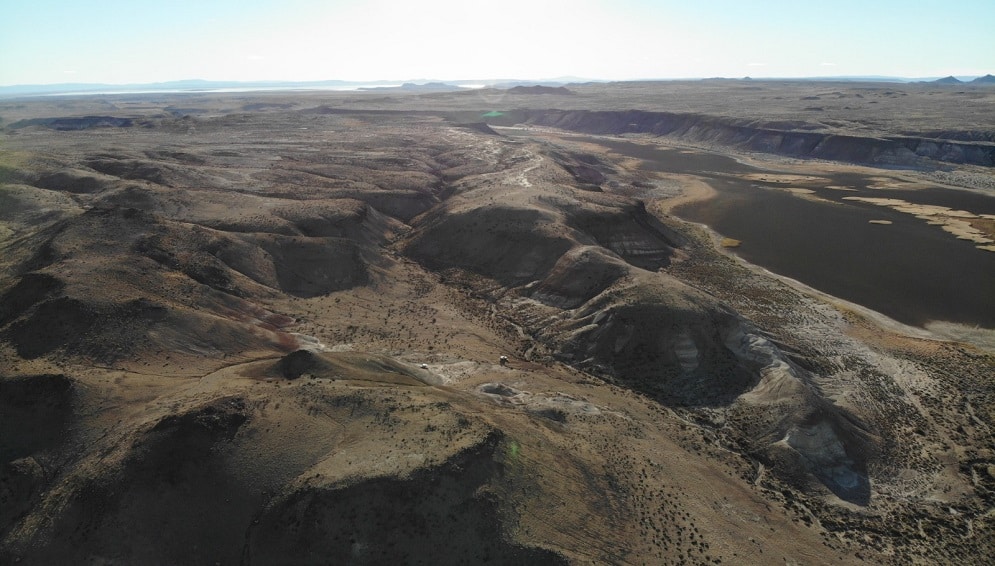
The skeleton lay at Valle Joaquín, near the Río Chico headwaters, east of the southeastern shore of Lago Colhué Huapi. According to the CONICET press release, the bones were first seen in 2019. National Geographic reported that Alvarez spotted a bone fragment, and the team returned months later to uncover it. Ibiricu, Lamanna, Alvarez, and others then excavated the skeleton, while Marcelo Luna prepared and photographed the fossils. Before the formal description, a 2020 abstract by Casal and colleagues had already assigned the horizon to the Maastrichtian.

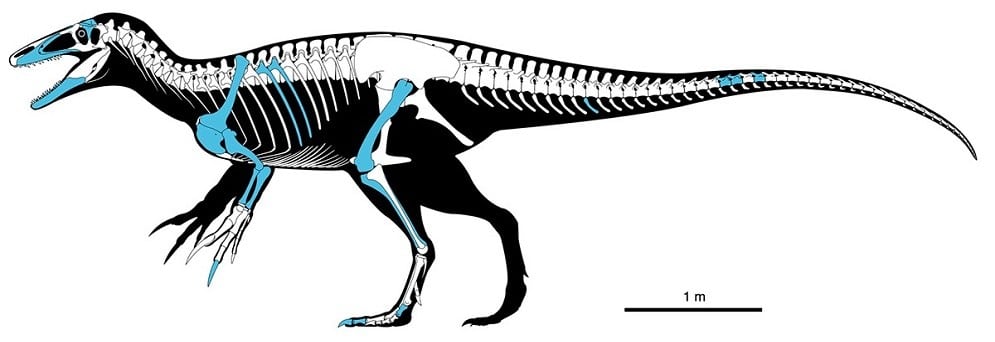
The holotype, UNPSJB-PV 1112, is a partially articulated skeleton of a single individual. From the skull, it preserves the right maxilla (main upper jaw bone), the skull roof and braincase, the right quadrate (jaw-joint bone), both dentaries (lower jaw bones), and teeth. Beyond the head are the atlantal intercentrum—part of the first neck vertebra—three tail vertebrae, back ribs, and a haemal arch (tail chevron). The left scapulocoracoid (shoulder blade), humerus (upper arm bone), radius, and ulna survive. So do a hand claw, the left femur (thigh bone), much of the right tibia (shinbone), and foot bones. A university repository in Comodoro Rivadavia, the Repositorio “Dr. Eduardo Musacchio,” now houses the fossils.
By a substantial margin, this is the most complete megaraptorid from central and southern Patagonia. Earlier megaraptorid finds from the formation, mostly hand claws, are far more fragmentary and come from its older Santonian to possibly early Maastrichtian middle section. No additional specimens of Joaquinraptor have been confirmed outside this locality.
Joaquinraptor Size and Description
Joaquinraptor paired a long, shallow lower jaw with a humerus more massive than that of any other known megaraptoran.
Short description of Joaquinraptor
Several skull bones survive, including a right maxilla 403 millimeters (15.9 inches) long and 130 millimeters tall. Among megaraptorids, a maxilla was previously known only in a juvenile Megaraptor, and this one has a taller, blunter front process. However, that difference may simply reflect the two animals’ different growth stages. Each dentary was long, flattened from side to side, and shallow, with 17 tooth sockets—a count that erosion may have affected. Likewise, a preserved upper tooth is flattened, with a strongly concave rear edge and no serrated ridge along its front.
Farther back, three middle or rear tail vertebrae bore oval hollows covering over half of each side, a unique feature. The back ribs were pneumatized—hollowed by air spaces—and a thin section of one rib revealed a large internal cavity. The arm, however, is the standout, with a 330-millimeter (13-inch) humerus notably more massive than any other in its group. A claw from the second finger also survives, measuring 140 millimeters (5.5 inches) in a straight line.
The holotype includes no skin or other soft tissue, so any discussion of its outer covering is speculative.

Size and Weight of Type Species
Without a complete skeleton, Ibiricu and colleagues estimated length by comparison, judging it probably longer than 23 feet (7 meters), like two other large megaraptorid specimens. For body mass, they turned to the nearly complete femur, which measures 685 millimeters (27 inches) long with a midshaft circumference of 275 millimeters. Using a scaling equation by Campione and Evans, that girth yields about 2,284 pounds (1,036 kilograms). The CONICET release rounds these figures to a little over 7 meters and about one metric ton.
By megaraptorid standards, this was a heavyweight—Australovenator is estimated at only 314 kilograms, about a third of Joaquinraptor‘s mass. The femur is also more robust than in Australovenator and Fukuiraptor. Still, it was not the largest of its kind. Maip, proposed at about 9 to 10 meters (30 to 33 feet) by Aranciaga Rolando and colleagues in 2022, is probably the biggest megaraptorid yet known. In addition, the describers estimate a Bajo Barreal Formation megaraptorid, UNPSJB-PV 958, at 1,089 kilograms, slightly more than Joaquinraptor.
These figures support a 2020 proposal by Lamanna and colleagues. In that view, South American megaraptorids grew from Australian-sized forms of about 5 meters and 300 kilograms to more than 7 meters and 1,000 kilograms. They then kept that size until their extinction.
The Dinosaur in Detail
What sets this dinosaur apart is its forearm. The olecranon—the bony point of the elbow—is proportionally longer than in any other megaraptoran, and the whole ulna measures 271 millimeters. According to the describers, a long olecranon and other forearm features shared across the family may have allowed stronger extension and flexion of the arm. The authors also see these family-wide traits as almost certainly tied to prey capture.
Ibiricu and colleagues listed 11 autapomorphies—traits unique to a single species. Among them are side-compressed parietals (skull-roof bones), an enlarged olecranon, and a crescent-shaped lower end of the radius. A few come with caveats, however. A missing median wall inside the braincase is probably unique but could reflect preservation. Similarly, its straight ulnar shaft might be shared with Megaraptor or simply vary. A ridge, a hollow, and a hooked process on the coracoid also set it apart from Maip, the only other named Maastrichtian megaraptorid.

Bone tissue adds a life history. Assuming one growth line per year, at least 19 lines in its tibia give a minimum age of 19 years. The authors call that estimate tentative, and a reviewer suggested grouped lines may mark single years. Meanwhile, the tibia and rib lack the outer layer that marks finished growth, so it was probably still growing. In contrast, narrowing gaps between the lines suggest it had reached sexual maturity.
In the describers’ analysis, Joaquinraptor emerged as the earliest-diverging member of a new clade of derived South American megaraptorids, informally called Megaraptorid Clade 1. That grouping rests on a single shared feature, so the authors urge further tests. Under alternative character weighting, Maip fell beside Tratayenia and Aerosteon within that clade. Taken together, Joaquinraptor is a heavy-armed megaraptorid whose exact branch within the family remains open.
Interesting Points about Joaquinraptor
- The genus name nods to both first author Lucio M. Ibiricu’s son Joaquín and the discovery site, Valle Joaquín.
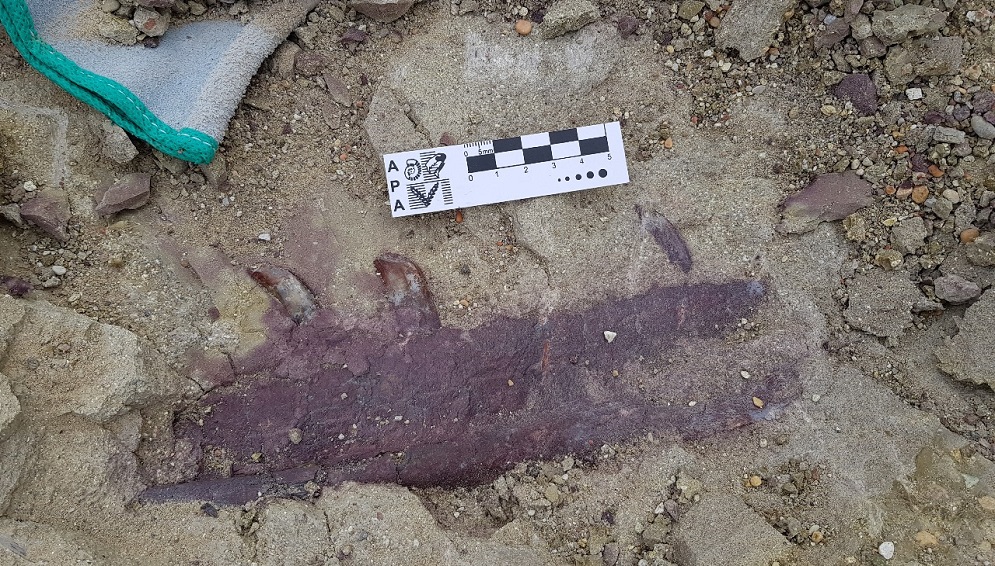
- A crocodyliform arm bone lay between its two dentaries, with several tooth tips touching it and possible tooth marks on its shaft.
- Co-author Rubén D. Martínez died before the 2025 description appeared, and the paper lists him as deceased.
- Its elbow process is proportionally the longest of any megaraptoran, and its humerus is the most massive in its group.
- If each growth line in its tibia marks one year, the holotype animal was at least 19 years old at death, though that count is tentative.
Joaquinraptor in its Natural Habitat
The world Joaquinraptor roamed was probably a warm, humid floodplain close to the sea, with at least seasonal rainfall. That picture comes mostly from nearby rocks at about the same level, while clays at the dig site hint at alternating dry and wet seasons. The quarry is an old river channel, its fine conglomerates grading up into cross-bedded sandstones. By contrast, the older middle section of the formation formed in a seasonally dry or semiarid setting far inland.
Nypa-type palm pollen from nearby outcrops led Ibiricu and colleagues in 2021 to suggest coastal palm swamps. Shallow freshwater pools with stromatolites—layered structures built by microbial mats—lay on the floodplains, perhaps linked to the advancing Atlantic. Charcoal from the area also shows wildfires were relatively common. Bones of at least two hadrosaurids (duck-billed dinosaurs), along with theropod teeth, eggshell, and wood, come from these upper levels. Ibiricu’s team also suspected that the hadrosaurid Secernosaurus, known from this formation, came from these levels, though its holotype lacks clear stratigraphic provenance.
The crocodyliform humerus between its jaws is the main clue to its menu. The authors suggest this may be direct evidence of prey choice, with crocodyliforms at least occasionally among its victims. Alternatively, it could reflect a fight, competition over food, or a chance placement by water currents. Studies of its burial are under way.
While there is no direct evidence of its social life, the describers note that megaraptorids appear to have been the apex predators of central and southern Patagonia. Farther north, abelisaurids and large unenlagiines—other theropod groups—filled those roles instead. Environment, isolation by inland seas, and differences in plant life may explain the split. Central Patagonian megaraptorids, they add, endured significant climate change and may have thrived in a broad range of habitats.
Frequently Asked Questions
It means “Joaquín’s thief,” honoring the first author’s son and the Valle Joaquín site, while casali honors Gabriel Andrés Casal.
It lived in the Maastrichtian stage of the Late Cretaceous, probably late in that 72.1 to 66.0 million-year interval.
It was probably more than 23 feet (7 meters) long, with an estimated weight of about 2,284 pounds based on its femur.
It was a carnivore, and its describers suggest that its prey may at least occasionally have included crocodyliforms.
It was found at Valle Joaquín, in the Lago Colhué Huapi Formation of south-central Chubut Province, Argentina.
It is among the most complete megaraptorans known, with an unusually massive humerus and the group’s proportionally longest elbow process.
Sources
The information in this article is based on various sources, drawing on scientific research, fossil evidence, and expert analysis. The aim is to provide a comprehensive and accurate overview of Joaquinraptor. However, please be aware that our understanding of dinosaurs and their world is constantly evolving as new discoveries are made.
- https://doi.org/10.1038/s41467-025-63793-5
- https://static-content.springer.com/esm/art%3A10.1038%2Fs41467-025-63793-5/MediaObjects/41467_2025_63793_MOESM1_ESM.pdf
- https://static-content.springer.com/esm/art%3A10.1038%2Fs41467-025-63793-5/MediaObjects/41467_2025_63793_MOESM3_ESM.pdf
- https://doi.org/10.1016/j.jsames.2021.103369
- https://rid.unrn.edu.ar/bitstream/20.500.12049/11367/1/Ibiricu_etal_inpresspdf.pdf
- https://www.conicet.gov.ar/cientificos-del-conicet-descubren-en-chubut-un-dinosaurio-carnivoro-que-habria-sido-de-los-ultimos-en-extinguirse/
- https://www.nationalgeographic.com/science/article/dinosaur-megaraptor-new-fossil-argentina-final-meal
- https://doi.org/10.1038/s41598-022-09272-z
This article was last fact checked: TheDinosaurs Team, 12-11-2026
Featured Image Credit: Connor Ashbridge, CC BY 4.0, via Wikimedia Commons
