
On the southern fringe of a vanished sand sea in Río Negro Province, Argentina, the dune sandstones of the Candeleros Formation hold one of South America’s most puzzling armored dinosaurs. Its 2022 describers called Jakapil kaniukura the first definitive thyreophoran species—an armored dinosaur—from Argentinian Patagonia. They placed this small herbivore in the Cenomanian stage of the Late Cretaceous, although a 2026 study points to older rocks. Unusually for an armored dinosaur, it seems to have walked on two legs.
In 2012, Sebastián Apesteguía of the Fundación Azara found two small, mysterious bones that looked like skull pieces. Then, in 2014, a field team including him collected the first remains. Facundo Riguetti, then writing a thesis on armored ornithischians, quickly recognized the strange jaw, and bones kept coming out of the site until 2020. In 2022, Riguetti, Apesteguía, and Xabier Pereda-Suberbiola named the animal in Scientific Reports. Since then, its family tree has become a lively debate—one that still rests on a single partial skeleton.
Jakapil Key Facts
| Keyword | Fact |
|---|---|
| Pronunciation | Ja-Kapïl (syllabification given by its describers) |
| Meaning of name | Shield Bearer |
| Group | Ornithischia, probably Thyreophora (disputed) |
| Type Species | Jakapil kaniukura |
| Diet | Herbivore |
| When it Lived | 97 to 94 MYA as originally described (a 2026 study dates the formation to about 111 to 106 MYA) |
| Period | Cretaceous |
| Epoch | Late Cretaceous (Cenomanian stage) as originally described, or Early Cretaceous (Albian stage) according to a 2026 study |
| Length | Less than 4.9 feet (1.5 meters), subadult holotype |
| Height | Not specified |
| Weight | About 9.9 to 15.4 pounds (4.5 to 7 kilograms), subadult holotype estimate |
| Mobility | Moved on two legs (bipedal), tentatively |
| First Discovery | 2012 to 2014, by Sebastián Apesteguía (first bones, 2012) and a field team including Facundo Riguetti (first collected remains, 2014) |
| Described by | 2022 by F.J. Riguetti, S. Apesteguía, and X. Pereda-Suberbiola |
| Holotype | MPCA-PV-630 |
| Location of first find | Rinconada de la Piedra Blanca, near Cerro Policía, La Buitrera Paleontological Area, upper Candeleros Formation, Río Negro Province, Argentina |
Jakapil Origins, Taxonomy and Timeline
The name Jakapil comes from the ‘gananah iahish,’ a Puelchean or northern Tehuelchean language, and means “shield bearer.” The species name joins the Mapudungun words kaniu (“crest”) and kura (“stone”), after the crest under its lower jaw. Riguetti’s team combined the two languages as a tribute to both native peoples who coexisted in North Patagonia. Together, the name honors both peoples, the animal’s armor, and its unusual jaw.
In 2022, Riguetti and colleagues placed Jakapil in Ornithischia, the “bird-hipped” dinosaurs, and within Thyreophora. Their analyses recovered it as a basal thyreophoran or a stem ankylosaur—an early offshoot toward the armored ankylosaurs—close to Scelidosaurus. Curiously, the main text and supplement disagree on whether it was the sister of Ankylosauria or of Eurypoda, the stegosaur-ankylosaur group. Across all four data sets, however, Jakapil always fell close to Scelidosaurus. The authors also judged a close link to Stegouros and other southern parankylosaurs unlikely. Instead, they saw it as a survivor of a lineage that probably arose in the Early to Middle Jurassic. Jakapil kaniukura is the type and only known species.
Following a 2018 study by Candia Halupczok and colleagues, Riguetti’s team assigned the upper Candeleros beds to the Cenomanian stage, roughly 97 to 94 million years ago. In 2026, however, Maniel and colleagues dated an ash bed near the base of the formation to about 111 million years ago—the early Albian stage of the Early Cretaceous. An ash just above it, in the Huincul Formation, gave about 106 million years. On that basis, they place the whole formation at about 111 to 106 million years ago. Because they gave no separate age for the Jakapil beds, its precise age remains open.
Discovery & Fossil Evidence
The holotype comes from ‘Rinconada de la Piedra Blanca,’ near Cerro Policía in the La Buitrera Paleontological Area. According to a CONICET press release, the find took shape when a block yielded a distinctive jaw.
Cataloged as MPCA-PV-630 at the Museo Provincial Carlos Ameghino in Cipolletti, the holotype is a partial skeleton of a subadult. It includes pieces of the premaxilla and maxilla (upper jaw bones), about 15 partial teeth, and a nearly complete left lower jaw. Also present are 12 partial vertebrae, ribs, both scapulae (shoulder blades), and two partial humeri (upper arm bones). Hip, thigh, and shin fragments survive too, along with three toe bones and more than forty osteoderms (bony armor plates). The bones lay scattered over about 4.9 by 3.3 feet (1.5 by 1 meters), with a slight southwest–northeast alignment from dune transport. That scattering is unusual here, where most fossils are articulated. Most girdle and limb bones are broken, with boreholes at their ends that probably reflect bioerosion—damage caused by living organisms.
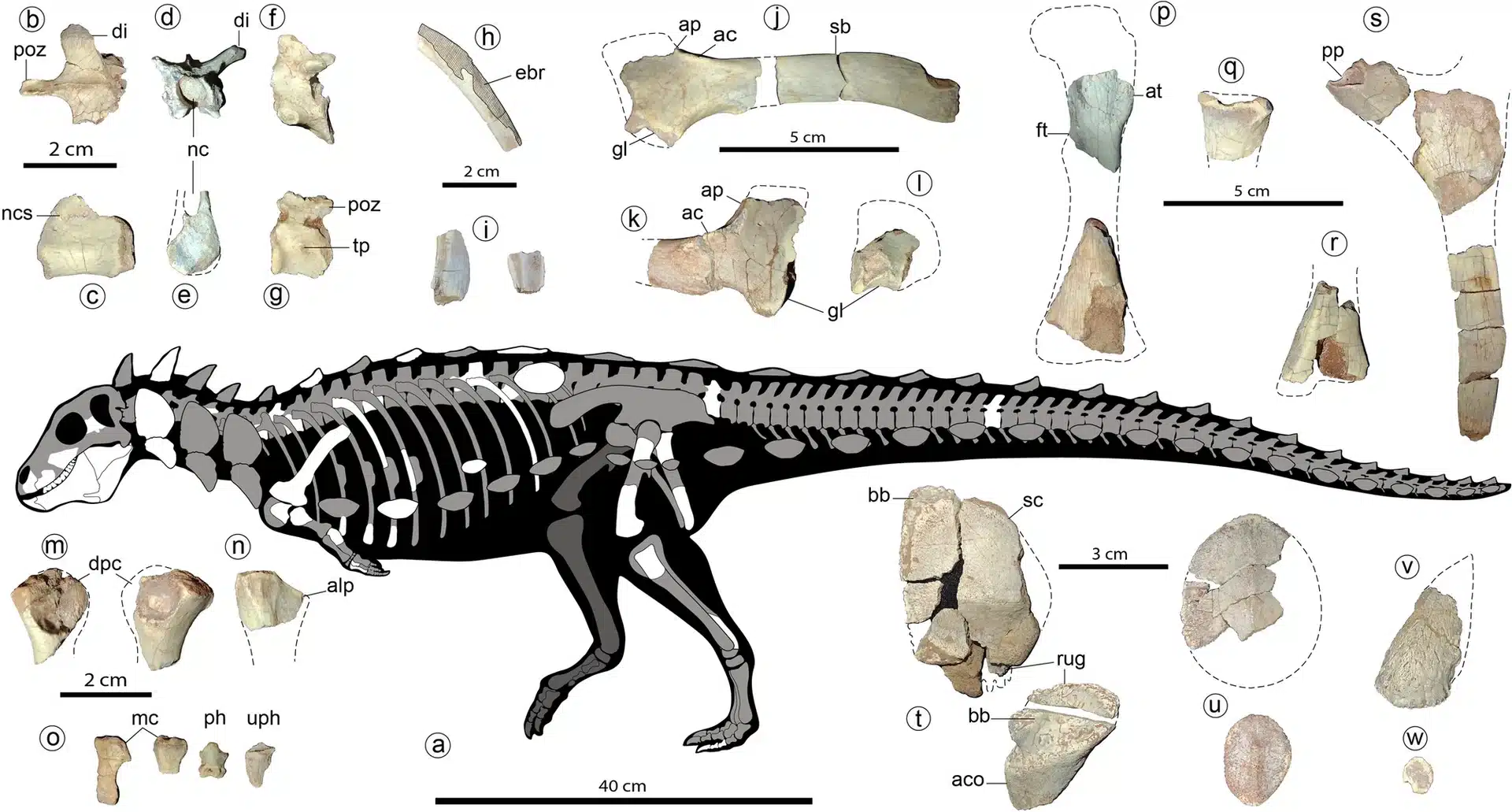

A second specimen, MPCA-PV-371, consists of two partial conical osteoderms from the nearby ‘Jofra’ site. Meanwhile, two decades of fieldwork at La Buitrera, about 6.2 miles (10 kilometers) north, have found no trace of it. Beyond these two, the record holds no other Jakapil specimens.
Jakapil Size and Description
Jakapil breaks the usual armored-dinosaur mold, pairing a deep, crested jaw with a lightly built, two-legged frame.
Short description of Jakapil
The skull was probably short, with eleven tooth positions in the dentary (lower jaw bone), although the supplement counts ten. Up front, a toothless premaxilla and a roughly triangular predentary—an extra bone at the jaw tip—point to a keratinous beak. The rear half of the lower jaw stood twice as tall as the front, with a large crest underneath. Its leaf-shaped teeth carried seven or eight denticles (small serrations) in front and four to six behind.
Low rib curvature suggests a wide torso. The shoulder blade was long and parallel-sided, much like that of several theropods, while the humeri were strongly reduced. By contrast, the upper end of the fibula (outer shin bone) seems larger, relative to the thigh and shin, than in any other thyreophoran. Its one known toe claw was bluntly pointed and hoof-like, as in Scelidosaurus.
At least five types of osteoderm covered the body, including neck scutes fused to a bony base and a few conical spikes. Others were flat disks, and many were minute ossicles just 0.3 to 0.4 inches (7 to 10 millimeters) across. Almost all the recovered osteoderms are extremely low, so this was no spiky tank. No skin is preserved, so any discussion of its coloring is speculative.

Size and Weight of Type Species
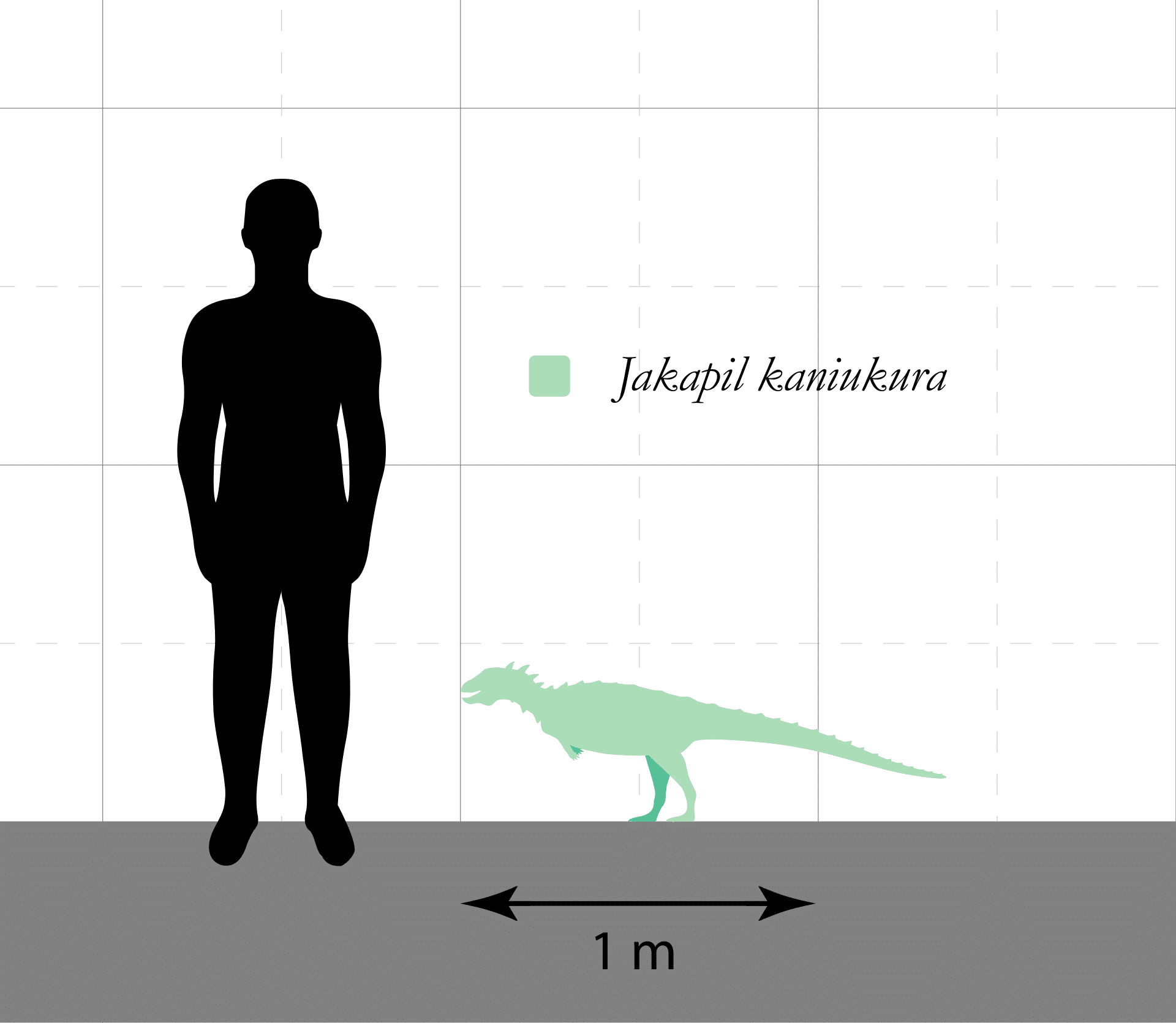
Riguetti and colleagues estimated that the holotype measured less than 4.9 feet (1.5 meters) long. They did not explain the figure, and no height at the hips has been published.
For body mass, the team fed the circumference of the incomplete femur (thigh bone) into a 2018 equation for bipedal dinosaurs by Benson and colleagues. Its real circumference of 1.8 inches (45 millimeters) gave about 15.8 pounds (7.15 kilograms). In contrast, an oval reconstructed from its minimum diameters, 1.5 inches (38 millimeters) around, gave about 9.9 pounds (4.5 kilograms). The main paper rounds this to between 4.5 and 7 kilograms—roughly the weight of a large house cat.
Both values are comparable with the 13.9 pounds (6.31 kilograms) estimated for Lesothosaurus, a small early ornithischian. Since the holotype was still growing, adults were presumably larger, although no adult estimate has been published.
The Dinosaur in Detail
What sets this dinosaur apart is its lower jaw. A large crest, built from three bones at its rear, juts from its underside. Behind the jaw joint, a short prong carries a small spur aimed upward and inward. That spur is absent in all other thyreophorans and resembles the one seen in several theropods. In overall depth, the rear of the jaw recalls those of heterodontosaurids and basal ceratopsians.
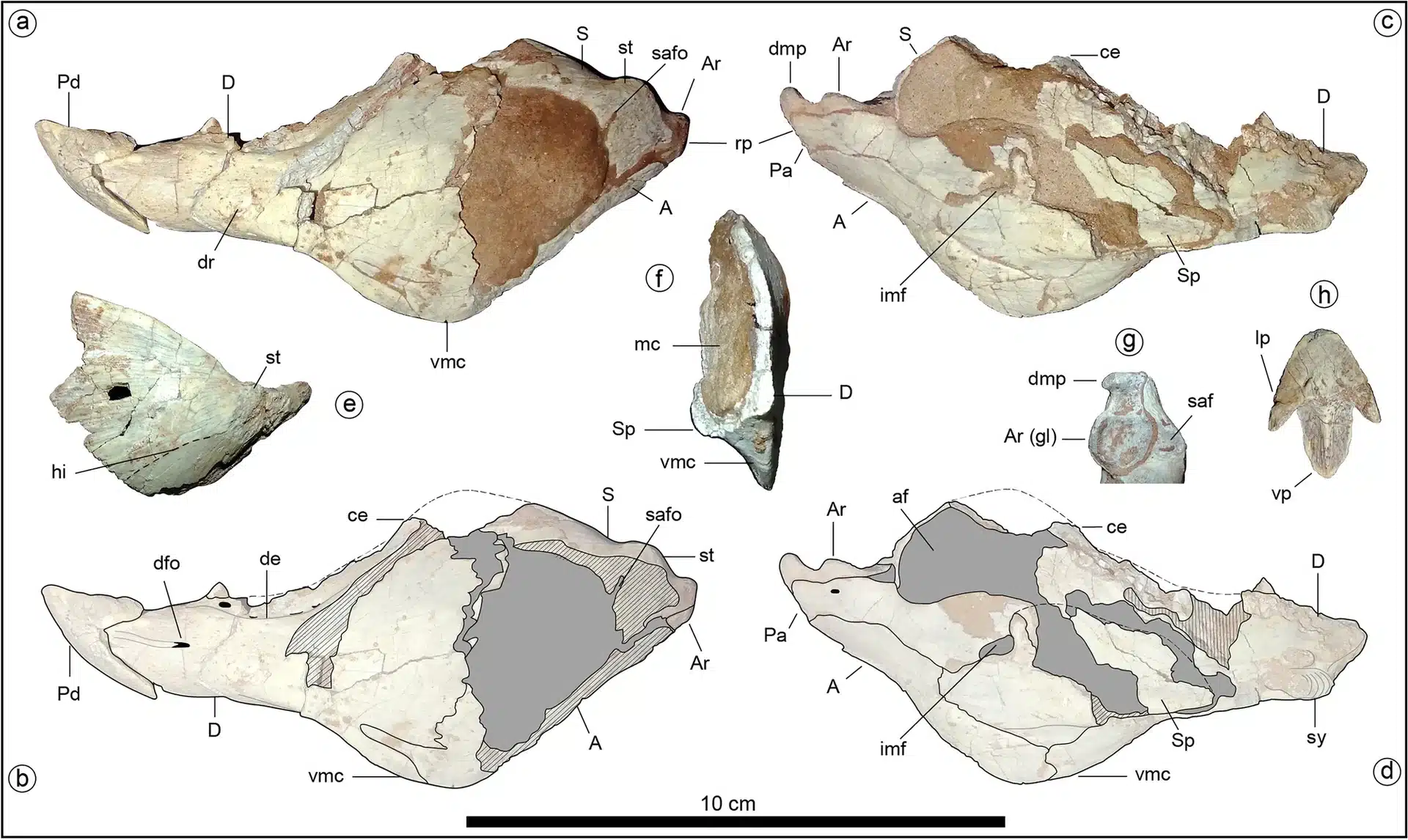

The describers offered two readings of the crest. If jaw muscles attached to the spur as in birds, the crest could have served for display. Otherwise, it may have enlarged the anchor for chewing muscles. They also argued that the short jaw delivered a quite strong bite for a thyreophoran.
Its family tree is far less settled. Riguetti’s team could score only about 22 to 35 percent of its anatomical characters, and adding it generally lowered branch support in all four analyses. In 2023, paleontologist T.J. Raven and colleagues noted that it has dermal armor but apparently no other thyreophoran hallmarks. They pointed to its toothless premaxilla, a deep dentary reminiscent of basal neoceratopsians like Bagaceratops, and teeth unlike those of any ornithischian they knew. They suggested it might instead be an armored marginocephalian—a relative of horned and dome-headed dinosaurs—or an unknown armored lineage. The original placement, they added, requires a 100-million-year ghost lineage—a stretch without fossils.
Later analyses differ. In 2025, Maidment and colleagues included Jakapil in their study of Spicomellus. Their equally weighted analysis recovered it as a basal thyreophoran. An alternative weighting placed it inside Stegosauria, in a tree the authors called weakly supported. In 2026, Riguetti and colleagues still described it as closely related to Scelidosaurus. Taken together, the bones paint a picture of an animal whose armor is clear but whose ancestry is not.
Interesting Points about Jakapil
- Its genus name comes from ‘gananah iahish’ and its species name from Mapudungun, honoring both native peoples of North Patagonia.
- Its describers reported the first thyreophoran predentary with a primitive, triangular shape, much like the one in Lesothosaurus.
- Bone tissue shows at least seven growth lines, yet the holotype was still growing, and its armor behind the neck may have formed later.
- Its fibrolamellar bone records periods of fast growth, unlike the slow growth of Scutellosaurus, another early armored dinosaur that walked on two legs.
Contemporary Dinosaurs
Closest at hand was Alnashetri cerropoliciensis, a small theropod named from La Buitrera in 2012 as a coelurosaurian. In 2026, researchers described a new skeleton from Cerro Policía itself—the Jakapil locality—and called it the most complete and smallest South American alvarezsauroid to date. No source records an interaction.
Also from La Buitrera was Buitreraptor, an unenlagiine dromaeosaurid from the top 164 feet (50 meters) of the Candeleros Formation there. A 2018 study of its skeleton cited an age of around 95 to 92 million years for those beds. Jakapil‘s describers list it among the area’s theropods, but no fossil links the two.
Far larger was Giganotosaurus, a giant carcharodontosaurid from the same formation. Jakapil‘s describers note that such giants turn up at other Candeleros sites, while the La Buitrera area mostly preserves small animals. Its level relative to Jakapil is not specified, and no source records an encounter.
Rounding out the list is Rayososaurus, a rebbachisaurid sauropod—part of a family of long-necked plant-eaters—also from the Candeleros Formation. A 2025 study lists it as Cenomanian, though its level relative to Jakapil is not specified. Because all four come from the Candeleros Formation, the 2026 re-dating would shift them together with Jakapil.
Jakapil in its Natural Habitat
The world Jakapil roamed was the Kokorkom Desert, a paleoerg (ancient sand sea) of at least 319 square miles (826 square kilometers). Its climate swung between arid and semi-arid, and three stages of erg contraction and expansion shifted the water table. Jakapil‘s fossils come from the southern margin, where wind-blown dunes interacted with rivers. Fragmentary sauropod skeletons and dinosaur tracks also turn up here.
Large wear facets show that its teeth met as it chewed. Jakapil probably processed plants more efficiently than early thyreophorans, mostly with up-and-down strokes. Its narrow snout suggests a selective feeder that picked out tougher plant parts rather than cutting leaves. In this herbivore guild, it joined Priosphenodon, a plant-eating sphenodontian (a tuatara relative).
While there is no direct evidence of whether Jakapil lived alone or in groups, its lone holotype says little—isolated finds are usual at the site. Its non-dinosaur neighbors included uruguaysuchid crocodyliforms such as Araripesuchus buitreraensis, the limbed snake Najash, lizards, chelid turtles, dryolestoid mammals, lungfish, and undescribed pterosaurs. Its describers list no birds from the area. Maniel and colleagues tie soil changes from the Candeleros into the overlying Huincul Formation to a shift toward warmer greenhouse conditions.
Frequently Asked Questions
Jakapil means “shield bearer,” and kaniukura means “crest stone,” after the crest beneath its lower jaw.
Its describers placed it in the Cenomanian, about 97 to 94 million years ago. A 2026 study dates its formation to roughly 111 to 106 million years ago.
The subadult holotype measured less than 4.9 feet long and weighed about 9.9 to 15.4 pounds.
It was a herbivore and probably a selective feeder with a beak and a strong bite for its group.
Its fossils come from the Candeleros Formation near Cerro Policía, in Río Negro Province, Argentina.
It was an armored ornithischian, originally described as an early thyreophoran, although a 2023 study questioned that placement, and later analyses differ.
Sources
The information in this article is based on various sources, drawing on scientific research, fossil evidence, and expert analysis. The aim is to provide a comprehensive and accurate overview of Jakapil. However, please be aware that our understanding of dinosaurs and their world is constantly evolving as new discoveries are made.
- https://doi.org/10.1038/s41598-022-15535-6
- https://static-content.springer.com/esm/art%3A10.1038%2Fs41598-022-15535-6/MediaObjects/41598_2022_15535_MOESM1_ESM.docx
- https://doi.org/10.1080/14772019.2023.2205433
- https://cris.brighton.ac.uk/ws/files/40730447/Raven_et_al_Manuscript_PostReview_Final.pdf
- https://doi.org/10.1038/s41586-025-09453-6
- https://doi.org/10.5710/PEAPA.25.11.2025.551
- https://doi.org/10.1016/j.gr.2026.06.020
- https://doi.org/10.3158/2158-5520-5.1.90
- https://doi.org/10.1038/s41586-026-10194-3
- https://doi.org/10.7717/peerj.4558
- https://doi.org/10.1016/j.cretres.2013.04.001
- https://doi.org/10.1016/j.cretres.2017.10.017
- https://doi.org/10.1016/j.cub.2022.05.057
- https://doi.org/10.1080/14772019.2025.2550760
- https://www.conicet.gov.ar/hallan-en-la-patagonia-el-primer-dinosaurio-bipedo-y-acorazado-de-sudamerica/
This article was last fact checked: TheDinosaurs Team, 06-11-2026
Featured Image Credit: TotalDino, CC BY-SA 4.0, via Wikimedia Commons
