
In Chaiyaphum Province, northeastern Thailand, the reddish siltstones of the Khok Kruat Formation have given up a genuine heavyweight. Named Nagatitan chaiyaphumensis in 2026, this sauropod lived during the Aptian to Albian stages of the Early Cretaceous. Its describers call it the first diagnostic sauropod specimen from this formation—the youngest fossil-bearing Mesozoic rock unit in Thailand. At an estimated 25 to 28 tonnes, it is also, its describers argue, Southeast Asia’s largest known taxon.
In the 2016 dry season, local resident Thanom Luangnan found bones that low water had exposed beside a communal pond. A decade later, paleontologist Thitiwoot Sethapanichsakul and five colleagues named the animal in Scientific Reports. Their study places it in the clade Euhelopodidae and ties it to a middle Cretaceous rise in titanosauriform body size across Asia. Because earlier finds from this formation were only teeth and fragments, one pond-side bone bed carries a lot of weight.
Nagatitan Key Facts
| Keyword | Fact |
|---|---|
| Pronunciation | Not specified |
| Meaning of name | Naga Titan |
| Group | Sauropoda |
| Type Species | Nagatitan chaiyaphumensis |
| Diet | Herbivore |
| When it Lived | Around 120 to 100 MYA |
| Period | Cretaceous |
| Epoch | Early Cretaceous (Aptian to Albian stages) |
| Length | About 89 feet (27 meters), estimated from body mass |
| Height | Not specified |
| Weight | About 27.6 to 30.9 tons (25 to 28 metric tonnes), estimated from limb-bone circumferences |
| Mobility | Moved on all four legs (quadrupedal) |
| First Discovery | 2016 by Thanom Luangnan, a local resident |
| Described by | 2026 by T. Sethapanichsakul, S.-O. Khansubha, S. Manitkoon, R. Hanta, P.D. Mannion, and P. Upchurch |
| Holotype | SM2025-1-546 to SM2025-1-556 |
| Location of first find | Ban Pha Nang Sua locality, Khok Kruat Formation, Nong Bua Rawe District, Chaiyaphum Province, Thailand |
Nagatitan Origins, Taxonomy and Timeline
The name Nagatitan blends two mythologies. “Naga” refers to a serpent-like creature of Asian cultures, especially in northeastern Thailand, where it is often associated with water and Buddhism. Meanwhile, “titan” recalls the giants of Greek mythology. The species name chaiyaphumensis comes from Chaiyaphum Province, where the bones came to light. The name thus pairs a water-linked serpent with a Greek giant—fitting for a skeleton found beside a pond.
Within Sauropoda, Nagatitan belongs to Titanosauriformes—the branch that includes brachiosaurids and titanosaurs. More specifically, its describers placed it in Somphospondyli and then in Euhelopodidae, a clade that also includes Euhelopus. Before this discovery, science recognized only two valid euhelopodids from Southeast Asia. These were Phuwiangosaurus sirindhornae from Thailand’s older Sao Khua Formation and Tangvayosaurus hoffeti from Laos. Nagatitan chaiyaphumensis is the type and only known species.
Palynomorphs—fossil pollen and spores—point to a late Aptian age for the Khok Kruat Formation. However, the overlying Mahasarakham Formation is Albian to Cenomanian, so the upper part may reach into the Albian. Later in 2026, a team led by Alexis Licht dated the formation to roughly 120 to 100 million years ago. They used detrital zircons, mineral grains eroded from older rocks. That window falls in the middle of the Cretaceous, when, its describers argue, Asian titanosauriforms were trending larger.
Discovery & Fossil Evidence
The Ban Pha Nang Sua locality lies in Nong Bua Rawe District. There, the late Dr. Assanee Meesook first surveyed the geology and, after the 2016 find, wrote a preliminary report on a “Cretaceous Giant Sauropod.” A 2017 conference abstract followed on a “Gigantic Titanosauriform Sauropod.” Meanwhile, initial fieldwork lasted until 2019, and the team moved the bones to the Sirindhorn Museum for preparation. A final excavation in 2024 recovered the remaining material.
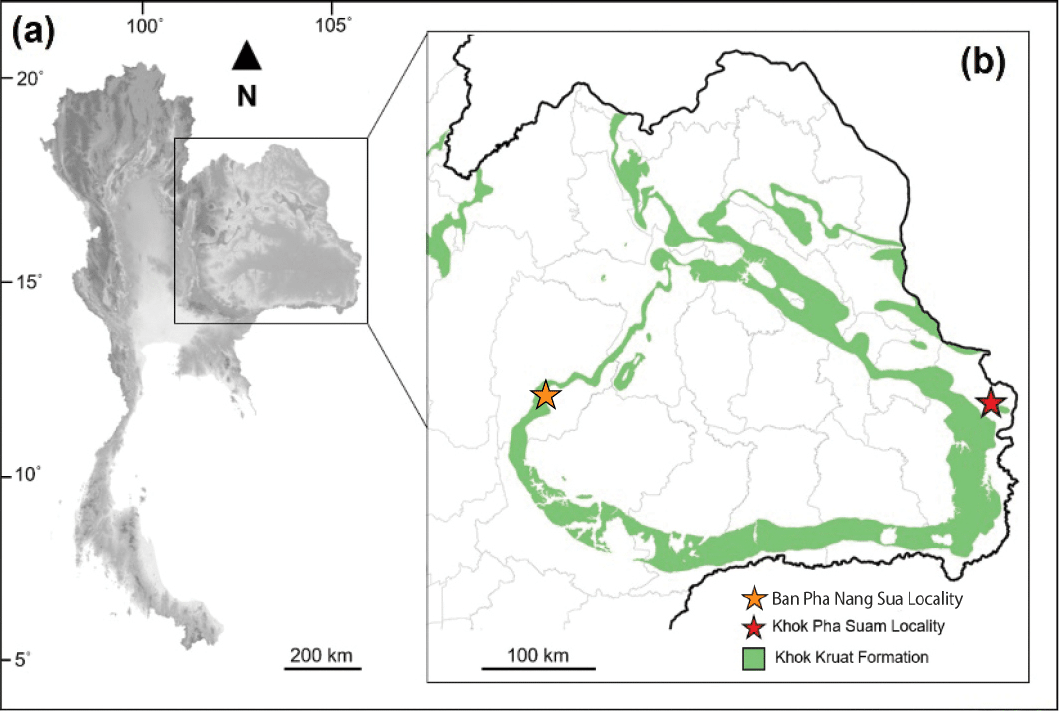

Today, the Sirindhorn Museum in Kalasin Province holds the holotype, cataloged as SM2025-1-546 to SM2025-1-556. It includes four dorsal (back) vertebrae, four sacral (hip) vertebrae, five dorsal ribs, and five sacral ribs. The limbs and hips add a right humerus (upper arm bone), a right ilium (main hip bone), and both pubes (lower hip bones). A mostly complete right femur (thigh bone) and indeterminate fragments complete the list. All of this material came from unit 1, a layer of reddish-brown calcareous siltstone about 1.5 meters (4.9 feet) thick.
With no duplicated elements, bones of matching size, and a close association, the describers concluded they belong to one individual. Earlier Khok Kruat sauropod finds consisted of isolated teeth and fragmentary bones of uncertain affinity. The team also posted 3D surface scans of the Nagatitan bones on MorphoSource. No additional specimens of Nagatitan have been confirmed outside this locality.
Nagatitan Size and Description
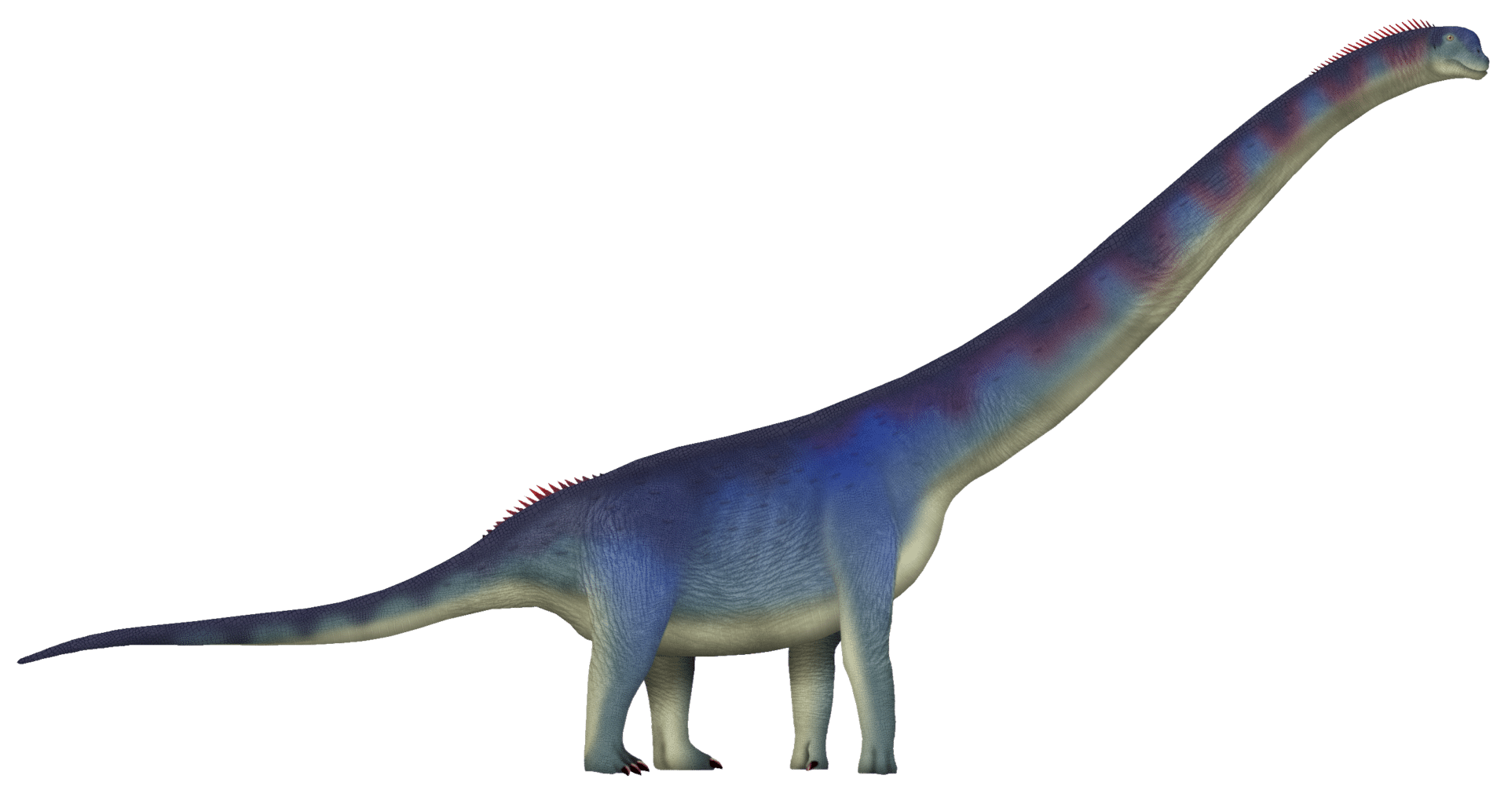
Only the back, hips, and two limb bones survive, so any portrait of Nagatitan leans on better-known relatives.
Short description of Nagatitan
Its dorsal centra—the spool-shaped bodies of the back vertebrae—were short from front to back and opisthocoelous, meaning convex in front and concave behind. Inside, the bone was camellate, a honeycomb of many small internal chambers. In the middle of the back, the neural spines that rise above each vertebra split into two prongs.
Turning to the limbs, the complete right humerus is gracile and measures 1,780 millimeters (about 5.8 feet). The incomplete femur, by contrast, probably measured 1.9 to 2 meters (about 6.2 to 6.6 feet), its describers estimate. The crushed pubes measure 1,194 millimeters on the right and 1,042 millimeters on the left.
Like other sauropods, Nagatitan probably walked on all fours, and the team used a mass equation built for quadrupeds. Skin impressions or soft tissue are not preserved, so any discussion of its outward appearance is speculative.

Size and Weight of Type Species
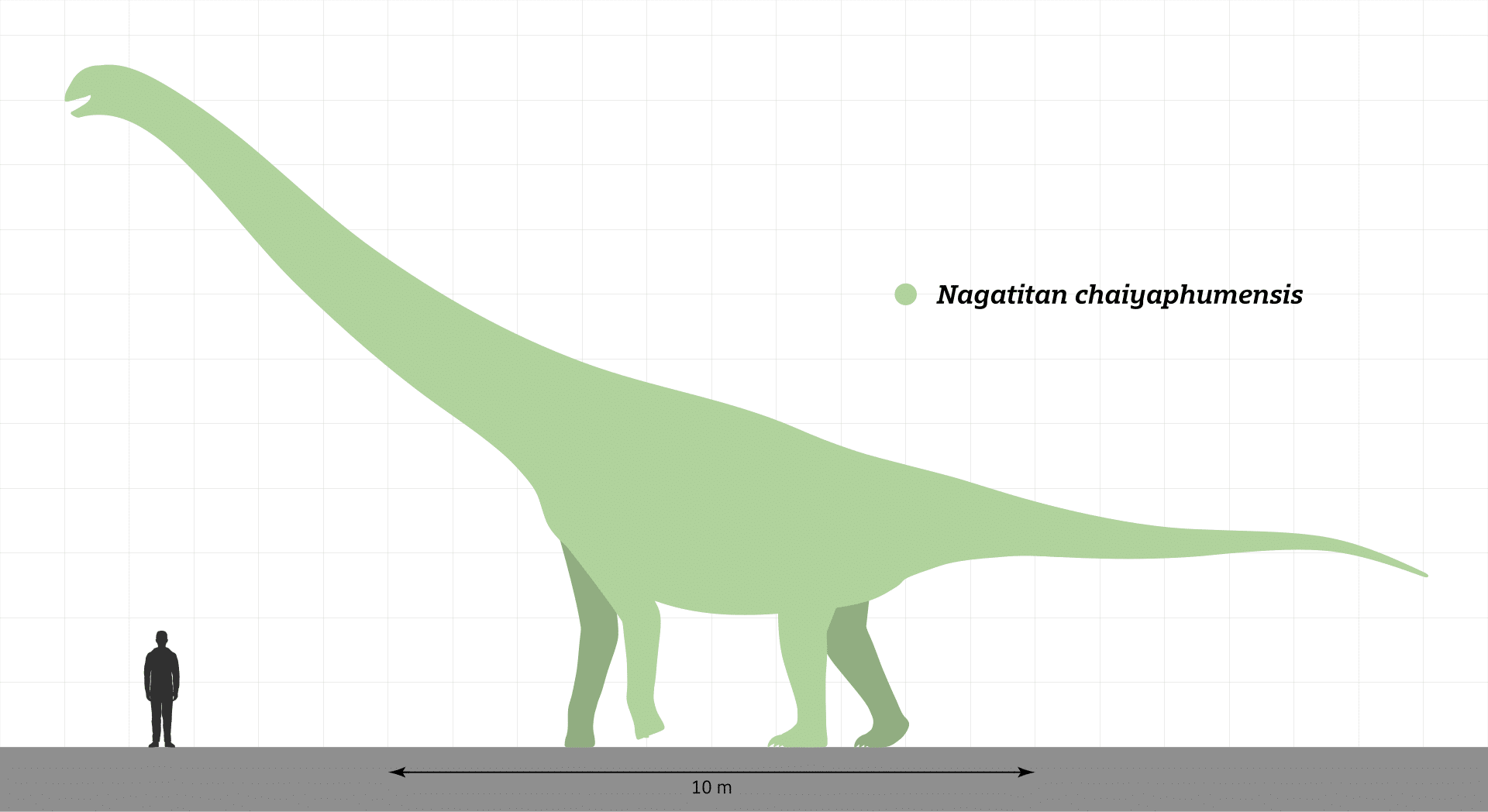
Sethapanichsakul and colleagues estimated its mass at 25 to 28 tonnes (about 27.6 to 30.9 tons), centered on approximately 27 tonnes. They fed the humerus and femur shaft circumferences—584 and 682 millimeters—into a standard quadruped equation. Campione and Evans published it in 2012, and Benson and colleagues applied it in 2014. The team measured both circumferences directly, which avoids the extra error of estimating them.
Length is more indirect still—the team derived it from mass with Seebacher’s equation, reaching about 89 feet (27 meters). No study has yet published a hip height.
In their tally, the holotype of its Thai relative Phuwiangosaurus reached only about 12 tonnes and 15 meters (49 feet). That individual, however, was likely not fully grown. Tangvayosaurus from Laos came closer, at about 23 tonnes and 24 meters (79 feet). Still, Nagatitan is not the largest titanosauriform from Asia. In its describers’ own table, China’s Ruyangosaurus tops 50 tonnes and Zhuchengtitan reaches about 34. They liken the mass of Nagatitan to those of Gobititan, Opisthocoelicaudia and Fusuisaurus, though Fusuisaurus edges ahead at about 31 tonnes. It also trails giants such as Argentinosaurus and Patagotitan, which its describers list at more than 40 tonnes.
The Dinosaur in Detail
What sets this dinosaur apart is the hyposphene, a bony projection at the rear of a back vertebra. In the middle dorsals of Nagatitan it is triangular. Further back, it shrinks to a vertical ridge, which the describers read as a reduced hyposphene. They treat this shift as one of two autapomorphies, or traits unique to the genus. The other is a pair of triangular anterior aliform (wing-like) processes on the rear dorsal neural spines. Researchers have reported such front-facing processes in no other sauropod.
The humerus is unusual too—its upper outer corner is rounded, whereas nearly all other somphospondylans show a squared corner. Unlike in Phuwiangosaurus, the split spines of Nagatitan continue into the middle of the back—one of 16 listed differences between the two.
However, its placement shifts with the way characters are weighted. The team scored Nagatitan in a matrix of 153 taxa and 570 characters, then ran both equal and extended implied weighting. Under equal weighting, it emerged as the sister taxon of Europatitan from Spain. Under implied weighting, Europatitan instead fell outside the group, in a polytomy (unresolved cluster) with Sauroposeidon and “Paluxysaurus.” Given that split and several anatomical differences, the authors consider a European euhelopodid premature.
Both analyses keep Nagatitan inside Euhelopodidae, and three shared traits support that placement. Even so, it does not form an endemic subclade with Phuwiangosaurus and Tangvayosaurus, its Southeast Asian relatives. Only Tangvayosaurus was roughly its contemporary, whereas Phuwiangosaurus is older. In the equal-weighting tree, Bremer support values—a measure of how robust each grouping is—are only 1 or 2 for every euhelopodid. Taken together, Nagatitan has a consistent home in its family, but its exact branch remains open.
Interesting Points about Nagatitan
- In a UCL press release, lead author Sethapanichsakul called it Thailand’s “last titan,” since it comes from the country’s youngest dinosaur-bearing rock formation.
- According to the same press release, a life-size reconstruction of Nagatitan stands at the Thainosaur Museum at Asiatique in Bangkok.
- Thai university and government news outlets describe Nagatitan as the 14th new dinosaur species identified in Thailand.
- The research ran under “Project Thaitan,” led by Sita Manitkoon with support from the National Geographic Society.
- Before the Aptian, its describers note, Asian titanosauriform species averaged about 9 tonnes, and only Daxiatitan topped 20 tonnes.
Contemporary Dinosaurs
Prowling elsewhere in the Khok Kruat Formation was Siamraptor suwati, an allosauroid theropod. Its describers regard it as a basal member of Carcharodontosauria—the lineage of “shark-toothed” predators. Its fossils come from Ban Saphan Hin in Nakhon Ratchasima Province, in rocks generally considered Aptian. Because the two sites cannot be matched level for level, nothing shows that it ever crossed paths with Nagatitan.
Adding further diversity was Sirindhorna khoratensis, one of the most basal hadrosauroids known. It also comes from Ban Saphan Hin, and its describers call it the best-preserved iguanodontian ornithopod in Southeast Asia. Like Siamraptor, it shared the formation and its broad time span with Nagatitan, though not the same locality.
A far more modest find is Ratchasimasaurus suranareae, a hadrosauroid known only from one toothless left dentary (lower jaw bone). That jaw, 19.81 centimeters (7.8 inches) long, comes from Ban Pong Malaengwan, also in Nakhon Ratchasima. Researchers cannot tell whether its owner was mature, or where it sits relative to the Nagatitan bone bed.
From the same province as Nagatitan came Psittacosaurus sattayaraki, a small early ceratopsian. Its fossils, a dentary and part of a maxilla (upper jaw bone), come from Ban Dong Bang Noi, the southernmost record of its genus. Sereno in 2000, and later You and Dodson in 2004, questioned its validity. However, Buffetaut and colleagues defended it in 2007, and a 2023 review treats it as valid.
Nagatitan in its Natural Habitat
Imagine a warm, semi-arid landscape crossed by meandering rivers, with floodplains and channels recorded at other sites in the formation. Caliche pebble conglomerates—gravels built from hardened soil nodules—suggest an arid to semi-arid subtropical climate. At least parts of Aptian to Albian Southeast Asia may have been savanna- or shrubland-like. Two units above the sauropod lay bivalves, allosauroid and spinosaurid teeth, and teeth of the freshwater shark Heteroptychodus steinmanni. A crocodyliform tooth also turned up at the locality, though the describers do not give its layer. Across the formation, fish, turtles, crocodyliforms, and pterosaurs shared the scene with unnamed ornithomimosaurian, spinosaurid, and sauropod dinosaurs.
Like other sauropods, Nagatitan was presumably a herbivore, although no teeth have turned up. Its describers count sauropods among the “large primary consumers” that savanna-like arid environments favor. In their view, rising global temperatures from the Aptian to the Cenomanian fed a trend toward such environments. They also suggest that this warming, along with expanded habitat, helped Asian titanosauriforms grow larger.
While there is no direct evidence of whether Nagatitan lived alone or in herds, its remains represent just one individual. Nor was its world isolated, since the Khok Kruat fauna resembles those of China’s Xinlong and Laos’s Grès supérieurs formations. A 2026 chronology study also links this interval to a shift toward ornithischian-dominated communities. Against that backdrop, Nagatitan stands out as a rare sauropod giant late in Thailand’s dinosaur record, at least on current evidence.

Frequently Asked Questions
It combines Naga, a serpent-like creature of Asian cultures, with titan, a giant of Greek mythology.
It lived in the Aptian to Albian stages of the Early Cretaceous, roughly 120 to 100 million years ago.
Its describers estimate a weight of about 27.6 to 30.9 tons and a length of about 89 feet, both indirect figures.
It was a somphospondylan titanosauriform sauropod, which both of its describers’ analyses place in the clade Euhelopodidae.
Its bones come from the Ban Pha Nang Sua locality of the Khok Kruat Formation, in Chaiyaphum Province, northeastern Thailand.
Its back vertebrae show two distinct hyposphene shapes, and its describers rank it as Southeast Asia’s largest known taxon.
Sources
The information in this article is based on various sources, drawing on scientific research, fossil evidence, and expert analysis. The aim is to provide a comprehensive and accurate overview of Nagatitan. However, please be aware that our understanding of dinosaurs and their world is constantly evolving as new discoveries are made.
- https://doi.org/10.1038/s41598-026-47482-x
- https://www.nature.com/articles/s41598-026-47482-x
- https://www.morphosource.org/projects/000796643
- https://doi.org/10.1038/s43247-026-04096-5
- https://doi.org/10.1186/1741-7007-10-60
- https://doi.org/10.3897/fr.26.e93456
- https://doi.org/10.3897/fr.25.83081
- https://journals.plos.org/plosone/article?id=10.1371/journal.pone.0222489
- https://journals.plos.org/plosone/article?id=10.1371/journal.pone.0145904
- https://www.eurekalert.org/news-releases/1127693
- https://inter.msu.ac.th/msu-researcher-joins-discovery-of-nagatitan-chaiyaphumensis-thailands-14th-dinosaur/
- https://www.thailand.go.th/issue-focus-detail/thai-british-team-discovers-thailands-largest-dinosaur-species-nagatitan-chaiyaphumensis
This article was last fact checked: TheDinosaurs Team, 06-11-2026
Featured Image Credit: Connor Ashbridge, CC BY 4.0, via Wikimedia Commons
