
In Morocco’s Middle Atlas Mountains, the mudstones of the El Mers III Formation have yielded an armored dinosaur unlike anything else on record. Named Spicomellus afer in 2021, this herbivore lived during the Middle Jurassic—roughly 168 to 165 million years ago by the latest estimate. Its describers suggested it was the earliest-known ankylosaur and the first to be named from Africa. Until then, the group was known almost entirely from the former northern continents of Laurasia.
Its story began with a fossil dealer in Cambridge rather than a field crew. In 2019, paleontologist Susannah Maidment acquired a spiked rib that had reached the commercial trade from near Boulemane. She and eight colleagues named the species from that rib alone, and some doubted it was an ankylosaur at all. Then a 2023 dig produced a partial skeleton. Its 2025 description confirmed the animal’s place among the ankylosaurs and revealed neck spikes approaching 1 meter long. Few fossils show so clearly how one bone can reshape the early history of a group.
Spicomellus Key Facts
| Keyword | Fact |
|---|---|
| Pronunciation | SPY-co-MEL-lus (Natural History Museum) |
| Meaning of name | Spike Collar |
| Group | Ankylosauria |
| Type Species | Spicomellus afer |
| Diet | Herbivore |
| When it Lived | 168.2 to 165.3 MYA (revised from 168.3 to 163.5 MYA) |
| Period | Jurassic |
| Epoch | Middle Jurassic (Bathonian stage) |
| Length | About 9.8 to 13.1 feet (3 to 4 meters), Natural History Museum estimate |
| Height | Not specified |
| Weight | Not specified |
| Mobility | Moved on all four legs (quadrupedal), according to the Natural History Museum |
| First Discovery | Year not specified (holotype acquired from a fossil dealer in 2019), with a partial skeleton excavated in 2023 |
| Described by | 2021 by S.C.R. Maidment, S.J. Strachan, D. Ouarhache, T.M. Scheyer, E.E. Brown, V. Fernandez, Z. Johanson, T.J. Raven, and P.M. Barrett |
| Holotype | NHMUK PV R37412 |
| Location of first find | Boulahfa, south of Boulemane, El Mers III Formation, Middle Atlas Mountains, Fez-Meknes, Morocco |
Spicomellus Origins, Taxonomy and Timeline
The name Spicomellus joins two Latin words. Spicus means “spike,” while mellus is “a collar with spikes.” According to the Natural History Museum, London, this ancient collar protected dogs from wild animals. The species name afer is Latin for “an inhabitant of Africa.” Together, the name describes a spiked collar from Africa—fitting for an animal later found to wear one.
Spicomellus belongs to Thyreophora, the armored ornithischian dinosaurs, and within it to Ankylosauria. In 2021, Maidment and colleagues based that referral on two clues. First, its rib is “T”-shaped in cross-section, a trait of Eurypoda—the group uniting stegosaurs such as Stegosaurus with ankylosaurs. Second, its armor preserves plywood-like layers of fibers, which they treated as an ankylosaur hallmark. Later finds have complicated that criterion, but the far more complete 2025 skeleton confirmed it as an ankylosaur. They also ruled out fish, turtles, titanosaurs, and Triassic reptiles. Spicomellus afer is the type and only known species.
As originally described, the holotype came from Upper Bathonian to Callovian rocks, roughly 168.3 to 163.5 million years ago. In 2025, however, Maidment and colleagues narrowed this to the Bathonian, citing new biostratigraphic work—dating rocks by their fossils. Their time-calibrated family tree accordingly used a range of 168.2 to 165.3 million years ago. Either way, Spicomellus lived in the middle of the Jurassic period, and its describers regard it as the oldest known ankylosaur. Even so, isolated teeth and armor of similar or disputed older age have been attributed to the group.
Discovery & Fossil Evidence
The 2021 paper places the holotype at Boulahfa, south of Boulemane. Because it had passed through the fossil trade, however, its exact origins were uncertain, and tracing them took detective work. At first, the researchers thought it might belong to a stegosaur, and they even wondered whether it was a fake. CT scanning (a 3D X-ray method) then confirmed that the spines and rib formed one fused piece of bone. Meanwhile, the team moved the site from “probably El Mers II” in 2020 to the slightly higher El Mers III Formation in 2021.
The Natural History Museum in London houses the holotype, NHMUK PV R37412. It is a slightly curved dorsal (back) rib fused to a flat osteoderm—a bone that forms within the skin. Four long, conical spines rise from it. The longest preserved spine measures about 3.8 inches (97 millimeters), and even its tip is missing.
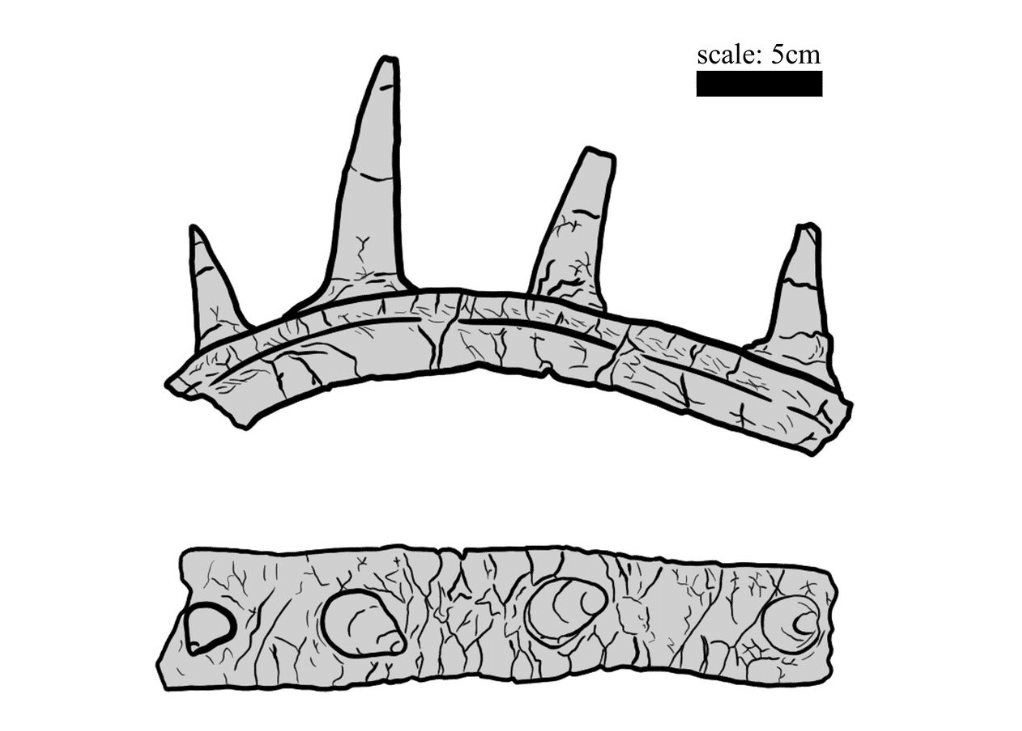

In 2023, a British, American, and Moroccan expedition to the region uncovered far more. The partial skeleton, USMBA 5 to 84, includes a quadrate (a jaw-joint bone), vertebrae, ribs, shoulder bones, and partial hips. It also preserves a cervical half-ring—a bony collar of neck armor—and parts of a sacral shield over the hips. Unlike the holotype, it stays in Morocco, prepared and stored at the Dhar El Mahraz Faculty of Sciences in Fez. Apart from the quadrate, two possible skull fragments, and two foot bones (metatarsals), it includes no skull or limb material.
Spicomellus Size and Description
Most of what survives of Spicomellus is armor and torso, so scientists must piece together its outline with care.
Short description of Spicomellus
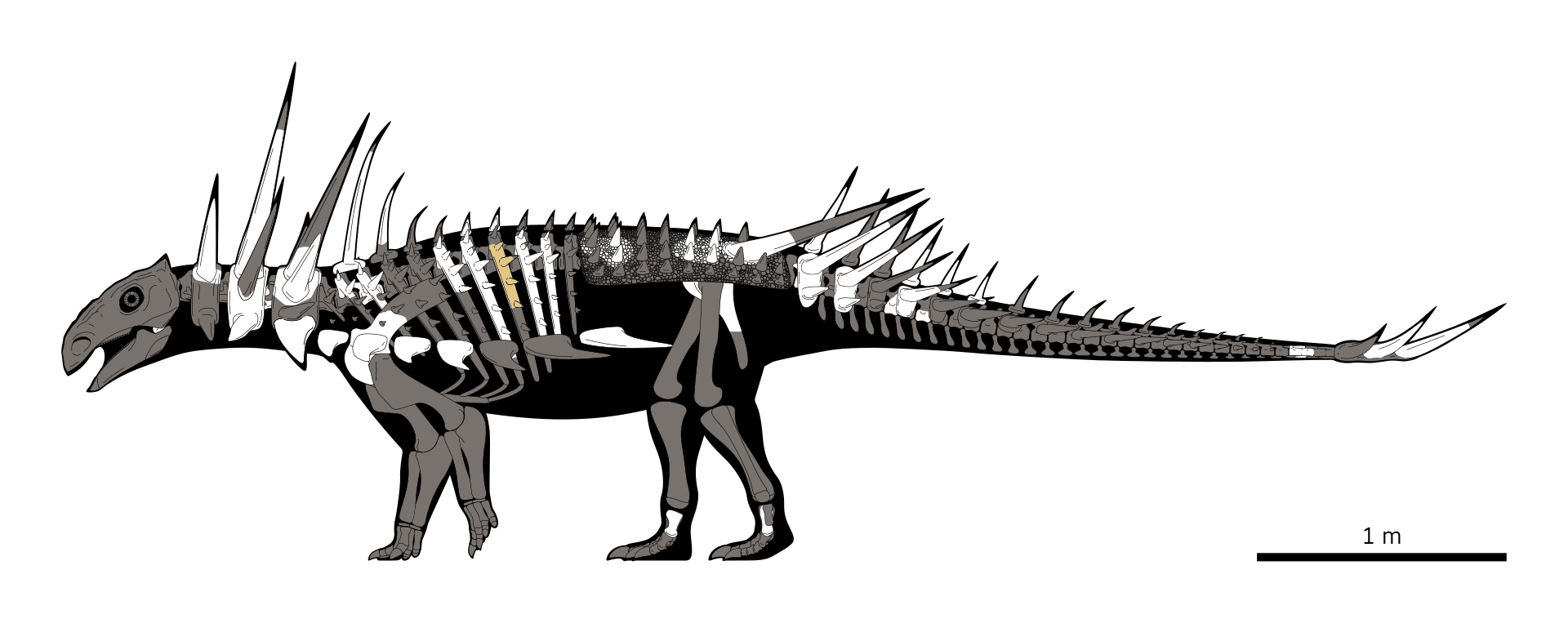
The head remains a mystery beyond a left quadrate about 8.3 inches (21 centimeters) long and two fragments that may come from the skull. Farther back, the neck carried the half-ring, with a horseshoe-shaped base, five fused spikes, and two small plates. At least two of those spikes approached 1 meter in length. Along the body, six recovered ribs carry spiked armor fused to the bone, and every one is T-shaped in cross-section.
Over the hips lay a sacral shield. One fragment measures about 15 by 10 inches (37 by 25 centimeters) and carries five short spikes. Slender spines up to about 20 inches (52 centimeters) long, flat blade-like spines, and spiked plates added to the armor. Researchers think the neck spikes carried a keratin sheath—the material of fingernails—which would have made them even longer in life. The limbs survive only as two foot bones, yet the Natural History Museum says it walked on all fours.

Size and Weight of Type Species
The available scientific descriptions give no body length for Spicomellus. Instead, the Natural History Museum estimates 9.8 to 13.1 feet (3 to 4 meters), based on comparisons with other ankylosaurs. The museum likens that to a small car. Neither paper gives a hip height or body mass either.
The largest measured element is the big right-hand spike of the neck collar, at about 34.3 inches (87 centimeters). Even that is an underestimate, because a few centimeters of its tip are missing. The ribs survive at lengths of 10 to 25 inches (26 to 63 centimeters). Meanwhile, the longest spike on each rib measures 2.4 to 5.5 inches (6 to 14 centimeters).
Without a skull or long leg bones, any figure for overall size remains provisional. Its armor, by contrast, survives in remarkable detail.
The Dinosaur in Detail
What sets this dinosaur apart is armor fused directly onto its ribs. In 2021, Maidment and colleagues called this “an unprecedented morphology among extinct and extant vertebrates.” Under the microscope, a holotype spine shows an outer layer of woven bone about 2.5 millimeters thick, plus at least nine growth lines. Its osteoderm contains fiber bundles 500 to 600 micrometers thick, laid in layers that cross at about 90 degrees like plywood. The describers suggested that such fibers reinforced the skin, adding strength and tear resistance.
The 2025 description revealed an even stranger feature in the neck collar. This half-ring measures about 13 inches (34 centimeters) around its inner surface. Maidment has said it would have been one of several collars around the neck. However, much of the armor placement in the published life reconstruction is conjectural, so any full-body image involves guesswork.
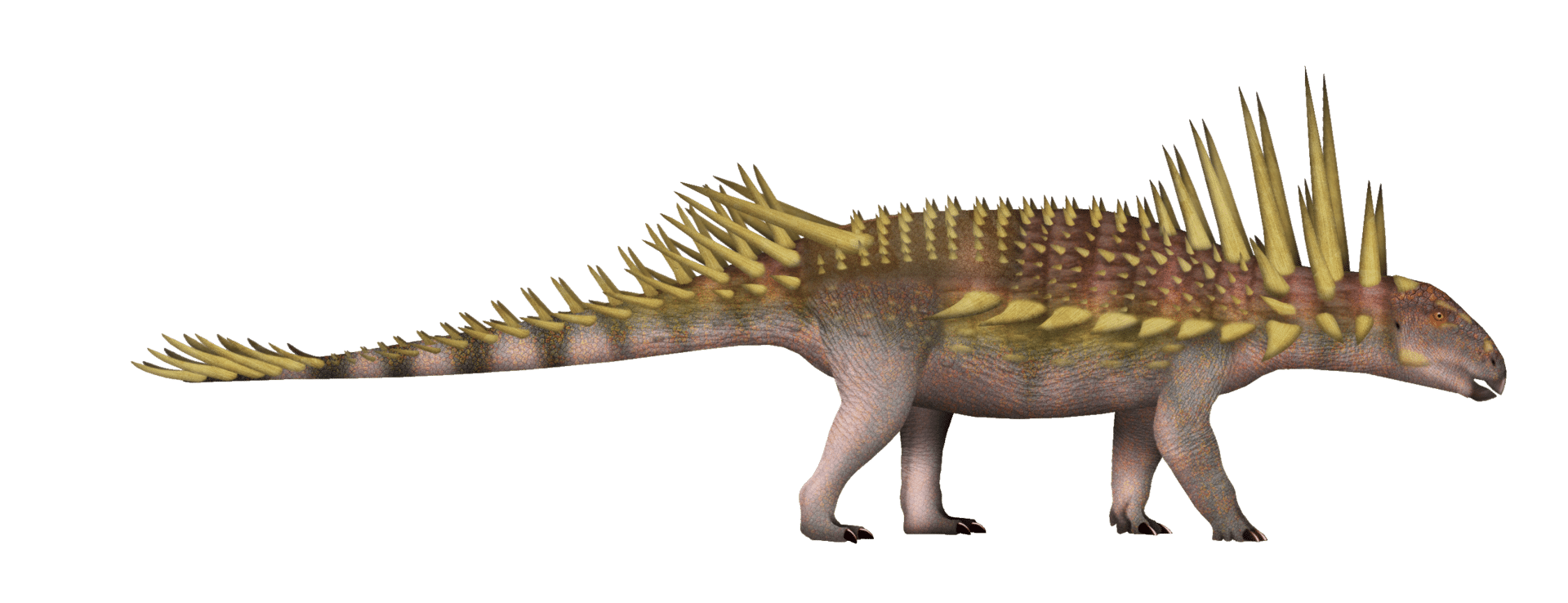

Two fused vertebrae wedged against a hip bone appear to be handle vertebrae—stiffened tail bones. According to the 2025 study, they indicate a tail weapon, a feature previously thought to have evolved only in the Early Cretaceous. The University of Birmingham put it more than 30 million years before any other ankylosaur’s. Still, no one has found the end of the tail, so a club remains a suggestion.
Its place in the family tree is also unsettled. With all traits weighted equally, the 2025 analysis grouped it with Shamosaurus, Gobisaurus, Chuanqilong, and Ahshislepelta. That clade—a group sharing one common ancestor—sat in an unresolved split with Ankylosauridae and Nodosauridae. Under a different weighting, it emerged as an early-diverging ankylosaurid, though the authors called the result weakly supported. Taken together, these findings paint a picture of an early ankylosaur whose armor was more extravagant than that of its Late Cretaceous relatives.
Interesting Points about Spicomellus
- Researchers coined the name “spike collar” in 2021 from a single rib, two years before a dig uncovered its spiked neck collar.
- Before CT scans showed that the spines and rib formed one fused piece, researchers wondered whether the holotype could be a fake.
- The largest preserved neck spike measures about 34 inches (87 centimeters), yet part of its tip is missing and it was probably longer in life.
- A patch of roughened bone, recorded as a pathology, marks the centrum (main body) of a vertebra from the front of its back.
- The 2021 press release on its discovery said ankylosaurs and stegosaurs coexisted for over 20 million years, questioning the idea that ankylosaurs outcompeted stegosaurs.
Contemporary Dinosaurs
Sharing the Boulahfa floodplain was Adratiklit boulahfa, described in 2020 as North Africa’s first stegosaur. Its holotype is a single dorsal vertebra, NHMUK PV R37366, from the same locality south of Boulemane. The 2020 description tentatively placed the site in the El Mers II Formation. Later studies, however, put both animals in the Bathonian El Mers III. A 2025 paper calls it one of the oldest stegosaurs, although no interaction between the two is recorded.
Adding further diversity was Thyreosaurus atlasicus, a stegosaur named in 2024 with thick, probably recumbent osteoderms—armor lying flat against the body. Its partial skeleton, HIIUC BN00, came from El Mers III rocks at Boulahfa North, which its describers dated to the Bathonian and possibly Callovian. They estimated a body length of about 19.7 feet (6 meters) and found it close to Dacentrurus. Adratiklit comes from the same rock levels, yet no source records how either stegosaur interacted with Spicomellus.
Spicomellus thus shared its landscape with at least two stegosaurs—a pairing that fits the 2021 press release’s view that the two groups long coexisted.
Spicomellus in its Natural Habitat
The world Spicomellus roamed was a Bathonian floodplain in what is now the Middle Atlas. The formation’s variegated green and red mudstones are, in one study’s words, “extremely fossiliferous.” Its gray-green marls hold fossil wood, dinosaur bones, and pyrite nodules, pointing to a continental setting with reducing (oxygen-poor) conditions. At the bone site, green siltstone rich in charcoal lies just below a red fossil soil. The Natural History Museum describes the area as part of a vast network of wetlands.
While there is no direct evidence of what Spicomellus ate, it was likely a plant-eater like other thyreophorans. No teeth or gut contents appear in its published descriptions, so its diet rests on its place in the group. According to the museum, the wetlands would have offered plenty of plants.
How it moved is just as uncertain. Maidment admitted that “we have very little idea about how this dinosaur would have moved at all.” She added that its armor “would have been very energetically expensive” and probably limited its movement. In 2025, she and her colleagues suggested that the ornate armor may have served for display as well as defense. Maidment has also speculated that the armor evolved first for defense before evolution co-opted it for attracting mates. The same formation has also yielded sauropod footprints and the femur of an unnamed cerapodan, described in 2025 as the world’s oldest.
Frequently Asked Questions
It comes from Latin words for “spike” and “a collar with spikes,” while the species name afer means “an inhabitant of Africa.”
It lived in the Middle Jurassic, about 168.2 to 165.3 million years ago, revised from a first estimate of 168.3 to 163.5 million years ago.
The available scientific descriptions give no size estimate, but the Natural History Museum suggests 9.8 to 13.1 feet (3 to 4 meters) long.
It was an ankylosaur, a plant-eating armored dinosaur, and its describers considered it the earliest-known member of that group.
Its fossils come from Boulahfa, south of Boulemane, in the El Mers III Formation of Morocco’s Middle Atlas Mountains.
It had spiked bony armor fused directly to its ribs and a neck collar with spikes approaching 1 meter long.
Sources
The information in this article is based on various sources, drawing on scientific research, fossil evidence, and expert analysis. The aim is to provide a comprehensive and accurate overview of Spicomellus. However, please be aware that our understanding of dinosaurs and their world is constantly evolving as new discoveries are made.
- https://doi.org/10.1038/s41559-021-01553-6
- https://treatment.plazi.org/id/03E0004D1F78FFE8D66EF9E1FD9DFAF3
- https://doi.org/10.1038/s41586-025-09453-6
- https://static-content.springer.com/esm/art%3A10.1038%2Fs41586-025-09453-6/MediaObjects/41586_2025_9453_MOESM1_ESM.pdf
- https://doi.org/10.1016/j.gr.2019.07.007
- https://doi.org/10.1098/rsos.241624
- https://doi.org/10.1016/j.gr.2024.03.009
- https://doi.org/10.1080/02724634.2024.2323646
- https://www.nhm.ac.uk/discover/dino-directory/spicomellus.html
- https://paleobiodb.org/classic/basicTaxonInfo?taxon_no=443991
- https://www.birmingham.ac.uk/news-archive/2021/bizarre-armoured-spikes-belong-to-oldest-ankylosaur-ever-discovered
- https://www.nhm.ac.uk/discover/news/2025/august/bizarre-armoured-dinosaur-spicomellus-afer-rewrites-ankylosaur-evolution.html
- https://www.birmingham.ac.uk/news/2025/bizarre-armoured-dinosaur-spicomellus-afer-had-spikes-sticking-out-from-its-neck-fossils-show
This article was last fact checked: TheDinosaurs Team, 31-10-2026
Featured Image Credit: Connor Ashbridge, CC BY 4.0, via Wikimedia Commons
