
In Liaoning Province, northeastern China, the ancient lake deposits of the Yixian Formation have produced a feathered predator of startling size. Named Yutyrannus huali in 2012, this basal tyrannosauroid—an early member of the group that later included Tyrannosaurus rex—lived in the Early Cretaceous, around 125 million years ago. Its describers estimated the adult at about 29.5 feet (9 meters) long. The fossils also preserve long, filament-like feathers—direct evidence, in the describers’ words, of extensively feathered gigantic dinosaurs.
The fossils reached science by an unusual route. A fossil dealer supplied three nearly complete skeletons and claimed that all of them came from one quarry. In 2012, paleontologist Xu Xing and eight colleagues described them in Nature, recognizing two distinct growth stages among the three. Although the exact quarry remains unknown, the skeletons offer a rare glimpse of what a large early tyrannosauroid looked like in life—feathers included.
Yutyrannus Key Facts
| Keyword | Fact |
|---|---|
| Pronunciation | yoo-ti-RAN-us |
| Meaning of name | Beautiful Feathered Tyrant |
| Group | Theropoda (basal Tyrannosauroidea) |
| Type Species | Yutyrannus huali |
| Diet | Carnivore |
| When it Lived | Around 125 MYA |
| Period | Cretaceous |
| Epoch | Early Cretaceous (Barremian stage) |
| Length | About 29.5 feet (9 meters), adult |
| Height | About 8 feet (2.5 meters), adult (co-author Corwin Sullivan’s estimate) |
| Weight | About 3,117 pounds (1,414 kilograms), adult (describers’ estimate) |
| Mobility | Moved on two legs (bipedal) |
| First Discovery | Year not specified (specimens acquired through a fossil dealer) |
| Described by | 2012 by X. Xu, K. Wang, K. Zhang, Q. Ma, L. Xing, C. Sullivan, D. Hu, S. Cheng, and S. Wang |
| Holotype | Not specified |
| Location of first find | Batuyingzi, Beipiao, Yixian Formation, Liaoning Province, China (exact quarry unknown) |
Yutyrannus Origins, Taxonomy and Timeline
The name Yutyrannus huali blends Mandarin and Latin. According to the Australian Museum, “yu” is Mandarin for “feather,” while the Latin root means “tyrant”—a nod to its place among the tyrannosauroids. The species name huali, Mandarin for “beautiful,” refers to the beauty of the animal’s plumage. Together, the name translates as “beautiful feathered tyrant”—the rendering given in the describing institute’s 2012 announcement.
Xu and colleagues classified Yutyrannus as a basal tyrannosauroid, an early-branching member of Tyrannosauroidea. They noted that some features, particularly of the skull, resemble those of derived tyrannosauroids. Even so, it keeps a three-fingered manus (hand) and a typical theropod pes (foot). Yutyrannus huali is the type and only known species.
The original description placed the fossils in the Lower Cretaceous Yixian Formation. The Paleobiology Database bins the locality broadly, from the late Barremian to the early Aptian stages. In 2021, however, Zhong and colleagues dated the formation in the Jin-Yang basin with high-precision uranium-lead methods. Their results put it between roughly 125.8 and 124.1 million years ago—a span of only about 1.6 million years. On the current international timescale, that whole window falls within the Barremian stage, in the middle of the Early Cretaceous. Still, its unknown layer prevents a narrower date.
Discovery & Fossil Evidence
The skeletons did not come from a recorded excavation. The dealer who supplied them could not name the quarry, so no collector or date is on record. Xu and colleagues gave the locality as Batuyingzi, Beipiao, while the Paleobiology Database notes that the exact quarry is unknown. By the time scientists saw them, the skeletons had been cut into pieces “about the size of bath mats,” as the Australian Museum puts it.
Nature’s open figure legends catalog the three skeletons as ZCDM V5000, ZCDM V5001, and ELDM V1001. The first two share a single slab and belong to the Zhucheng Dinosaur Museum in Shandong. The third belongs to the Erlianhaote Dinosaur Museum in Inner Mongolia. Between them, the slab skeletons preserve nearly every region of the body, from skull and mandible (lower jaw) to gastralia (belly ribs), hips, and feet. According to the Australian Museum, the Institute of Vertebrate Paleontology and Paleoanthropology in Beijing prepared the fossils under Xu’s guidance.
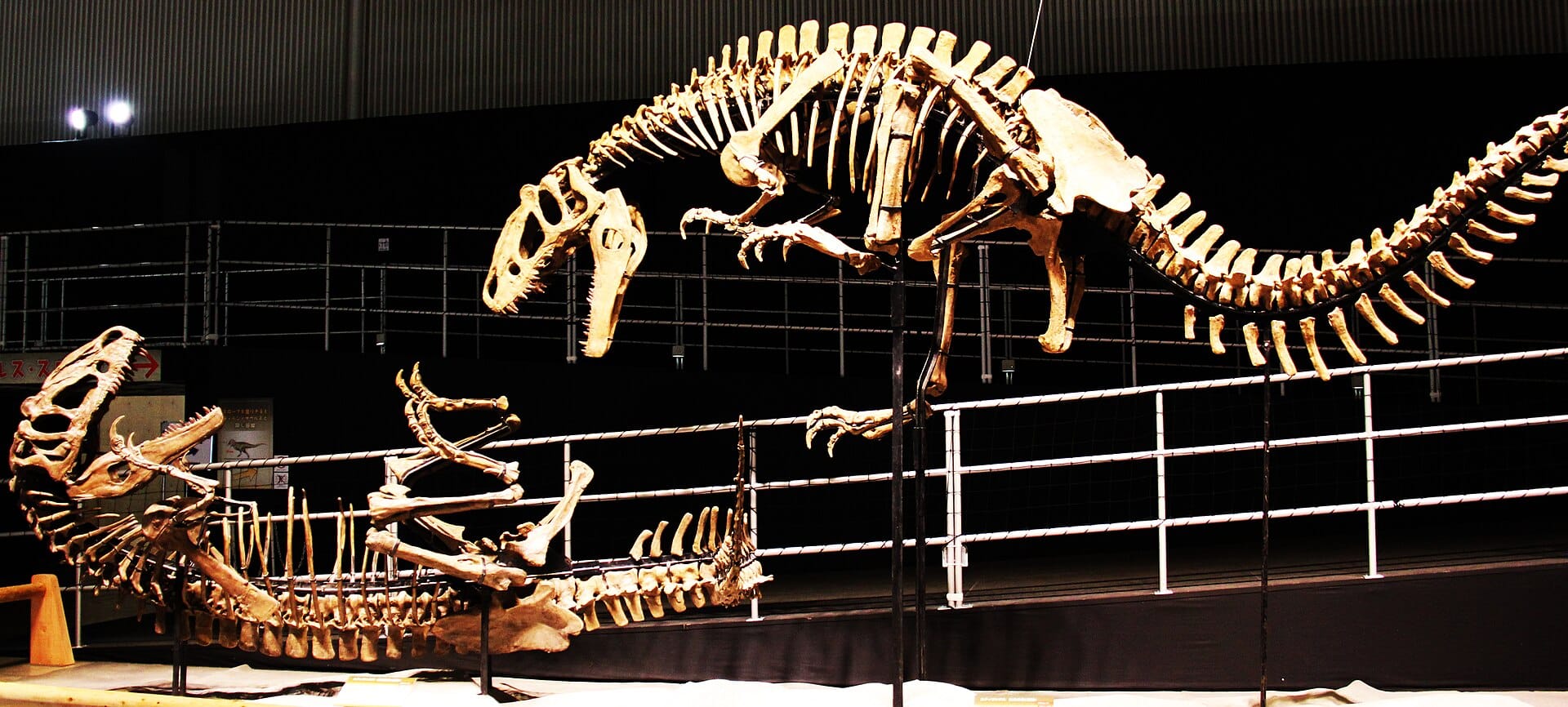

The three skeletons represent two distinct ontogenetic stages—phases of growth from young to adult. The Australian Museum describes the holotype as the largest specimen, a nearly complete adult skeleton with its skull. It lists the other two as a subadult and a juvenile, the latter about eight years younger than the holotype. In contrast, press accounts described one adult and two juveniles. A sauropod skeleton reportedly came from the same quarry. It may be the animal later named Ruixinia, although open sources do not confirm this. Either way, its link to the tyrannosauroids remains unproven.
Yutyrannus Size and Description
Yutyrannus combined a crested skull with long arms and a coat of filaments.
Short description of Yutyrannus
A high crest ran along the midline of the snout. The Australian Museum describes it as formed by the nasals and premaxillae—the bones of the upper snout—and covered in large pneumatic recesses (air pockets). In 2016, Brusatte and Carr noted a huge external naris (nostril opening) and a skull shallower and less robust than in T. rex and its kin. Below the eye sat a large, thickened flange on the jugal (cheekbone), a condition more common in derived tyrannosaurids.
The animal walked on two legs, and its large, proportionally long arms ended in three fingers—unlike the withered, two-fingered forearm of T. rex. In contrast, its lower legs and feet were proportionally shorter than in tyrannosaurids. In 2016, Persons and Currie scored ZCDM V5001 at 6.3 on a cursorial (running-adaptation) index—one of the lowest among sampled tyrannosauroids.
Filamentous feathers survive on all three skeletons. Xu likened them to “the fuzzy down of a modern baby chick” rather than adult bird plumes. Nature’s figure legends place them on the tail of ZCDM V5000 and near the foot of ZCDM V5001. On ELDM V1001, they lie along the neck and a limb bone. According to the Australian Museum, the filaments reached up to 8 inches (20 centimeters) long. Although preservation is patchy, the describers argued that the fossils show an extensively feathered body in life.
Size and Weight of Type Species
Xu’s team estimated the adult at about 29.5 feet (9 meters) long and about 1,414 kilograms (3,117 pounds). In 2025, Morrison and colleagues cited the same 1,414-kilogram figure for Yutyrannus. As for height, co-author Corwin Sullivan told Science News in 2012 that the adult stood about 8 feet (2.5 meters) tall. Even so, its posture is unclear.
Ed Yong of National Geographic gave a length of at least 7 or 8 meters (about 23 to 26 feet). In 2016, Brusatte and Carr put Yutyrannus and its relative Sinotyrannus together at about 8 to 9 meters long and 1.5 tons. In 2025, Christophe Hendrickx described the pair as large-bodied animals of 9 to 10 meters. Taken together, published lengths run from about 23 to 33 feet.
The skull alone was roughly 35 inches (90 centimeters) long, by the Australian Museum’s estimate.
The Dinosaur in Detail
One of the most distinctive features of Yutyrannus is its mosaic of primitive and derived traits. Among the traits that set it apart, the Australian Museum lists the snout crest and a hollowed-out outer face of the postorbital (the bone behind the eye). Meanwhile, a morphometric analysis—comparing body measurements across specimens—suggested that it grew differently from tyrannosaurids.
Its exact position on the family tree remains disputed. The describers’ cladogram placed it among the basal tyrannosauroids. In 2016, however, Brusatte and Carr recovered Yutyrannus with Sinotyrannus in Proceratosauridae, an early-branching tyrannosauroid family, in both parsimony and Bayesian analyses. In their view, it was not on the direct line to T. rex and resembled an “overgrown” Guanlong rather than a proto-tyrannosaurid. Several later studies, as well as the Paleobiology Database, follow this placement.
However, Naish and Cau (2022) recovered Yutyrannus outside Proceratosauridae. In their tree, it is the sister taxon to a clade containing Eotyrannus and the remaining tyrannosauroids—closer, in other words, to the tyrannosaurid line.
Either way, its size tells an evolutionary story. The describers had already suggested that tyrannosauroids became giants separately in the Early and Late Cretaceous. In 2017, Bell and colleagues likewise concluded that large size evolved independently in Yutyrannus and in tyrannosaurids. They also argued that tyrannosauroids had lost extensive feather coverings by the Albian stage, before Tyrannosauridae arose, and that the loss was unrelated to climate. Taken together, Yutyrannus shows that tyrannosauroids reached great size more than once—and that at least one of those giants wore feathers.
Interesting Points about Yutyrannus
- Its name blends Mandarin and Latin, and huali refers to the beauty of the animal’s plumage.
- Before scientists could study them, the three skeletons had been cut into pieces about the size of bath mats.
- Xu compared its filamentous feathers to the fuzzy down of a baby chick rather than the plumes of adult birds.
- The Australian Museum calls it the largest known dinosaur with direct evidence of feathers, with filaments up to 8 inches (20 centimeters) long.
- Because the three turned up together, Xu suggested that they belonged to a pack, although at least one science writer considers that evidence weak.
Contemporary Dinosaurs
Because the exact layer that held Yutyrannus is unknown, the animals below share its formation rather than a single bed, except where noted.
Sharing the very same locality was Ruixinia zhangi, a titanosauriform sauropod about 39 feet (12 meters) long. The Paleobiology Database lists it in the same Batuyingzi collection as Yutyrannus, so it may be the sauropod reported from the quarry. No known fossil records an interaction between the two.
Another long-necked herbivore, Dongbeititan dongi, was the first sauropod described from the Jehol Group. It comes from the Jianshangou beds of the same Yixian Formation, near Beipiao. A large theropod tooth is embedded in one of its ribs. In 2012, Xing and colleagues suggested that the tooth may come from Yutyrannus, possibly through scavenging, and Johnson-Ransom and colleagues repeated the idea in 2026.
Far smaller was Dilong paradoxus, a gracile basal tyrannosauroid with three-fingered hands and filamentous “protofeathers.” Described in 2004, it also comes from the Yixian Formation of western Liaoning. It shows the same lineage on a much smaller scale, although nothing records contact between the two.
Adding further plumage to the scene was Beipiaosaurus, a feathered therizinosauroid theropod from the lower Yixian at Sihetun. The describers estimated Yutyrannus to be roughly 40 times heavier than this previous record holder among feathered dinosaurs. In 2025, Xu and Barrett paired the two by their proportionally broad monofilaments—single-strand feathers that probably served as ornaments.
Yutyrannus in its Natural Habitat
The world Yutyrannus roamed was surprisingly cool. In 2011, Amiot and colleagues used isotopes to estimate mean air temperatures of about 50°F (10°C) at midlatitudes near 42 degrees north. They also noted that temperate Xenoxylon wood was widespread and that crocodilians were absent. At Sihetun, meanwhile, a 2021 study by Zhang, Yin, and Wang suggested a mean annual temperature near 42.6°F (5.9°C), a high elevation, and frozen winters.
As a carnivore, Yutyrannus would have hunted or scavenged other animals. In 2024, Johnson-Ransom and colleagues found lower cranial stress than in most adult tyrannosaurids. They also found weaker jaw-muscle forces than in broad-skulled tyrannosaurines of similar size. If the tooth in the Dongbeititan rib is its own, it may have fed on sauropod carcasses.
Its feathers may have kept it warm, and the describers linked them to the cooler climate of its time. As co-author Corwin Sullivan noted, big animals usually face more of an overheating problem. Alternatively, the feathers may have served for display if they covered only some body regions. While there is no direct evidence of group living, Xu suggested that the three individuals hunted as a pack. In 2026, Boisvert and colleagues echoed Xu’s and Amiot’s teams. They noted that it grew large in a cold, remote ecosystem apparently without other giant predatory lineages.
Frequently Asked Questions
It means “beautiful feathered tyrant,” blending Mandarin yu (feather) and huali (beautiful) with Latin tyrannus (tyrant).
It lived in the Early Cretaceous, around 125 million years ago, during the Barremian stage.
Its describers estimated the adult at about 29.5 feet (9 meters) long and about 3,117 pounds (1,414 kilograms). Co-author Corwin Sullivan put its height at about 8 feet (2.5 meters).
It was a carnivorous theropod, originally described as a basal tyrannosauroid. Scientists still debate its exact family placement.
The fossils came from Batuyingzi, near Beipiao, in the Yixian Formation of Liaoning, China, though the exact quarry remains unknown.
Its describers argue that its long filamentous feathers are direct evidence that at least one gigantic dinosaur had an extensive feathery coat.
Sources
The information in this article is based on various sources, drawing on scientific research, fossil evidence, and expert analysis. The aim is to provide a comprehensive and accurate overview of Yutyrannus. However, please be aware that our understanding of dinosaurs and their world is constantly evolving as new discoveries are made.
- https://doi.org/10.1038/nature10906
- https://www.ebi.ac.uk/europepmc/webservices/rest/search?query=EXT_ID:22481363%20AND%20SRC:MED&resultType=core&format=json
- https://sciencedaily.com/releases/2012/04/120405133401.htm
- https://www.nationalgeographic.com/news/2012/4/120404-yutyrannus-feathers-dinosaur-science-nature-biggest/
- https://www.nationalgeographic.com/science/article/yutyrannus-a-giant-tyrannosaur-with-feathers
- https://www.sci.news/paleontology/article00248.html
- https://www.smithsonianmag.com/science-nature/scientists-discover-a-gigantic-feathered-tyrannosaur-172633563/
- https://australian.museum/learn/dinosaurs/fact-sheets/yutyrannus-huali/
- https://www.nature.com/articles/srep20252
- https://doi.org/10.7717/peerj.12727
- https://doi.org/10.1098/rsbl.2017.0092
- https://doi.org/10.1038/srep19828
- https://doi.org/10.1371/journal.pone.0198078
- https://doi.org/10.1098/rsos.242238
- https://doi.org/10.1098/rsbl.2024.0517
- https://doi.org/10.1111/joa.14242
- https://doi.org/10.1002/ar.25326
- https://doi.org/10.1002/ar.70126
- https://doi.org/10.1111/j.1502-3931.2012.00310.x
- https://doi.org/10.7717/peerj.21007
- https://doi.org/10.1093/nsr/nwab063
- https://doi.org/10.1073/pnas.1011369108
- https://doi.org/10.1029/2021GL094370
- https://doi.org/10.1002/gj.1045
- https://www.ebi.ac.uk/europepmc/webservices/rest/search?query=TITLE:%22Basal%20tyrannosauroids%20from%20China%22&resultType=core&format=json
- https://paleobiodb.org/data1.2/colls/single.json?id=126447&show=loc,strat,time,ref
- https://paleobiodb.org/data1.2/taxa/single.json?name=Yutyrannus&show=attr,class
- https://paleobiodb.org/data1.2/occs/list.json?base_name=Dongbeititan&show=loc,strat,coll,ref
- https://www.sci.news/paleontology/ruixinia-zhangi-11495.html
- https://www.nature.com/articles/nature10906/figures/1
- https://www.nature.com/articles/nature10906/figures/2
- https://www.nature.com/articles/nature10906/figures/3
- https://www.sciencenews.org/article/t-rex-has-another-fine-feathered-cousin
- https://doi.org/10.1093/nsr/nwaf131
- https://paleobiodb.org/data1.2/intervals/list.json?name=Barremian,Aptian
This article was last fact checked: TheDinosaurs Team, 28-10-2026
Featured Image Credit: Tomopteryx, CC BY-SA 4.0, via Wikimedia Commons
