
Along the Milk River in northwestern Montana, an isolated pocket of badlands called Landslide Butte exposes the upper Two Medicine Formation. These and other rocks have yielded Brontotholus harmoni, the first pachycephalosaurid—or dome-headed dinosaur—named from the formation. It lived during the Campanian stage of the Late Cretaceous, about 75 million years ago. Although only its thick skull roofs are known, their length ranks it third among North American dome-heads.
Its story began long before it had a name. In 1992, paleontologist John R. Horner and colleagues reported an unnamed pachycephalosaurid from the formation and treated it as an evolutionary halfway point between two famous relatives. A 2003 study then referred two of the same domes to another dome-head entirely. Finally, in October 2025, paleontologist D. Cary Woodruff and three colleagues gave the animal its own genus. Their analysis also rejected the old halfway-point idea—a reminder that even a handful of skull bones can reshape a family tree.
Brontotholus Key Facts
| Keyword | Fact |
|---|---|
| Pronunciation | Not specified |
| Meaning of name | Thunder Dome |
| Group | Pachycephalosauria |
| Type Species | Brontotholus harmoni |
| Diet | Not specified |
| When it Lived | Around 75 MYA |
| Period | Cretaceous |
| Epoch | Late Cretaceous (Campanian stage) |
| Length | About 12.5 feet (3.8 meters), estimated indirectly from dome proportions |
| Height | Not specified |
| Weight | Not specified |
| Mobility | Not specified |
| First Discovery | First reported in 1992 by J.R. Horner, D.J. Varricchio, and M.B. Goodwin |
| Described by | 2025 by D.C. Woodruff, J.R. Horner, M.B. Goodwin, and D.C. Evans |
| Holotype | MOR 480, a frontoparietal dome, Museum of the Rockies |
| Location of first find | Upper Two Medicine Formation (Flag Butte Member at the paratype level, per Rogers et al. 2024), Glacier County, Montana, USA |
Brontotholus Origins, Taxonomy and Timeline
The name Brontotholus joins “bronto,” meaning “thunder,” with “tholus,” meaning “dome.” It is also a playful homage to the 1985 film Mad Max Beyond Thunderdome. Fittingly, the paratype—a second specimen that supports the name-bearing holotype—came from a locality called “Beyond Thunder Dome.” The species name harmoni honors the late Robert “Bob” Harmon, former Chief Preparator at the Museum of the Rockies. Together, the name ties a cinematic pun to the people and places behind the fossils.
Brontotholus belongs to Ornithischia, the great group of bird-hipped dinosaurs, and within it to Pachycephalosauria. More narrowly, Woodruff and colleagues placed it in the family Pachycephalosauridae and the subfamily Pachycephalosaurinae. However, their consensus tree collapses into a large polytomy, a branching point the data cannot resolve. Even so, most of their trees recovered Foraminacephale as its sister taxon, or closest relative, while none supported a close link with Stegoceras or Pachycephalosaurus. Brontotholus harmoni is the type and only known species.

The holotype and paratype lie above a bentonite—a layer of altered volcanic ash. At Landslide Butte, that ash is dated to about 75.24 million years ago. It correlates with an ash dated to 75.252 million years ago in the formation’s type area. Both specimens also lie below the Bearpaw Formation, which the inland Bearpaw sea left behind as it advanced. According to paleontologist John P. Wilson and colleagues, that spreading sea was then confining the region’s centrosaurine horned dinosaurs to Montana. Its referred specimens range from about 78.6 to about 75 million years old. All of them fall within the Campanian, a stage that ran from roughly 83.6 to 72.2 million years ago.
Discovery & Fossil Evidence
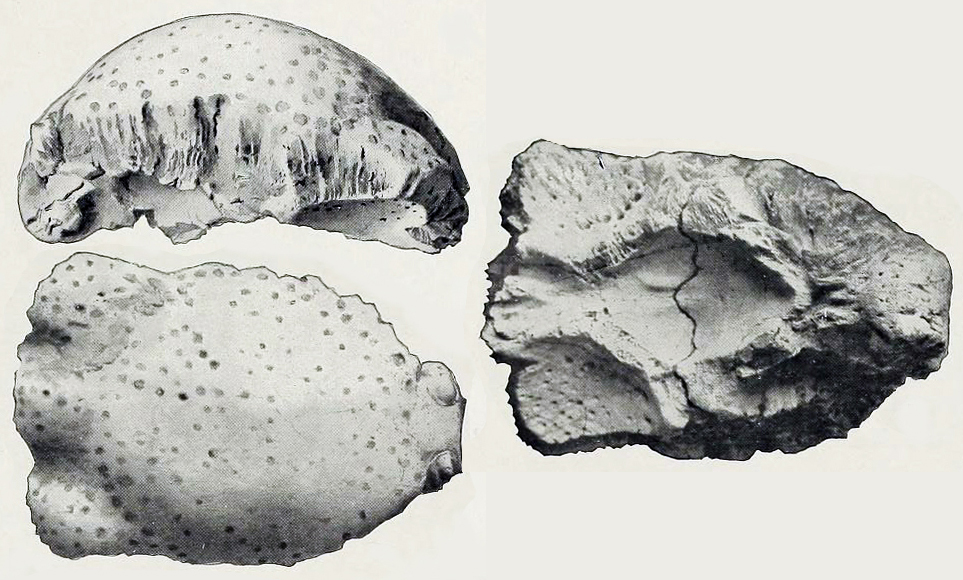
The fossils came to light gradually, and their identity shifted more than once. The only specimen whose finder is named is TMP 1989.69.21, which Wendy Sloboda found in 1989 in Alberta’s Milk River Natural Area. In 1992, Horner and colleagues based their unnamed pachycephalosaurid on three Montana domes: MOR 453, MOR 550, and MOR 480. In 2003, Sullivan referred MOR 453 and MOR 480 to Hanssuesia sternbergi. The describers name no collector for the holotype, but its field number, like the paratype’s, appears to date to 1987.
The holotype, MOR 480, is a frontoparietal dome—the fused, thickened bones of the skull roof—held by the Museum of the Rockies in Bozeman. It came from Glacier County, about 35 to 40 meters (115 to 130 feet) above a marker layer called the “datum ash.” It also sat roughly 12 meters (39 feet) below the Bearpaw Formation. The paratype, MOR 479, is a dome about 125.7 millimeters (4.9 inches) long. Woodruff’s team places it at roughly the holotype’s level, about 15 meters (49 feet) below the Bearpaw. By contrast, geologist Raymond R. Rogers and colleagues put it about 25 meters (82 feet) below that contact.
The describers refer three more domes to the genus only, as Brontotholus sp. MOR 453, also from Glacier County, lay about 3 meters (10 feet) below the datum ash. Woodruff’s team estimated that 300,000 to 1.5 million years separate it from the holotype and paratype. MOR 550 came from mid-formation dark mudstone in Pondera County. Its level went unmeasured, but Rogers and colleagues modeled it at about 78.6 million years old. That makes it some 3.5 million years older than the holotype, from the lower Hagans Crossing Member. The fifth dome comes from the Oldman Formation near Onefour, Alberta, a lateral equivalent of the Two Medicine.
Brontotholus Size and Description
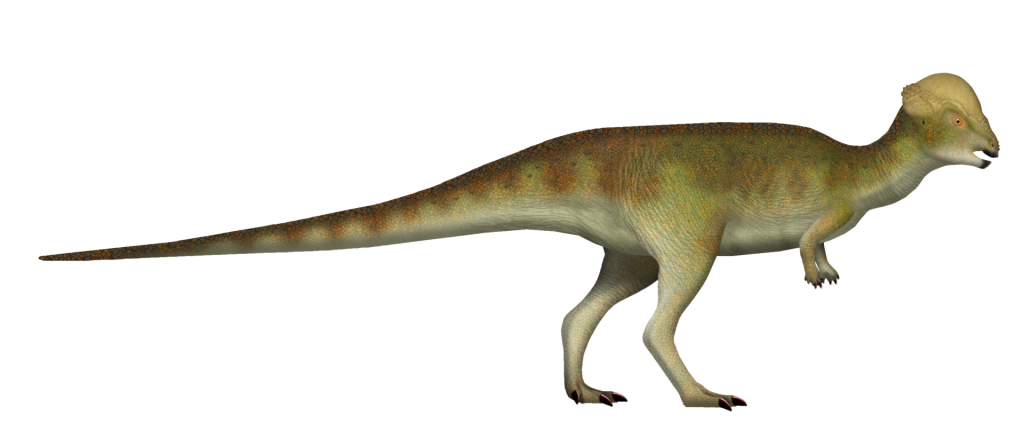
With only domes to work from, any picture of the body leans on its relatives.
Short description of Brontotholus
The frontoparietal dome of Brontotholus was longer from front to back than it was wide. Seen from above, it formed a rough triangle—broad at the back and tapering strongly forward. From the front, the dome looked low. The describers’ diagnosis calls the largest domes over 1.5 times wider than thick, although their own measurements give about 1.3 for the holotype. Along its edges, the seams with neighboring skull bones rose into vaulted or triangular peaks.
Each rear contact with the supraorbitals (bones above the eye sockets) formed a prominent vertical concavity. Ridges and grooves lined these contacts and those with the postorbitals (bones behind the eye sockets). At the back, the parietal process, a rear prong of the skull roof, was greatly reduced and tapered. Beyond the dome, the body remains unknown, and the describers’ full-body silhouette is explicitly hypothetical. Skin is not preserved either, so any discussion of its outward appearance is speculative.

Size and Weight of Type Species
Woodruff and colleagues estimated the holotype’s body length at about 12.5 feet (3.8 meters). With no skeleton to measure, they compared dome length with body length in Stegoceras validum, Pachycephalosaurus wyomingensis, and Prenocephale prenes. The study gives no estimate of height or weight.
The holotype dome is 171.72 millimeters (6.76 inches) long. Among North American pachycephalosaurids, only Pachycephalosaurus wyomingensis and Platytholus clemensi have longer domes. That makes Brontotholus the third-largest of its family known from the continent, at least by dome length.
Dome size varies widely across the five specimens, from 52 millimeters (2 inches) in MOR 550 to about 178 millimeters (7 inches) in the damaged MOR 453. To the describers, the relative size of the dome marks Brontotholus as a large-bodied pachycephalosaurid. Such animals, they argue, existed as early as the Middle Campanian.
The Dinosaur in Detail
One of the most distinctive things about Brontotholus is that no single trait defines it. The describers found no autapomorphy (a feature seen in no other species) on its dome. Even so, they called it “easily diagnosable” through a unique combination that includes its length, triangular outline, low profile, and peaked seams. Still, the domes are very similar, differing mainly in how much they widen at the back, and MOR 453 is the largest and roundest.
Growth offers another clue, and Woodruff’s team described the doming of younger individuals as “baseball cap”-like. According to a 2004 study by Goodwin and Horner, histology (the study of bone tissue) showed that MOR 453 was a late sub-adult. Meanwhile, the holotype and the Alberta dome lack a tesserate surface, a mosaic-like bone texture. The describers suggest that this absence marks them as more mature individuals.
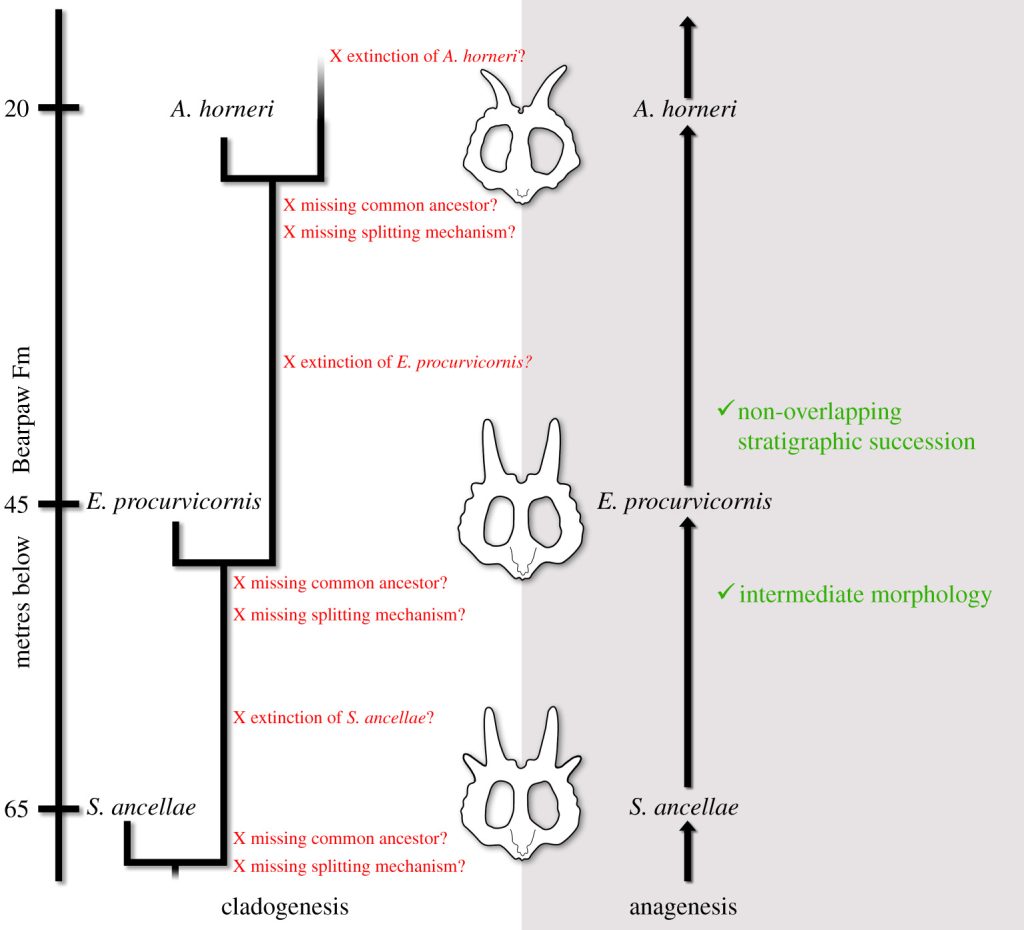
In 1992, Horner and colleagues proposed that MOR 480 was an anagenetic intermediate between Stegoceras validum and Pachycephalosaurus wyomingensis—a stage in one species gradually transforming into another without branching. They also argued that some Two Medicine dinosaurs evolved this way as the Bearpaw sea advanced. Rogers and colleagues later found that their new dating neither confirms nor refutes it, although the ages still fit the original sequence. For the dome-heads themselves, however, Woodruff’s team rejects it.
Woodruff’s team also left open whether change within the genus came from sexual selection or genetic drift—random shifts in a population over time. Together, these studies point to an easily diagnosed dome-head whose exact branch on the family tree is still unsettled.
Interesting Points about Brontotholus
- The name honors the film Mad Max Beyond Thunderdome and the “Beyond Thunder Dome” locality that produced the paratype.
- At 171.72 millimeters long, the holotype dome makes Brontotholus the third-largest pachycephalosaurid known from North America by dome length.
- Before Brontotholus got its name, researchers treated the holotype first as an evolutionary intermediate and then as Hanssuesia sternbergi.
- One of the five known domes comes from the Oldman Formation near Onefour, Alberta, rather than from Montana.
Contemporary Dinosaurs
Sharing the same level of rock as the Brontotholus paratype at Landslide Butte was a skeleton of Daspletosaurus, a Two Medicine tyrannosaurid. Rogers and colleagues identify this skeleton, MOR 468, only to genus. Because no evidence links the two animals directly, they are best pictured as sharing a landscape.
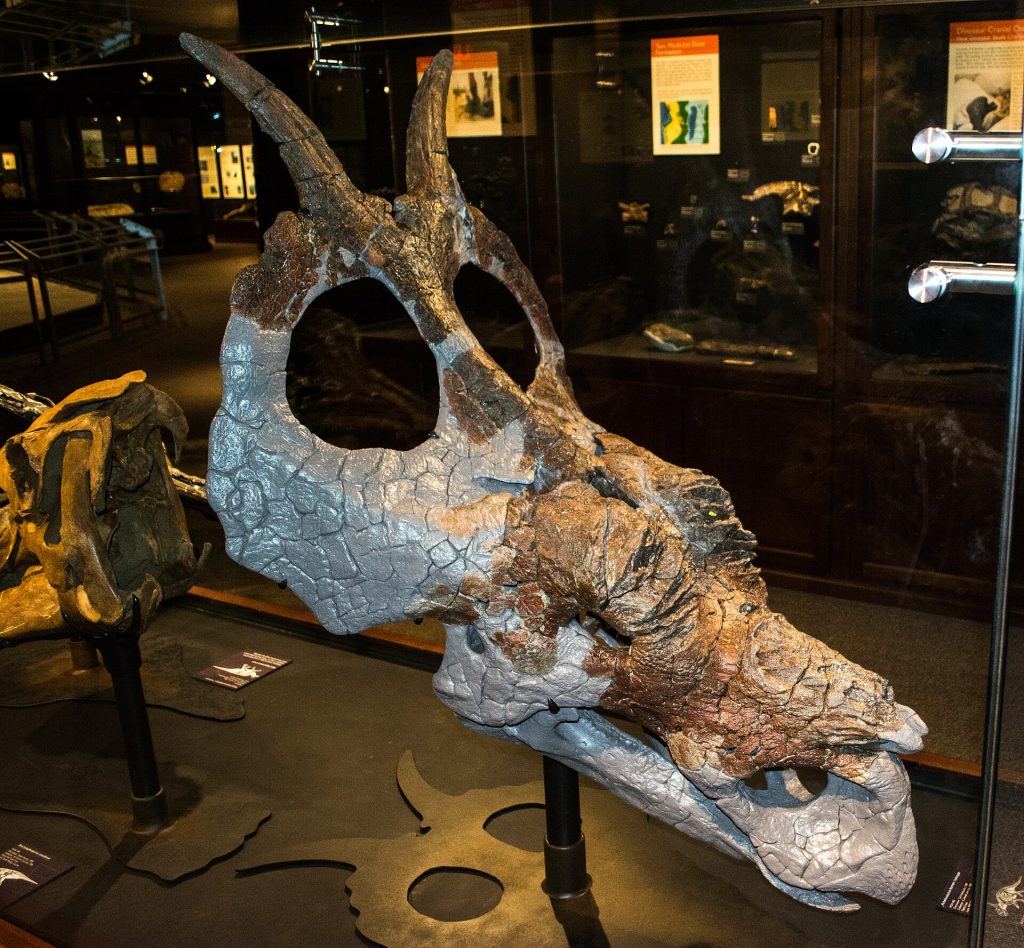

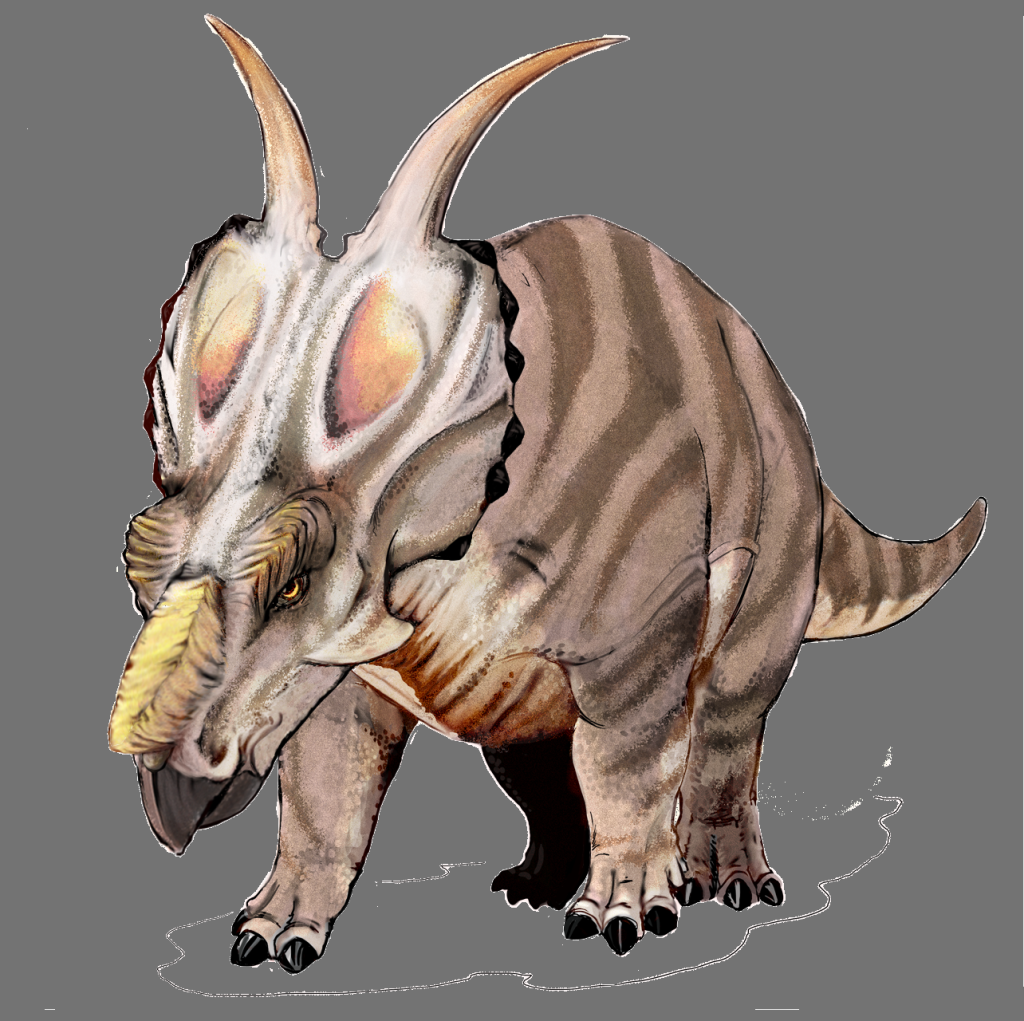
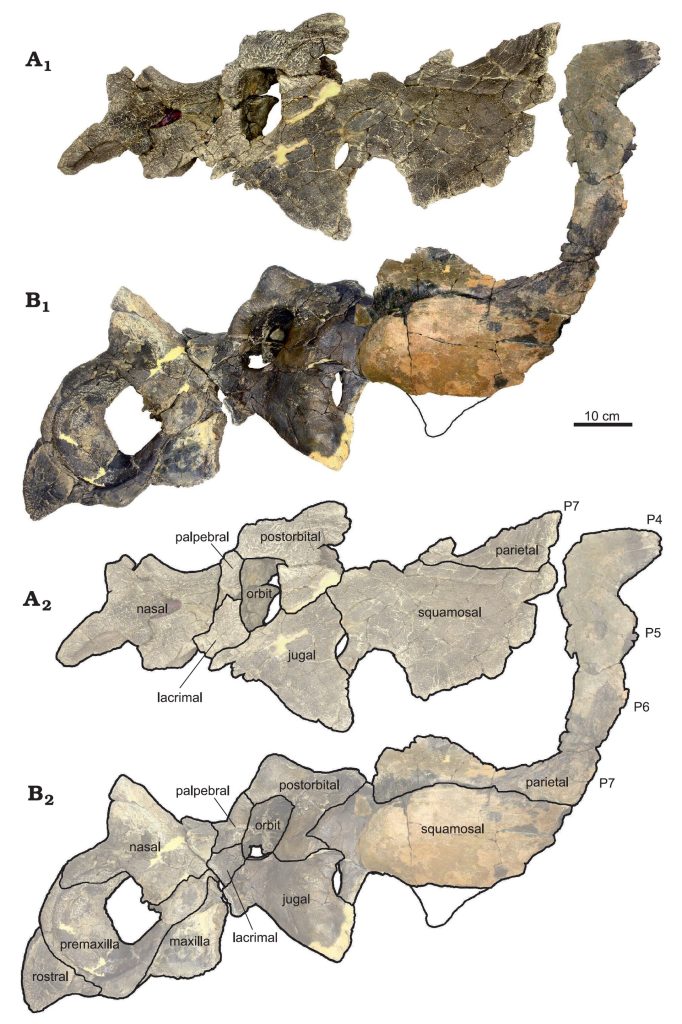
Also known from the Two Medicine Formation are several other named dinosaurs, though none at the paratype’s exact level. At Landslide Butte, Rogers and colleagues place the centrosaurine horned dinosaur Achelousaurus horneri about 5 meters (16 feet) above that level. Wilson and colleagues call it the formation’s highest centrosaurine. Below the paratype lie another centrosaurine, Einiosaurus procurvicornis, about 15 meters (49 feet) lower, and the duck-billed hadrosaurid Prosaurolophus blackfeetensis, about 20 meters (66 feet) lower. In 2013, McGarrity and colleagues suggested that this hadrosaurid may be the same species as Prosaurolophus maximus. Meanwhile, the exact levels of Styracosaurus ovatus, Prenoceratops pieganensis and the armored nodosaurid Edmontonia rugosidens (originally named Palaeoscincus rugosidens) are not known. The formation spans about 8 million years, from roughly 82.4 to 74.4 million years ago, so these animals may not all have lived at the same time.
Brontotholus in its Natural Habitat
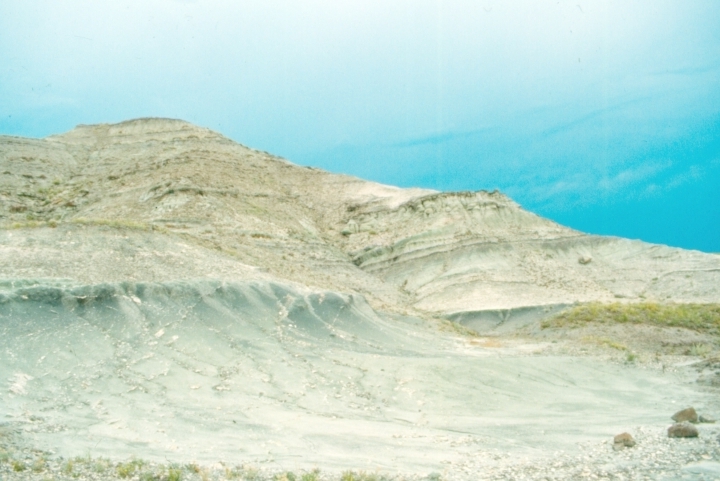
The world Brontotholus roamed was an alluvial plain—land built up by rivers—where channels flowed toward the northeast. Its rocks are mostly gray and gray-green floodplain mudstones with thin siltstones and lens-shaped sandstones. Small root traces show where plants once grew, while caliche nodules (hard lumps of carbonate) remain common. Woodruff’s team describes this as an upland setting, unlike the coeval lowland Judith River Formation.
There is no direct evidence of what Brontotholus ate, and its describers make no claim about diet. Landslide Butte, however, has yielded several dinosaur bonebeds and nest sites. Unnamed finds near the paratype level include a lambeosaurine egg clutch, an ankylosaurid tail, and a bonebed of small vertebrate fossils. Elsewhere, the pterosaur Montanazhdarcho minor, a flying reptile, is known from the formation’s type area.
The holotype and paratype come from the top 80 meters (260 feet) of the formation. According to Rogers and colleagues, Flag Butte dinosaurs inhabited the alluvial plain as the Bearpaw sea moved in. By contrast, the coeval lowland formations host several endemic pachycephalosaurids, while the Two Medicine shows no evidence of such diversity. So far, Brontotholus is the only dome-head named from its upland world—at least according to the current fossil record.
Brontotholus Gallery
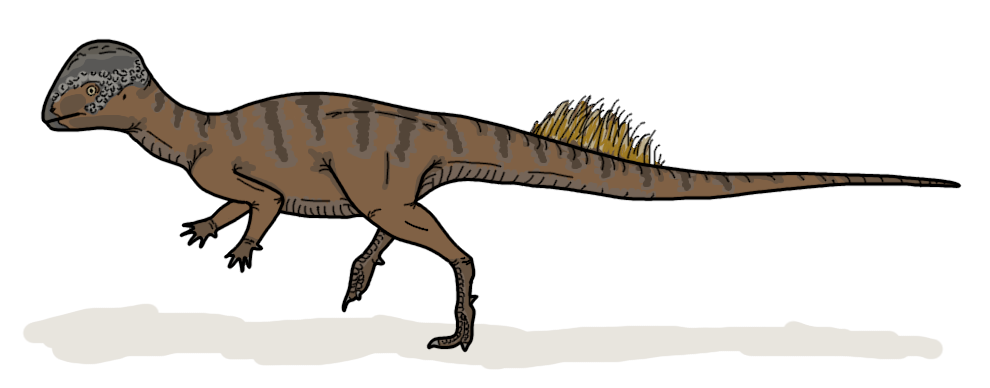
These images show relatives of Brontotholus, its Two Medicine neighbors, and the formation’s rocks.





Frequently Asked Questions
It means “thunder dome,” a nod to the film Mad Max Beyond Thunderdome and the “Beyond Thunder Dome” locality of its paratype.
It lived during the Campanian stage of the Late Cretaceous, around 75 million years ago.
Researchers estimated a length of about 12.5 feet (3.8 meters) from its dome, but published no height or weight.
It was a pachycephalosaurid, a dome-headed ornithischian, and the first of its family named from the Two Medicine Formation.
Its holotype comes from the Two Medicine Formation in Glacier County, Montana, and one referred dome comes from Alberta, Canada.
Its long, low, triangular dome is diagnosed by a unique combination of features, and its dome length ranks third among North American dome-heads.
Sources
The information in this article is based on various sources, drawing on scientific research, fossil evidence, and expert analysis. The aim is to provide a comprehensive and accurate overview of Brontotholus. However, please be aware that our understanding of dinosaurs and their world is constantly evolving as new discoveries are made.
- https://doi.org/10.1093/zoolinnean/zlaf087
- https://academic.oup.com/zoolinnean/article/205/2/zlaf087/8279680
- https://doi.org/10.1130/B37498.1
- https://par.nsf.gov/servlets/purl/10565300
- https://doi.org/10.1098/rsos.200284
- https://stratigraphy.org/ICSchart/ChronostratChart2024-12.pdf
- https://doi.org/10.4202/app.2012.0125
This article was last fact checked: TheDinosaurs Team, 25-11-2026
Featured Image Credit: Connor Ashbridge, CC BY 4.0, via Wikimedia Commons
