
In China’s Yunnan Province, the Lufeng Formation preserves a fauna dominated by early sauropodomorphs—the long-necked group that later produced the giant sauropods. One of them is Yunnanosaurus huangi, which paleontologist C.C. Young named in 1942 as the type species of a new genus. It lived in the Early Jurassic, roughly 199 to 184 million years ago, although the exact stages remain under debate. Its slender holotype teeth generally lack the tiny serrations, or denticles, that line the edges of its relatives’ teeth. Its 2007 redescribers called this trait unique among early sauropodomorphs, although a 2024 study suggested it may partly reflect damaged tooth surfaces.
Young based the genus on an almost complete skeleton, now held at the Nanjing Geological Museum. Two more species followed—Y. robustus in 1951, whose status researchers still dispute, and the much larger Y. youngi in 2007. That same year, Paul Barrett and colleagues redescribed the holotype skull and rejected older attempts to merge the genus with others. In 2017, Wang and colleagues placed it among the earliest branches of a lineage that they think arose in Asia.
Yunnanosaurus Key Facts
| Keyword | Fact |
|---|---|
| Pronunciation | yoo-nahn-oh-sore-us |
| Meaning of name | Yunnan Lizard |
| Group | Sauropodomorpha |
| Type Species | Yunnanosaurus huangi |
| Diet | Herbivore |
| When it Lived | Roughly 199 to 184 MYA (debated) |
| Period | Jurassic |
| Epoch | Early Jurassic (exact stages debated) |
| Length | About 23 feet (7 meters) for Y. huangi, about 43 feet (13 meters) for Y. youngi |
| Height | Not specified |
| Weight | Not specified |
| Mobility | Not specified |
| First Discovery | Year not specified |
| Described by | 1942 by C.C. Young (Y. huangi), 2007 by J. Lü, T. Li, S. Zhong, Y. Azuma, M. Fujita, Z. Dong, and Q. Ji (Y. youngi) |
| Holotype | NGMJ 004546 (cataloged by Young as V20) |
| Location of first find | Huangchiatien village, Dark Red Beds of the Lower Lufeng Formation, Lufeng County, Yunnan Province, China |
Yunnanosaurus Origins, Taxonomy and Timeline
The name Yunnanosaurus means “Yunnan lizard,” after the province that yielded it. Young also erected a family for it, Yunnanosauridae. When Lü Junchang and colleagues named Y. youngi in Young’s honor in 2007, they credited him with that family.
Young classified Yunnanosaurus in Prosauropoda, the traditional grouping for early sauropodomorphs. Later authors pulled it in different directions—Rozhdestvensky sank it into Lufengosaurus huenei in 1965, and Cooper merged it with Massospondylus in 1981. Barrett’s team rejected both moves, yet judged its position “labile,” or unsettled. Studies in 2017 and 2024 recovered it as an early member of Sauropodiformes—the wider group to which sauropods also belong. The 2024 study also named Lishulong wangi as its sister taxon, or closest relative. In contrast, a 2018 analysis of skull characters alone placed it outside Sauropodiformes. Its authors read this as a sign of similar skull features evolving more than once.
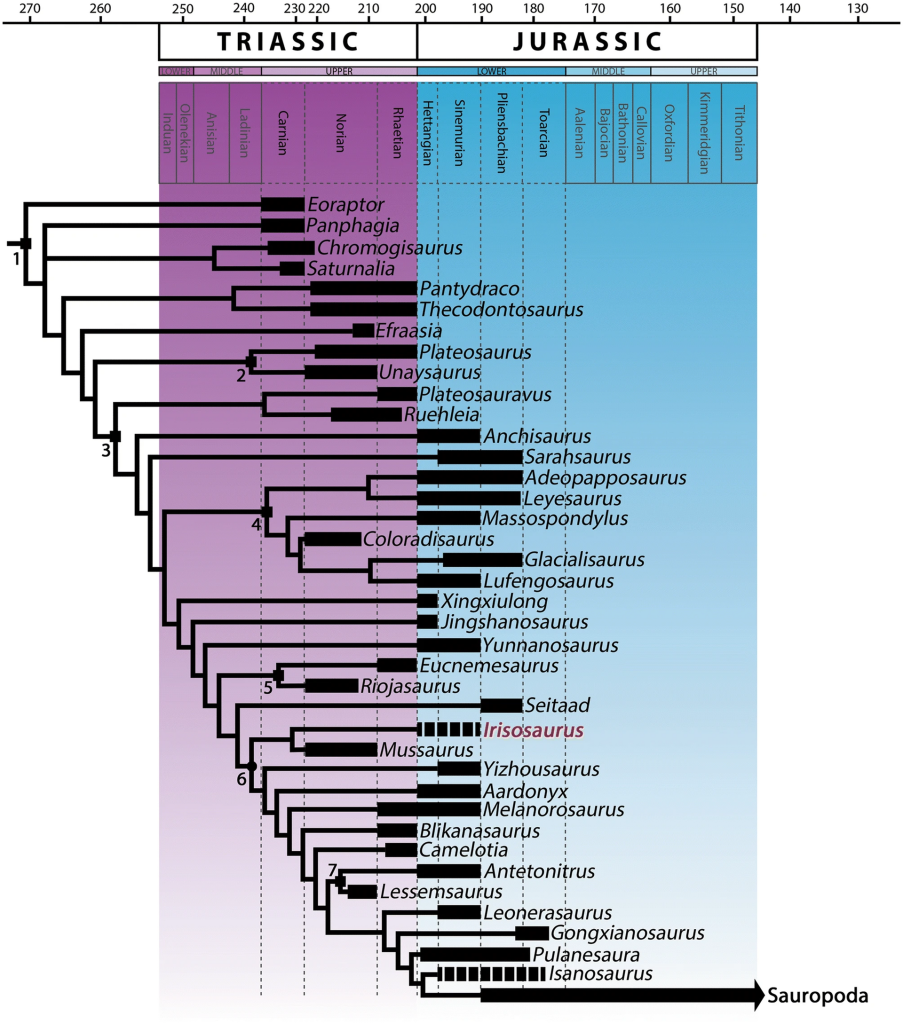

Y. youngi stays in the genus, although its describers assigned it only “temporarily” because its skull is missing. Most authors have treated Y. robustus as a junior synonym of Y. huangi or Lufengosaurus huenei. In 2014, however, Sekiya and colleagues kept it as a valid species and revised its diagnosis.
Citing earlier fossil correlations, Barrett’s team placed the type specimen in the Sinemurian stage. Later, Ren and colleagues put Y. youngi probably in the Pliensbachian. Together, those stages span roughly 199 to 184 million years ago. Yet the formation’s own age is still in dispute. Fossil correlation favors the Hettangian to Sinemurian, while magnetostratigraphy—dating rocks by past flips in Earth’s magnetic field—points to the late Sinemurian to Toarcian. A 2025 study suggested that its upper unit probably falls between the Sinemurian and Pliensbachian.
Discovery & Fossil Evidence
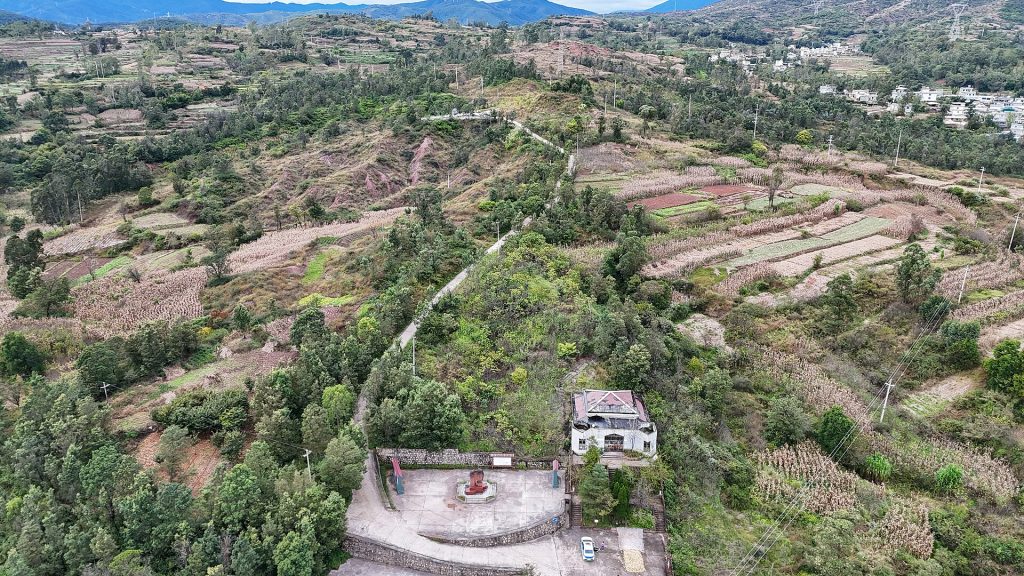
The holotype came from Huangchiatien village in Lufeng County, in the Dark Red Beds of the Lower Lufeng Formation. In 2018, Zhang and colleagues equated those beds with the Zhangjiaao Member, the upper of the formation’s two units. As Barrett’s team noted, earlier authors had already ruled out several worn, isolated teeth once credited to the genus.
Young cataloged the specimen as V20, a later label read NGMJ V0116, and its correct number is now NGMJ 004546. It preserves the skull, the atlas and axis (first two neck vertebrae), three other neck vertebrae, and nine back vertebrae. Behind them come the sacrum (hip vertebrae) and eight tail vertebrae with six chevrons. Also present are the left shoulder blade, sternum, both upper arm bones, right ulna, and part of the left hand. The pelvis, both legs to the ankle, and two metatarsals complete it. The skull survives in three dimensions—though crushed from side to side—with the lower jaws still attached. Barrett’s team found that some damage to the left side of the skull, including a lost cheek bone, happened after Young’s description.
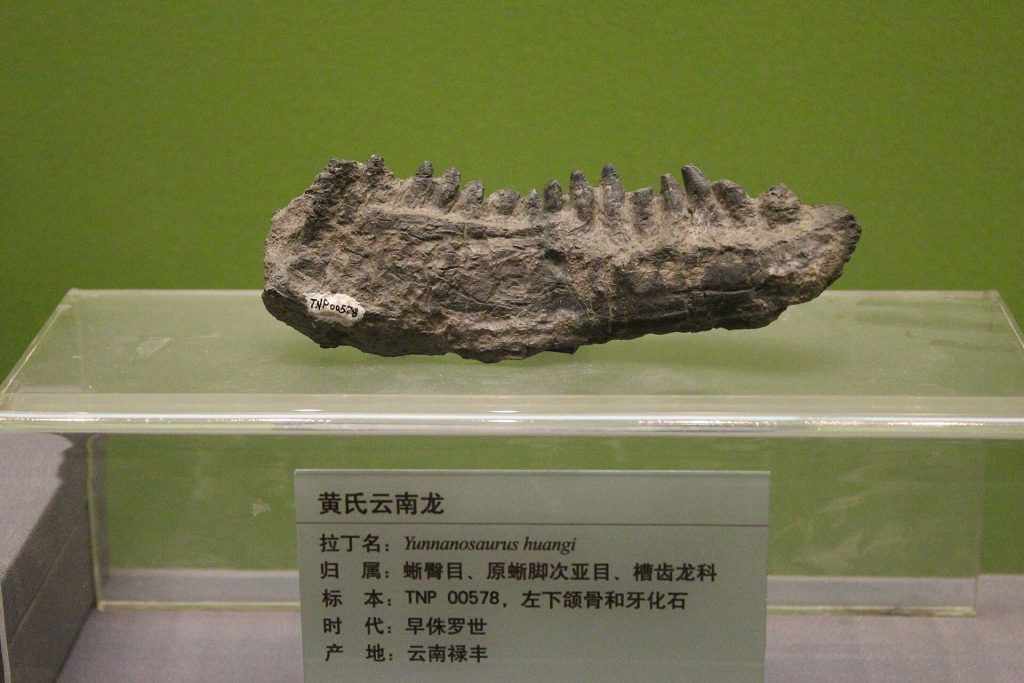

In 1951, Young named Y. robustus on a partial skeleton with skull remains, though published sources give its holotype two different numbers. Sekiya’s team later referred a juvenile, ZMNH-M8739, to it—its unfused vertebrae and grooved bone texture mark it as immature. Y. youngi rests on CXMVZA 185 at the Chuxiong Museum, a skeleton that lacks its skull, shoulder girdle, and limbs. Zhang Jiahua, Wang Guofu, and Li Shaoxue collected it at Banqing Houshanliangzi in Yuanmou County. Its neck held 10 vertebrae, of which nine survive. It also preserves 14 back, 3 hip, and 17 tail vertebrae, plus the pelvis. Yunnanosaurus also occurs in the Fengjiahe Formation, a lateral equivalent of the Lufeng beds that may be slightly older.
Yunnanosaurus Size and Description
Yunnanosaurus paired a long, low skull with teeth unlike its neighbors’—and its two best-known species differed sharply in size.
Short description of Yunnanosaurus
The skull was low and elongate, more than twice as long as high and triangular when seen from above. Its orbits (eye sockets) measured about 30 percent of the skull’s length, while the external nostril was small—about a tenth of it. Rounded bumps, or bosses, sat on the midline of the skull roof. A 2024 study, though, suggested the frontal boss may be an artifact of preservation. In his original diagnosis, Young listed 15 teeth in the maxilla (upper jaw bone) and 13 in the dentary (lower jaw bone). Two rod-like bones about 2.2 inches (55 millimeters) long probably represent ceratobranchials, or throat bones. A stapes, or ear bone, also survives.
Behind the head, Y. youngi shows that the sixth neck vertebra was the longest. Its three hip vertebrae formed a tightly fused, stout unit, while Young described those of Y. huangi as loosely joined. Lü and colleagues also suggested that the type species had 14 back vertebrae, not the 15 Young had inferred.
Y. youngi lacks a shoulder blade, so that bone is known from Y. huangi. In 2017, Wang and colleagues found that it flares more at its upper end than near the shoulder joint. Studies differ on its build, though—Peyre de Fabrègues and colleagues called it elongate and slender in 2020. Posture remains unresolved, too. The same 2017 study suggested that the Lufeng sauropodiforms might represent a step toward walking on all fours. In contrast, the 2020 study noted that Yunnanosaurus shows no further adaptations to four-legged walking.
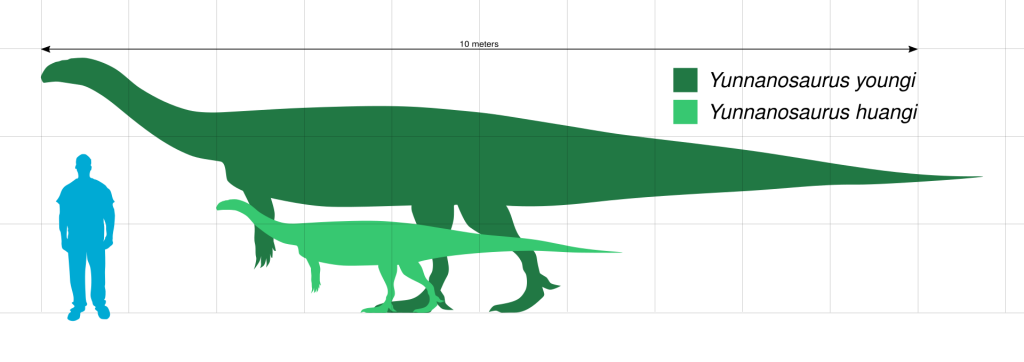

Size and Weight of Type Species
Lü and colleagues cite Young for a length of about 23 feet (7 meters) for Y. huangi, without saying how he reached it. By contrast, they put Y. youngi at about 43 feet (13 meters), nearly twice as long. They left that estimate unexplained, too.
No height or body-mass estimate appears in the published descriptions. The hip bones of Y. youngi do offer hard numbers, though. Its ilium and pubis each measure about 25 inches (63 centimeters), and its ischium about 30 inches (77 centimeters).
How old the holotype was at death matters, too. Barrett’s team described it as a large, presumably subadult or adult individual, because many of its skull bones lack open sutures. On the other hand, Wang and colleagues considered Yunnanosaurus probably subadult or juvenile. Zhang’s team wrote in 2024 that the holotype could belong to a subadult.
The Dinosaur in Detail
What sets this dinosaur apart is its teeth. They are flattened from side to side, with blunt tips, no backward curve, and smooth enamel instead of the wrinkled texture of sauropods. Most strikingly, they lack marginal denticles—a condition Barrett’s team called unique among basal sauropodomorphs. That changed in 2020, when Irisosaurus became the second sauropodomorph known with such teeth. Yunnanosaurus teeth are also slender, with a slenderness index of 1.95 against 1.70 in Lufengosaurus and 2.36 in Irisosaurus. Even so, Barrett’s team noted bead-like crenulations at the tips of a few teeth. In 2024, Zhang and colleagues added that the missing denticles may reflect scraped bone surfaces or covering rock.
In 2015, synchrotron X-ray imaging measured the enamel of a single isolated tooth cataloged as Yunnanosaurus at 32.3 micrometers thick. Diplodocus enamel came out at 106.8 micrometers, although the paper gives no provenance for the tooth. Tooth wear, though, divides researchers. Barrett’s team saw no wear on the holotype and stated that wear facets are unknown in genuine Yunnanosaurus teeth. However, Sekiya and colleagues reported tooth-to-tooth wear facets on the front teeth of the juvenile Y. robustus, whose rear upper teeth carry coarse serrations.
Barrett’s team also found it “tempting to speculate” that the midline bosses played a part in species recognition. More broadly, they tentatively linked its small nostril, bosses, tooth shape, and smooth maxilla to a way of life “rather different” from other prosauropods. Despite its sauropod-like teeth, they saw no sign that it belonged within Sauropoda itself. Its family tree keeps shifting, too—Sekiya’s team placed the Yunnanosaurus clade in an unnamed group that is the sister of Sauropoda.
Interesting Points about Yunnanosaurus
- Some databases list the genus as named in 1940, but Barrett’s 2007 redescription and the Y. youngi paper both give 1942.
- Its smooth-edged teeth were called unique among early sauropodomorphs in 2007, until Irisosaurus became the second known example in 2020. A 2024 study suggested the trait may partly reflect preservation.
- Yunnanosaurus youngi first appeared in print as a Middle Jurassic animal, but a 2021 sedimentary study moved its horizon into the Early Jurassic Fengjiahe Formation.
- Enamel from one isolated tooth cataloged as Yunnanosaurus measured 32.3 micrometers, less than a third of the Diplodocus figure in the same 2015 study.
- Zhang and colleagues suggested in 2024 that Yunnanosaurus and its sister taxon Lishulong might one day share a family called “Jingshanosauridae.”
Dinosaurs from the Same Formation
Also known from the Lufeng Formation (exact level relative to Yunnanosaurus not known): the crested theropod Sinosaurus, the massospondylid Lufengosaurus, and the sauropodiform Jingshanosaurus. Yizhousaurus, another sauropodiform, comes from the uppermost Zhangjiaao Member, the type specimen’s unit. Two others come from the lower Shawan Member—Xingxiulong from its base and Lishulong from its upper-middle part. The two members carry different stage assignments and no radiometric dates. In 2013, however, Xing and colleagues listed Yunnanosaurus in the fauna of a Shawan-level Sinosaurus site, so the genus may span both levels. Xing Lida’s 2012 master’s thesis places a Sinosaurus and a Yunnanosaurus in one 1987 Jinning County quarry, citing Dong’s 2003 report and eyewitnesses. The peer-reviewed descriptions do not place the two in the same bed. The formation’s debated age may cover more than one stage, so these animals may not all have lived at the same time.
Yunnanosaurus in its Natural Habitat
Isotopes from Lufeng sauropodiforms and Sinosaurus point to a mean annual temperature of at least 21 °C (70 °F). They also suggest roughly 38 inches (965 millimeters) of rain a year, give or take about 18 inches (460 millimeters). Shen and colleagues described this as “a relatively arid tropical savanna climate.” Early sauropodomorphs dominated the fauna, which also included mammals, early crocodylomorphs, and sphenodontians (tuatara relatives). Freshwater bivalves turn up too, yet the Lufeng Basin has yielded almost no fish.

Peer-reviewed studies treat Yunnanosaurus as a herbivore, although the Natural History Museum in London lists it as omnivorous. In 2026, a preliminary study by Kubo and colleagues found its dental microwear smoother than that of Camarasaurus, Euhelopus, and Omeisaurus. They read the difference as a likely shift toward tougher, more fibrous plants in later sauropods. Barrett’s team suggested that the missing denticles may indicate some dietary specialization. Meanwhile, Sekiya and colleagues argued that the mixed dentition of the juvenile Y. robustus could represent a unique feeding mechanism.
Nothing shows whether Yunnanosaurus lived alone or in groups, although the Natural History Museum reports some 20 skeletons of adults and juveniles. Peyre de Fabrègues and colleagues interpreted the loss of denticles as a possible adaptation to a specific kind of vegetation. That, they suggested, may have given it a different niche from most other sauropodomorphs.
Yunnanosaurus Gallery
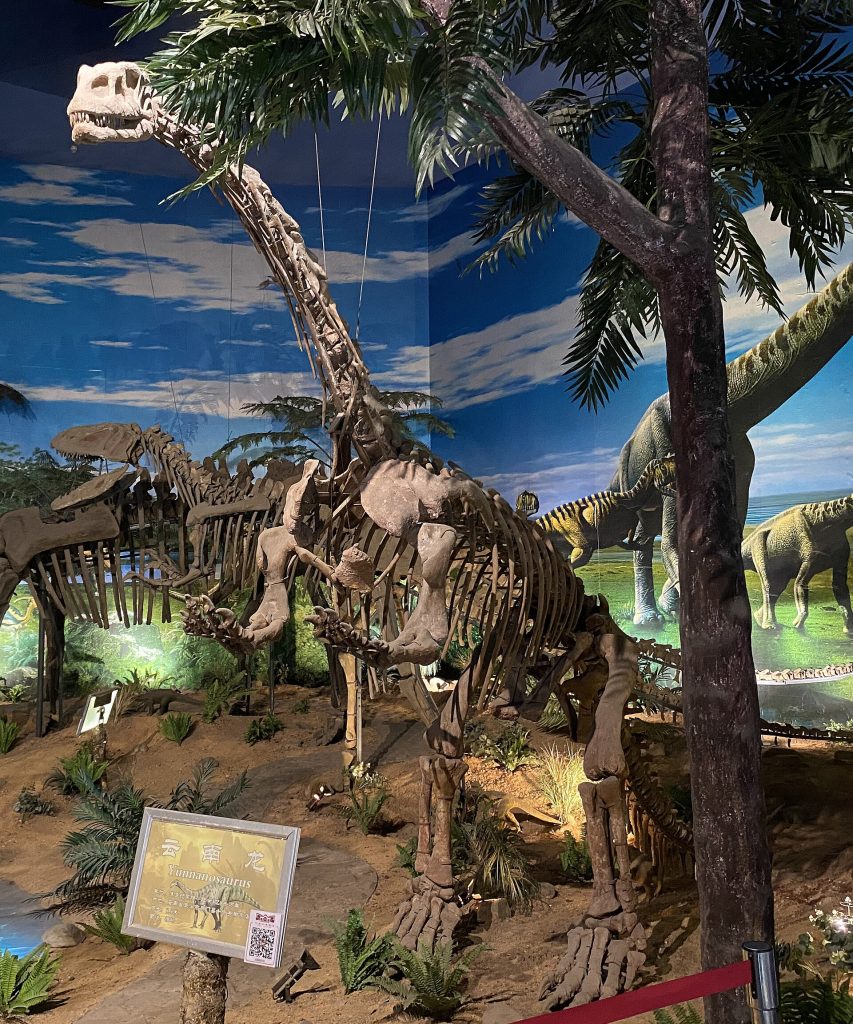
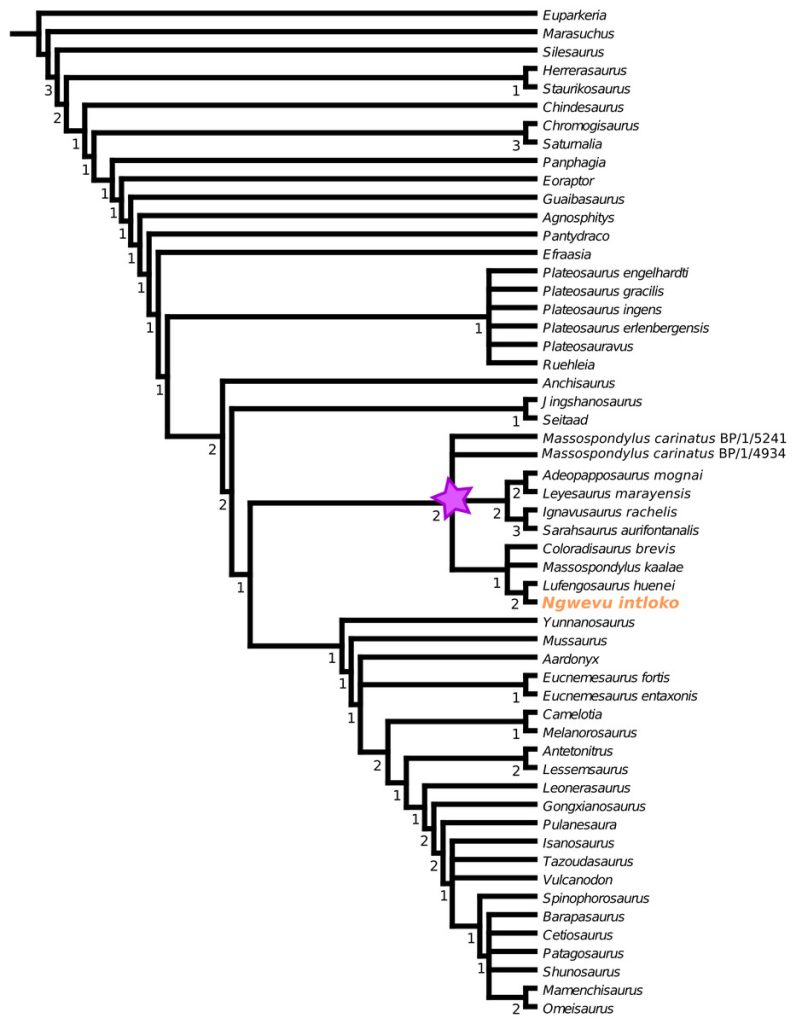
A museum skeleton in Yunnan and a second family tree round out the picture.


Frequently Asked Questions
It means “Yunnan lizard,” after the province in southwestern China that yielded its fossils.
It lived in the Early Jurassic, roughly 199 to 184 million years ago, though its exact stages are still debated.
Y. huangi reached about 23 feet (7 meters) long, and the later species Y. youngi about 43 feet (13 meters). No weight estimate appears in the published descriptions.
It was a herbivore, and its smooth-edged teeth may point to some dietary specialization.
The type specimen came from Huangchiatien village in Lufeng County, Yunnan, within the Lower Lufeng Formation.
Its slender holotype teeth appear to lack marginal denticles, a trait no other early sauropodomorph was known to share until Irisosaurus in 2020. A 2024 study suggested the smooth edges might partly reflect damage.
Sources
The information in this article is based on various sources, drawing on scientific research, fossil evidence, and expert analysis. The aim is to provide a comprehensive and accurate overview of Yunnanosaurus. However, please be aware that our understanding of dinosaurs and their world is constantly evolving as new discoveries are made.
- https://www.dinosaur.pref.fukui.jp/archive/memoir/memoir006-001.pdf
- https://doi.org/10.1111/j.1096-3642.2007.00290.x
- https://doi.org/10.1080/08912963.2013.821702
- https://doi.org/10.1080/08912963.2021.1984445
- https://doi.org/10.1038/srep41881
- https://doi.org/10.1038/s41598-018-31874-9
- https://doi.org/10.1038/s41598-020-67754-4
- https://doi.org/10.7717/peerj.18629
- https://doi.org/10.1038/s41598-025-12185-2
- https://doi.org/10.7554/eLife.75248
- https://doi.org/10.1038/srep15202
- https://doi.org/10.1016/j.palaeo.2026.113768
- https://doi.org/10.1007/s11434-013-5765-7
- https://doi.org/10.7939/R3HP8F
- https://doi.org/10.11646/zootaxa.3873.3.3
- https://doi.org/10.1002/gj.4168
- https://www.nhm.ac.uk/discover/dino-directory/yunnanosaurus.html
This article was last fact checked: TheDinosaurs Team, 25-11-2026
Featured Image Credit: Jonathan Chen, CC BY-SA 4.0, via Wikimedia Commons