
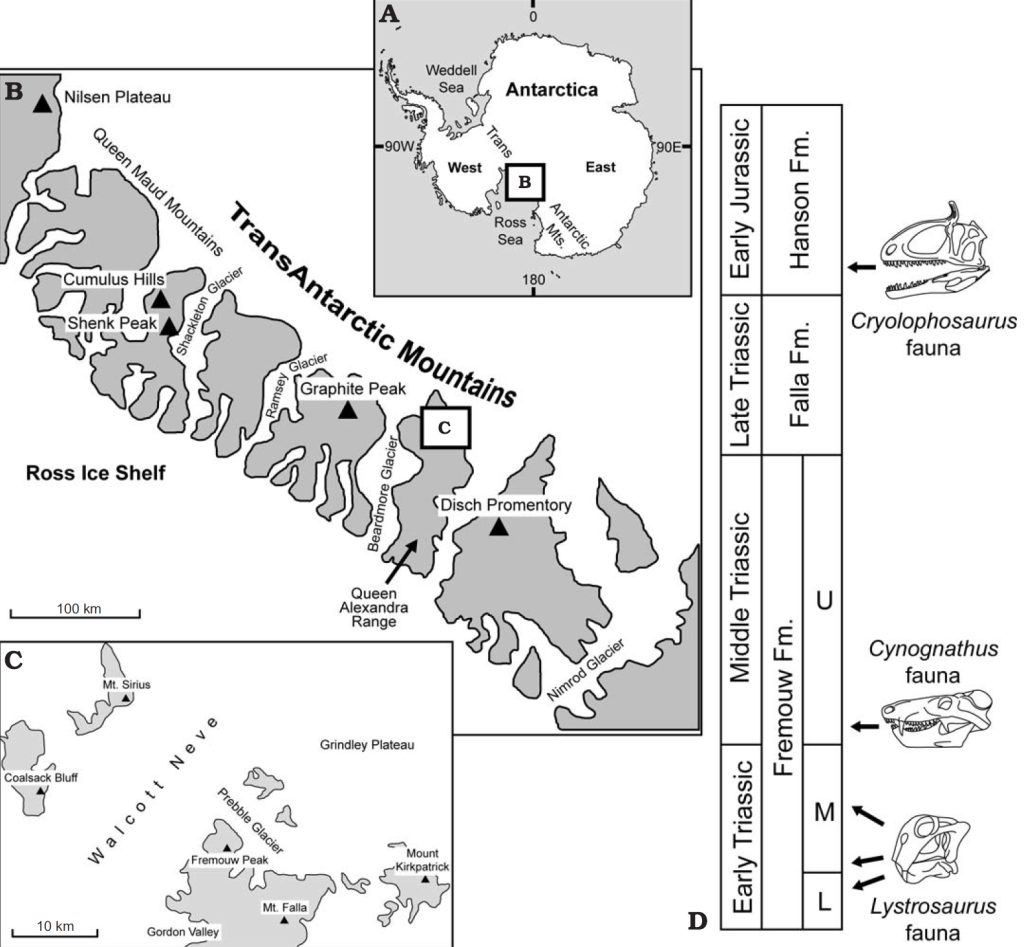
High on the slopes of Mount Kirkpatrick, in Antarctica’s Central Transantarctic Mountains, lie the ashy siltstones of the Hanson Formation. They hold one of only two dinosaurs ever named from the continent’s Jurassic rocks. Named Glacialisaurus hammeri in 2007, this robust animal lived during the Early Jurassic—roughly 196 to 184 million years ago. It was a sauropodomorph, a member of the broad group that includes the giant long-necked sauropods. Its known bones are few—only part of an ankle, part of a foot, and the lower end of a thigh bone survive. Even so, they placed Antarctica within the Early Jurassic range of sauropodomorphs.
A field team led by William Hammer of Augustana College found the first remains during the austral summer of 1990–1991. In 1996, Hammer and Hickerson tentatively placed them in the Plateosauridae, citing only the bones’ size and robustness. Eleven years later, paleontologists Nathan D. Smith and Diego Pol gave the animal a full description and a name of its own. At the time, these fossils and one possible sauropod were Antarctica’s entire sauropodomorph record. Even today, Antarctica has the sparsest Mesozoic dinosaur record of any continent.
Glacialisaurus Key Facts
| Keyword | Fact |
|---|---|
| Pronunciation | Not specified |
| Meaning of name | Icy or Frozen Lizard |
| Group | Sauropodomorpha (Massospondylidae) |
| Type Species | Glacialisaurus hammeri |
| Diet | Herbivore (inferred for the group) |
| When it Lived | About 196 to 184 MYA (approximate) |
| Period | Jurassic |
| Epoch | Early Jurassic (late Sinemurian to late Pliensbachian stages) |
| Length | Not specified |
| Height | Not specified |
| Weight | Not specified |
| Mobility | Probably moved on two legs (bipedal), inferred from its relatives |
| First Discovery | 1990 to 1991 by a field team led by William R. Hammer |
| Described by | 2007 by N.D. Smith and D. Pol |
| Holotype | FMNH PR1823 |
| Location of first find | Lower Hanson Formation, Mount Kirkpatrick, Beardmore Glacier region, Central Transantarctic Mountains, Antarctica |
Glacialisaurus Origins, Taxonomy and Timeline
The genus name comes from the Latin glacialis, meaning “icy” or “frozen.” It refers to the Beardmore Glacier region, where the type species came to light. Meanwhile, the species name hammeri honors Dr. William R. Hammer of Augustana College in Rock Island, USA, for his work in vertebrate paleontology and Antarctic research. Together, the name honors both the glacier country where it was found and the man whose team dug it out.
Smith and Pol placed Glacialisaurus within Sauropodomorpha, a branch of the Saurischia (lizard-hipped dinosaurs). In their view, it was more derived than early forms such as Saturnalia, Thecodontosaurus, Efraasia, and Plateosaurus. Their analysis recovered it inside Massospondylidae, in the stem-based sense defined by Yates in 2007. Later work, from Rauhut and colleagues in 2020 to a 2026 table of Antarctic dinosaurs by Barrett’s team, still keeps it in that family. Glacialisaurus hammeri is the type and only known species.
Its fossils come from the lower Hanson Formation, which Smith and Pol, following Elliot (1996), considered probably middle Early Jurassic. A 2017 study led by Elliot, cited by Barrett’s team, places the formation in the late Sinemurian to late Pliensbachian, a span of roughly 196 to 184 million years ago. A 2013 conference abstract, not peer reviewed, used zircon dates of about 194 million years to constrain the fauna’s age. According to Smith and Pol, basal sauropodomorphs still kept a global distribution into the middle of the Early Jurassic.
Discovery & Fossil Evidence
Most of the fossils came from a single quarry at about 4,100 meters (13,450 feet) on Mount Kirkpatrick, near the base of the Hanson Formation. Hammer’s team returned for a second field season in 2003–2004. The articulated ankle and foot lay within 5 meters (16 feet) sideways of other fossils—and within 1 meter (3.3 feet) vertically. In contrast, the thigh bone turned up as float—loose at the base of the exposure. It may have come from higher in the section, yet its preservation and rock matrix fit the exposure.

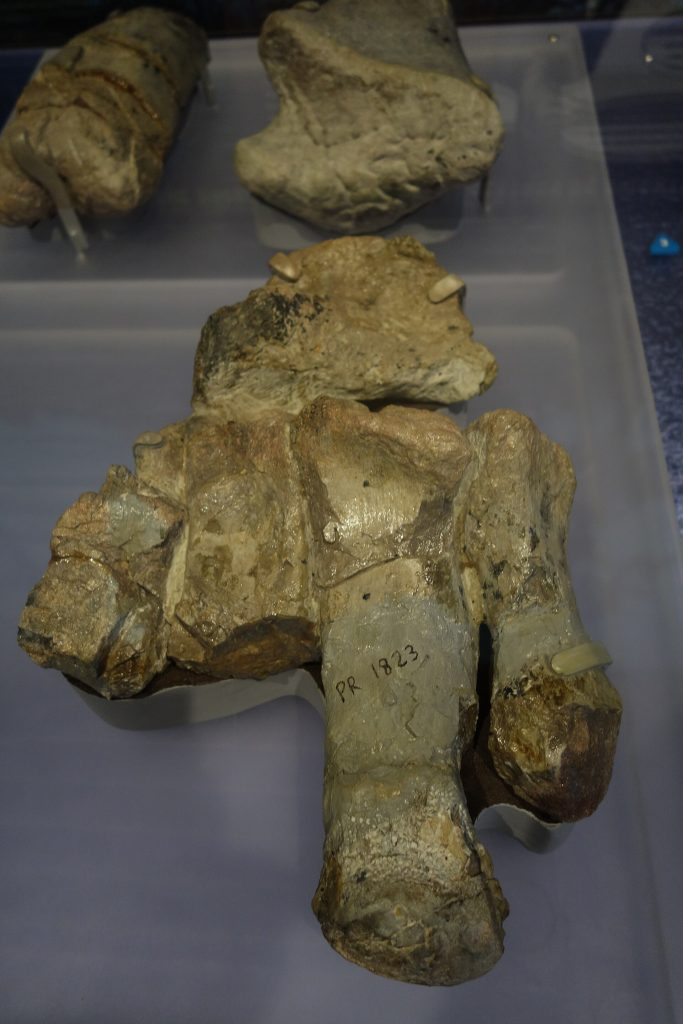
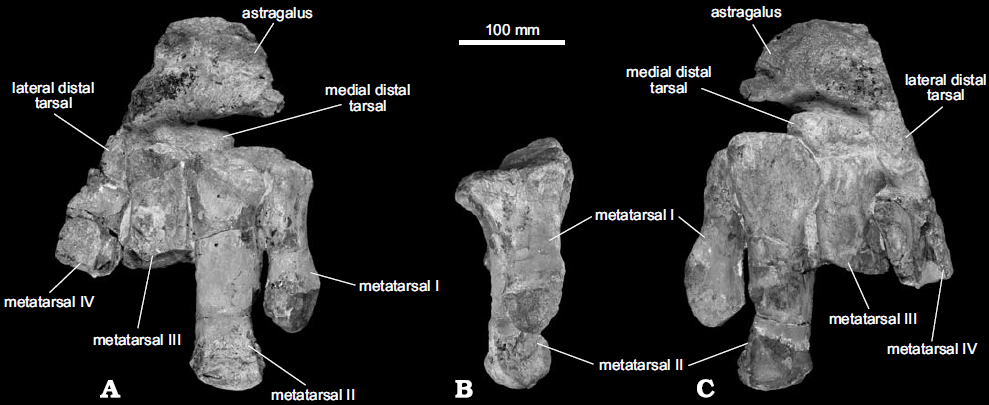
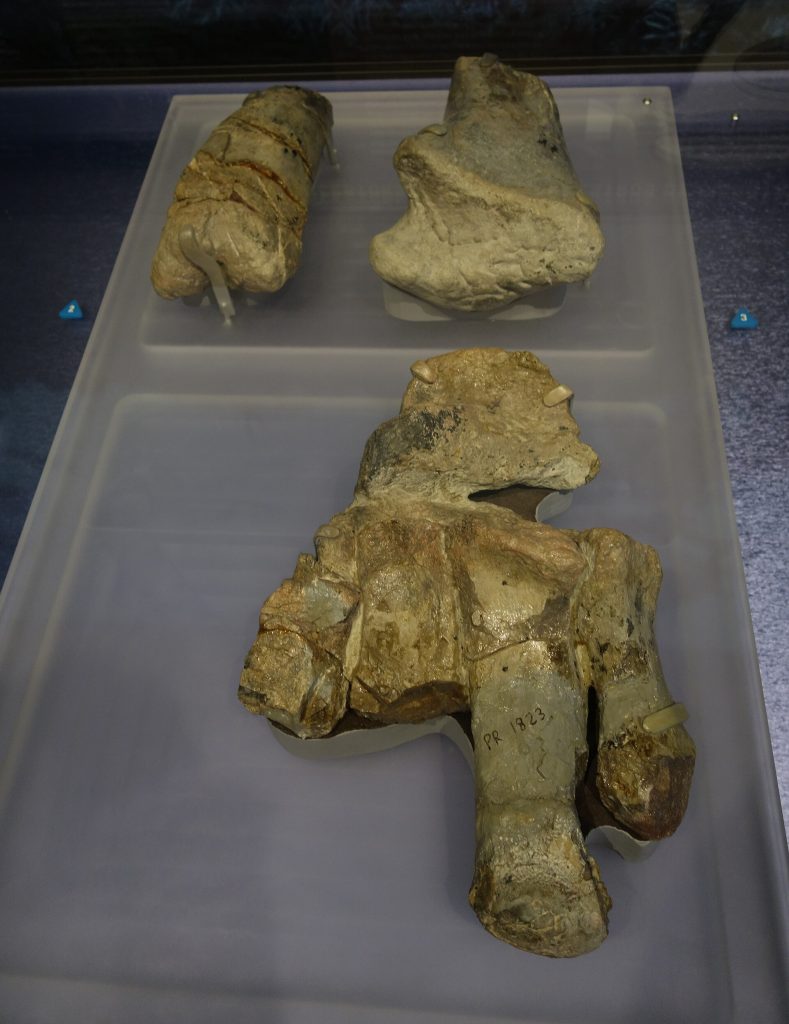
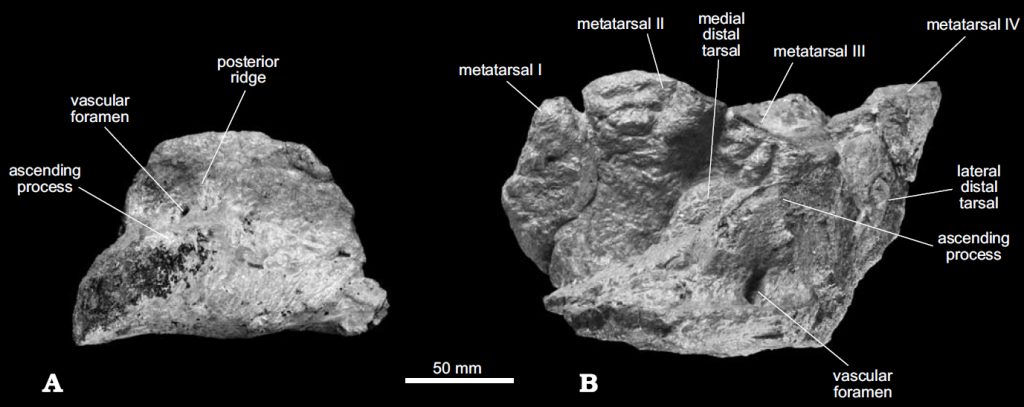
The holotype, FMNH PR1823, belongs to the Field Museum of Natural History in Chicago. It includes a partial right astragalus (a large ankle bone) and two distal tarsals (small bones between ankle and foot). A partial right metatarsus (the long bones of the foot), with metatarsals I through IV, completes the set—and all of it still lay joined together.

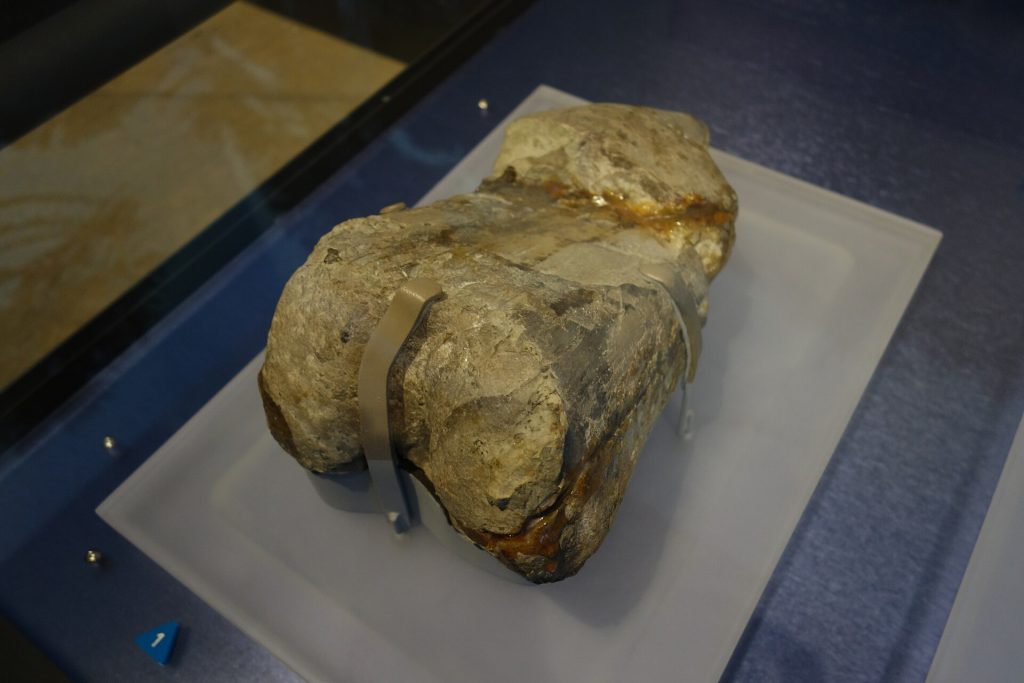
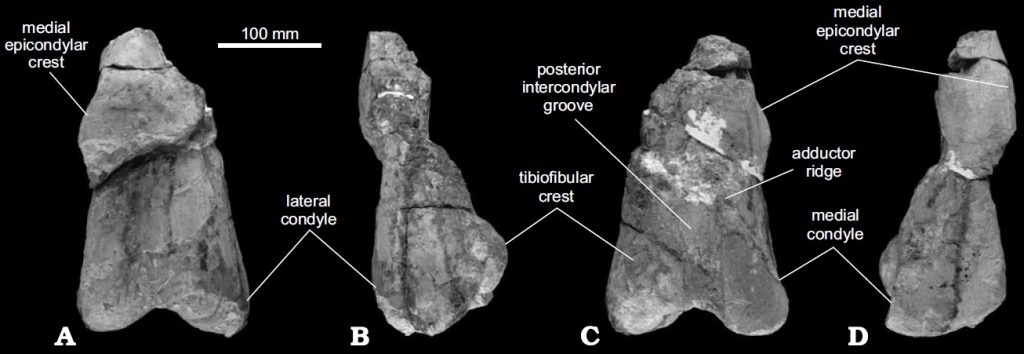
Smith and Pol referred a distal left femur, FMNH PR1822, to the same species. They ruled out Cryolophosaurus, whose holotype already has both femora, with far more gracile lower ends. Some neck vertebrae once linked to the sauropodomorph also proved to belong to Cryolophosaurus. A 2013 abstract mentions new Glacialisaurus material from a later expedition, but it apparently awaits formal description. For now, every described specimen comes from that single quarry.
Glacialisaurus Size and Description
With only foot, ankle, and thigh bones, Glacialisaurus offers a portrait built from the ground up.
Short description of Glacialisaurus
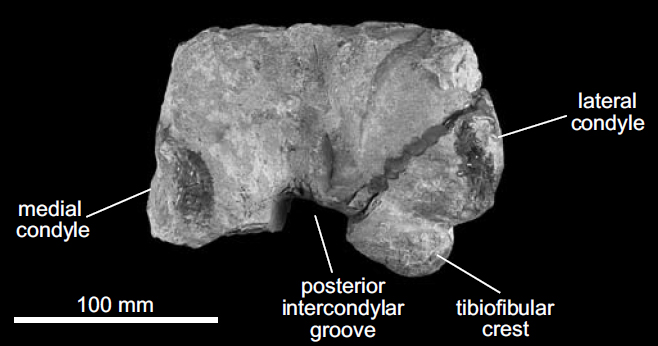
Smith and Pol diagnosed Glacialisaurus as robust, and its bones bear that out. The lower femur carries a thick medial epicondylar ridge (a crest on the inner side of the knee end). It also shows a strong adductor ridge (a muscle ridge) rising from the medial condyle, the inner knob of the knee joint. Its shaft is slightly wider side to side than front to back, but less elliptical than in eusauropods (advanced sauropods). A repaired crack also crosses the femur’s shaft, leaving the upper piece slightly shifted. Calcite fills parts of the break, so Smith and Pol suggest it happened after death but before fossilization.
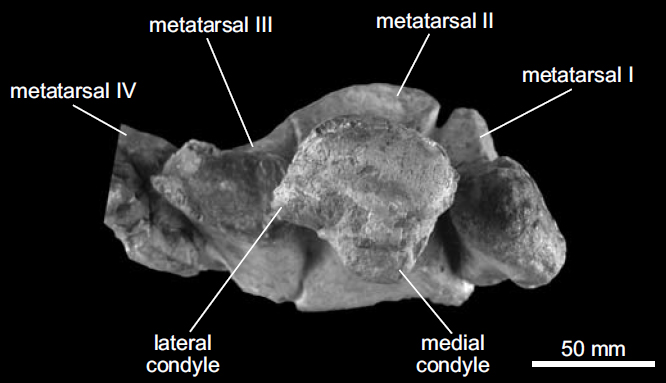
Below the ankle, the metatarsals are more robust than those of Plateosaurus—one of five differences the authors listed between the two. Metatarsal I reaches roughly three-quarters the length of metatarsal II. However, no skull, neck, arms, or tail survive, so relatives must fill in the rest of the body. Skin impressions and soft tissue are not preserved either, which leaves its outward appearance speculative. A 2021 study by Apaldetti and colleagues infers from its relatives that it was probably bipedal. Still, the fossils themselves do not record its posture.

Size and Weight of Type Species
The best size clue is the femur—the only bone above the ankle that survives. Its preserved part measures 300 millimeters (11.8 inches), but the bone is incomplete. Smith and Pol inferred that the whole femur was at least 600 millimeters (23.6 inches) long—about 2 feet, a size that also matches what the foot bones would predict.
Neither the original paper nor any later scientific study offers a body length, hip height, or weight.
Without a more complete skeleton, any firmer figure would have to rest on comparisons. In 2023, Chapelle and colleagues noted that by femur length, Glacialisaurus outsizes Coloradisaurus, whose femur measures 514.3 millimeters. Similarly, a 2021 dataset puts the femur of Lufengosaurus at 780 millimeters and that of Massospondylus carinatus at 550. By that single measure, Glacialisaurus was larger than both Massospondylus carinatus and Coloradisaurus. However, because 600 millimeters is only a minimum, the comparison with Lufengosaurus stays open.
The Dinosaur in Detail
What sets this dinosaur apart lies mostly in one bone. Smith and Pol listed six autapomorphies (traits unique to the genus), and four sit in the second metatarsal. That bone has a weakly convex front border and a hypertrophied (greatly enlarged) flange on the outer back side of its upper end. Near its lower end, the shaft twists gently inward, although the authors note that repairs made during preparation may exaggerate the twist. Its inner condyle is also more robust than the outer one.

Some of its features recall theropods, yet its medial epicondylar ridge is far thicker than the slender crest of basal theropods.
In their analysis, Glacialisaurus emerged as the sister taxon (closest relative) of Lufengosaurus from China’s Lower Lufeng Formation. Next came Coloradisaurus, then Massospondylus, and together these formed Massospondylidae. Glacialisaurus shares several foot features with Coloradisaurus and Lufengosaurus, such as a subtrapezoidal (roughly four-sided) upper surface on metatarsal III. Still, the authors warned that the result should be “viewed as tentative,” since few characters could be scored. Its weak support, they added, also limits its value for dating the Hanson Formation.
Later work has largely held to that picture, starting in 2011, when Apaldetti and colleagues grouped it with Coloradisaurus and Lufengosaurus. That trio was sister to Massospondylus, Adeopapposaurus, and Leyesaurus. Their 2021 trees again paired it with Lufengosaurus, even though 92.8 percent of its data were missing. A 2022 master’s thesis, not peer reviewed, went further and suggested its ancestral range lay in South Africa. These studies place Glacialisaurus in a largely southern family. In the 2011 analysis, five of six massospondylids came from South America, South Africa, or Antarctica.
Interesting Points about Glacialisaurus
- The first referral of these bones, to the Plateosauridae in 1996, rested on nothing more than their size and robustness.
- Some neck vertebrae that Hammer and Hickerson cautiously suggested might belong to the sauropodomorph turned out to come from the crested theropod Cryolophosaurus instead.
- A synthesis from the same year as its naming cited it as evidence that Prosauropoda—a traditional grouping of early sauropodomorphs—was paraphyletic, not one natural group.
- Four of the six features that make Glacialisaurus unique are packed into a single bone, the second metatarsal of the foot.
Contemporary Dinosaurs
Sharing the Mount Kirkpatrick quarry was Cryolophosaurus ellioti—a theropod that Smith and Pol called relatively complete. Its holotype, FMNH PR1821, preserves both femora—one reason the lone sauropodomorph thigh bone could not be its own. Its bones came from the same site at about 4,100 meters, with its skull pieces recovered as nearby float. In a 2007 synthesis, Smith and colleagues placed it in a clade of mid-sized, crested Early Jurassic theropods with Dilophosaurus wetherilli and Dracovenator. Even so, its exact position among early theropods is still debated, and a 2026 table lists it as a tetanuran. No source records any interaction, so the two are best pictured simply as sharing a landscape.
Glacialisaurus in its Natural Habitat
The world Glacialisaurus roamed was a rift valley in the making—an active volcano-tectonic rift system that formed as Gondwana broke apart. Its siltstones, tuffs, and tuffaceous sandstones (sandstones rich in volcanic ash) hold ash reworked from distant Plinian eruptions—violent, towering blasts. These probably came from a volcanic arc on the West Antarctic margin. Even then, the site lay far to the south—at least 55° and possibly 65°S, according to Smith and Pol. That makes Glacialisaurus one of the highest-paleolatitude (farthest from the equator) Jurassic sauropodomorphs known. Later, lavas and sills of the Ferrar Large Igneous Province, dated to about 182.8 million years ago, capped the sequence.
While there is no direct evidence of its diet, Glacialisaurus belonged to what Apaldetti and colleagues call the first global radiation of herbivorous dinosaurs. Because no teeth or jaws survive, any plant-eating habits rest on its group alone.
Its quarry also yielded a pterosaur humerus and a tooth from a large tritylodont, a mammal relative. Barrett and colleagues mention unnamed early-diverging sauropodomorph material from the formation. A 2013 abstract reported new specimens, including a nearly complete juvenile skeleton, that may represent distinct species. In addition, a 2022 master’s thesis (not peer reviewed) described a juvenile, FMNH PR 3051, from the lower Hanson Formation as a possible new species distinct from Glacialisaurus. It preserves the only sauropodomorph skull known from Antarctica.
About 100 meters (330 feet) higher in the formation, a separate site produced pelvic bones of a possible sauropod. For Smith and Pol, that find lends further evidence that the earliest sauropods coexisted with their basal sauropodomorph cousins. Whatever its habits, Glacialisaurus marks the edge of what Antarctica’s sparse dinosaur record can reveal.
Glacialisaurus Gallery
These photos and figures show the holotype foot and ankle, the referred femur, and close-up views of single bones.





Frequently Asked Questions
It comes from the Latin glacialis, “icy” or “frozen,” for the Beardmore Glacier region, and hammeri honors William R. Hammer.
It lived in the late Sinemurian to late Pliensbachian stages of the Early Jurassic, roughly 196 to 184 million years ago.
No body length or weight estimate has been published in the scientific literature. Its femur was at least 600 millimeters (23.6 inches) long.
No direct evidence survives, but like its close relatives among the massospondylids, it was probably mainly a plant-eater.
It was found in the lower Hanson Formation on Mount Kirkpatrick, in Antarctica’s Central Transantarctic Mountains.
Four of its six unique traits sit in the second metatarsal, and it is one of the highest-paleolatitude Jurassic sauropodomorphs known.
Sources
The information in this article is based on various sources, drawing on scientific research, fossil evidence, and expert analysis. The aim is to provide a comprehensive and accurate overview of Glacialisaurus. However, please be aware that our understanding of dinosaurs and their world is constantly evolving as new discoveries are made.
- https://app.pan.pl/article/item/app52-657.html
- https://app.pan.pl/archive/published/app52/app52-657.pdf
- https://doi.org/10.3133/of2007-1047.srp003
- https://europepmc.org/article/PMC/PMC3212523
- https://sjg.springeropen.com/articles/10.1186/s00015-020-00360-8
- https://europepmc.org/article/PMC/PMC8602272
- https://europepmc.org/article/PMC/PMC10265025
- https://doi.org/10.4202/app.01315.2025
- https://doi.org/10.1017/S0016756816000388
- https://pubs.usgs.gov/of/2007/1047/srp/srp051/of2007-1047srp051.pdf
- https://studio.m-anage.com/gsa/2013AM/webprogram/Paper232923.html
- https://conservancy.umn.edu/items/47788a2f-4858-4166-b88f-7dd611a6b5c0
- https://stratigraphy.org/ICSchart/ChronostratChart2024-12.pdf
- https://doi.org/10.1016/j.epsl.2015.01.037
This article was last fact checked: TheDinosaurs Team, 25-11-2026
Featured Image Credit: Jens Lallensack, CC BY-SA 4.0, via Wikimedia Commons
