
On the northern slope of Thaba ‘Nyama, in South Africa’s Eastern Cape, the lower Elliot Formation yielded the bones of Melanorosaurus readi. Named by paleontologist Sidney Haughton in 1924, it now sits in the Norian stage of the Late Triassic—roughly 220 to 206 million years ago. It was a large member of Sauropodomorpha, the broad group that includes the long-necked sauropods. For years, it even served as a reference point in the formal definition of Sauropoda itself.
Its modern story, however, is one of shrinkage rather than growth. After 1924, two further sets of fossils—including a complete skull—were referred to the genus. One was removed in 2017, and in 2024 both were excluded pending reassessment. That year, paleontologists Paul Barrett and Jonah Choiniere designated a lectotype—a single individual chosen from the original bones—and restricted the species to it. What remains is a smaller but firmer Melanorosaurus, and a reminder that a famous name can outgrow its evidence.
Melanorosaurus Key Facts
| Keyword | Fact |
|---|---|
| Pronunciation | me-lan-or-oh-sore-us |
| Meaning of name | Black Mountain Lizard |
| Group | Sauropodomorpha |
| Type Species | Melanorosaurus readi |
| Diet | Not specified |
| When it Lived | About 220 to 206 MYA |
| Period | Triassic |
| Epoch | Late Triassic (Norian stage) |
| Length | Not specified |
| Height | Not specified |
| Weight | Not specified |
| Mobility | Not specified |
| First Discovery | Before 1924, probably during Haughton’s own collecting in Herschel district (collector and year not stated in the species account) |
| Described by | 1924 by S.H. Haughton |
| Holotype | Lectotype designated 2024 from Haughton’s syntypes (SAM-PK 3449/3450) |
| Location of first find | Northern slope of Thaba ‘Nyama, near Bensonvale, Herschel district, Eastern Cape, South Africa (lower Elliot Formation) |
Melanorosaurus Origins, Taxonomy and Timeline
Haughton did not explain the name Melanorosaurus, but he translated Thaba ‘Nyama, the type locality, as “Black Mountain.” London’s Natural History Museum renders the full name as “Black [Mountain] lizard.” The species name readi honors Mr. B. Read, a former Principal of the Bensonvale Training School near the site. Together, the name ties the animal to a mountain and to a local educator.
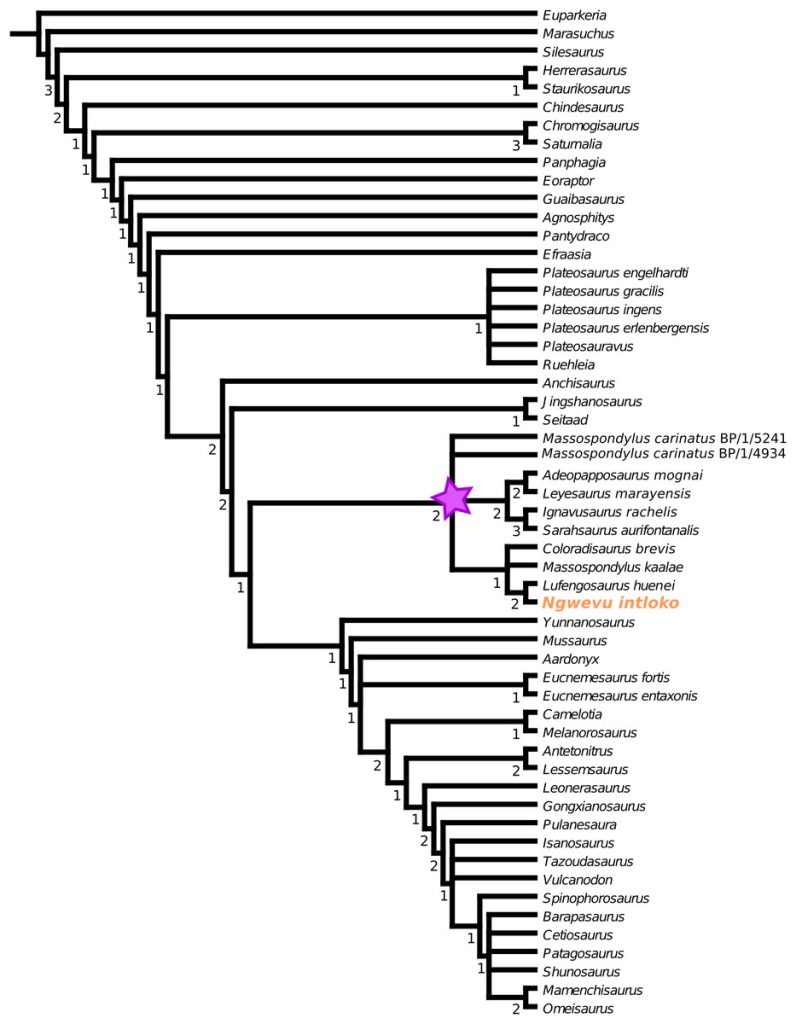
At first, Haughton placed his new genus in Plateosauridae, comparing it with Gresslyosaurus, Euskelesaurus, and Plateosaurus. In 2007, Yates placed the genus in Anchisauria, a view built on the skull specimen NMQR 3314. Today, Barrett and Choiniere describe it as a sauropodiform sauropodomorph—a member of the branch leading toward true sauropods. M. readi is the type and only known species, since M. thabanensis from Lesotho moved to its own genus in 2016.

Barrett and Choiniere date Melanorosaurus to the Norian stage of the Late Triassic. In 2020, Emese Bordy and colleagues dated the lower Elliot Formation from the middle Norian to the Rhaetian. In contrast, a separate 2020 study of its fossil zone favored an upper Norian to Rhaetian age. The formation’s base lies near 220 million years ago, and the Norian ended about 205.7 million years ago. That places the animal roughly 220 to 206 million years ago. The type bed itself, however, has never been directly dated. Bordy’s team placed the provenanced lower Elliot sauropodomorphs in its lowest 160 feet (50 meters) “with one exception,” probably the higher Thaba ‘Nyama site. Higher up, the Elliot Formation spans the end-Triassic mass extinction.
Discovery & Fossil Evidence
The bones lay in “a soft red mudstone below a sandstone band not far above the base of the Red Beds.” The site lies about 7 miles (11 kilometers) south-southwest of Sterkspruit. In 2017, Blair McPhee and colleagues placed all strata below the first sandstone ridge, west of a dolerite dyke—a wall of once-molten rock—in the lower Elliot. Their elevations, however, suggest the site lies roughly 390 feet (120 meters) above that unit’s base, and they noted the bones came from two neighboring spots. Haughton’s species account names no collector or year, though his paper reports his own Herschel district expeditions.
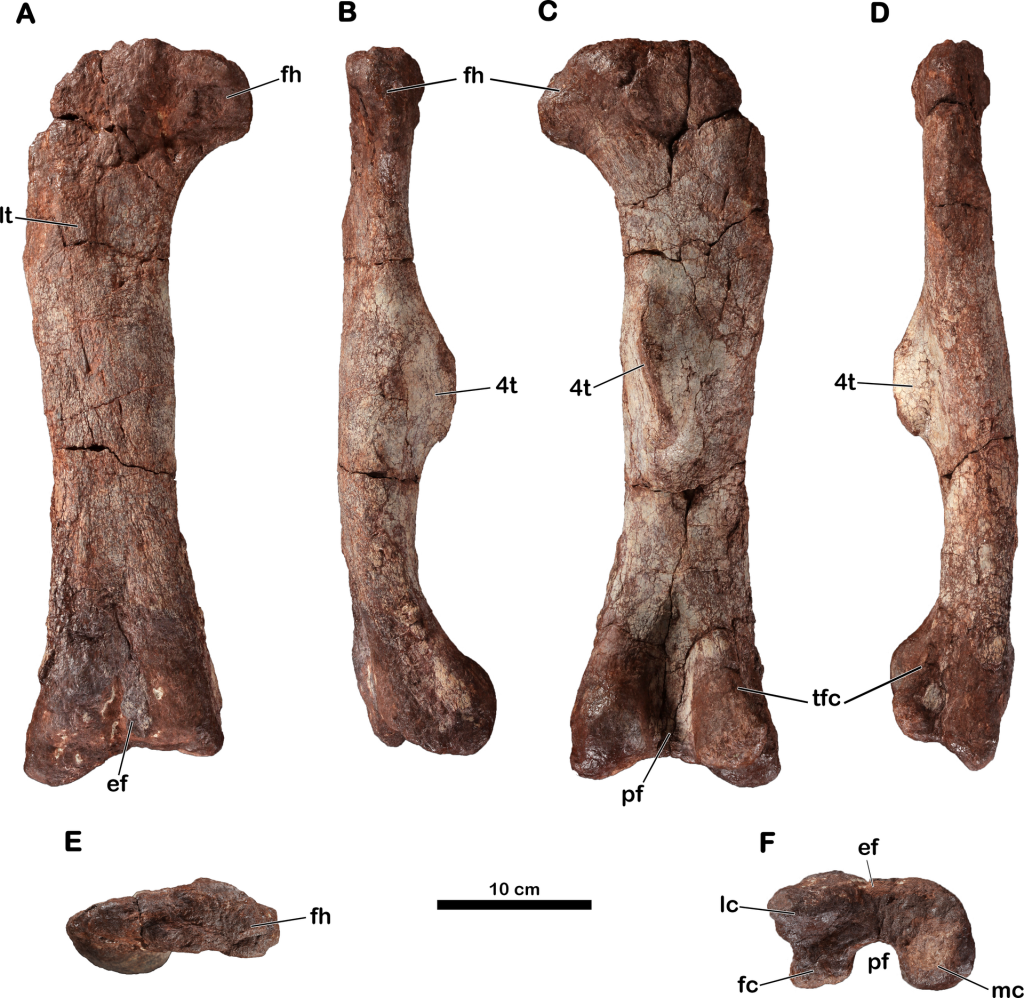
Haughton’s type, an incomplete skeleton, bears South African Museum numbers 3449 and 3450. It included a tibia (shin bone), a fibula, part of the pelvis, some vertebrae, and metatarsals (foot bones). Half a humerus (upper arm bone) had weathered down the slope. A femur (thigh bone) lay partly in the overlying sandstone, and Haughton warned it “was in doubtful association.” In 2016, Claire Peyre de Fabrègues and Ronan Allain excluded it as coming from a higher layer.
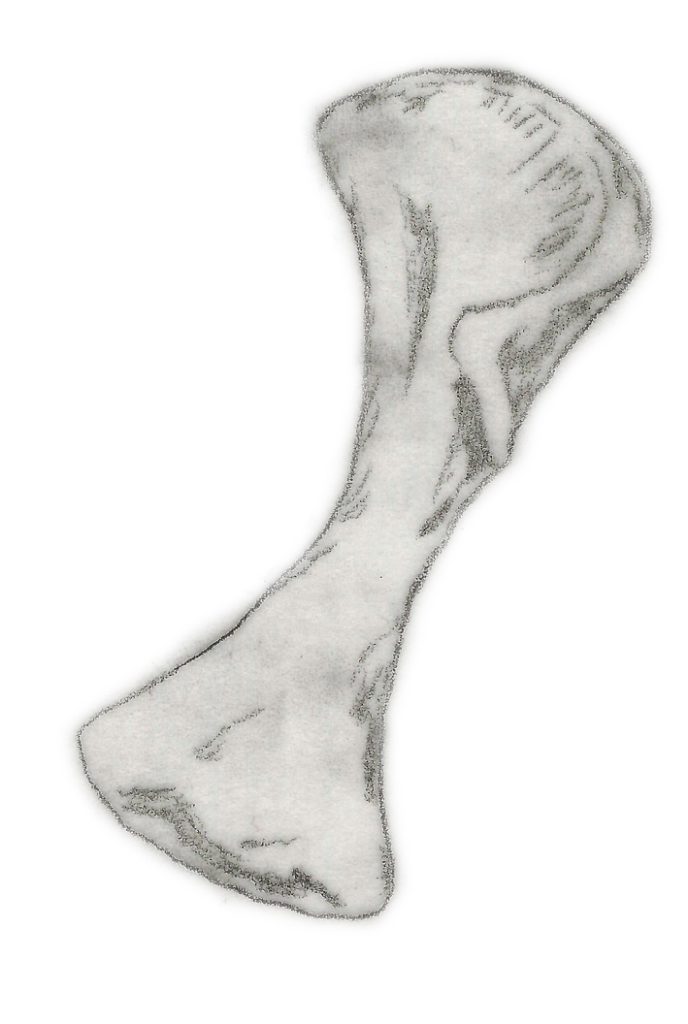

Later authors treat these bones as a syntype series, several specimens that jointly carry the name. After 1924, however, many extra bones, mostly of Plateosauravus, joined them under the same numbers. McPhee and colleagues suggested a neotype—a replacement name-bearing specimen—”may therefore be necessary.” Barrett and Choiniere instead chose a lectotype from the original bones, listed in a 2026 comparison table as SAM-PK-3449.
In 1997, Van Heerden and Galton referred NMQR 1551 to the species. Galton and colleagues referred and described NMQR 3314 in 2005, two years before Yates described its complete skull. Yet NMQR 3314 comes from the younger upper Elliot Formation, and both now count as indeterminate sauropodomorphs. In 2024, the hypodigm—the full list of assigned specimens—shrank to the lectotype.
Melanorosaurus Size and Description
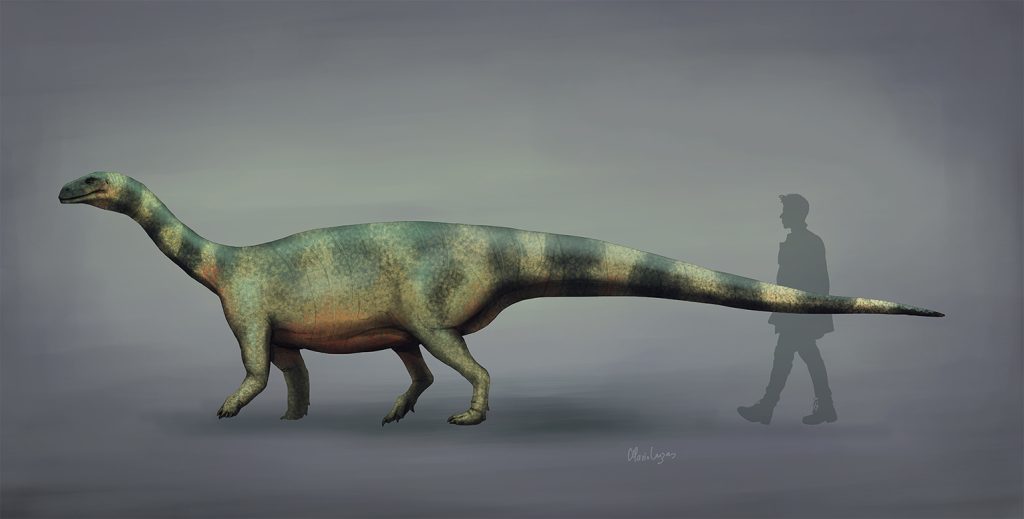
Stripped back to its original bones, Melanorosaurus is harder to picture than older books suggest.
Short description of Melanorosaurus
The lectotype preserves no skull or teeth, so any restoration with a head borrows from excluded material. Haughton described vertebrae with centra—the spool-shaped vertebral bodies—”considerably longer than high.” One dorsal (back) centrum measured about 4.3 inches (110 millimeters) long and 3.7 inches (95 millimeters) high. The tibia was “a massive bone” with a straight shaft and a broadened lower end. A straight metatarsal, probably the third, measured about 8 inches (200 millimeters).
The pelvis included an ilium—the upper hip bone—with a short rear process ending in “a hook-like projection.” Haughton thought its shape “most like that of” Massospondylus. No skin or soft tissue survives, so any discussion of its outer covering is speculative. Its posture is also unknown for the lectotype, since arguments about four-legged walking rested mainly on NMQR 1551 and NMQR 3314. The latter anchored a 2007 forelimb study by Matthew Bonnan and Adam Yates.
Size and Weight of Type Species
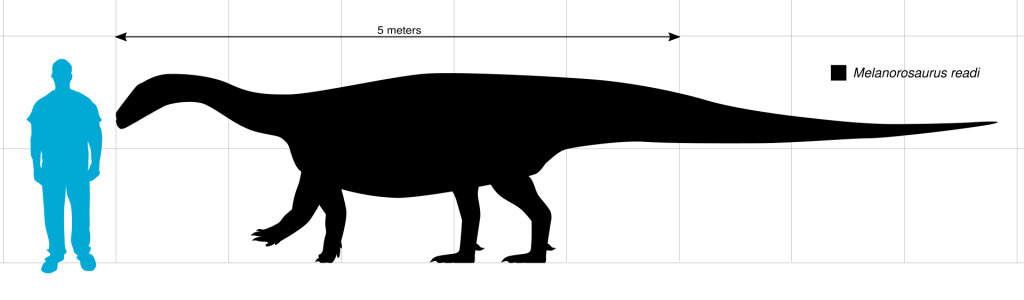
No published length, height, or weight exists for the lectotype. The Natural History Museum’s fact page gives an older figure of about 39 feet (12 meters) but does not give its basis. Likewise, published size estimates predate 2024 and drew on specimens since removed from the genus.
The bones themselves still speak to size. Haughton’s tibia measured about 1 foot 6 inches (45 centimeters), and his fibula reached about 1 foot 7 inches (477 millimeters). A right ulna (forearm bone) that Haughton figured with the type ran about 12 inches (300 millimeters), and the doubtful femur about 2 feet (620 millimeters). Haughton counted Melanorosaurus among the “still large forms” a little above the base of the Red Beds.
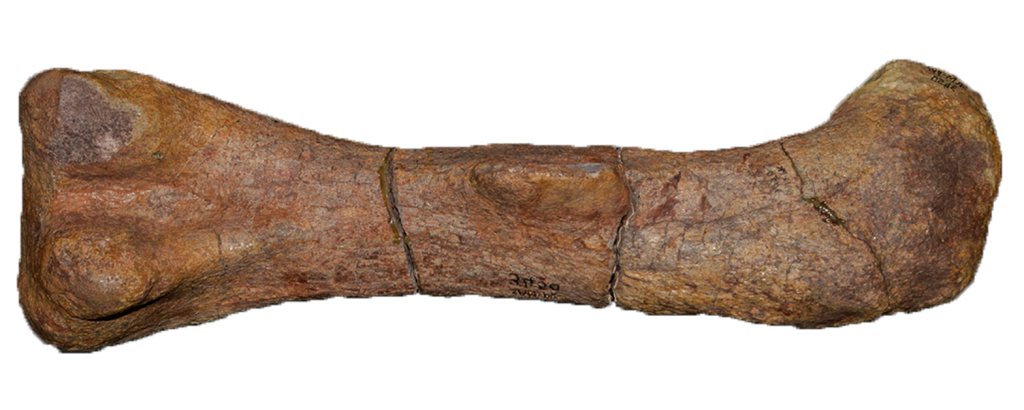

SAM 3532, a smaller specimen Haughton also referred to the species, adds a 20-inch (500-millimeter) humerus and an 18-inch (450-millimeter) scapula, or shoulder blade. Because it is not part of the lectotype, any estimate of overall body size must stay open.
The Dinosaur in Detail
What sets this dinosaur apart today is less a single feature than a careful diagnosis. In Haughton’s diagnosis, the vertebrae were lighter and smaller relative to the femur than in Gresslyosaurus and Euskelesaurus. The humerus had a sharply bent lateral process, while the femur had a straight shaft, with the fourth trochanter—a muscle-attachment ridge—ending below mid-length. Finally, the lower tibia was “broader in front than behind.” He also noted an S-shaped rear edge on the ulna, unlike the straight edge in Plateosaurus. Two of those traits, however, relied on the since-excluded femur.
Barrett and Choiniere now diagnose the species “on the basis of features of the caudal vertebrae and ilium”—tail and hip bones. Their abstract, however, does not list those features. In 2026, the describers of Nyana, a new lower Elliot sauropodomorph, noted tall middle neck vertebrae in Melanorosaurus.
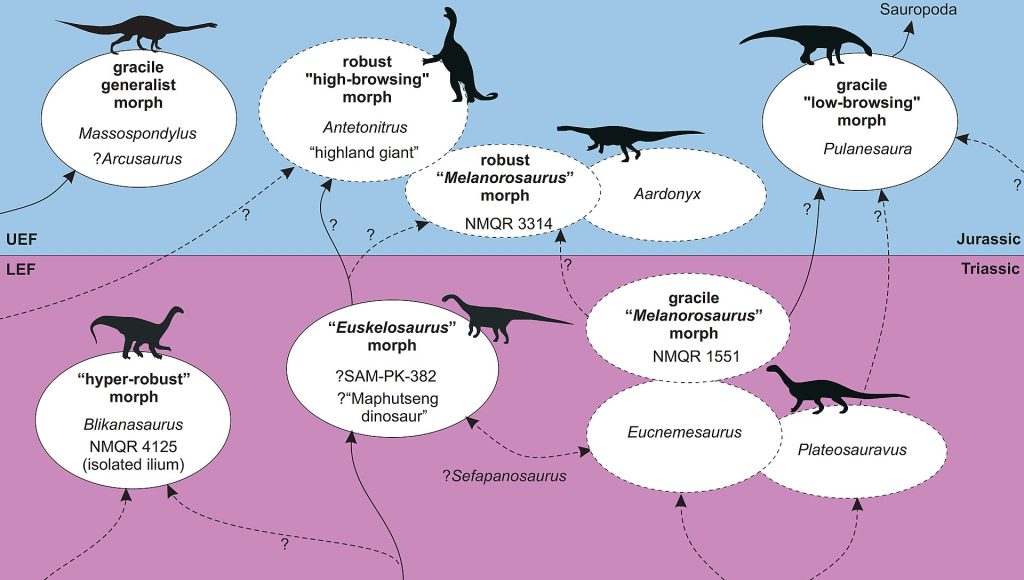

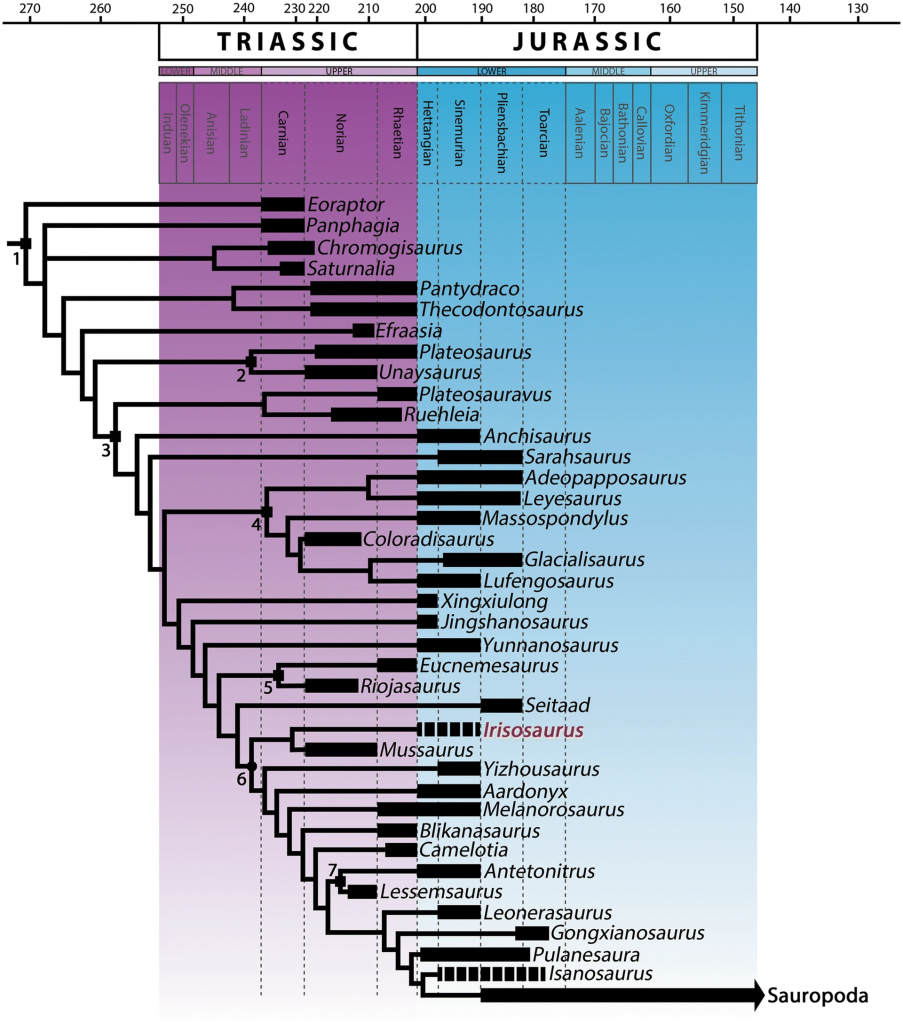
Yates (2007) and later authors used Melanorosaurus as the external specifier in the stem-based definition of Sauropoda, marking which animals did not count. In 2016, Peyre de Fabrègues and Allain analyzed a composite Melanorosaurus that included specimens since removed. It fell in a polytomy, an unresolved branch, with Anchisaurus, Blikanasaurus, Camelotia, Aardonyx, Meroktenos, and the clade uniting Antetonitrus, Lessemsaurus, and Sauropoda.
By 2024, Barrett and Choiniere pointed to its fragmentary bones, “lack of clear ‘sauropod-like’ features,” and “phylogenetic lability.” Using it as a specifier, they suggested, “is no longer appropriate.” The genus survives, but as a modest, hard-to-place sauropodiform rather than the sauropod forerunner of popular accounts.
Interesting Points about Melanorosaurus
- Haughton named Melanorosaurus readi and Plateosauravus cullingworthi, then called Plateosaurus cullingworthi, in the same 1924 paper.
- After 1924, many bones, mostly of Plateosauravus, ended up under the Melanorosaurus type numbers, helping turn the genus into a long-running puzzle.
- A complete skull once celebrated as Melanorosaurus came from younger upper Elliot rocks, which gave researchers “robust grounds” to remove it from the genus.
- The second named species, M. thabanensis from Lesotho, was once called “the only Early Jurassic Melanorosauridae” but now belongs to Meroktenos and the Late Triassic.
- For years its name anchored the definition of Sauropoda, a role its 2024 describers suggested is “no longer appropriate.”
Dinosaurs from the Same Formation
Also known from the lower Elliot Formation (exact level relative to Melanorosaurus not known): Nyana, Plateosauravus, Eucnemesaurus, Blikanasaurus, Kholumolumo, and Meroktenos. Nyana, an early sauropodomorph known from a juvenile skull and partial skeleton, lies about 460 feet (140 meters) above the formation’s base at Qhemegha. Haughton placed Plateosauravus a little lower than Melanorosaurus, though its exact position is unknown. By contrast, specimens of Eucnemesaurus, Blikanasaurus, and the bipedal Kholumolumo come from low in the formation, within roughly its first 160 feet (50 meters). Meroktenos, from Lesotho’s Mafeteng district, lacks a precise site altogether. The lower Elliot spans about 20 million years, so these animals may not all have lived at the same time.
Melanorosaurus in its Natural Habitat
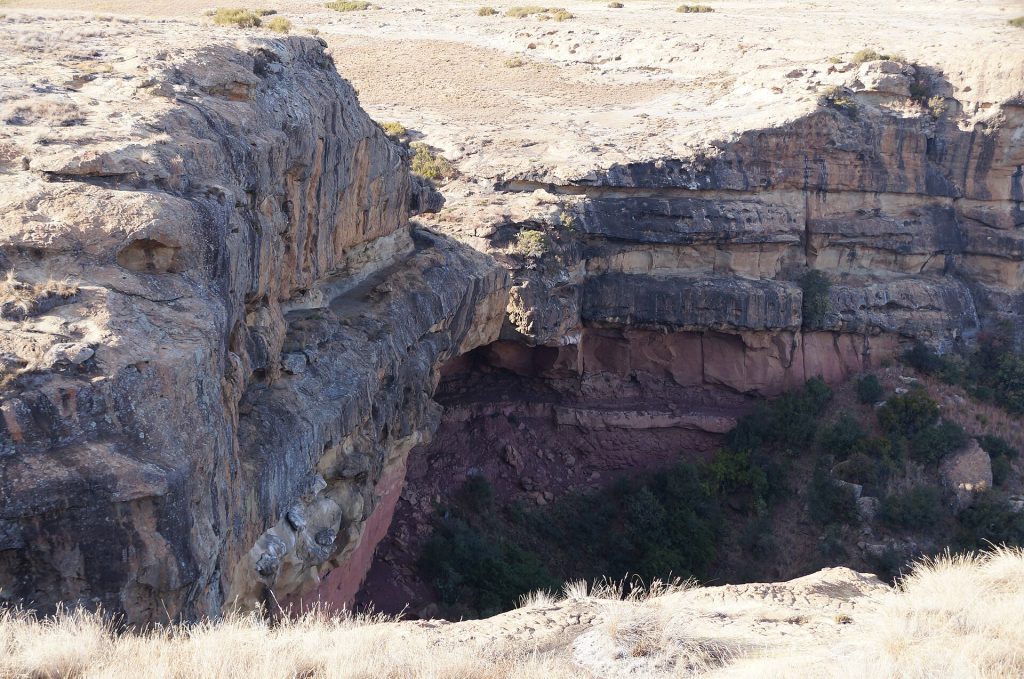
The world Melanorosaurus inhabited was one of meandering rivers, wide floodplains, and riverside forests under a humid to semi-arid climate. Olive-gray to purplish-red mudstone units, typically 65 to 100 feet (20 to 30 meters) thick, record that setting. At the type locality, cross-bedded channel sandstones up to 33 feet (10 meters) thick stack one on another. Haughton read the basal Red Beds as “flood-plain deposits in a semi-arid climate,” with “aridity increasing as time went on.”
What Melanorosaurus ate remains unknown, because no skull or teeth belong to the lectotype. The Natural History Museum lists it as omnivorous, but no study of the lectotype states a diet. More broadly, early-branching sauropodomorphs dominated the lower Elliot fauna. McPhee and colleagues noted it so far lacks taxa as gracile as Massospondylus. They took this to suggest “a genuine ecological bias” toward larger sauropodomorphs. Trackways also led Bordy and colleagues to infer quadrupedal sauropodomorphs in southern Africa by between about 220 and 216 million years ago. None of those tracks is tied to Melanorosaurus.
The lectotype reveals nothing about its social life, growth, or behavior. Haughton, however, saw large, heavy-limbed forms such as Melanorosaurus low in the Red Beds giving way to smaller, more agile ones as aridity grew. Sauropodomorphs, but not ornithischians or theropods, had become well established in the main Karoo Basin by about 220 million years ago. Non-dinosaurs lived there too, including Scalenodontoides, a cynodont (mammal relative) that names the local fossil zone.
Melanorosaurus Gallery
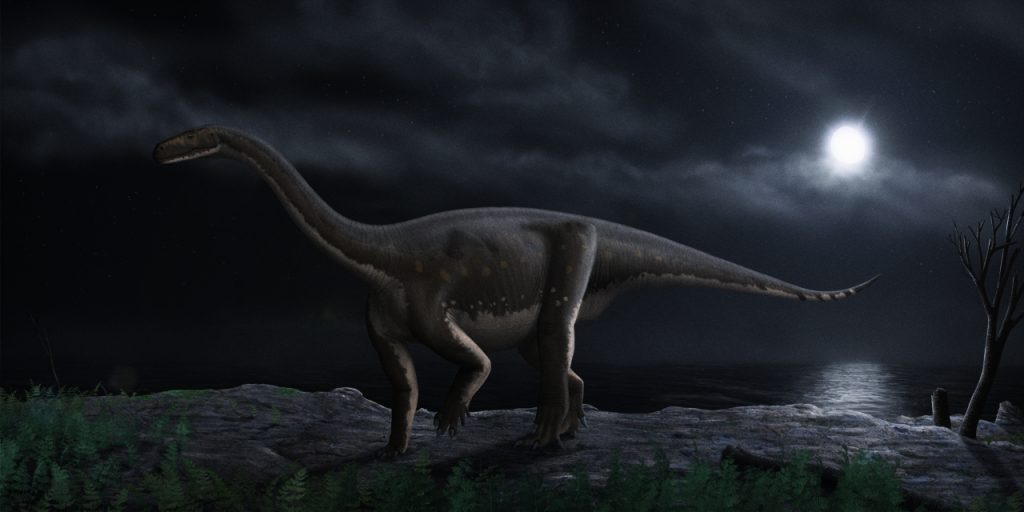
These further images show restorations, family trees, and fossils of Elliot Formation relatives.







Frequently Asked Questions
It means “Black Mountain lizard,” after Thaba ‘Nyama, the South African mountain where its bones were found.
It lived in the Norian stage of the Late Triassic, roughly 220 to 206 million years ago.
No published length, height, or weight exists for the lectotype. Its tibia alone measured about 1 foot 6 inches (45 centimeters).
It was a sauropodomorph, described in 2024 as a sauropodiform, though its exact position on the family tree remains unstable.
Its bones came from the lower Elliot Formation on Thaba ‘Nyama, in the Herschel district of South Africa’s Eastern Cape.
It once anchored the definition of Sauropoda, but since 2024 the species has rested on a single lectotype individual.
Sources
The information in this article is based on various sources, drawing on scientific research, fossil evidence, and expert analysis. The aim is to provide a comprehensive and accurate overview of Melanorosaurus. However, please be aware that our understanding of dinosaurs and their world is constantly evolving as new discoveries are made.
- https://archive.org/details/annalsofsouthafr12sout
- https://doi.org/10.1080/02724634.2024.2337802
- https://doi.org/10.4202/app.00377.2017
- https://www.app.pan.pl/archive/published/app62/app003772017.pdf
- https://doi.org/10.1016/j.earscirev.2020.103120
- https://ora.ox.ac.uk/objects/uuid:4d2bdd32-b2da-42fd-bebb-58899f483492
- https://doi.org/10.7717/peerj.1639
- https://doi.org/10.1111/joa.14229
- https://doi.org/10.1098/rsos.261002
- https://doi.org/10.7717/peerj.15970
- https://dml.reptilis.net/2007Mar/msg00059.html
- https://doi.org/10.25131/sajg.123.0017
- https://doi.org/10.1080/02724634.2019.1732996
- https://stratigraphy.org/ICSchart/ChronostratChart2024-12.pdf
- https://www.nhm.ac.uk/discover/dino-directory/melanorosaurus.html
This article was last fact checked: TheDinosaurs Team, 25-11-2026
Featured Image Credit: Sidney H. Haughton, 1924 (uploaded by Ghedo), Public domain, via Wikimedia Commons
