
In southeastern Alberta, at the Onefour Research Station, the upper layers of the Dinosaur Park Formation have yielded a horned dinosaur that spent 86 years under another genus’s name. Now called Cryptarcus russelli, it was a chasmosaurine ceratopsid—a member of one branch of the large horned dinosaurs. It lived about 75 million years ago, during the Campanian stage of the Late Cretaceous. The exact figure depends on how its level is matched to dated ash beds elsewhere. Its skull combines features of Chasmosaurus from Dinosaur Provincial Park with those of horned dinosaurs from the southwestern United States. As a result, where its lineage came from is still an open question.
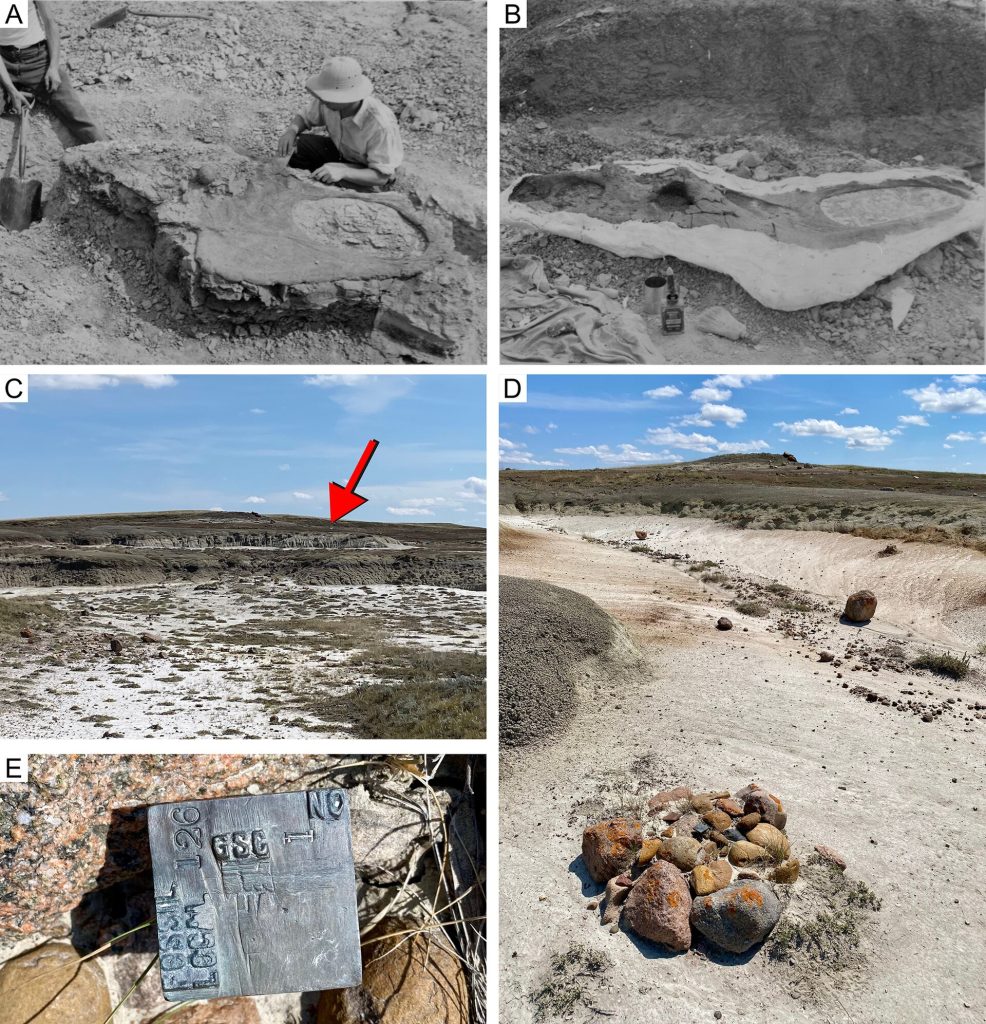
The quarry was excavated under the oversight of Loris Russell, and paleontologist C. M. Sternberg marked the site with a stake in 1937. Three years later, Sternberg named the skull Chasmosaurus russelli. In 2026, paleontologists Robert B. Holmes, Jordan C. Mallon, Michael J. Ryan, and David C. Evans restudied the holotype and concluded that it fit no known chasmosaurine genus. Their answer was a new name—and a reminder that a skull studied for decades can still change how a species is classified.
Cryptarcus Key Facts
| Keyword | Fact |
|---|---|
| Pronunciation | Not specified |
| Meaning of name | Hidden Arch |
| Group | Ceratopsian (Chasmosaurinae) |
| Type Species | Cryptarcus russelli |
| Diet | Herbivore |
| When it Lived | Around 75 MYA |
| Period | Cretaceous |
| Epoch | Late Cretaceous (Campanian stage) |
| Length | Not specified |
| Height | Not specified |
| Weight | Not specified |
| Mobility | Moved on all four legs (quadrupedal), as modeled for ceratopsids |
| First Discovery | 1936 by a party under Loris Russell with H. Johnsen, quarry staked by C. M. Sternberg in 1937 |
| Described by | 1940 by C. M. Sternberg (as Chasmosaurus russelli), new genus 2026 by Robert B. Holmes, Jordan C. Mallon, Michael J. Ryan, and David C. Evans |
| Holotype | CMNFV 8800 (earlier cited as CMN 8800) |
| Location of first find | Quarry at the Onefour Research Station, upper Dinosaur Park Formation, southeastern Alberta, Canada |
Cryptarcus Origins, Taxonomy and Timeline
According to the fossil news site Everything Dinosaur, the name Cryptarcus means “hidden arch.” The “hidden” part refers to the species’ long concealment inside Chasmosaurus. Meanwhile, the “arch” points to the arch-like shape of its frill, the bony shield at the back of the skull. Together, the name refers to its misplaced identity and to its arched frill.
Cryptarcus belongs to Ceratopsidae, the family of large horned dinosaurs, and to its subfamily Chasmosaurinae. C. russelli is its type and only known species, and for decades it sat within Chasmosaurus. In 2020, Fowler and Freedman Fowler divided chasmosaurines into a Chasmosaurus clade and a Pentaceratops clade. They placed the specimens then referred to “C. russelli” in the first. However, the 2026 authors found that, under current definitions, the holotype fits neither Chasmosaurus nor any other known chasmosaurine genus. Cryptarcus russelli is therefore a new combination—Sternberg’s species in a new genus.
In 2016, Campbell and colleagues placed the quarry about 1 meter below the Lethbridge Coal Zone, a coal-rich band high in the formation. They equated that level with roughly 54 meters above the base of the formation in Dinosaur Provincial Park, give or take about 5 meters. In 2022, Ramezani and colleagues dated volcanic ash beds below and above that level with high-precision uranium-lead methods. Their dates bracket the holotype at roughly 75.6 to 75.0 million years ago—nearer the younger end, in the upper Campanian. Older argon-argon dates cited in 2016 had put the same beds at about 76.4 and 76.1 million years.
Discovery & Fossil Evidence
The type quarry lies at the Onefour Research Station in southeastern Alberta. According to specimen records compiled by Campbell and colleagues, Loris Russell and H. Johnsen collected the skull there in 1936, with Russell overseeing the excavation. It came from a sandstone layer, and Sternberg emplaced the quarry stake “Fossil Local 126 GSC 1” in 1937. For years, paleontologists thought the specimen came from the lower part of the formation. In July 2012, however, a team working under permits issued to Evans and Ryan relocated the quarry without excavating. Their fieldwork, published in 2016 by Campbell and colleagues, showed that it came from the upper Dinosaur Park Formation instead.
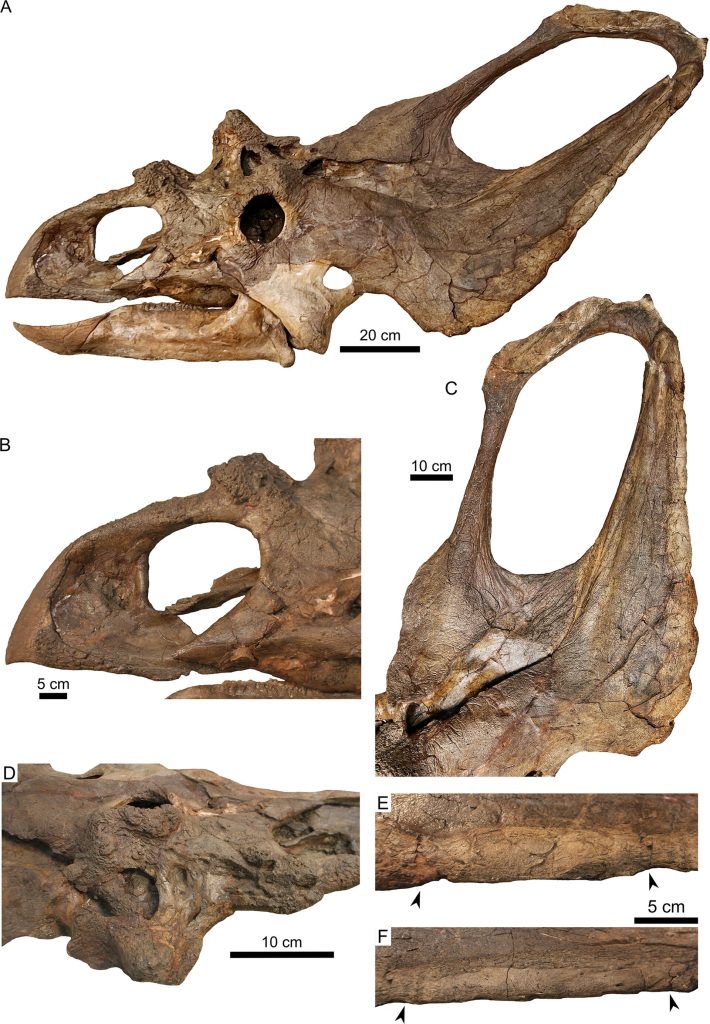
The Canadian Museum of Nature in Ottawa holds the holotype, CMNFV 8800, a mostly complete skull missing the lower jaw. It also lacks parts of the rostral (the beak bone at the tip of the upper jaw), the jugals (cheekbones), and the right quadrate (a jaw-joint bone). Similarly, gaps affect the squamosal and parietal, the paired and central bones of the frill. According to Everything Dinosaur, the restudy removed old paint and plaster restorations, and it identified a jugal restored during the late-1930s preparation.

Beyond the holotype, the 2026 paper figures a referred partial parietal from near Onefour, catalogued as TMP 2013.019.0038. It also figures a left postorbital horncore—the bony core of a brow horn—catalogued as CMNFV 55193 and called “possibly referable.” Meanwhile, Everything Dinosaur reports that fossils from the lower Dinosaur Park Formation long assigned to C. russelli will be reassessed in a future study. For now, the phylogenetic analysis scored the holotype alone.

Cryptarcus Size and Description
Because Cryptarcus is known almost entirely from one skull, its portrait is a head-first one.
Short description of Cryptarcus
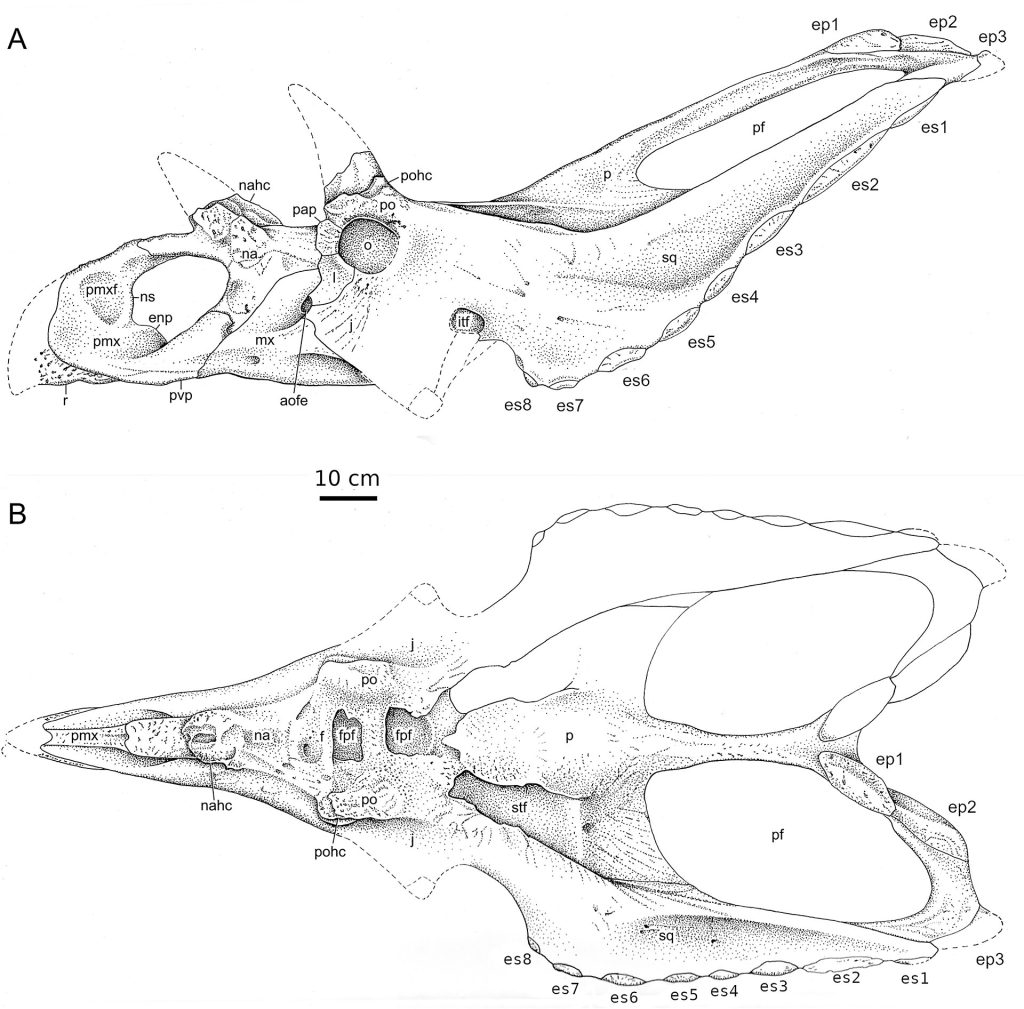
The skull carried a nasal horn and a pair of brow horns, all reduced by resorption—the body re-absorbing bone. Campbell and colleagues considered this probably age-related. Resorption affected only part of the nasal horn, but it reduced the brow horns to their bases. Even so, Campbell and colleagues inferred that the brow horns had been long, judging from their broad bases. The frill was wider at the front than at the back, and a deep, arch-like notch, the parietal embayment, cut into its rear edge. Its first epiparietals—small bony points on the frill’s margin—nearly met at the midline.
The suture between the rostral and the premaxilla, the front upper jaw bone, had closed. For this reason, Campbell and colleagues placed the skull in the most mature growth stage of their study of Chasmosaurus skulls. Since no body bones survive with it, reconstructions borrow the rest of the animal from relatives. Like other ceratopsids, it probably walked on all four legs.

Size and Weight of Type Species
No length, height, or weight has been published for Cryptarcus. Without a skeleton, any body estimate would have to rest on comparisons with relatives.
For context only, adult Chasmosaurus skulls—the age class that includes the holotype—usually measure about 2.5 to 3.0 feet (750 to 900 millimeters) from beak to cheek horn. That range covers the whole class, not this skull alone.
Until someone finds a body, the size of Cryptarcus remains an open question—at least according to the current fossil record.
The Dinosaur in Detail
What sets this dinosaur apart, according to its 2026 describers, are unique features of the premaxilla and of the frill’s epiossifications—the small bones set along its edge. In addition, it shares features with Chasmosaurus from Dinosaur Provincial Park and with chasmosaurines from the southwestern United States. Its broad-fronted frill, deep embayment, and nearly touching first epiparietals all recall Pentaceratops.
Long before 2026, the frill had already set the species apart. In 1995, Godfrey and Holmes kept C. belli and C. russelli as separate species, while admitting much gradational variation. Later, Campbell and colleagues upheld C. russelli on a single trait—a rear frill notch angled between 89 and 128 degrees. They also accepted a 2011 proposal by Maidment and Barrett that Mojoceratops perifania is a junior synonym of C. russelli. Then, in 2020, Fowler and Freedman Fowler argued that the holotype “requires redescription” and would likely need to leave Chasmosaurus. Now that the species rests on the holotype alone, the status of Mojoceratops and of the lower-formation C. russelli skulls is open again.
The 2026 analysis, scoring only the holotype, produced three different results. One placed it nearer Chasmosaurus, another nearer Pentaceratops, and a third left it unresolved. From this, the authors offered two hypotheses. On one hand, Cryptarcus may represent a migrant from the southern Pentaceratops clade. On the other hand, it may belong to a lineage closer to Chasmosaurus that evolved its Pentaceratops-like traits convergently. Notably, none of the results supported a recently proposed anagenetic trend—one species evolving into the next—from C. russelli through Pentaceratops to Terminocavus.
Even after the restudy, Cryptarcus remains a horned dinosaur whose northern address and southern-looking frill still pull in opposite directions.
Interesting Points about Cryptarcus
- The species was named in 1940, but its genus, Cryptarcus, was only created in 2026.
- Campbell and colleagues placed its holotype in their most mature growth stage, marked by a closed suture between the beak bone and the premaxilla.
- Fieldwork in 2012 moved the holotype from the lower to the upper Dinosaur Park Formation.
- Its describers’ analysis allowed links to either Chasmosaurus or Pentaceratops, so its closest relatives remain undecided.
- According to Everything Dinosaur, the genus name refers to the species hiding inside Chasmosaurus for decades and to its arch-shaped frill.
Contemporary Dinosaurs
Plotted at about the same level of the upper Dinosaur Park Formation, within an error margin of about 5 meters, was Vagaceratops irvinensis, another chasmosaurine once placed in Chasmosaurus. In 2016, Campbell and colleagues placed two Vagaceratops specimens at about 54.4 and 53 meters, close to the Cryptarcus holotype’s projected height of about 54 meters. One came from Dinosaur Provincial Park, while the other, from Manyberries, is identified only to genus. In 2020, Fowler and Freedman Fowler dated Vagaceratops to about 76.1 million years ago, on an older dating of the formation, and placed it in their Chasmosaurus clade. The two frilled horned dinosaurs may therefore have shared the same coastal landscape, although no direct interaction between them is known.
Also known from the Dinosaur Park Formation (exact level relative to Cryptarcus not known): the crested hadrosaur Lambeosaurus magnicristatus, the tyrannosaurid Gorgosaurus, the small caenagnathid theropod Citipes, and the hadrosaurid Prosaurolophus. According to Ramezani and colleagues, the formation spans about 2 million years, so these animals may not all have lived at the same time.
Cryptarcus in its Natural Habitat
The world Cryptarcus roamed was a coastal lowland slowly giving way to the sea. Over its span, the formation records a transgression—the sea advancing over the land—from sandy to muddy to coal-rich layers. Its rocks preserve river, estuary, and shoreline settings with more coastal influence than the Oldman Formation below. As the Western Interior Seaway crept inland, the Lethbridge Coal Zone marked a shift toward marine conditions. The holotype lies just below that zone, late in the sequence. In fact, the formation has even yielded an elasmosaurid plesiosaur, a marine reptile.
As a ceratopsid of this formation, Cryptarcus was a herbivore—one of the region’s megaherbivores, or very large plant-eaters. Group-level reconstructions suggest that ceratopsids here fed no higher than about 3.3 feet (1 meter) or slightly above. Because that study predates the name, this applies to the group rather than to Cryptarcus directly.
While there is no direct evidence of whether Cryptarcus lived alone or in groups, its setting is better known. Its plotted level falls in a faunal zone named for Lambeosaurus magnicristatus and an unnamed “pachyrhinosaur”—the Lambeosaurus magnicristatus–pachyrhinosaur Zone.
Frequently Asked Questions
According to Everything Dinosaur, it means “hidden arch,” for its long concealment inside Chasmosaurus and its arch-shaped frill.
It lived during the Campanian stage of the Late Cretaceous, about 75 million years ago.
No length or weight has been published, and only a skull is known in detail.
It was a herbivore, like the other large ceratopsids of the Dinosaur Park Formation.
Its holotype came from a quarry at the Onefour Research Station in the upper Dinosaur Park Formation of southeastern Alberta.
Its describers cite unique features of the premaxilla and frill epiossifications, plus a frill that recalls Pentaceratops.
Sources
The information in this article is based on various sources, drawing on scientific research, fossil evidence, and expert analysis. The aim is to provide a comprehensive and accurate overview of Cryptarcus. However, please be aware that our understanding of dinosaurs and their world is constantly evolving as new discoveries are made.
- https://doi.org/10.1139/cjes-2025-0031
- https://commons.wikimedia.org/wiki/File:Cryptarcus_locality.jpg
- https://commons.wikimedia.org/wiki/File:Cryptarcus_referred_and_possible_Cryptarcus_fossils.jpg
- https://doi.org/10.1371/journal.pone.0145805
- https://doi.org/10.7717/peerj.9251
- https://doi.org/10.1186/1472-6785-13-14
- https://doi.org/10.1371/journal.pone.0067182
- https://doi.org/10.1186/s12898-016-0106-8
- https://doi.org/10.1126/sciadv.adi0505
- https://doi.org/10.7717/peerj.10720
- https://blog.everythingdinosaur.com/blog/_archives/2026/04/17
- https://doi.org/10.1038/s41598-022-19896-w
- https://doi.org/10.18435/vamp29362

This article was last fact checked: TheDinosaurs Team, 20-11-2026
Featured Image Credit: Connor Ashbridge, CC BY 4.0, via Wikimedia Commons
