
Near Salas de los Infantes in northern Spain, a thin lens of red clay held the broken bones of a very small plant-eater. The clay belongs to the Castrillo de la Reina Formation. Named Foskeia pelendonum in 2026, the animal lived during the late Barremian to early Aptian stages of the Early Cretaceous. Its describers place it in Rhabdodontomorpha, a lineage of iguanodontian ornithopods, and in a new European clade they call Rhabdodontia. It was slender and one of the smallest ornithopods ever reported—press coverage compared it with an adult chicken.
The site, known as Vegagete, was excavated in 1998. Its bones were first identified as a possible Hypsilophodon and later only as an indeterminate ornithopod. In 2016, Paul-Emile Dieudonné and colleagues described the material in detail, but the fragments did not allow a formal diagnosis. A decade later, newly identified skull bones—scanned and rebuilt in 3D—finally gave the animal its name. Its story shows how a handful of fragments can still stir up fresh questions about the dinosaur family tree.
Foskeia Key Facts
| Keyword | Fact |
|---|---|
| Pronunciation | Not specified |
| Meaning of name | Light Forager (per press releases) |
| Group | Ornithopoda (Rhabdodontomorpha) |
| Type Species | Foskeia pelendonum |
| Diet | Herbivore |
| When it Lived | Late Barremian to early Aptian, about 125 to 120 MYA |
| Period | Cretaceous |
| Epoch | Early Cretaceous (late Barremian to early Aptian stages) |
| Length | About 1.6 to 2.3 feet (0.5 to 0.7 meters) |
| Height | About 1 foot (30 centimeters), per a CONICET release |
| Weight | About 8.8 pounds (4 kilograms), per a CONICET release |
| Mobility | Moved on two legs as an adult, though young juveniles may have walked on four, per a 2022 histology study |
| First Discovery | Excavated in 1998 (discovery and inventory credited to Fidel Torcida Fernández-Baldor) |
| Described by | 2026 by P.-E. Dieudonné, M.G. Becerra, T. Zanesco, T. Tortosa, P. Cruzado-Caballero, K. Stein, and F. Torcida Fernández-Baldor |
| Holotype | Not specified |
| Location of first find | Vegagete site, Castrillo de la Reina Formation, Salas de los Infantes, Burgos Province, Spain |
Foskeia Origins, Taxonomy and Timeline
According to a press release from the Vrije Universiteit Brussel (VUB), the genus name draws on the Greek “fos,” meaning “light,” for the lightweight, small adults. The same release traces “skei” to the Greek boskein, meaning “foraging.” Meanwhile, the species name pelendonum honors the Pelendones, a Celtiberian tribe from the Fuentes del Duero area.
Foskeia belongs to Ornithopoda and, more narrowly, to Iguanodontia. Within that group it sits in Rhabdodontomorpha, a clade named in 2016 to unite the Australian Muttaburrasaurus with the Rhabdodontidae. However, analyses by Fonseca and colleagues in 2024 and by Czepiński and Madzia in 2025 placed Muttaburrasaurus outside that clade. In the 2026 analysis, Rhabdodontomorpha nests at the base of Ankylopollexia, a group of more derived iguanodontians. According to the VUB release, that analysis also recovered Foskeia as the closest relative of Muttaburrasaurus. Without the full paper, though, it is unclear how this fits with Rhabdodontia. The abstract defines that new clade as a restricted group of European rhabdodontomorphs, including Foskeia and the rhabdodontids. Foskeia pelendonum is the type and only known species.
Separately, a 2026 study in Nature by Maidment and colleagues argued that some “rhabdodontid” taxa were actually ceratopsians—the horned dinosaurs and their kin. That study appeared weeks before Foskeia received its name, so its bearing on Rhabdodontia remains an open question.
The rocks are dated to the late Barremian to early Aptian using charophytes (stonewort algae) and ostracods (tiny seed shrimps). That window straddles the stage boundary, which the International Commission on Stratigraphy places at 121.4 million years ago. Press reports give rounder figures of about 125 or around 120 million years ago. During this part of the Cretaceous, western European faunas shared Gondwanan affinities, which the 2016 authors linked to a land connection called the “Apulian Route.”
Discovery & Fossil Evidence
Vegagete lies between the municipalities of Salas de los Infantes and Villanueva de Carazo, in the north-western Cameros Basin. That basin filled with sediment between the Tithonian and the Albian, as a rift opened along the Iberian Range. The deposit itself was a red clay lens covering roughly 32 square feet (3 square meters) and no deeper than 2 inches (5 centimeters). The 2016 paper credits Fidel Torcida Fernández-Baldor with discovering and inventorying the material. It came partly as a donation from the Colectivo Arqueológico y Paleontológico Salense and partly from a regional heritage prospecting campaign.
All of the Vegagete material is housed at the Museo de Dinosaurios de Salas de los Infantes. Its fragments are numbered MDS-VG,1 to MDS-VG,280, although many remain uninventoried. Described elements include pieces of the dentary (lower jaw bone), premaxilla (front upper jaw), and maxilla (main upper jaw bone), plus teeth. There are also a laterosphenoid (a braincase bone), vertebrae from neck to tail, girdle and limb pieces, and a reconstructed foot.
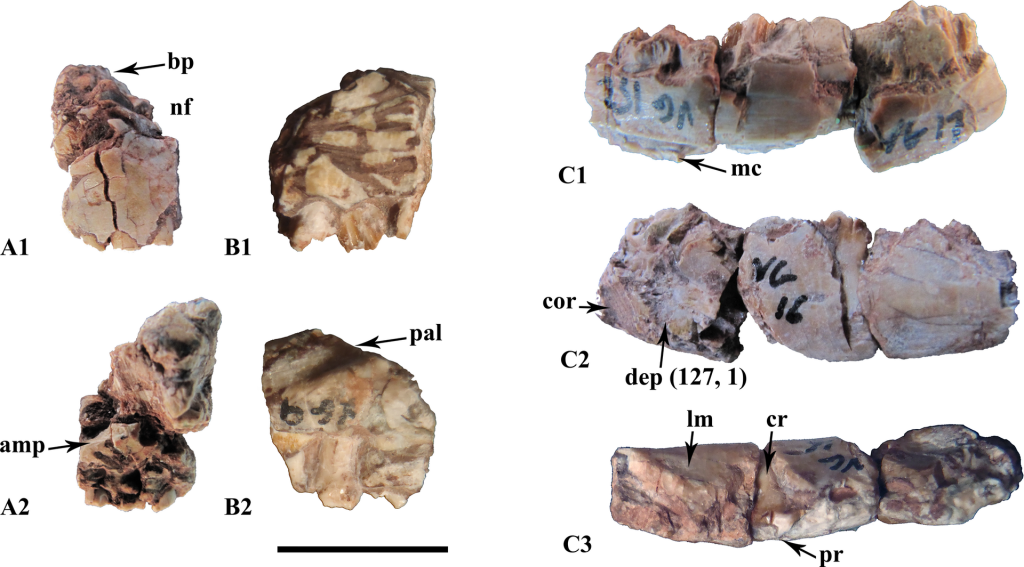

The assemblage holds a single species and is mostly fractured, preserving chiefly the ends of long bones. By counting left and right fragments of the second metatarsal (a foot bone), the 2016 team found at least five individuals. These fall into three size-based growth stages—one very small, three medium, and one larger animal. In 2026, newly identified skull elements were micro-CT scanned, segmented, and assembled in 3D. Meanwhile, teeth from the nearby Peñascal site are “very similar,” although they were classified as “Ornithopoda nov. gen. et sp.”
Foskeia Size and Description
Short description of Foskeia
Its premaxillae were fused, and the teeth at the front of the upper jaw were procumbent—angled forward. The first tooth of the lower jaw was single and filiform (thread-like). Its jaw joint also sat well above the level of the tooth row. In 2025, Czepiński and Madzia, citing the 2016 description, noted a buccal platform—a shelf beside the tooth row—on its dentary. That shelf is otherwise present in all rhabdodontoids, including Zalmoxes. Co-author Marcos Becerra put it bluntly in the VUB release: “this skull is weird and hyper-derived.”
Behind the head, the 2016 team described a slender animal. The femur (thigh bone) bears an extensor groove near the knee. Foot bones of medium-sized individuals suggest a digitigrade posture—walking on the toes, as in other bipedal ornithopods. By contrast, the back of the smallest juvenile would have been more strongly arched downward than in larger animals. The described material is all bone, so any picture of its outer covering is speculative.
Size and Weight of Type Species
In 2001, Fuentes Vidarte and Meijide Calvo estimated the largest individual at about 2.1 to 2.3 feet (65 to 70 centimeters) long. The 2016 paper repeated that figure without giving a method. Press coverage of the 2026 paper is smaller still. The VUB release says “barely half a meter,” while CONICET gives about 2 feet (60 centimeters). Combined, the published figures run from about 1.6 to 2.3 feet (0.5 to 0.7 meters).
A CONICET release adds a height of about 1 foot (30 centimeters) and a weight of about 8.8 pounds (4 kilograms). It does not say how it reached either figure. For scale, a press figure shows the animal in five growth sizes, the largest just bigger than an adult chicken.
Its exact maturity is hard to pin down. In 2022, a histology study judged the largest individual a late subadult, “making it the smallest ornithopod ever recovered.” Then, in 2026, the same research group’s press release called the largest specimen a sexually mature adult.
The Dinosaur in Detail
One of its most unusual features is where a jaw-closing muscle, the m. adductor mandibulae externus superficialis, attached. The 2026 paper reports a unique extension of that attachment ventrolaterally (down and outward) onto the coronoid process—a bony prong at the back of the dentary. According to the authors, as quoted by Scientific American, its teeth suggest a “novel mode of feeding.”
The 2016 study found at least three premaxillary teeth, while its cheek teeth were remarkably similar to teeth with a “rhabdomorphan” (rhabdodontid-like) affinity. That work recovered it as a basal iguanodontian, possibly a stem member of Rhabdodontidae. If so, it pulls that family’s origin back to the late Barremian of Spain. Later, Czepiński and Madzia listed the “Vegagete ornithopod” among the best candidates for early members of the Rhabdodon lineage.
Its bones also record how it grew: a 2022 histology study found no lines of arrested growth—yearly pauses in bone growth—and inferred fast, uninterrupted hindlimb growth. The authors suggested it shifted from four legs to two as a juvenile. In their view, it probably could not run far. Instead, small size and relatively long legs would have helped it escape and hide from predators. Per the VUB release, its bone structure points to a metabolism approaching that of small mammals or birds.
The naming paper also offered a new ornithischian family tree. For example, it placed Tenontosaurus in Thescelosauridae and kept Heterodontosauridae at the base of Pachycephalosauria. It also resolved sauropodomorphs closer to ornithischians than to theropods, a result the authors call provisional. According to the VUB release, the dataset revives Phytodinosauria, a grouping of plant-eating dinosaurs, though the hypothesis “should be further tested with more data.” In short, this tiny animal carries big questions—about its own lineage and about ornithischians as a whole.
Interesting Points about Foskeia
- Press releases say the genus name combines Greek words for “light” and “foraging,” chosen for its lightweight, small adults.
- Its bones sat in a clay lens of only about 32 square feet, yet they record at least five individuals.
- It went unnamed for a decade after its 2016 description, because that material did not allow a formal diagnosis.
- A 2022 histology study called it “the smallest ornithopod ever recovered,” based on its largest individual being a late subadult.
- The same study called it the earliest known rhabdodontomorph, though researchers have since proposed an older Argentine candidate, Emiliasaura, whose placement is disputed.
Dinosaurs from the Same Formation
Also known from the Castrillo de la Reina Formation (exact level relative to Foskeia not known): Demandasaurus darwini and Europatitan eastwoodi. Demandasaurus was a rebbachisaurid sauropod, while Europatitan was a titanosauriform sauropod described as the basalmost member of the Somphospondyli. The formation spans part of the late Barremian and early Aptian, so these animals may not all have lived at the same time.
Foskeia in its Natural Habitat
Foskeia lived in a river landscape. The Castrillo de la Reina Formation alternates white river sandstones with red floodplain clays, and the Vegagete fossils came from a red clay. Elsewhere in the formation, studies describe a braided river system with well-drained floodplains. Distal alluvial plains there also recorded long spells of slow sedimentation, with occasional caliche (nodular carbonate) layers.
As a herbivore, Foskeia fed on plants, though its exact menu is unknown. The VUB release also pictures it relying on bursts of speed through dense forests.
While there is no direct evidence of its daily social life, the 2016 authors suggested the mixed-size group was living in a herd. In their view, a sudden flood likely killed the five together before carrying them a short distance. Beyond Vegagete, the Demandasaurus site, Tenadas de los Vallejos II, produced a small ornithopod, two spinosaurid vertebrae, and a crocodile tooth. At El Oterillo II, several Europatitan bones bear tooth marks. That site also yielded isolated theropod and crocodyliform teeth and an iguanodontian ilium (hip bone). In addition, the varanoid lizard Arcanosaurus ibericus comes from the same formation.
Frequently Asked Questions
Press releases say it combines Greek words for “light” and “foraging,” and pelendonum honors the Pelendones, a Celtiberian tribe.
It lived in the late Barremian to early Aptian of the Early Cretaceous, about 125 to 120 million years ago. That age comes from fossils in the rocks, not from a numerical date.
Published figures range from about 1.6 to 2.3 feet (0.5 to 0.7 meters) long. A CONICET release gives about 8.8 pounds (4 kilograms).
It was a herbivore, and its describers suggest its teeth reflect a “novel mode of feeding.”
Its fossils come from the Vegagete site in the Castrillo de la Reina Formation, near Salas de los Infantes in Burgos Province, Spain.
It combines fused premaxillae, forward-angled front teeth, a single thread-like first dentary tooth, and a unique jaw-muscle attachment.
Sources
The information in this article is based on various sources, drawing on scientific research, fossil evidence, and expert analysis. The aim is to provide a comprehensive and accurate overview of Foskeia. However, please be aware that our understanding of dinosaurs and their world is constantly evolving as new discoveries are made.
- https://doi.org/10.1002/spp2.70057
- https://doi.org/10.1371/journal.pone.0156251
- https://doi.org/10.1016/j.cretres.2022.105342
- https://ri.conicet.gov.ar/handle/11336/227344
- https://www.nature.com/articles/s41598-025-98083-z
- https://doi.org/10.1038/s41586-025-09897-w
- https://doi.org/10.4202/app.2010.0003
- https://doi.org/10.7717/peerj.3409
- https://stratigraphy.org/ICSchart/ChronostratChart2024-12.pdf
- https://www.vub.be/en/news/tiny-new-dinosaur-foskeia-pelendonum-reshapes-dinosaur-f
- https://www.eurekalert.org/news-releases/1114694
- https://www.scientificamerican.com/article/new-chicken-sized-dinosaur-baffles-paleontologists/
- https://patagoniaconfluencia.conicet.gov.ar/cientifico-del-conicet-patagonia-confluencia-describe-un-nuevo-dinosaurio-de-125-millones-de-anos-hallado-en-espana/
- https://www.sci.news/paleontology/foskeia-pelendonum-14526.html
This article was last fact checked: TheDinosaurs Team, 20-11-2026
Featured Image Credit: Connor Ashbridge, CC BY 4.0, via Wikimedia Commons
