
In Xiangyun County, in Yunnan’s Dali Bai Autonomous Prefecture, the Lower Jurassic Fengjiahe Formation has yielded a new sauropodomorph. It belongs to the long-necked lineage that also includes the giant sauropods. Named Xiangyunloong fengming in 2026, it lived during the Early Jurassic. News reports place it roughly 190 million years ago, although the paper’s abstract gives no figure. Its describers place the site about 124 miles (200 kilometers) west of the famous Lufeng dinosaur beds. That matters because early sauropodomorphs are abundant at Lufeng but relatively scarce in other regions of China.
In March 2026, a team of 14 researchers, with Shao-Bin Hu as first author, described the animal in Royal Society Open Science. The skeleton is partial—vertebrae from the neck, back and tail, plus parts of the hip, according to Sci.News. Even so, its describers found enough distinctive features to name a new genus, separate from its close relative Xingxiulong. The find widens the known cast of Early Jurassic sauropodomorphs in southwest China—one more clue to how this lineage developed before the age of giants.
Xiangyunloong Key Facts
| Keyword | Fact |
|---|---|
| Pronunciation | Not specified |
| Meaning of name | Auspicious Cloud Dragon (as reported by Everything Dinosaur) |
| Group | Sauropodomorpha |
| Type Species | Xiangyunloong fengming |
| Diet | Not specified |
| When it Lived | Around 190 MYA (as reported by Sci.News) |
| Period | Jurassic |
| Epoch | Early Jurassic (stage not specified) |
| Length | About 30 to 33 feet (9 to 10 meters), as reported by Sci.News |
| Height | Not specified |
| Weight | Not specified |
| Mobility | Possibly bipedal (as reported by The Independent) |
| First Discovery | Year not specified |
| Described by | 2026 by S.-B. Hu, Y.-C. Wang, X. Mo, X.-Q. Zhang, W.-T. Zeng, T. Wang, Z.-B. Sun, Q.-X. Dong, Q. Guan, Y.-H. Liu, Y.-S. Zhang, Y. Bing, Y.-M. Wang, and H.-L. You |
| Holotype | Not specified |
| Location of first find | First Member of the Fengjiahe Formation, near Daaonai, Xiangyun County, Dali Bai Autonomous Prefecture, Yunnan Province, China |
Xiangyunloong Origins, Taxonomy and Timeline
The name Xiangyunloong blends place and legend. According to the Everything Dinosaur blog, the genus refers to Xiangyun County and adds “loong,” a traditional term for dragon. The same source translates the name as “auspicious cloud dragon.” The species name fengming honors Lin Fengmian, founding president of the China Academy of Art, the blog reports. It also means “phoenix calling,” an echo of Luming, or “deer calling,” a town close to the fossil quarry. Together, the name ties the animal to its county, a nearby town and a pioneer of Chinese art education.
Xiangyunloong belongs to Sauropodomorpha, the broad group of long-necked dinosaurs that eventually produced the sauropods. The Paleobiology Database files it under Massopoda, a large subgroup within that lineage. In their analysis, Hu and colleagues recovered it between the Massospondylidae, the family of Massospondylus, and the Sauropodiformes (“sauropod forms”). There, it fell within an unresolved clade alongside two species of Xingxiulong—X. chengi and X. yueorum. Xiangyunloong fengming is the type and only known species.
The original paper places the fossils in the Lower Jurassic Fengjiahe Formation but names no stage in its abstract. Instead, the “roughly 190 million years ago” figure comes from Sci.News. In the Chuxiong Basin, the formation rests on the Lower Jurassic Yubacun Formation, once lumped into the older Shezi Formation. In 2021, paleontologist Hongqing Li and colleagues described that sequence, and paleontologist Xi Yao and colleagues followed it in 2022. Above lies the Middle Jurassic Zhanghe Formation. Near Xiangyun, however, the describers’ geological map shows the formation resting on the Upper Triassic Baitutian Formation. For now, the animal’s precise place within the Early Jurassic remains an open question.
Discovery & Fossil Evidence
The fossils come from Xiangyun County, at a site Sci.News places in Luming town. A geological map in the original paper marks the find with a red star near the village of Daaonai. The star sits in the First (lower) Member of the Fengjiahe Formation. However, the abstract describes the material only as recently collected, and the discovery date remains unpublished. Staff of the China Academy of Art took part in excavating and preparing the fossils, according to Everything Dinosaur.
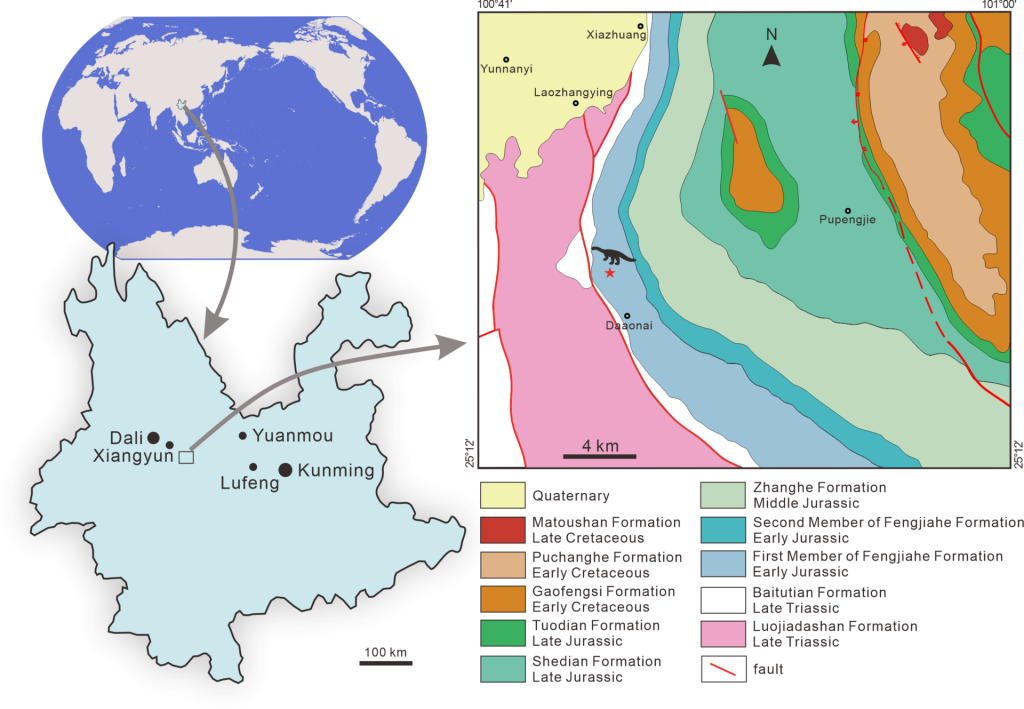

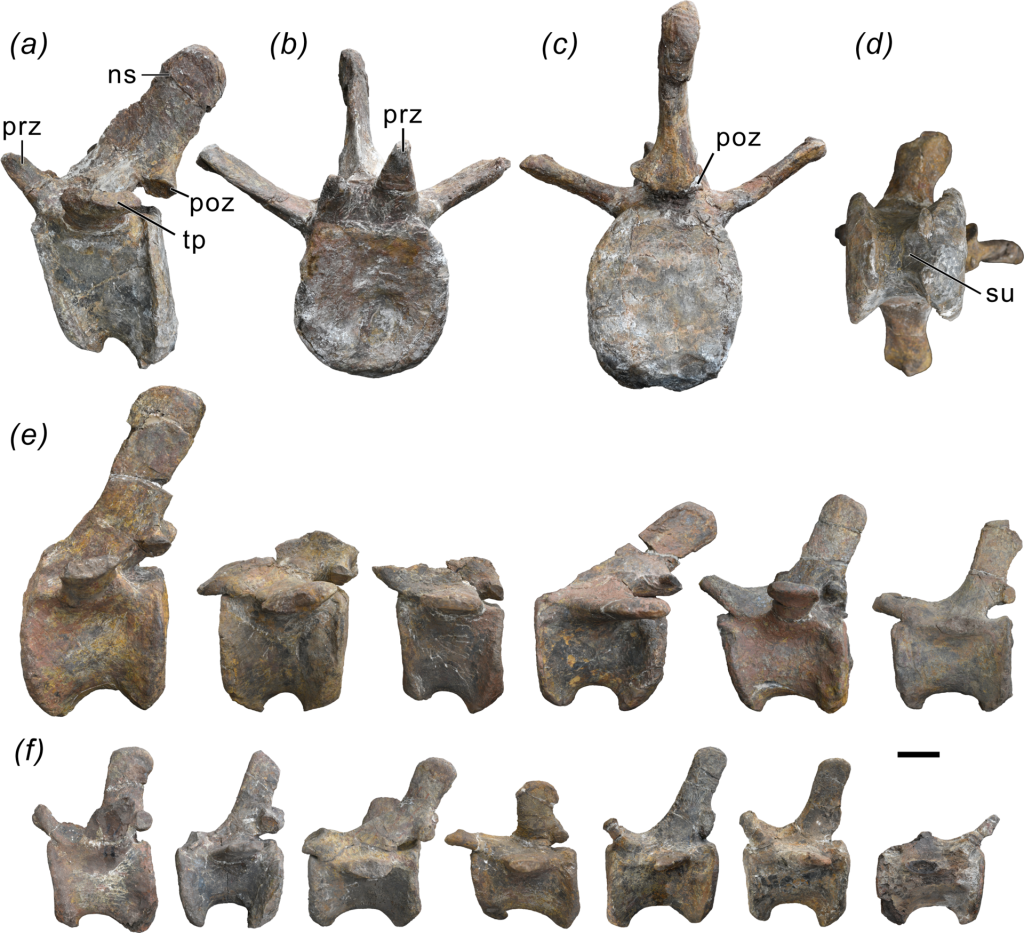
The holotype—the specimen that anchors the name—is incomplete. In the abstract, the highlighted diagnostic features sit on three kinds of bone—cervical (neck) and dorsal (back) vertebrae and the ilium, the upper hip bone. One figure shows caudal (tail) vertebrae, including the third tail vertebra in four views. It also shows two longer runs tentatively numbered as the fifth to tenth and twelfth to eighteenth. Everything Dinosaur adds dorsal rib fragments, chevrons (small bones beneath the tail), part of the left ilium and a right ischium—another hip bone.

So far, no other specimens of Xiangyunloong have been reported, and as of November 2026, no later study had cited the paper. Meanwhile, the team deposited its phylogenetic character matrix in the open Dryad repository, so other researchers can test the result.
Xiangyunloong Size and Description
With only part of the skeleton known, the portrait of Xiangyunloong rests on a handful of bones from the spine and hip.
Short description of Xiangyunloong
At the top of each neck vertebra rose a neural spine—the bony blade above the spinal cord. In Xiangyunloong, these spines carried a lateral expansion at the middle of their upper end. Farther back, the hyposphene, a bony peg that helps link neighboring back vertebrae, was heightened. At the hip, the ilium bore a supracetabular crest, a shelf above the hip socket. That crest was short from front to back but flared outward and downward.
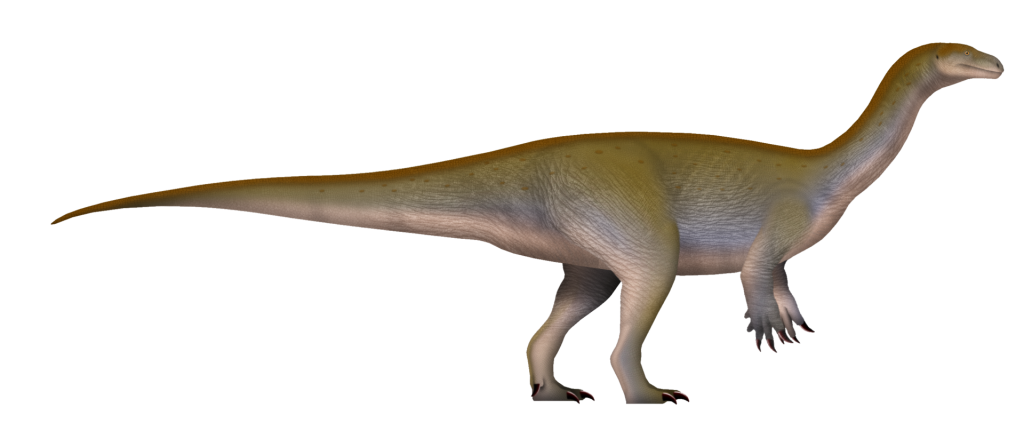
Along the tail, the paper’s figure labels neural spines, transverse processes (sideways projections) and the prezygapophyses and postzygapophyses, the joints that linked each vertebra to the next. Everything Dinosaur also describes proportionally short neck vertebrae and robust hip bones. The material includes no skull or limb bones, so its head shape remains unknown. According to Sci.News, the tail may have served as a counterbalance, letting the animal rear up on its hind legs to feed. The Independent likewise mentions a potential ability to walk on two legs. Without limb bones, though, that idea is hard to test. Skin impressions or soft tissue are not reported, so any discussion of integument is speculative.
Size and Weight of Type Species
Sci.News reports that Xiangyunloong reached approximately 30 to 33 feet (9 to 10 meters) in length. The outlet says the figure rests on its preserved bones.
Everything Dinosaur says only that “it has been speculated” the animal reached that size—a fair caution for an animal known from so few bones. Even so, the blog describes the animal as much larger than Lufengosaurus, a better-known early sauropodomorph from Yunnan.
No published figure exists for its height or body mass. Without more of the skeleton, any figure beyond length would be guesswork.

The Dinosaur in Detail
What sets this dinosaur apart is a small set of features on its neck, back and hip. Hu and colleagues introduced them as “several unique features such as” these three, so the full diagnosis may list more. The expanded neck spines, tall hyposphenes and flaring hip crest are the traits the authors chose to highlight.
Those differences matter most in comparison with Xingxiulong. In the analysis, the new animal and both Xingxiulong species formed one unresolved clade, meaning the data could not sort out their branching order. Nevertheless, the authors judged the “significant morphological distinctions” strong enough to support a separate genus. Further study of the deposited matrix may test how stable that grouping is.
Its broader position is equally telling. The analysis placed it between the massospondylids and the sauropodiforms—a stretch of the family tree close to the roots of later long-necked giants. In remarks quoted by Sci.News, coauthor Ya-Ming Wang and colleagues stressed the wider stakes. Non-sauropodan massopodans, they said, “played a crucial role in the evolutionary pathways leading to the gigantic body plans characteristic of sauropods.” These bones add a new data point on that transition from a corner of China where such fossils are uncommon.
Interesting Points about Xiangyunloong
- According to Everything Dinosaur, the name Xiangyunloong translates as “auspicious cloud dragon,” combining Xiangyun County with “loong,” a traditional term for dragon.
- The species name fengming, “phoenix calling,” honors Lin Fengmian and nods to Luming, the “deer calling” town near the find.
- Its describers place the site about 124 miles (200 kilometers) west of the Lufeng fossil beds, outside the region where most early Chinese sauropodomorphs are known.
- In its describers’ analysis, it formed an unresolved clade with two species of Xingxiulong, yet differed enough to earn its own genus.
- One of its distinguishing traits is a heightened hyposphene, an extra bony peg that helps lock its back vertebrae together.
Dinosaurs from the Same Formation
Also known from the Fengjiahe Formation (exact level relative to Xiangyunloong not known): the early sauropodomorphs Lufengosaurus and Yunnanosaurus and the theropod Sinosaurus. However, three more come from a different level. The early sauropodomorph Yimenosaurus, the small sauropodiform Irisosaurus and the early armored dinosaur Yuxisaurus are all from the upper part of the formation. In contrast, the describers’ map places Xiangyunloong in the First (lower) Member. Yimenosaurus was found in 1987 and named in 1990, while Irisosaurus was collected in Yimen County in 2018. In 2022, Yao and colleagues gave the upper part a late Sinemurian to Toarcian age, borrowed from magnetic dating of the Lufeng Formation. Older fossil-based correlations, they noted, pointed to a Hettangian to Sinemurian age instead. Published ages for the formation thus range across much of the Early Jurassic, so these animals may not all have lived at the same time.
Xiangyunloong in its Natural Habitat
The world Xiangyunloong inhabited is known mostly from other parts of the Fengjiahe Formation, not from the Xiangyun site itself. Its main exposures lie in the Chuxiong Basin and the Yiliang region, where the rocks are mainly dull purplish and dark red mudstone and siltstone. Greenish siltstone, quartz sandstone, calcareous mudstone and nodules add variety. At the Xiyang track site in Jinning County, footprints were laid down in shallow lake water. Citing earlier climate work, Li and colleagues described that area as tropical to subtropical, with lakes that may have faced periodic droughts or floods.
Footprints add to the cast. The formation has also yielded theropod tracks named Grallator, Kayentapus and Eubrontes, along with the ornithischian track Anomoepus. These are ichnotaxa—names for tracks rather than for the animals that made them. The Xiyang track beds lie about 108 feet (33 meters) below the base of the Middle Jurassic rocks, in the upper member of the formation. In addition, paleontologist Claire Peyre de Fabrègues and colleagues note that the Fengjiahe is recognized as a lateral equivalent of the Lufeng Formation, with a similar fauna. The Lufeng Formation also holds mammals, early crocodylomorphs and sphenodontians (relatives of the tuatara).
While there is no direct evidence of its diet, the question stays open—the reported material does not include the skull. Likewise, no evidence shows whether it lived alone or in groups. Its describers instead stress its place among the Early Jurassic sauropodomorphs of southwest China, a group they link to the rise of the later giants.
Frequently Asked Questions
According to Everything Dinosaur, it means “auspicious cloud dragon,” and the species name fengming means “phoenix calling.”
It lived in the Early Jurassic. News reports place it around 190 million years ago, but no stage has been confirmed.
Sci.News reports a length of about 30 to 33 feet, a figure Everything Dinosaur presents as speculation.
It was a sauropodomorph, placed between the massospondylids and the sauropodiforms, close to Xingxiulong.
Its fossils come from the Fengjiahe Formation of Xiangyun County, in Yunnan Province, China.
Its neck spines, tall hyposphenes and flaring hip crest set it apart from Xingxiulong and other relatives.
Sources
The information in this article is based on various sources, drawing on scientific research, fossil evidence, and expert analysis. The aim is to provide a comprehensive and accurate overview of Xiangyunloong. However, please be aware that our understanding of dinosaurs and their world is constantly evolving as new discoveries are made.
- https://doi.org/10.1098/rsos.252219
- https://datadryad.org/dataset/doi:10.5061/dryad.vdncjsz8k
- https://api.crossref.org/works/10.1098/rsos.252219
- https://commons.wikimedia.org/wiki/File:Xiangyunloong_fengming_(holotype,_caudal_vertebrae).png
- https://commons.wikimedia.org/wiki/File:Xiangyunloong_fengming_(type_locality).png
- https://doi.org/10.1038/s41598-020-67754-4
- https://doi.org/10.7554/eLife.75248
- https://doi.org/10.7717/peerj.11788
- https://paleobiodb.org/data1.2/taxa/single.json?name=Xiangyunloong
- https://www.sci.news/paleontology/xiangyunloong-fengming-14741.html
- https://blog.everythingdinosaur.com/blog/_archives/2026/03/28
- https://www.inkl.com/news/new-dinosaur-species-found-in-china-bridges-key-gap-in-evolution-of-colossal-plant-eaters
This article was last fact checked: TheDinosaurs Team, 20-11-2026
Featured Image Credit: Connor Ashbridge, CC BY 4.0, via Wikimedia Commons
