
Near the village of Pourrières in southern France, river sandstones of the lower Argiles Rutilantes Formation yielded the most complete abelisaurid yet known from Europe. Named Arcovenator escotae, this predator lived in the late Campanian stage of the Late Cretaceous—roughly 72 to 73.5 million years ago. Abelisaurids were medium- to large-bodied theropods with deep, heavily sculptured skulls. Surprisingly, its describers found its nearest kin in India and Madagascar rather than in South America.
Its bones came to light in the late 2000s, during construction work on the A8 motorway. The Muséum d’Histoire Naturelle d’Aix-en-Provence carried out the dig, and the motorway company ESCOTA funded it. In 2014, paleontologist Thierry Tortosa and five colleagues named the animal in Annales de Paléontologie. Their study tied a European predator to relatives far to the south and east, raising fresh questions about how abelisaurids spread across the Cretaceous world.
Arcovenator Key Facts
| Keyword | Fact |
|---|---|
| Pronunciation | Not specified |
| Meaning of name | Hunter from the River Arc |
| Group | Theropoda |
| Type Species | Arcovenator escotae |
| Diet | Carnivore |
| When it Lived | About 73.5 to 72 MYA |
| Period | Cretaceous |
| Epoch | Late Cretaceous (Campanian stage) |
| Length | Up to about 19.7 feet (6 meters), museum estimate |
| Height | Not specified |
| Weight | Not specified |
| Mobility | Not specified |
| First Discovery | Late 2000s by the Muséum d’Histoire Naturelle d’Aix-en-Provence, during A8 motorway excavations |
| Described by | 2014 by T. Tortosa, E. Buffetaut, N. Vialle, Y. Dutour, E. Turini, and G. Cheylan |
| Holotype | Partial skeleton, including braincase MHNAix-PV 2011-12 |
| Location of first find | Pourrières-Jas Neuf Sud, lower Argiles Rutilantes Formation, Var, Provence-Alpes-Côte d’Azur, France |
Arcovenator Origins, Taxonomy and Timeline
The name Arcovenator is translated as “hunter from the River Arc,” a reference to the Arc river region of Provence. The species name escotae honors Escota, the motorway company whose roadworks uncovered the fossils. Together, the name ties the animal to its river valley and to the modern road that brought it back to light.
Arcovenator belongs to Theropoda and, within it, to the subgroup Ceratosauria. More specifically, it is an abelisaurid. In 2014, Tortosa and colleagues recovered it within a subgroup they named Majungasaurinae, after Majungasaurus, which also held Indian forms such as Rajasaurus. Later, paleontologist Rafael Delcourt worked from a family tree published by Wang and colleagues. On that basis, he argued in 2018 that the group should rank as a tribe, Majungasaurini, within the subfamily Carnotaurinae. Arcovenator escotae is the type species, and studies from 2018 to 2026 continue to treat the name as valid.
Its home rocks date to the late Campanian. In 2019, Fondevilla and colleagues placed the site within chron C32n.2n—a span of normal polarity in Earth’s magnetic record—about 72 to 73.5 million years ago. However, they marked this as the interval in which the site could fall, not as a precise date. That caution is fair, since paleontologist Zoltán Csiki-Sava and colleagues describe dating southern France’s Late Cretaceous fossil sites as a major, ongoing problem. At the time, southern France lay on the Ibero-Armorican landmass, one island in the archipelago that made up Late Cretaceous Europe.
Discovery & Fossil Evidence
The fossils came from the Pourrières-Jas Neuf Sud locality in the Var department, within the Aix-en-Provence Basin. Accounts of the discovery date differ. The Paleobiology Database records collecting from 2006 to 2008 and again in 2010, while news coverage gives 2007 and the Aix museum gives 2009. Either way, the main finds belong to the late 2000s. Tortosa’s formal description then appeared online in December 2013, ahead of its January 2014 print issue.
The holotype—the specimen that anchors the name—is a partial skeleton with cranial, axial, and appendicular elements (bones of the skull, spine, and limbs). The Muséum d’Histoire Naturelle d’Aix-en-Provence houses its braincase, cataloged as MHNAix-PV 2011-12. News coverage listed bones from the back of the skull, a caudal (tail) vertebra, lower right leg bones, and three teeth. The same report added that these remains probably came from a single individual.
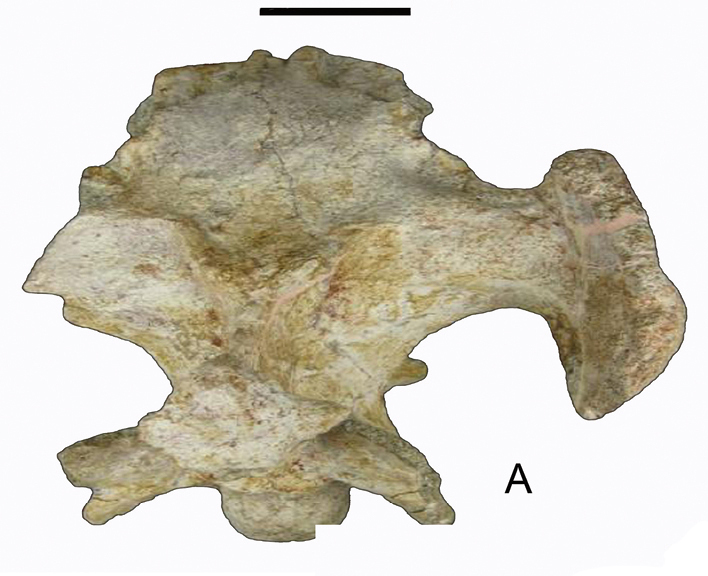

Paleontologists have also referred isolated teeth and tail vertebrae from other horizons and parts of the type locality to the genus. Tortosa’s team tentatively assigned a specimen from the Pourcieux-Les Tuillières site to Arcovenator as well. Farther afield, teeth referred to Arcovenator have turned up at Laño in Spain, with similar remains at Armuña. In 2019, Fondevilla and colleagues drew mostly on such tooth referrals to suggest that material related to Arcovenator spans the middle Campanian to the late Maastrichtian. Later, a single tooth from Chera in eastern Spain joined these referrals, although a cladistic analysis did not group it with Arcovenator. In 2025, paleontologists Erik Isasmendi and Elisabete Malafaia also referred two vertebrae from Laño to cf. Arcovenator—a label for remains that closely resemble it. One of them, a dorsal neural arch, had earlier been identified as the ornithopod Rhabdodon.
Arcovenator Size and Description
Much of what is known about Arcovenator comes from its head, its teeth, and a handful of bones farther back.
Short description of Arcovenator
As an abelisaurid, Arcovenator likely had a deep, heavily sculptured skull, a hallmark of its family. Its describers singled out the braincase as highly diagnostic. The Aix museum likewise notes that the species rests notably on this complete rear part of the skull. Its side teeth have strongly deflected distal carinae—rear cutting edges that bend sharply. Later tooth studies use them as a reference when identifying isolated abelisaurid teeth.
Behind the head, the known skeleton includes tail vertebrae and bones of the lower leg. No reported bones come from the arms, so its forelimbs remain unknown. Skin impressions are not reported either, so any discussion of its outer covering is speculative.
Size and Weight of Type Species
The Aix-en-Provence museum gives Arcovenator a length of up to about 19.7 feet (6 meters). It also calls it the largest predator of Late Cretaceous Provence. Similarly, news coverage in 2013 gave an estimated length of six meters.
However, neither the museum nor the 2013 report explains the basis for that length, and neither gives a hip height or body weight.
For comparison, Isasmendi and Malafaia describe abelisaurids in general as about 16 to 30 feet (5 to 9 meters) long. That places the museum figure in the lower part of the family range—well short of its largest members. Since no peer-reviewed study has estimated its length, these figures are approximate.
The Dinosaur in Detail
What sets this dinosaur apart is less a single bone than its place on the family tree. In 2014, Tortosa and colleagues found it closer to abelisaurids from India and Madagascar than to South American forms. The same analysis recovered Genusaurus, Tarascosaurus, and earlier Late Cretaceous European finds as basal abelisaurids—early-branching members of the family. Of these, Tarascosaurus was named in 1991 from lower Campanian rocks at Le Beausset, while Arcovenator comes from the younger upper Campanian.
That result raised a geographic puzzle. In 2015, Csiki-Sava and colleagues noted that the Indo-Malagasy link might look surprising, given how far Europe lay from India and Madagascar, though they noted similar links in other animal groups. Contrary to earlier models of abelisaurid evolution, Tortosa’s team had proposed that Europe and Africa may have played a major role in abelisaurid dispersal. In their view, that spread apparently involved crossing marine barriers.
More recent work adds another layer. In 2025, paleontologist Eric Buffetaut argued that two distinct abelisaurid lineages appear to have lived in Europe during the Cretaceous. Work by Buffetaut and colleagues had placed Genusaurus and Caletodraco in Furileusauria—a separate branch of the family—while Arcovenator sat among the majungasaurines. Still, he judged it uncertain whether the two lineages coexisted. Then, in 2026, paleontologist Mirella López-Miguel and colleagues described Cenomanian teeth from Algora in central Spain. They found them most likely majungasaurine, from an animal closely related to Majungasaurus. In their view, the teeth support two abelisaurid lineages coexisting in Late Cretaceous Europe. Meanwhile, Isasmendi and Malafaia call Arcovenator the best-known European abelisaurid, and researchers routinely compare new European finds against it.
Interesting Points about Arcovenator
- Its species name, escotae, honors Escota, the motorway company whose roadworks near Pourrières uncovered the fossils in the late 2000s.
- A 2025 study by Isasmendi and Malafaia calls Arcovenator the most complete abelisaurid currently known from Europe.
- Its describers found it closer to abelisaurids from India and Madagascar than to those from South America, despite the distances involved.
- Its strongly bent tooth edges now serve as a reference point when paleontologists identify isolated abelisaurid teeth.
- Teeth referred to Arcovenator are known from Spain as well as France, including the Laño site in the north and a single tooth from Chera in the east.
Contemporary Dinosaurs
The two dinosaurs below come from Laño in northern Spain, a neighboring region of the same landmass. Laño is a late Campanian site placed in the same magnetic interval as Jas Neuf Sud. Paleontologists have also found teeth of Arcovenator there.
From the Laño quarry, in the Sedano Formation of Spain’s Condado de Treviño, comes Lirainosaurus, a slender, small-bodied titanosaur—one of the long-necked sauropods. Fondevilla and colleagues place Laño in the late Campanian, within chron C32n.2n, the same interval assigned to the French site. Teeth referred to Arcovenator sp. also occur at Laño, so the genus is shared between the two areas. Even so, Lirainosaurus is a regional neighbor from another site, not a confirmed companion at Pourrières.
Also from Laño’s Sedano Formation comes a species of Struthiosaurus, a nodosaurid ankylosaur—a member of the armored dinosaur group. Paleontologists have referred skull, jaw, and tooth fossils from the site to the genus, along with bones from the rest of the skeleton. Like Lirainosaurus, it belongs to the wider regional fauna rather than to the French locality itself.
Arcovenator in its Natural Habitat
The world Arcovenator roamed was a land of rivers on one island of the European archipelago. At Jas Neuf Sud, the fossils lie in coarse sandstones that fill river channels, among crisscrossing meandering channel deposits. In Provence, only the oldest non-marine deposits rest on marine rocks of Santonian age. The lower Argiles Rutilantes at Jas Neuf Sud lie far higher, in the upper Campanian, and no marine layers occur within the continental series. As a result, Provence’s sites cannot be tied directly to marine rocks of known age, unlike sites farther west.
According to Isasmendi and Malafaia, abelisaurids were the only apex terrestrial predators of Late Cretaceous Ibero-Armorica, and among its most abundant theropods. News coverage likewise described Arcovenator as probably the top predator of its region. However, its exact prey is unknown, so its diet is inferred from its family alone.
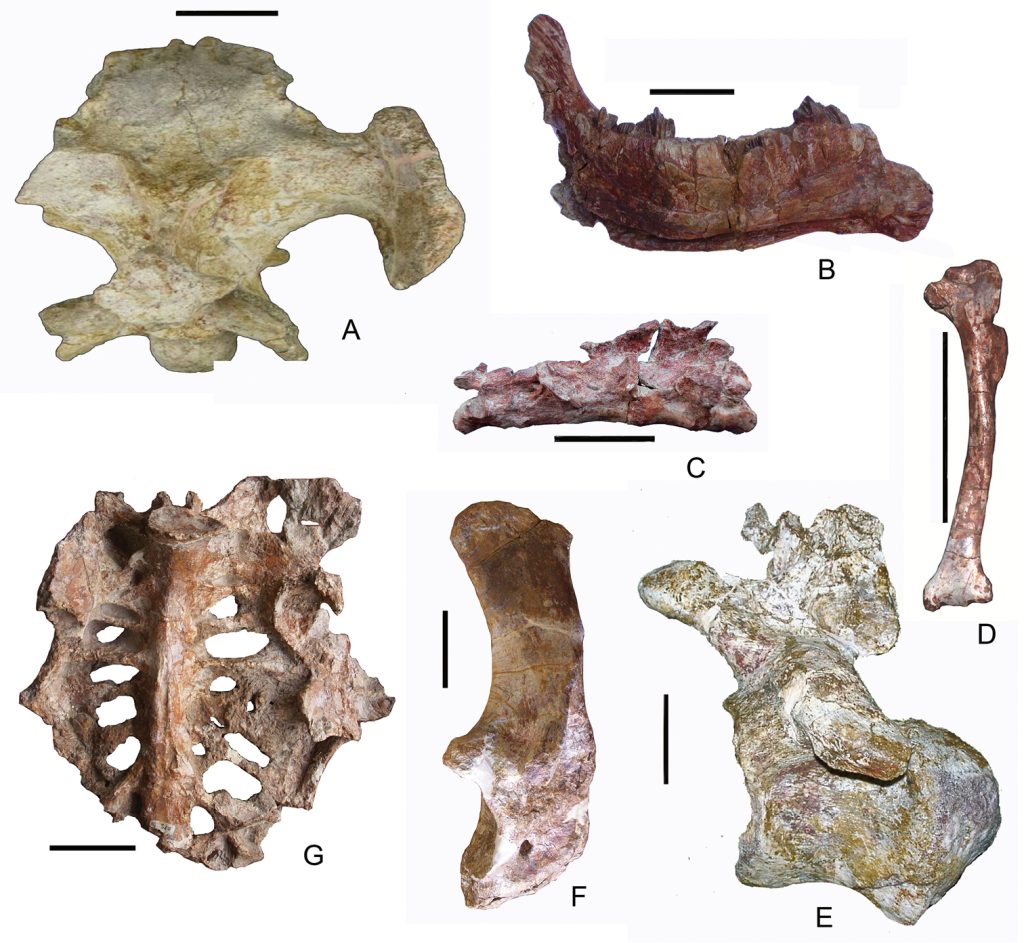

Csiki-Sava and colleagues list rhabdodontids and various titanosaurs as the most common dinosaurs in southern French faunas of this broad age. In their account, ankylosaurs and theropods such as abelisaurids and dromaeosaurids were also relatively common. Some genera, such as Rhabdodon and Ampelosaurus, ranged on both sides of the Pyrenees. Even so, Csiki-Sava and colleagues stress that the French and Iberian faunas also differed in many details.
Elsewhere in the Aix-en-Provence Basin, the Velaux-La Bastide Neuve site has yielded the titanosaur Atsinganosaurus and the rhabdodontid Matheronodon. However, studies disagree on its age. In 2019, Robin and colleagues put the site at about 72 to 74 million years old. That same year, Fondevilla and colleagues placed it earlier, at roughly 74 to 76.5 million years ago, so its animals may predate Arcovenator. While there is no direct evidence of how Arcovenator behaved, its family points to a place near the top of this food web.
Frequently Asked Questions
It is translated as “hunter from the River Arc,” and the species name escotae honors the motorway company Escota.
It lived in the late Campanian stage of the Late Cretaceous, about 72 to 73.5 million years ago.
The Aix-en-Provence museum gives a length of up to about 19.7 feet (6 meters). Its height and weight are not specified.
It was an abelisaurid theropod, placed in a majungasaurine group with relatives from India and Madagascar.
Its fossils come from the Pourrières-Jas Neuf Sud locality in the lower Argiles Rutilantes Formation of Var, France.
It is the most complete abelisaurid known from Europe, and its braincase is highly diagnostic.
Sources
The information in this article is based on various sources, drawing on scientific research, fossil evidence, and expert analysis. The aim is to provide a comprehensive and accurate overview of Arcovenator. However, please be aware that our understanding of dinosaurs and their world is constantly evolving as new discoveries are made.
- https://doi.org/10.1016/j.annpal.2013.10.003
- https://dml.reptilis.net/2013Dec/msg00106.html
- https://doi.org/10.3897/zookeys.469.8439
- https://doi.org/10.5710/AMGH.17.10.2025.3660
- https://doi.org/10.1016/j.earscirev.2019.01.007
- https://www.earth-prints.org/bitstream/2122/13084/4/2019_Fondevilla_Synthesis_South-Western_Europe_preprint.pdf
- https://doi.org/10.1038/s41598-018-28154-x
- https://doi.org/10.1038/s41598-026-53271-3
- https://carnetsnatures.fr/volume12/Genusaurus%20sisteronis_Buffetaut-CN20025.pdf
- https://doi.org/10.1038/s41598-017-13160-2
- https://doi.org/10.1038/s41598-019-56180-w
- https://paleobiodb.org/classic/basicCollectionSearch?collection_no=89990
- https://www.aixenprovence.fr/IMG/pdf/le_museum_en_album_-_solution_10.pdf
- https://blog.everythingdinosaur.com/?p=15793
This article was last fact checked: TheDinosaurs Team, 20-11-2026
Featured Image Credit: Bluedwarf, CC BY-SA 4.0, via Wikimedia Commons
