
Far out in central Niger, the reddish siltstones of the Tiouraren Formation have yielded one of Africa’s most puzzling theropods. Named Spinostropheus gautieri, it began in 1960 as a species of Elaphrosaurus. Only in 2004 did it receive a genus of its own. The paper that named the genus treated it as Early Cretaceous. Later studies, however, moved its rocks to the late Middle or early Late Jurassic—a shift of tens of millions of years. Even its family ties remain open.
Albert-Félix de Lapparent described the first fossils, which came from Tedreft, about 250 kilometers (155 miles) northwest of Agadez. Decades later, paleontologists Paul Sereno, Jeffrey Wilson, and Jack Conrad named the genus in a 2004 paper that also introduced Rugops. Since then, the story has grown more tangled rather than less. Its type material is a mixed lot, and in 2016 the articulated specimen once referred to it left the genus. As a result, Spinostropheus shows how much a dinosaur name depends on the bones behind it.
Spinostropheus Key Facts
| Keyword | Fact |
|---|---|
| Pronunciation | Not specified |
| Meaning of name | Spine Vertebrae |
| Group | Theropoda (exact placement debated) |
| Type Species | Spinostropheus gautieri |
| Diet | Not specified |
| When it Lived | Age debated (late Middle to early Late Jurassic) |
| Period | Jurassic |
| Epoch | Late Middle to early Late Jurassic (age debated) |
| Length | About 20.3 feet (6.2 meters), estimate by Holtz |
| Height | Not specified |
| Weight | Not specified (lion-sized class, per Holtz) |
| Mobility | Moved on two legs (like all theropods) |
| First Discovery | Year not specified, by A.-F. de Lapparent (described 1960) |
| Described by | 1960 by A.-F. de Lapparent (as Elaphrosaurus gautieri), genus named 2004 by P.C. Sereno, J.A. Wilson, and J.L. Conrad |
| Type material | Syntypes under MNHN 1961-28, Lapparent’s Tedreft material. No valid holotype or lectotype—the mid-neck vertebra Sereno et al. called the holotype in 2004 is not a valid lectotype designation |
| Location of first find | Tedreft, about 250 km northwest of Agadez, Tiouraren Formation, Agadez Region, Niger |
Spinostropheus Origins, Taxonomy and Timeline
In the genus list that accompanies his 2007 book Dinosaurs, paleontologist Thomas R. Holtz Jr. translates Spinostropheus as “spine vertebrae.” The species name gautieri is older still—it comes from Lapparent’s 1960 Elaphrosaurus gautieri. Together, the name carries two layers of history—a 1960 species and a 2004 genus.
Spinostropheus is a theropod, but exactly where it sits on the family tree remains open. In 2023, Souza-Júnior and colleagues reviewed the African material and filed it under “Problematic taxa.” By contrast, Holtz’s genus list, last updated in 2012 before MNN TIG6 was removed, groups it with the elaphrosaurs—”Early Swift-Running Ceratosaurs.” The Paleobiology Database likewise lists Ceratosauria as its parent group. Other researchers, discussed below, have suggested it could be a tetanuran or placed it outside both groups.
Its age has shifted just as sharply. The 2004 abstract describes an abelisauroid forerunner “of Early Cretaceous age (ca. 130-110 Myr ago),” and later reviews identify that animal as Spinostropheus. At the time, a University of Chicago press release even spoke of “135-million-year-old rocks.” In 2009, however, Rauhut and López-Arbarello argued that the Tiouraren Formation is late Middle or early Late Jurassic. Remes and colleagues followed that view the same year. Since then, Souza-Júnior’s team has listed the age as Bathonian, while other studies favor the latest Middle Jurassic or the Callovian. As a result, the exact age is still debated, and an early Late Jurassic date remains possible.
Discovery & Fossil Evidence
At Tedreft, Lapparent described two series of fossils—a lot of probably unassociated remains and an associated skeleton. His description and illustrations were incomplete, however, so it is hard to tell which bones belonged to that skeleton. Carrano and Sampson (2008) also reported that some of the material is now missing. Lapparent further assigned a proximal metatarsal (upper foot bone) from the younger Continental Intercalaire to the species. Souza-Júnior’s team, however, set that bone aside as too fragmentary to assign with confidence.
In 2004, Sereno’s team called a mid-cervical (neck) vertebra from the unassociated lot the holotype—a bone Lapparent had pictured in plate XI of his monograph. Yet both series share the number MNHN 1961-28 as syntypes—a set of specimens that together bear the original name. In 2016, Rauhut and Carrano noted that the 2004 choice is not a formal lectotype—a single specimen formally chosen from the syntypes, under zoological naming rules, to anchor the name. Consequently, the species has no valid holotype. Together, the two series include neck, back, hip, and tail vertebrae, part of an upper arm bone, three hand claws, shin bones, and foot fragments.
The articulated specimen MNN TIG6 complicated matters further. It was found at Fako, about 100 kilometers (62 miles) southwest of Agadez. The specimen preserves the backbone from the third neck vertebra to the front of the hip. The 2004 press release called it “an articulated, or connected, spine.” It also has complete neck ribs, fragmentary back ribs, and ossified tendons. Today it is housed in the Musée National du Niger (MNN), Niamey. Sereno’s team referred it to Spinostropheus, but in 2016 Rauhut and Carrano removed it from the genus. Since then, the name has rested on Lapparent’s Tedreft material alone.
Spinostropheus Size and Description
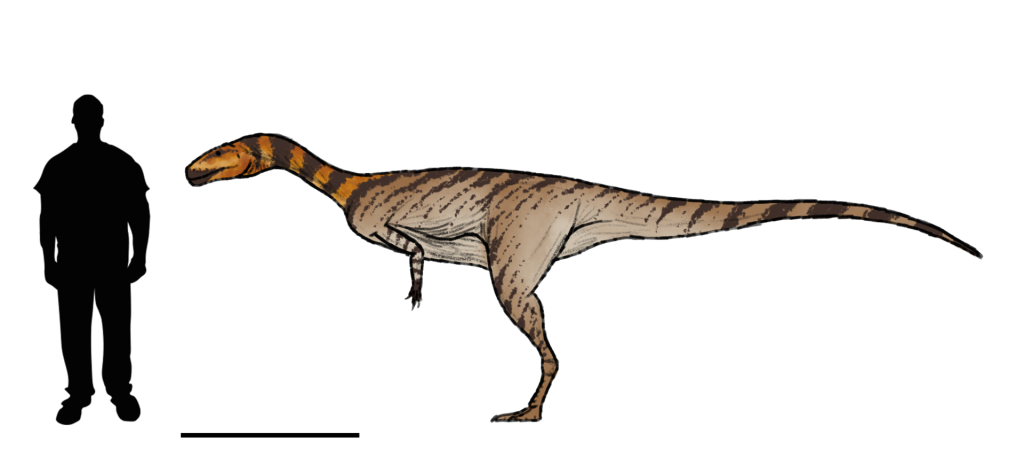
With only a scattered lot of bones to go on, any portrait of Spinostropheus is necessarily rough.
Short description of Spinostropheus
The syntypes give a glimpse of the body from the neck backward. They include a mid-cervical vertebra, a cervical neural arch (the upper part of a vertebra), and two fused neck centra (vertebral bodies). From the trunk come several dorsal (back) vertebrae, while sacral and caudal pieces stand for the hips and tail. No skull bones appear among the listed syntypes.
The limbs are just as patchy—there is a partial left humerus (upper arm bone), an ulna, and three manual unguals, or hand claws, plus part of a pubis (a lower hip bone). The hind limb fares better, with the lower end of a femur (thigh bone), tibiae (shin bones), fibulae, metatarsal pieces, and toe-bone fragments. Because these remains may come from more than one individual, they do not add up to one reliable skeleton.

Size and Weight of Type Species
Holtz lists a length of about 20.3 feet (6.2 meters) for Spinostropheus. That figure comes from a book appendix rather than a peer-reviewed study. Moreover, Holtz does not say which specimen it rests on or how he reached it, so readers should treat it as a rough guide.
For weight, Holtz gives only a size class—”Lion”—rather than a figure in pounds or kilograms. That would put Spinostropheus roughly in the weight range of a modern lion. Neither Holtz nor later reviews offer a height at the hips.
Any estimate also faces a deeper problem—the syntypes may mix several individuals, and MNN TIG6 no longer counts. Even the proportions behind a size figure, then, stay uncertain.
The Dinosaur in Detail
What sets this dinosaur apart is less a single feature than an unsettled identity. In 2008, Carrano and Sampson considered the mid-cervical and at least one tibia to resemble those of ceratosaurs. Rauhut and Carrano later argued that the type material lacks ceratosaurian synapomorphies—shared, derived traits that define a group. In their view, it might instead belong to Tetanurae, the lineage that includes megalosaurs, allosaurs, and birds. Even so, they listed differences from Elaphrosaurus that support keeping the separate name.
Researchers have proposed at least five placements for it, or for specimens once referred to it. Working from MNN TIG6, Sereno’s team originally recovered the Tiouraren animal as an early relative of the abelisauroids, which include Rugops. Later, Carrano and Sampson (2008) found a basal ceratosaur, and Wang and colleagues (2017) found a noasaurid. However, both of those analyses scored MNN TIG6 alongside the syntypes.
In 2020, Zaher and colleagues, building on Rauhut and Carrano’s 2016 dataset, scored the two specimens separately. Their tree places Spinostropheus just outside Averostra—the group uniting ceratosaurs and the line leading to Allosaurus. In the same figure, MNN TIG6 sits inside Noasauridae next to Camarillasaurus. In 2021, however, Samathi and colleagues reinterpreted Camarillasaurus itself as a spinosaurid. The results show how much depends on which bones go into an analysis—and no study has yet settled the question.
Interesting Points about Spinostropheus
- Spinostropheus began its scientific life in 1960 as Elaphrosaurus gautieri, and it kept that name for more than four decades.
- The vertebra chosen in 2004 as its holotype does not formally count as one, so the name still rests on a lot of bones that may come from several individuals.
- MNN TIG6, the articulated backbone that Sereno’s team referred to it in 2004, left the genus in 2016 after Rauhut and Carrano judged it too different.
- Its age estimate has moved from about 130 to 110 million years ago to the late Middle or early Late Jurassic after later studies redated its formation.
- Researchers have placed it, or specimens once referred to it, as an early abelisauroid relative, a ceratosaur, a noasaurid, a possible tetanuran, and a theropod outside Averostra.
Dinosaurs from the Same Formation
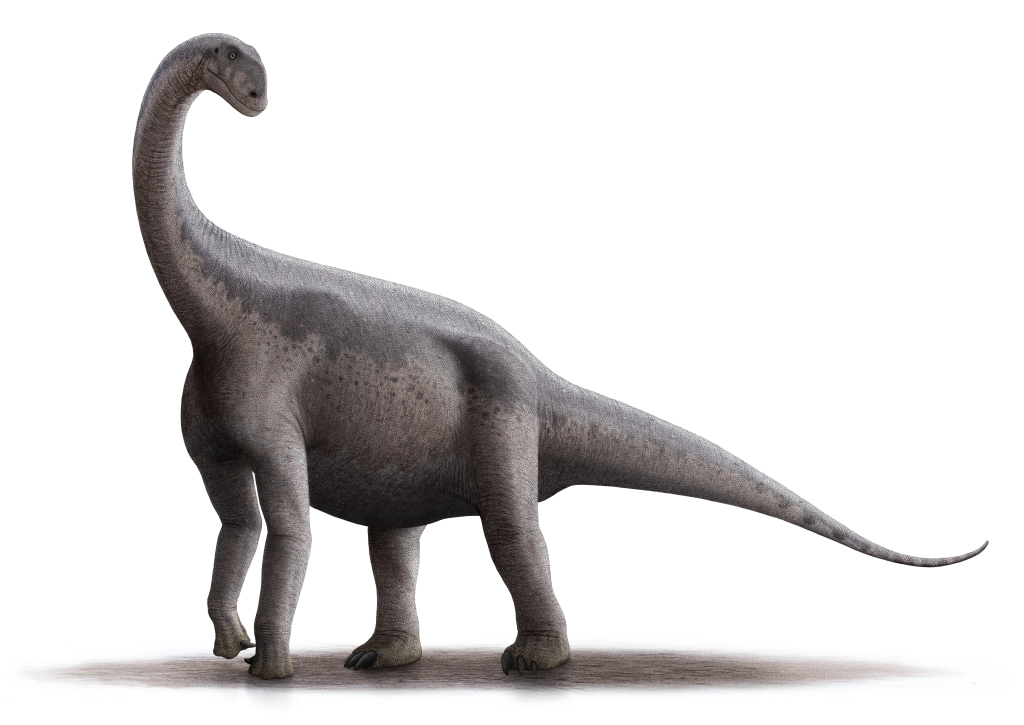
Also known from the Tiouraren Formation (exact level relative to Spinostropheus not known): Jobaria, a broad-toothed sauropod, and Afrovenator, a megalosaurid theropod. The formation’s age is still debated, with current estimates running from the late Middle to the early Late Jurassic. The Niger stratigraphic lexicon even assigns it a broad Callovian-to-Tithonian bracket, roughly 165 to 143 million years ago. These animals, therefore, may not all have lived at the same time.

Spinostropheus in its Natural Habitat
Imagine a low-lying landscape of broad floodplains, short-lived lakes, and meandering rivers—the setting that the Niger stratigraphic lexicon describes for the Tiouraren Formation. Its rocks are mostly clay-rich overbank deposits with paleosols (fossil soils) and rare river channels. Crocodiles and fishes such as Hybodus, Lepidotes, and the coelacanth Mawsonia lavocati turn up in these beds. In addition, clam shrimp, freshwater mussels, a turtle egg, and dinosaur tracks round out the record.
While there is no direct evidence of what Spinostropheus ate, Holtz raises a question about its whole group. He notes that no one yet knows whether all elaphrosaurs shared the toothless beak, and likely plant-based diet, of Limusaurus. Because that caveat applies to the group rather than this genus, its diet remains an open question.
Likewise, nothing is known of its behavior or growth, though the surrounding rocks add some context. The underlying Argiles de l’Irhazer clays, home of the sauropod Spinophorosaurus, are probably older, according to Remes and colleagues. Above the Tiouraren, the Tazolé Formation follows after an erosional break. Until fresh, well-associated fossils turn up, Spinostropheus remains a name in search of a body—a Jurassic puzzle written in scattered bone.
Frequently Asked Questions
According to Holtz’s genus list, it means “spine vertebrae,” and the species name comes from Lapparent’s 1960 Elaphrosaurus gautieri.
Most studies now place it in the late Middle Jurassic, although some allow an early Late Jurassic age, so its exact age remains debated.
Holtz estimates a length of about 20.3 feet (6.2 meters), but he gives only a lion-sized class for its weight.
No one knows its diet yet, and no published study has proposed one for this genus.
Its type fossils come from Tedreft in the Tiouraren Formation, about 250 kilometers northwest of Agadez in Niger.
It was a theropod, but studies disagree on whether it was a ceratosaur, a tetanuran, or something more primitive.
Sources
The information in this article is based on various sources, drawing on scientific research, fossil evidence, and expert analysis. The aim is to provide a comprehensive and accurate overview of Spinostropheus. However, please be aware that our understanding of dinosaurs and their world is constantly evolving as new discoveries are made.
- https://doi.org/10.1098/rspb.2004.2692
- https://pmc.ncbi.nlm.nih.gov/articles/PMC1691741/
- https://revistas.usp.br/paz/article/view/177016
- https://sciencepress.mnhn.fr/sites/default/files/articles/pdf/comptes-rendus-palevol2020v19a6.pdf
- https://doi.org/10.1111/zoj.12425
- https://pmc.ncbi.nlm.nih.gov/articles/PMC2737122/
- https://pmc.ncbi.nlm.nih.gov/articles/PMC3260197/
- https://www.app.pan.pl/article/item/app001012014.html
- https://pmc.ncbi.nlm.nih.gov/articles/PMC4454574/
- https://pmc.ncbi.nlm.nih.gov/articles/PMC10523064/
- https://pubmed.ncbi.nlm.nih.gov/10558986/
- https://www.geol.umd.edu/~tholtz/dinoappendix/HoltzappendixWinter2011.pdf
- https://nigerlex.geolex.org/formations/Tiouraren%20Fm
- https://paleobiodb.org/data1.2/taxa/single.txt?name=Spinostropheus&show=attr,app,class,parent
- https://paleobiodb.org/data1.2/colls/single.txt?id=25226&show=loc,strat,ref
- https://www.eurekalert.org/news-releases/465880
- https://doi.org/10.1080/08912963.2021.1874372
- https://www.uni-bonn.de/en/news/078-2021
This article was last fact checked: TheDinosaurs Team, 20-11-2026
Featured Image Credit: Older 2013 life restoration of Spinostropheus, made before MNN TIG6 was removed from the genus: Nobu Tamura, CC BY-SA 4.0, via Wikimedia Commons
