
In the Wardha Valley of central India, the green clays of the Lameta Formation near Dongargaon held a long-necked giant. Known today as Isisaurus colberti, this herbivore was a titanosaur—one of the long-necked, plant-eating sauropods. It lived during the Maastrichtian stage of the Late Cretaceous, roughly 72 to 66 million years ago. It is also one of the few Indian dinosaurs known from associated remains.
Between 1984 and 1986, paleontologist Sohan Jain of the Indian Statistical Institute led a three-season excavation of the bones. In 1997, Jain and Saswati Bandyopadhyay described them as a new species of Titanosaurus. Six years later, however, paleontologists Jeffrey Wilson and Paul Upchurch judged Titanosaurus itself undiagnosable. The species therefore needed a new genus. Today, Wilson and colleagues recognize it as one of only two valid sauropod species from India’s Late Cretaceous.
Isisaurus Key Facts
| Keyword | Fact |
|---|---|
| Pronunciation | Not specified |
| Meaning of name | ISI Reptile (honoring the Indian Statistical Institute) |
| Group | Sauropoda (Titanosauria) |
| Type Species | Isisaurus colberti |
| Diet | Herbivore |
| When it Lived | 72.2 to 66.0 MYA |
| Period | Cretaceous |
| Epoch | Late Cretaceous (Maastrichtian stage) |
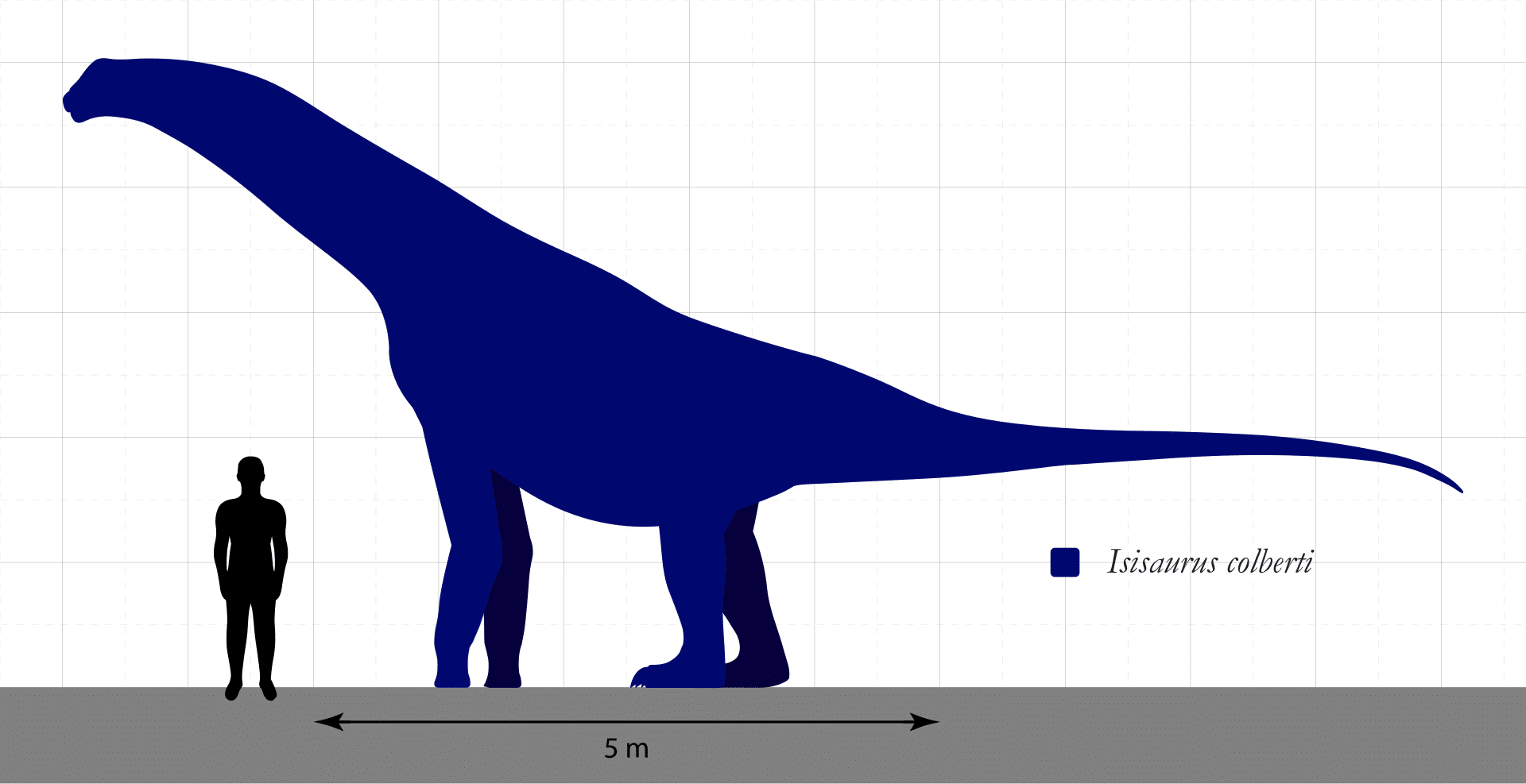
| Length | Not specified in the original descriptions, but about 59 feet (18 meters) per Montague (2006) |
| Height | Not specified |
| Weight | Not specified in the original descriptions, but about 30,900 pounds (14,000 kilograms) per Montague (2006) |
| Mobility | Moved on all four legs (quadrupedal) |
| First Discovery | 1984 to 1986 (holotype) by a team led by S.L. Jain |
| Described by | 1997 by S.L. Jain and S. Bandyopadhyay (as Titanosaurus colberti), with the genus named in 2003 by J.A. Wilson and P. Upchurch |
| Holotype | ISIR 335/1–65 |
| Location of first find | Lameta Formation, near Dongargaon village, Chandrapur district, Maharashtra, India |
Isisaurus Origins, Taxonomy and Timeline
The name Isisaurus is a tribute to an institution rather than a place. “Isi” honors the Indian Statistical Institute, or ISI, while “saurus” is Greek for “reptile.” Wilson and Upchurch chose it because the ISI houses India’s foremost collection of Mesozoic fossil vertebrates, and its scholars found and described the holotype. The species name colberti honors Edwin Colbert, whom Jain and Bandyopadhyay called the “foremost exponent of dinosaurs.”
Isisaurus belongs to Sauropoda and, within it, to Titanosauria. Its describers originally placed it in the family Titanosauridae as Titanosaurus colberti. In 2003, however, Wilson and Upchurch found that only 5 of the 14 species once referred to Titanosaurus were valid. One was the Romanian form now called Magyarosaurus. The type species, T. indicus, was a nomen dubium—a doubtful name whose type bones no longer set it apart from other titanosaurs.
The original description dates the beds to the Maastrichtian, the final Cretaceous stage. In 2014, Samant and Mohabey placed the Dongargaon remains in sediments of magnetic chron C30N—an interval defined by the direction of Earth’s magnetic field. Laskar and colleagues later repeated that placement in 2020. Today, the Lameta beds lie beneath the later basalt flows of the Deccan Traps.
Discovery & Fossil Evidence
Exploration around Dongargaon in 1968 and 1969 had already turned up dinosaur bones, including a braincase, ISI R199, that later work treats as Isisaurus-like. From 1984 to 1986, Jain’s team uncovered a partly articulated skeleton concentrated in an area of about 75 by 26 feet (23 by 8 meters). According to Jain and Bandyopadhyay, the association strongly suggested a single individual, buried close to where it died.
The holotype, ISIR 335/1–65, is housed in the Geology Museum of the Indian Statistical Institute in Kolkata. It comprises “a total of 65 bones”: 9 cervicals (neck vertebrae), 7 dorsals (back vertebrae), 14 ribs, and a sacrum of six fused vertebrae. There are also 16 caudals (tail vertebrae) and 9 chevrons (small bones beneath the tail). The left scapula (shoulder blade), coracoid (lower shoulder bone), humerus (upper arm bone), and ulna (forearm bone) follow. Both ilia, both pubes, and the right ischium complete the hips. The skull, hind limbs, and feet are missing, and the forelimb lacks its radius and hand.
Only parts of the skeleton lay joined together. The original paper reported a run of four tail vertebrae and a sacrum still attached to the hip bones. It also listed the last cervical and three front dorsals in articulation. In 2019, however, Wilson and colleagues found that the quarry map shows only the middle two of those four joined.

Beyond Dongargaon, referred braincases come from the ISI pits at Rahioli in Gujarat (ISIR 467) and from western Pakistan. At Rahioli, two further dorsal vertebrae “match well” with Isisaurus, although their describers stopped short of formalizing the link.
Isisaurus Size and Description
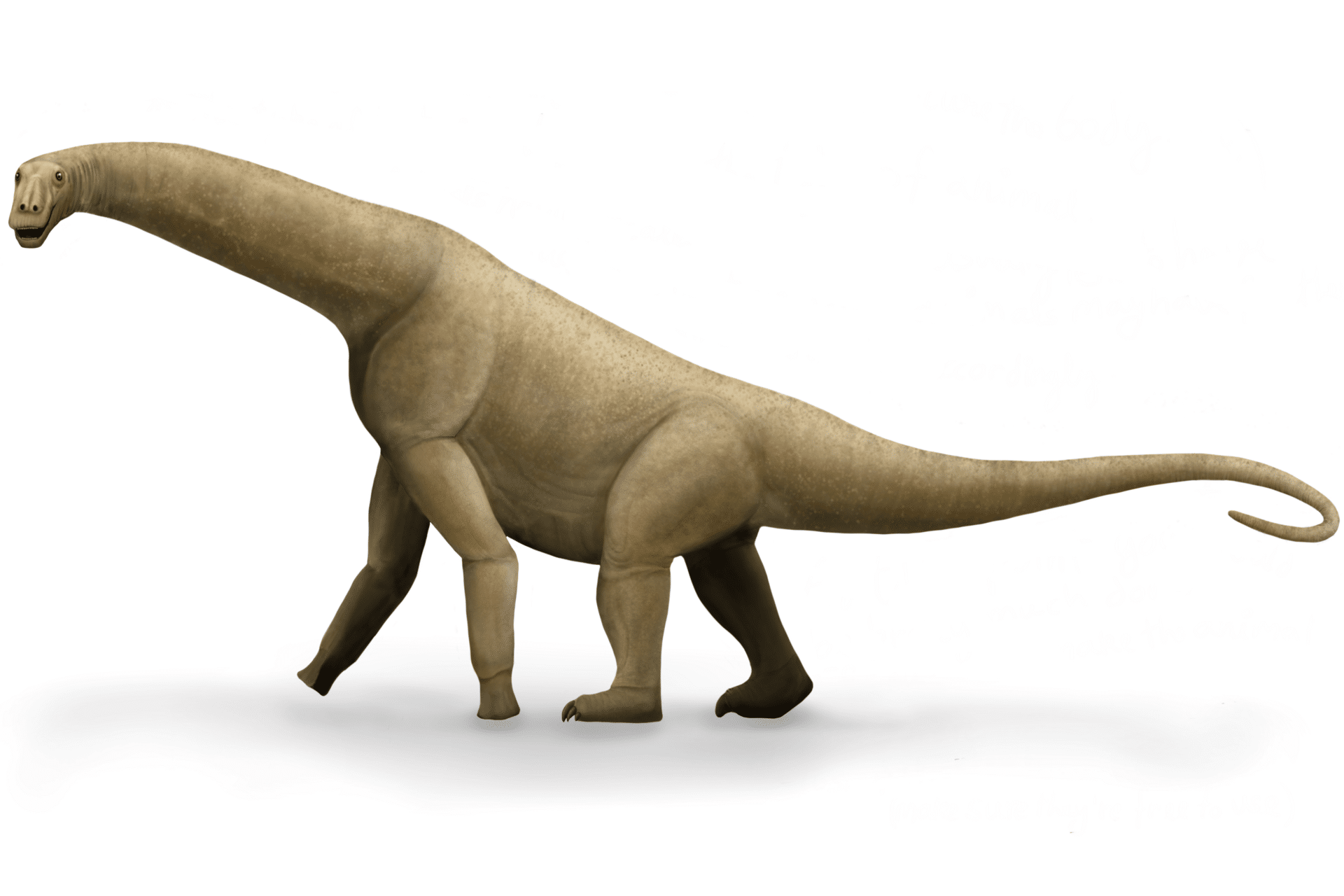
With no skull and no hind limbs, any portrait of Isisaurus rests on its spine, shoulder, forelimb, and hips.
Short description of Isisaurus
Only braincases represent the head, so its overall shape remains unknown. Behind it ran a neck of strongly opisthocoelous vertebrae—each body ball-shaped at the front and cupped at the back. These had pleurocoels (side hollows) and small centra, the spool-shaped vertebral bodies. The back vertebrae followed the same pattern, and six fused vertebrae formed the sacrum over the hips.
In the tail, the pattern reversed. Every caudal was strongly procoelous—cupped at the front and ball-shaped at the back—with a deep canal beneath for blood vessels. The scapula was broad with an upturned blade, and the ulna was robust and triangular in cross section. Finally, the hips paired a robust pubis with a flat, blade-like ischium shorter than the pubis.
Titanosaurs as a group evolved a “wide-gauge” stance, with the limbs set well apart, and Isisaurus likely shared it.

Size and Weight of Type Species
Neither original description gives a length, height, or weight. Jain and Bandyopadhyay’s diagnosis calls it “large,” and their discussion adds that it was “probably twice the size” of Saltasaurus. Yet the paper also calls it “a medium-sized advanced titanosaurid,” a label Wilson and Upchurch echoed in 2003. The measured bones are more telling. Its 4-foot-10-inch (148-centimeter) humerus is longer than the 4-foot-5-inch (134-centimeter) humerus of the Jainosaurus type series.
The scapula is about 3 feet 6.5 inches (108 centimeters) long and the ulna about 31.5 inches (80 centimeters). One dorsal centrum reaches about 11.8 inches (30 centimeters).
A 2023 review by Khosla and Lucas reports Montague’s 2006 estimate of about 59 feet (18 meters) and 30,900 pounds (14,000 kilograms). That length equals roughly one and a half city buses, but the review does not report his method. In 2020, Laskar and colleagues noted that no direct size estimate existed. Instead, they assumed about 44,100 pounds (20,000 kilograms) for eggshell producers they attributed to Isisaurus, borrowing the figure from an earlier mass compilation. They warned that it could be off by a factor of two. With no peer-reviewed estimate yet built from a measured reconstruction of the holotype, these figures are rough guides.
The Dinosaur in Detail
What sets this dinosaur apart is a suite of unique backbone features. In 2003, Wilson and Upchurch listed its autapomorphies—traits found in no other species. Its neck vertebrae had elongated parapophyses (rib attachment knobs) and thin bony ridges, or laminae, in front of and behind the spine. The first dorsal held a pronounced hollow framed by three laminae, while rear dorsal rib attachments sat unusually high.
Like other titanosaurs, its rear dorsals lack the hyposphene–hypantrum, an extra set of interlocking joints seen in many earlier sauropods. With more derived titanosaurs, it shares an upturned scapular blade, stout ulnar proportions, and an ischium shorter than the pubis.
Its family tree is far less settled. Wilson and Upchurch noted that two cladistic analyses placed I. colberti as the sister group to Saltasauridae. According to Khosla and Lucas, an initial 2011 analysis by Wilson and colleagues linked it firmly with South American “lognkosaurian” titanosaurs. That group, they note, includes Futalognkosaurus and Mendozasaurus. González-Riga had noted resemblances to Mendozasaurus in 2005, and the Gujarat vertebrae “obliquely” point the same way. Even so, Khosla and Lucas wrote in 2023 that its closest relatives remain disputed, though analyses repeatedly place it just outside Saltasauridae.
Its link to Jainosaurus is equally open—a sister-taxon connection, Khosla and Lucas write, “is not yet established, although it cannot be ruled out.” In 2024, however, Mocho and colleagues placed Isisaurus in Lohuecosauria, a new group of saltasauroids that also holds European and South American forms. They proposed that its lineage, like that of Rapetosaurus from Madagascar, dispersed into the region before Indo-Madagascar became isolated around 105 to 108 million years ago. Taken together, these studies still disagree on its closest kin—South American lognkosaurs in some analyses, saltasauroids in others.
Interesting Points about Isisaurus
- Isisaurus is named for a research institute, the Indian Statistical Institute, rather than for a place or a person.
- Its 65-bone holotype lay within an area of about 75 by 26 feet (23 by 8 meters), yet it most likely came from a single animal.
- Until Wilson and colleagues described two complete back vertebrae from Rahioli in 2019, complete presacral vertebrae—those ahead of the hips—were known only for Isisaurus among Indian Late Cretaceous fossils.
- Coprolites thought to come from Isisaurus contain leaf-spot and powdery-mildew fungi, which researchers took as evidence that it ate leaves.
Contemporary Dinosaurs
At Rahioli in Gujarat, the Geological Survey of India pits yielded Rajasaurus, an abelisaurid—one of a family of meat-eating theropods—named in 2003. The ISI pits about 200 meters away produced an Isisaurus braincase, and field sections suggest that both quarries sample the same deposits. Laskar and colleagues also place Rajasaurus remains in C30N sediments. No fossil shows how the two interacted, so they are best pictured as sharing the landscape.
Closer still was Rahiolisaurus gujaratensis, another abelisaurid from the Lameta Formation. Its bones came from the same ISI-pit layer as the Isisaurus braincase, yet nothing shows how they interacted.
Rounding out the trio was Jainosaurus septentrionalis, which Wilson and colleagues regard as the only other valid titanosaur from India’s Late Cretaceous. Both titanosaurs have turned up at Rahioli, and Wilson’s team wrote in 2009 that “these genera coexist in central and western India.” The type locality of Jainosaurus, however, lies at Bara Simla near Jabalpur. In 2014, Samant and Mohabey placed Jainosaurus remains in younger Maastrichtian sediments than the Dongargaon Isisaurus, as Laskar and colleagues noted in 2020.
These overlaps rest on shared localities, not precise dates, since Lameta deposits may vary in age and lack radiometric dates.
Isisaurus in its Natural Habitat
The world Isisaurus roamed was one of rivers and lakes, later buried beneath volcanic basalt. At Dongargaon, 10 miles (16 kilometers) southeast of Pisdura, red and green silty clays lie at the base. Above them come finely laminated clays with thin limestone, marl, and sandstone layers. Researchers generally read these rocks as fluvio-lacustrine—laid down by rivers and lakes—in a freshwater setting. Earlier studies, summarized by Joyce and Bandyopadhyay in 2020, describe a semi-arid climate, whereas coprolite fungi suggest tropical or subtropical conditions. Fishes, an unidentified crocodile and snake, and pleurodire (side-necked) turtles known from their shells shared the waters and shores.
Coprolites—fossilized dung—attributed to titanosaurs offer clues to its diet, though none can be tied to Isisaurus with certainty. In 2005, Sharma and colleagues studied a type of coprolite “supposed to be voided by Isisaurus” and found fungi that infect leaves. They concluded that it ate leaves, postulating that it browsed trees with its long, slender neck, like camels and giraffes. Large concentrations of plant-rich coprolites also occur with Isisaurus bones. More broadly, Prasad and colleagues found grass remains in Indian coprolites and suggested that their suspected producers, titanosaurs, ate a wide range of plants.
While there is no direct evidence of whether Isisaurus lived alone or in herds, the Nand-Dongargaon and Pisdura areas have yielded sauropod egg nests alongside skeletal material. Those eggs, however, have not been assigned to Isisaurus itself. The eggshells Laskar’s team linked to it came from Gujarat and Madhya Pradesh instead.
Frequently Asked Questions
It means “ISI reptile,” honoring the Indian Statistical Institute, while the species name colberti honors paleontologist Edwin Colbert.
It lived in the Maastrichtian stage of the Late Cretaceous, about 72.2 to 66.0 million years ago.
The original descriptions give no size. A 2006 estimate by Montague suggested about 59 feet and 30,900 pounds, while a 2020 eggshell study assumed about 44,100 pounds for animals it linked to Isisaurus.
It was a herbivore, and fungi in coprolites thought to be its dung suggest that it ate leaves.
Its holotype came from the Lameta Formation near Dongargaon in Maharashtra’s Chandrapur district, central India.
Its 65-bone skeleton is one of India’s few associated dinosaur finds, and it was long the only Indian Late Cretaceous sauropod with complete presacral vertebrae.
Sources
The information in this article is based on various sources, drawing on scientific research, fossil evidence, and expert analysis. The aim is to provide a comprehensive and accurate overview of Isisaurus. However, please be aware that our understanding of dinosaurs and their world is constantly evolving as new discoveries are made.
- https://dspace.isical.ac.in/items/9e0a8273-8ff5-49c6-b05d-26f414520cb0
- https://doi.org/10.1017/S1477201903001044
- https://public.websites.umich.edu/~wilsonja/JAW/Publications_files/Wilson&Upchurch2003.pdf
- https://par.nsf.gov/biblio/10189027
- https://doi.org/10.24425/agp.2023.145623
- https://deepblue.lib.umich.edu/bitstream/handle/2027.42/63584/Contributions_32_no2_FINAL_07-14-09.pdf;sequence=1
- https://deepblue.lib.umich.edu/bitstream/handle/2027.42/48667/ID573.pdf?sequence=2
- https://doi.org/10.1007/978-3-642-10311-7_3
- https://doi.org/10.1016/j.heliyon.2020.e05265
- https://doi.org/10.7717/peerj.9330
- https://doi.org/10.1038/s42003-024-06653-0
- https://doi.org/10.1661/0026-2803(2005)051[0073:FIDICF]2.0.CO;2
- https://doi.org/10.1126/science.1118806
- https://doi.org/10.1671/039.029.0131
- https://stratigraphy.org/ICSchart/ChronostratChart2024-12.pdf
- https://paleobiodb.org/data1.2/taxa/single.json?name=Isisaurus
This article was last fact checked: TheDinosaurs Team, 12-11-2026
Featured Image Credit: Ansh Saxena, CC BY-SA 4.0, via Wikimedia Commons
