
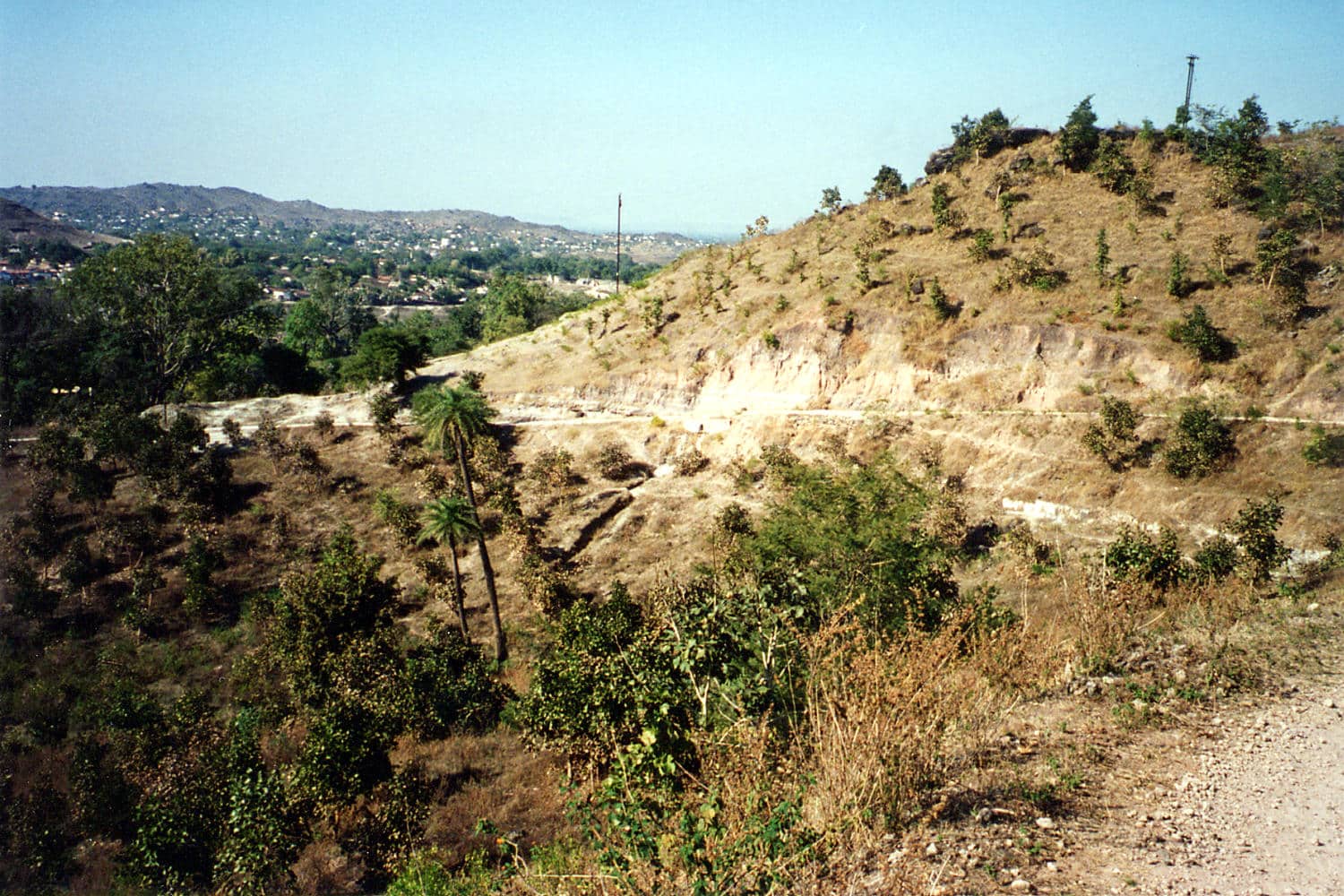
On Bara Simla hill, near Jabalpur in central India, the river and lake sediments of the Lameta Formation hold the bones of a giant plant-eater. Named Jainosaurus septentrionalis, this titanosaur lived during the Maastrichtian stage of the Late Cretaceous—in beds later capped by the lava flows of the Deccan Traps. Its type material centers on a partial braincase, the very bone that first tied it to a South American genus. In 2019, Wilson and colleagues counted it as one of only two valid Indian titanosaur species.
Between 1917 and 1920, Charles A. Matley dug the first bones of this animal from the hill. In 1933, paleontologist Friedrich von Huene and Matley described them as a northern species of Antarctosaurus, a genus Huene had named from Patagonia. Then, in 1994, Adrian P. Hunt and three colleagues gave the Indian animal a genus of its own.
Jainosaurus Key Facts
| Keyword | Fact |
|---|---|
| Pronunciation | Not specified |
| Meaning of name | Not specified for the genus. Species name septentrionalis: Northern |
| Group | Sauropoda (Titanosauria) |
| Type Species | Jainosaurus septentrionalis |
| Diet | Herbivore |
| When it Lived | 72.2 to 66 MYA (span of the Maastrichtian stage, no date specific to Jainosaurus) |
| Period | Cretaceous |
| Epoch | Late Cretaceous (Maastrichtian stage) |
| Length | 66 to 82 feet (20 to 25 meters), a single figure given for Jainosaurus and Isisaurus together, with no method stated |
| Height | Not specified |
| Weight | Not specified |
| Mobility | Moved on all four legs (quadrupedal) |
| First Discovery | 1917 to 1920 by Charles A. Matley (also dated 1917 to 1919) |
| Described by | 1933 by F. von Huene and C.A. Matley (species, as Antarctosaurus septentrionalis), and 1994 by A.P. Hunt, M.G. Lockley, S.G. Lucas, and C.A. Meyer (genus, dated 1995 by the Paleobiology Database) |
| Holotype | None designated by Huene and Matley. Lectotype GSI K27/497, a partial braincase and skull roof, chosen by Hunt and colleagues |
| Location of first find | Sauropod bed, Lameta Formation, Bara Simla hill, Jabalpur, Madhya Pradesh, India |
Jainosaurus Origins, Taxonomy and Timeline
The species name holds a small astronomical riddle. Septentrionalis is Latin for “northern,” built from septem (“seven”) and trio (“plough-ox”)—a nod to the seven stars of Ursa Major. Combined with Antarctosaurus, it produced what Wilson and colleagues in 2009 called a “somewhat counterintuitive moniker”—”Antarctic reptile from the north.” However, the studies we consulted do not explain the genus name.
Jainosaurus belongs to Sauropoda and, within it, to Titanosauria. In their 2009 revised diagnosis, Wilson and colleagues called it a derived titanosaur—one with advanced rather than ancestral features—based on two skull traits. The same study ruled out a sister relationship with the Indian titanosaur Isisaurus. It also found no unique features linking it to Madagascar’s Rapetosaurus. Jainosaurus septentrionalis is the type species and the only one currently recognized.
Its fossils come from the Lameta Formation, which researchers consider Maastrichtian in age based on coccoliths, magnetostratigraphy, and radiometric dates. At Bara Simla, the Lameta beds lie beneath basalts of magnetochron C29r—a span of reversed magnetic polarity recorded in the rock. As a result, this titanosaur lived near the end of the Cretaceous, before those lavas buried its home.
Discovery & Fossil Evidence
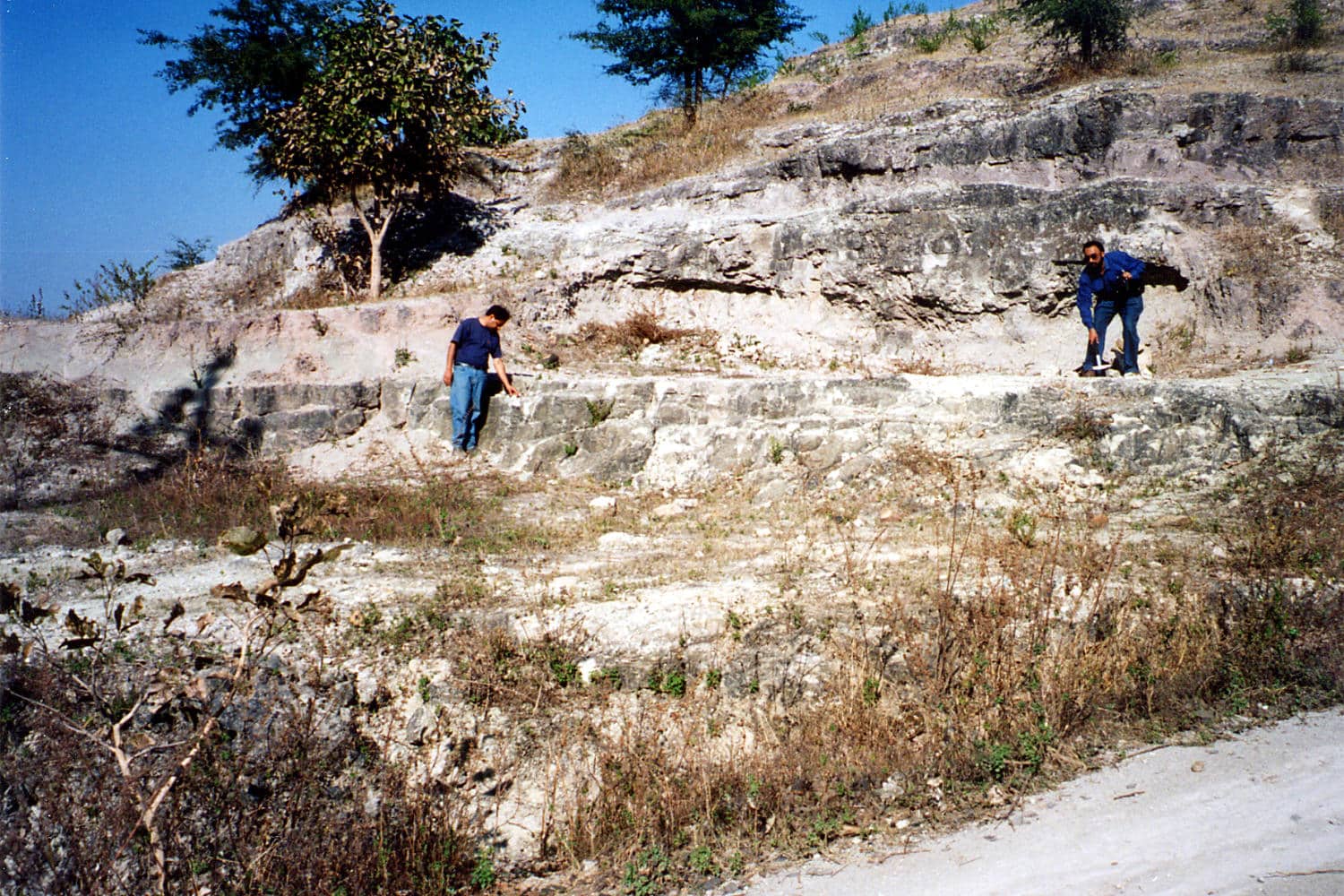
Matley and a field assistant collected the type series, although Wilson and Upchurch date the work to 1917–19 and the 2009 redescription to 1917–20. The bones came from the “Sauropod bed,” about 1.2 meters (4 feet) above the Main Lameta Limestone. According to Matley, they had been “washed about and somewhat damaged and broken before fossilisation.” Much of his collection went to the British Museum, but the sauropod remains stayed with the Geological Survey of India.

Huene and Matley’s type series began with a braincase, a squamosal (a rear skull bone), and a hyoid (a throat bone). Then came a tail vertebra, chevrons (small bones beneath the tail), and rib fragments. It also held two scapulae (shoulder blades), a humerus (upper arm bone), a radius and ulna (forearm bones), and a sternal plate (breastbone). However, Huene and Matley never established a holotype. Instead, when Hunt and colleagues named the genus, they chose a lectotype—a type specimen picked later from an original series—GSI K27/497, a partial braincase and skull roof. They treated the other bones as paralectotypes because “their exact association with the lectotype cannot be determined.”
Some of that material has since gone missing, including the dorsal ribs, radius, ulna, and hyoid. The scapulae survive only as a cast. Fortunately, the humerus resurfaced atop a case in Kolkata’s Indian Museum. A smaller, younger braincase, ISI R162, also comes from Bara Simla. In addition, Wilson’s team refers humeri from Rahioli in Gujarat and Vitakri in Pakistan to Jainosaurus. Nearby Chhota Simla, about 0.5 kilometers (0.3 miles) away, produced a partial skeleton that Matley collected in the 1930s. Long labeled “Titanosaurus sp.,” it was referred in 2011 to Jainosaurus cf. septentrionalis (“cf.” marks a close but tentative match).
Jainosaurus Size and Description
Short description of Jainosaurus
The best-known part of Jainosaurus is its braincase. In the lectotype, the braincase and skull roof are fused together, with many sutures—the seams between bones—fully closed. Like A. wichmannianus, it had a tall nuchal crest (a ridge across the back of the skull). It also shared a sinuous parietal–supraoccipital contact and broad basal tubera, the knobs beneath the braincase. Even so, several researchers cite its large, floorless pituitary opening as a difference from the Patagonian skull.
Little is known of the neck or tail, since the type series held one tail vertebra and a few chevrons. The forelimb, however, is better understood. Its radius was only about 0.58 times the length of the humerus—a low ratio typical of titanosaurs.
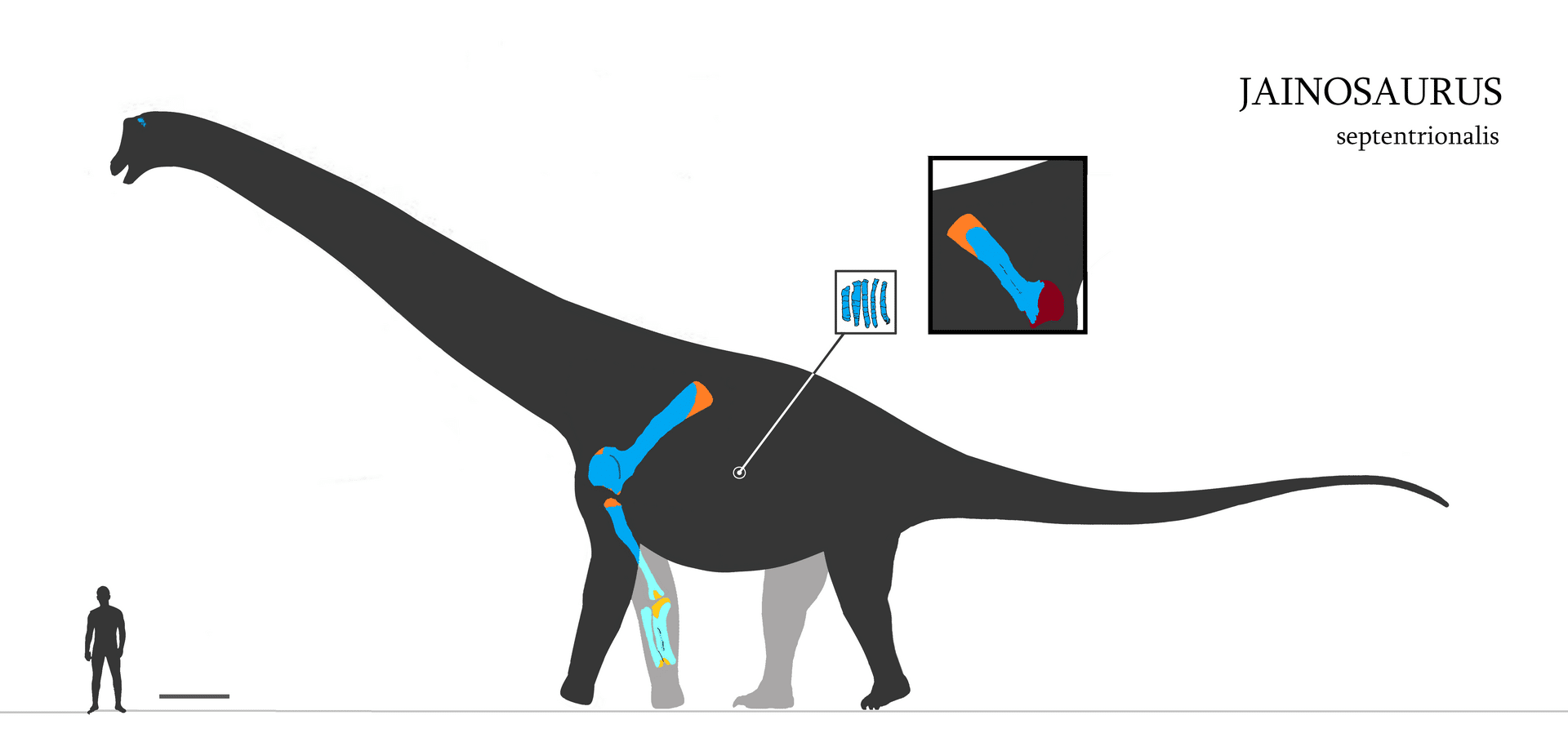

Like other titanosaurs, it walked on all fours and likely shared the group’s “wide-gauge” posture, legs set well apart.
Size and Weight of Type Species
Size estimates are scarce. In fact, the only length figure we found comes from a 2010 predation study by Wilson and colleagues. It gives 66 to 82 feet (20 to 25 meters) for Jainosaurus and Isisaurus together. That paper states no method, and its cited 2009 source gives only bone measurements.
Those measurements are firmer ground. The right scapula, known today from a cast, was complete when found and measured 1.67 meters (5.5 feet). By contrast, the left is incomplete at about 1.32 meters (4.3 feet). The type humerus is about 133 to 134 centimeters (4.4 feet) long, with a midshaft width of about 21.5 centimeters (8.5 inches). Referred humeri are smaller, at 70 to 85 centimeters (2.3 to 2.8 feet) from Gujarat and 94 centimeters (3.1 feet) from Chhota Simla.
No weight or hip-height estimate appears in the sources we reviewed. Meanwhile, its braincase is larger than that of Antarctosaurus wichmannianus but less fused. Wilson’s team took that pairing to suggest the two reached different adult body sizes.
The Dinosaur in Detail
A mix of braincase and arm-bone details sets this dinosaur apart. Its quadrate (the bone that hinges the lower jaw) contacts the basal tubera, and its paroccipital processes carry a hanging flange. Wilson and colleagues also listed a long prootic spur running onto the basipterygoid process, a strut beneath the braincase. On the humerus, they noted a medially inset, obliquely oriented deltopectoral crest—a ridge for shoulder muscles. A bulge on that crest, thin bone around the fossa beside it, and a forward-expanded radial condyle complete the list.
Other details separate it from Isisaurus. They include the occipital condyle (the joint between skull and neck), basal tubera, scapula, upper humerus, and ulna shaft.
Originally, Huene and Matley’s referral to Antarctosaurus rested solely on braincase features. They explained a genus shared by South America and India through a land connection, writing of “communication with south-eastern Asia … via Antarctis.” In 1990, McIntosh removed the Indian species from Antarctosaurus, and Wilson and Upchurch supported that move in 2003. Even so, they kept writing ‘A.’ septentrionalis rather than adopting Jainosaurus.
In 2005, Curry Rogers placed it in an unresolved grouping with Euhelopus and other somphospondylans. Four years later, Wilson’s team saw its closest affinities with “Malagasy Taxon B,” Pitekunsaurus, Muyelensaurus, a titanosaur from Río Negro, and possibly A. wichmannianus. That preliminary study found no evidence for an endemic Indian sauropod fauna. In 2014, the Malagasy braincase became the holotype of Vahiny depereti, which its describers found most similar to Jainosaurus. Then, in 2019, Mannion and colleagues ran a cladistic analysis. In two of its three runs, Jainosaurus and Vahiny came out as sister taxa in a clade with A. wichmannianus—the very Patagonian species it was first lumped with. Its closest kin, in short, may lie beyond India.
Interesting Points about Jainosaurus
- The type humerus was rediscovered atop a case in the Siwalik Gallery of the Indian Museum in Kolkata.
- Its 2011 describers called the Chhota Simla partial skeleton only the fifth such documented association from Indo-Pakistan.
Contemporary Dinosaurs
Prowling the Rahioli landscape was Rajasaurus, a heavy-bodied, stout-limbed abelisaurid theropod. Its describers placed it in the Maastrichtian Lameta Formation at Rahioli. There, the same 1982–84 Geological Survey of India excavation recovered remains of both Rajasaurus and Jainosaurus. No fossil records a direct interaction, so the two are best pictured as sharing the landscape.
Towering nearby was Isisaurus colberti, the other Indian titanosaur that Wilson and colleagues accepted as valid in 2019. Wilson and Upchurch named the genus in 2003 for a species first described in 1997 as “Titanosaurus” colberti. Its type skeleton comes from Dongargaon. Even so, a braincase of Isisaurus also comes from Rahioli, from pits about 200 meters from those that yielded Jainosaurus. The two shared a homeland but not a close kinship.
Adding further diversity was Rahiolisaurus gujaratensis, an abelisaurid named by Novas and colleagues in 2010. It comes from a Maastrichtian Lameta bonebed near Rahioli that also held titanosaur bones. Its describers called Rajasaurus a “sympatric” abelisaurid—one living in the same area. Still, no fossil evidence links it directly to Jainosaurus.
Bara Simla itself yielded Indosuchus, a theropod named by Huene and Matley in 1933 whose jaws later work reinterpreted as abelisaurid. Its type material, however, comes from the Carnosaur bed beneath the Main Lameta Limestone, below the Sauropod bed of Jainosaurus.
Because Lameta exposures in different basins may differ in age, these pairings rest on shared sites, not proof of a single moment.
Jainosaurus in its Natural Habitat
The world Jainosaurus roamed was a fluvio-lacustrine coastal plain—a lowland of rivers and lakes—whose deposits reach about 50 meters (164 feet) thick. Its climate was semi-arid and tropical, with alternating wet and dry seasons. At Rahioli, bones lie in a thick conglomerate below a tooth-bearing sandstone and an egg-bearing calcrete.
As a titanosaur, Jainosaurus was a herbivore, although no study ties particular plants to it. Coprolites—fossilized droppings—from India suggest that titanosaurs, their suspected producers, fed on a wide range of plants, such as grasses, dicots, conifers, and palms. In fact, grass phytoliths in the same coprolites, tiny mineral bodies from plant tissue, come from at least five grass taxa of living subclades.
While there is no direct evidence of how Jainosaurus lived, Wilson and colleagues argued in 2010 that large adult size may have deterred predators. Hatchlings, by contrast, were likely vulnerable to small predators. At Dholi Dungri in Gujarat, for example, the snake Sanajeh preyed on hatchling sauropods. Limestone horizons at Rahioli contain egg clutches, and 92 titanosaur clutches with 256 eggs come from Dhar District in Madhya Pradesh. Although none of those eggs is assigned to Jainosaurus, their variety of egg types hints at more titanosaur diversity than the bones alone reveal.

Frequently Asked Questions
The species name septentrionalis means “northern” in Latin. The sources we consulted do not explain the genus name.
It lived in the Maastrichtian stage of the Late Cretaceous, a span of 72.2 to 66 million years ago.
One study gives 66 to 82 feet for Jainosaurus and Isisaurus together, without a method. Its type humerus is about 4.4 feet long.
It was a herbivore, and fossil dung suggests Indian titanosaurs ate a wide range of plants.
Its type material comes from the Lameta Formation at Bara Simla hill, near Jabalpur in central India.
Its braincase, first referred to a Patagonian genus, carries traits that mark it as a derived titanosaur.
Sources
The information in this article is based on various sources, drawing on scientific research, fossil evidence, and expert analysis. The aim is to provide a comprehensive and accurate overview of Jainosaurus. However, please be aware that our understanding of dinosaurs and their world is constantly evolving as new discoveries are made.
- https://deepblue.lib.umich.edu/handle/2027.42/63584
- https://public.websites.umich.edu/~wilsonja/JAW/Publications_files/Wilson&Upchurch2003.pdf
- https://doi.org/10.1017/S1477201903001044
- https://doi.org/10.1111/j.1475-4983.2011.01087.x
- https://palass.org/publications/palaeontology-journal/archive/54/5/article_pp981-998
- https://par.nsf.gov/servlets/purl/10189027
- https://journals.plos.org/plosbiology/article?id=10.1371/journal.pbio.1000322
- https://deepblue.lib.umich.edu/bitstream/handle/2027.42/48667/ID573.pdf?sequence=2
- https://doi.org/10.1007/978-3-642-10311-7_3
- https://ri.conicet.gov.ar/handle/11336/275301
- https://journals.plos.org/plosone/article?id=10.1371/journal.pone.0278242
- https://pubmed.ncbi.nlm.nih.gov/16293759/
- https://paleobiodb.org/classic/basicTaxonInfo?taxon_no=81766
- https://doi.org/10.1098/rsos.191057
- https://doi.org/10.1080/02724634.2013.822874
This article was last fact checked: TheDinosaurs Team, 12-11-2026
Featured Image Credit: Ansh Saxena, CC BY-SA 4.0, via Wikimedia Commons
