
In the badlands of New Mexico’s San Juan Basin, the coal-streaked Fruitland or Kirtland Formation yielded one of the largest horned dinosaur skulls ever found. In 2011, paleontologist Nicholas R. Longrich made its skeleton the basis of a new species, Titanoceratops ouranos. He called it a giant ceratopsid from the late Campanian of the Late Cretaceous. It was also, he argued, the earliest known triceratopsin, in the group that includes Triceratops. Its identity has been argued over ever since.
A University of Oklahoma party under J. W. Stovall collected the bones in July 1941. Once prepared, they were identified as an unusually large Pentaceratops, as paleontologist T. M. Lehman described them in 1998. Longrich, however, disagreed. In 2020, paleontologists Denver W. Fowler and Elizabeth A. Freedman Fowler moved the skeleton back toward Pentaceratops—possibly as an especially old, large individual. One skeleton, in other words, carries two identities.
Titanoceratops Key Facts
| Keyword | Fact |
|---|---|
| Pronunciation | Not specified |
| Meaning of name | After the Titans of Greek myth, with “-ceratops” (“horned face” by naming convention), species name after Ouranos, father of the Titans |
| Group | Ceratopsia |
| Type Species | Titanoceratops ouranos |
| Diet | Herbivore |
| When it Lived | Probably about 76 to 75 MYA, if from the upper Fruitland as Fowler and Freedman Fowler (2020) think likely. Longrich’s (2011) 74 to 73 MYA rests on a misplotted ash bed. Source rocks span 76.0 to 73.4 MYA |
| Period | Cretaceous |
| Epoch | Late Cretaceous (Campanian stage) |
| Length | Not specified |
| Height | Not specified |
| Weight | 6.5 tons (unit not stated), about 13,000 to 14,300 pounds |
| Mobility | Not specified |
| First Discovery | July 1941 by a University of Oklahoma party led by J. W. Stovall, with Don Savage and Wann Langston Jr. Hunt and Lucas (2003) give 1940 |
| Described by | 2011 by Nicholas R. Longrich |
| Holotype | OMNH 10165 |
| Location of first find | Upper Fruitland or lower Kirtland Formation, exact quarry lost, near Coal Creek, San Juan County, New Mexico, USA |
Titanoceratops Origins, Taxonomy and Timeline
According to Yale’s 2011 announcement, the genus name comes from the Titans of Greek myth. By convention, “-ceratops” means “horned face,” and Longrich himself glosses the genus as “giant horn-face.” The species name, Longrich explains, refers to Ouranos, father of the Titans in Greek myth. The name thus nods to his idea that this animal could be ancestral to later giants such as Triceratops.
Titanoceratops belongs to Ceratopsidae, the family of large horned dinosaurs, and to Chasmosaurinae, its long-frilled subfamily. Longrich placed it in Triceratopsini, a clade (an ancestor and all its descendants) that he first defined informally. It covers everything closer to Triceratops than to Anchiceratops or Arrhinoceratops. His analysis recovered Titanoceratops as the sister of a group formed by Eotriceratops, Triceratops, and Torosaurus. In contrast, Fowler and Freedman Fowler list it as aff. Pentaceratops sp.—close to Pentaceratops, species unassigned. Titanoceratops ouranos is the type and only known species.
Longrich dated the skeleton to the late Campanian, about 74 to 73 million years ago. He had plotted an ash bed dated to 74.11 million years—an unrecalibrated date—at the top of the Fruitland. However, Sullivan and Lucas (2006) relocated it high in the Kirtland’s Hunter Wash Member. Fowler and Freedman Fowler (2020) confirmed this and called Longrich’s range incorrect, wherever the quarry was. Instead, they consider a Fruitland origin probable, at roughly 76 to 75 million years ago. Either way, the whole Fruitland–Kirtland sequence formed between 76.0 and 73.4 million years ago.
Discovery & Fossil Evidence
In July 1941, Stovall, Don Savage, and Wann Langston Jr. collected in the San Juan Basin for the university’s museum. Their prize was what R. K. Hunt-Foster and colleagues later called “the largest and most complete specimen of Pentaceratops sternbergi.” Hunt and Lucas (2003), however, give 1940 for Stovall and Savage’s find, and no later source resolves the discrepancy. Langston’s notes, as Longrich reported them, place the quarry about 40 miles south of Aztec, in Coal Creek’s headwaters. Yet the site has been lost, and a 2009 search failed to relocate it with certainty.
Using the Wood Ranch headquarters located by earlier workers, Hunt and Lucas (2003) found that the section implied by the notes has no outcrop. Instead, they suggested the section just north—home to the “Fossil Forest” study area of the Fruitland Formation. Hunt-Foster and colleagues likewise place the site near Coal Creek and count the skeleton in the Hunter Wash local fauna.
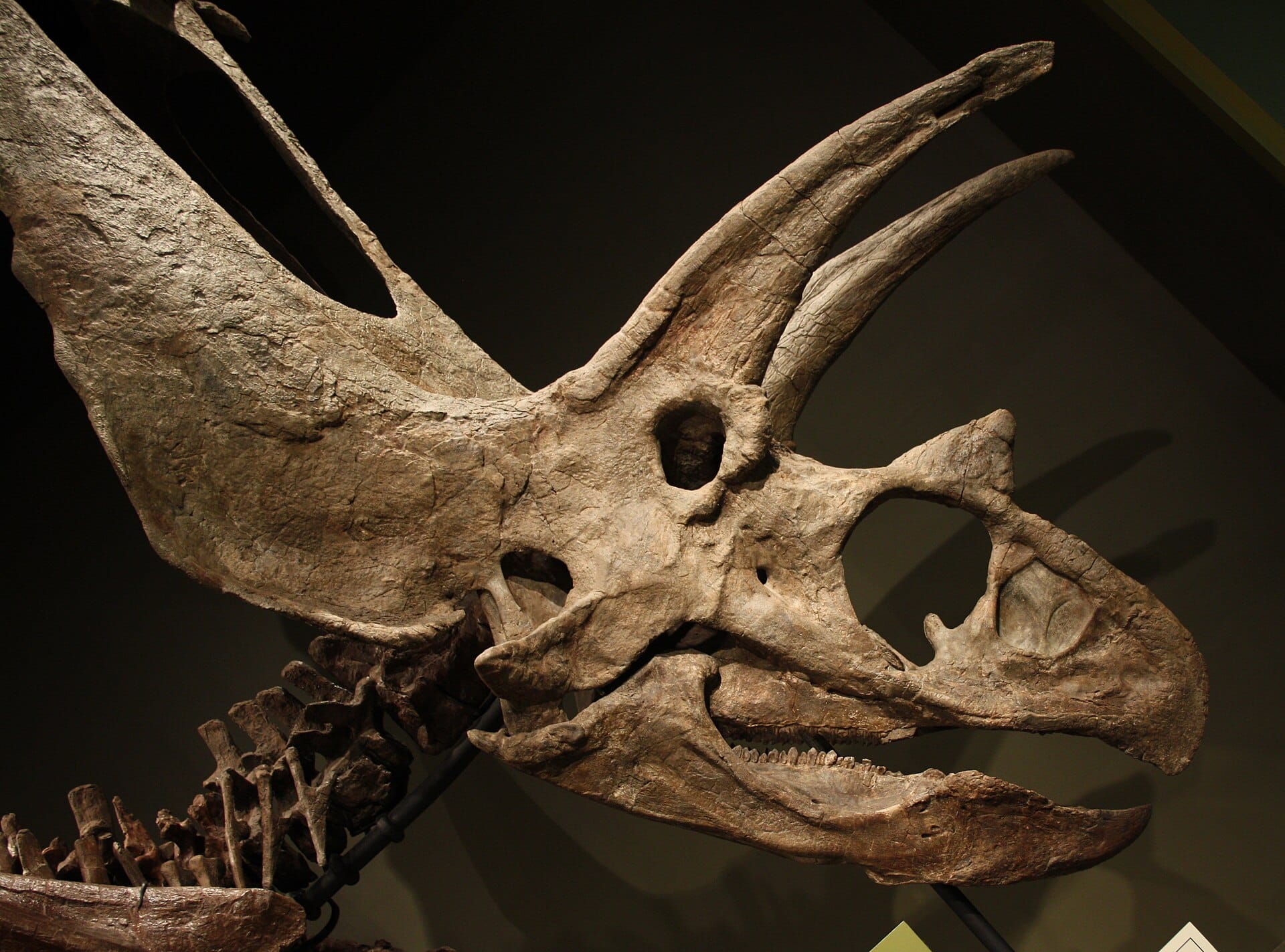

The holotype, OMNH 10165, belongs to the Sam Noble Oklahoma Museum of Natural History in Norman. Lehman called it the only known Pentaceratops specimen with a skull associated with most of the postcranial skeleton—the bones behind the head. According to news reports, the bones sat in field jackets until they were finally prepared in 1995. One account even says they spent years beneath the university’s football stadium. Today, the mounted skeleton is on permanent display at the museum.
Titanoceratops Size and Description
Almost everything known about Titanoceratops comes from one restored skeleton.
Short description of Titanoceratops
The skull dominated the animal. Longrich describes huge, forward-curving brow horns with large sinuses (air-filled spaces) at their bases—”more like Triceratops,” in his words. He also notes an elongate nostril and premaxilla (the front upper jawbone) with extensive sinuses. The nasal horn sat far forward, at the front of the nostrils, and the maxilla (the main tooth-bearing upper jawbone) was very tall.
Behind the eyes rose the frill. Longrich describes very low epoccipitals—the bony scallops along its edge—and a thin, keeled parietal bar, unlike the rod-like bar of Pentaceratops. However, much of the rear frill was rebuilt in plaster, and Longrich says even its Pentaceratops-like hornlets were plaster, not bone.
Longrich adds that the humerus (upper arm bone) and ischium (a rear hip bone) resemble those of Triceratops and Torosaurus.
Size and Weight of Type Species
No accessible peer-reviewed source gives its body length or hip height. Longrich gave “an estimated mass of 6.5 tons,” placing it “among the largest dinosaurs known from the Campanian of North America.” Yet his abstract does not say which tons. In metric tons, that is about 14,300 pounds, while 6.5 short tons is 13,000 pounds (5.9 metric tons). Yale’s “nearly 15,000 pounds” sits closer to the metric reading.
Elsewhere, Longrich has described the animal as “pushing 7 tons”—more than twice a typical Pentaceratops. His abstract also says it “rivaled Triceratops in size” but gives no method.
The skull has its own tangle of numbers. Lehman restored it at nearly 9.8 feet (3 meters) long, the largest of any ceratopsian and of any land vertebrate then known. Hunt-Foster and colleagues give over 3 meters, while news reports range from “eight-foot-long” to “more than ten and a half feet tall.” All are restored values, and Smithsonian even called its Guinness listing as the largest dinosaur skull “a somewhat dubious distinction.”
The Dinosaur in Detail
What sets this dinosaur apart, for Longrich, is a skull that looks forward to Triceratops rather than back to Pentaceratops. According to Smithsonian, he listed 22 features separating the two. In Fowler and Freedman Fowler’s summary, his diagnosis includes large size and low front epoccipitals on the squamosal (the side bone of the frill). It also cites extensive horn sinuses, very long and strongly curved brow horns, and extremely elongate premaxillae. Longrich concluded that giant chasmosaurines evolved once, within Triceratopsini, five million years earlier than previously thought.
Lehman, however, had seen the same oddities in 1998. He judged the long snout, premaxillary structure, and sinuses to show high variation within a single species. In 2020, Fowler and Freedman Fowler agreed, noting that six of Longrich’s characters change with growth in other chasmosaurines. The differences could therefore reflect “an especially large and old individual”—possible, “if not probable.”
They add that the specimen lacks the diagnostic rear-center part of the parietal (the rear frill bone). A full comparison is therefore impossible. Its narrow midline bar is, they note, unlike that of all later chasmosaurines, Triceratopsini included. Even the shoulder blade comparison fails, they argue, because the comparison skeleton Longrich used—PMU 24922—cannot itself be referred to Pentaceratops.
According to the Paleobiology Database, Longrich kept Titanoceratops in Triceratopsini in 2014. By contrast, Loewen and colleagues left it out of their 2024 phylogenetic analysis, citing poorly diagnosable holotype material or too much missing data. Meanwhile, Mallon and colleagues wrote in 2016 that its place in the Triceratops clade “is debated.” A 2021 review of clade names, built on Fowler and Freedman Fowler’s tree, does not list it in Triceratopsini. No published study has settled the matter. Taken together, the evidence offers two credible readings of one skeleton.
Interesting Points about Titanoceratops
- Longrich told Yale that he found it while searching the literature, realizing it “was just too different from the other known Pentaceratops.”
- In 2026, a local news report still called the mount the only fully mounted Pentaceratops on public display anywhere.
- Longrich told Yale the skeleton is “exactly what you would expect” an ancestor of Triceratops and Torosaurus to look like.
Contemporary Dinosaurs
All four come from the upper Fruitland and lower Kirtland, about 76 to 74.5 million years old. That is also the interval from which the skeleton most likely came.
The closest-tied neighbor is Pentaceratops sternbergii, a chasmosaurine whose type specimen is AMNH 6325. Fowler and Freedman Fowler place it in the Fruitland’s Fossil Forest Member, roughly 76 to 75 million years ago. It counts as a separate contemporary only under Longrich’s view. If the 2020 reassessment is right, the giant skeleton is itself Pentaceratops-like.
Prowling the same rock sequence was Bistahieversor sealeyi, a tyrannosauroid classed as a basal member of Eutyrannosauria (“true tyrannosaurs”). Its holotype, NMMNH P-27469, comes from the Kirtland’s Hunter Wash Member. A 2024 study places the genus at about 75.5 to 74.5 million years ago in both formations. No bite marks or other evidence link the two animals.
Adding a crested plant-eater to the scene was Parasaurolophus cyrtocristatus, a lambeosaurine hadrosaurid, or crested duck-billed dinosaur. Gates and colleagues place its holotype and a newer skull in the Fruitland’s Fossil Forest Member. That is the area Hunt and Lucas linked to the lost quarry. Volcanic ashes bracket the newer skull’s site between about 76.14 and 75.02 million years ago.
Rounding out the horned fauna was Navajoceratops sullivani, another chasmosaurine known from the holotype SMP VP-1500. Fowler and Freedman Fowler place it in the lowermost Hunter Wash Member, about 75.0 million years ago. That puts it in the lower Kirtland, one of the two possible sources of the lost skeleton.
Titanoceratops in its Natural Habitat
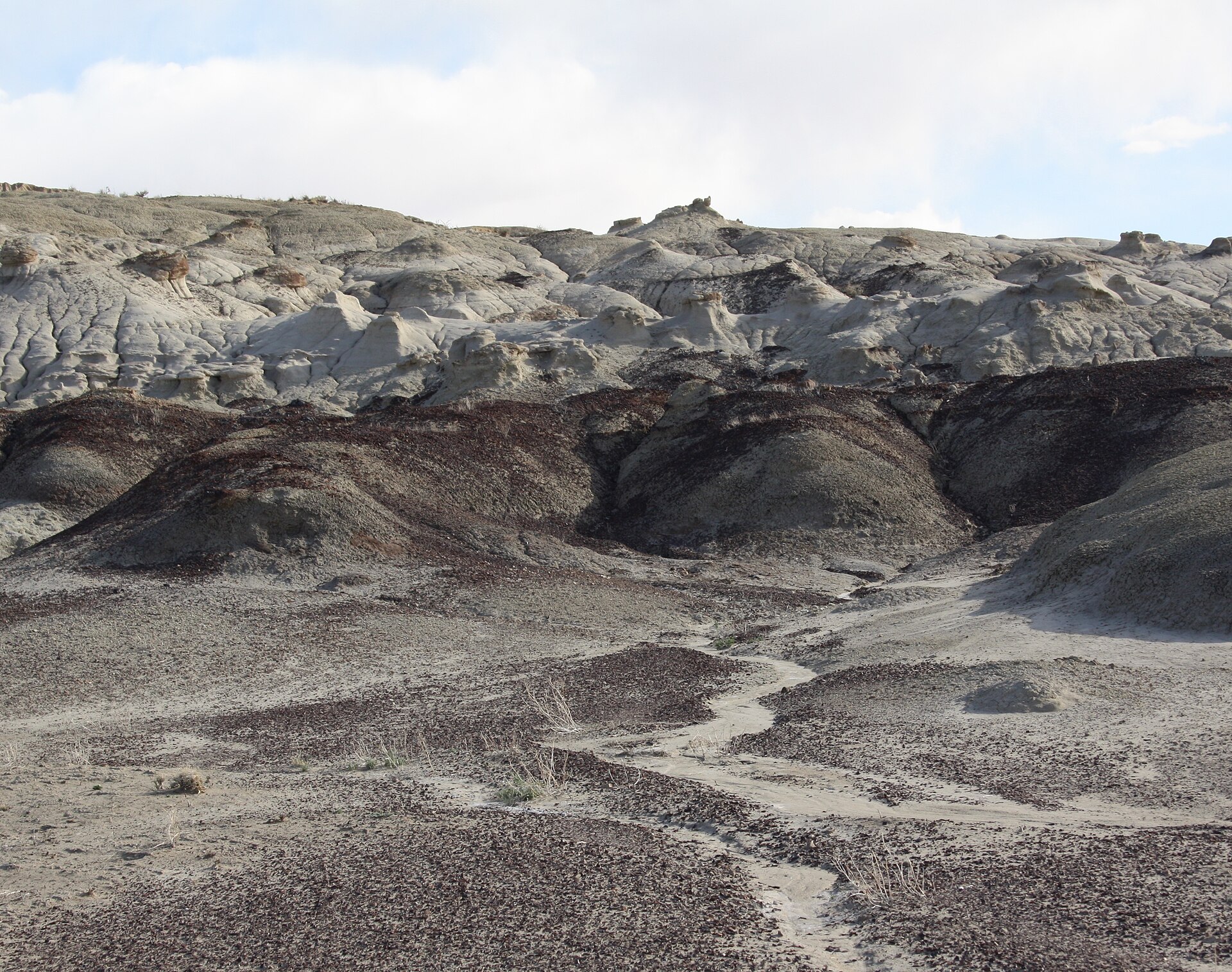
The world Titanoceratops roamed was a coastal plain where the sea had given way to land. During the Campanian, the San Juan Basin shifted from the marine Lewis Shale and shallow-marine Pictured Cliffs Sandstone to the nonmarine Fruitland and Kirtland. The Fruitland holds sandstones, mudstones, and thick coals laid down in what a 2022 study calls a nearshore swamp setting. Further up, it grades into the river sandstones and shales of the Kirtland, with only occasional thin coals.

A 2021 study described ceratopsids as “a diverse family of herbivorous dinosaurs,” so Titanoceratops was presumably a herbivore. Lehman also linked chasmosaurine nasal structures to “an advanced level of herbivory.” Still, no study has identified the plants this animal ate.
Beyond diet, its bones feed a wider debate about where giants evolved. Longrich argued that giant horned dinosaurs probably originated in the south during the Campanian and spread widely only in the Maastrichtian. In contrast, Fowler and Freedman Fowler argue that a north–south shoreline barrier was passable by about 76 million years ago. In their view, basin-by-basin endemism is not supported, and some supposed differences reflect age. Still, they accept broader north–south differences in Campanian faunas.
Frequently Asked Questions
The genus name refers to the Titans of Greek myth, and “-ceratops” conventionally means “horned face” in horned dinosaur names. The species name, ouranos, refers to Ouranos, father of the Titans.
Probably about 76 to 75 million years ago, in the late Campanian. Longrich’s figure of 74 to 73 million years rests on a misplotted ash bed.
Longrich estimated its mass at 6.5 tons, and its restored skull is nearly 9.8 feet long, but its body length is unverified.
Like other ceratopsids, it was presumably a herbivore, though its exact plant foods are unknown.
It was found in 1941, or 1940 by one account, in the upper Fruitland or lower Kirtland Formation of San Juan County, New Mexico, at a quarry now lost.
It is debated. Longrich keeps it as a separate genus, while Fowler and Freedman Fowler treat it as aff. Pentaceratops, possibly an especially old, large individual.
Sources
The information in this article is based on various sources, drawing on scientific research, fossil evidence, and expert analysis. The aim is to provide a comprehensive and accurate overview of Titanoceratops. However, please be aware that our understanding of dinosaurs and their world is constantly evolving as new discoveries are made.
- https://doi.org/10.1016/j.cretres.2010.12.007
- https://sites.google.com/site/longrich/nick-longrich/titanoceratops-ouranos
- https://doi.org/10.56577/FFC-54.383
- https://researchportal.bath.ac.uk/en/publications/emtitanoceratops-ouranosem-a-giant-horned-dinosaur-from-the-late-/
- https://doi.org/10.1017/S0022336000027220
- https://doi.org/10.7717/peerj.9251
- https://nmgs.nmt.edu/meeting/abstracts/view.cfm?aid=661
- https://doi.org/10.1371/journal.pone.0154218
- https://doi.org/10.7717/peerj.17224
- https://doi.org/10.7717/peerj.12362
- https://doi.org/10.1016/j.cretres.2021.105034
- https://doi.org/10.7717/peerj.10669
- https://doi.org/10.1016/j.isci.2024.110679
- https://nmgs.nmt.edu/meeting/abstracts/view.cfm?aid=1548
- https://doi.org/10.1038/s41598-022-19896-w
- https://paleobiodb.org/classic/basicTaxonInfo?taxon_no=179222
- https://nicklongrich.com/blog/the-discovery-of-titanoceratops
- https://www.sciencedaily.com/releases/2011/01/110131133404.htm
- https://www.smithsonianmag.com/science-nature/a-giant-from-new-mexico-titanoceratops-90897622/
- https://www.normantranscript.com/community/once-hidden-dinosaur-now-featured-in-museum-exhibit/article_811b3bc5-87c8-49de-a381-5b9d777e6fd4.html
This article was last fact checked: TheDinosaurs Team, 12-11-2026
Featured Image Credit: Mitternacht90 at English Wikipedia, Public domain, via Wikimedia Commons
