
Near the village of Berivotra in northwestern Madagascar, the Maevarano Formation holds one of the most debated small theropods. Named Rahonavis ostromi, it lived during the Maastrichtian stage—roughly 72.2 to 66 million years ago. Its forearm was far longer than its thigh bone, while its second toe ended in a sickle-like claw. Its blend of bird and raptor features keeps its family tree in dispute.
In 1995, a team led by paleontologist David Krause found the skeleton during a joint Stony Brook–Antananarivo expedition. Three years later, Catherine Forster, Scott Sampson, Luis Chiappe, and Krause described it in Science as “one of the most primitive birds yet discovered.” A 2020 monograph by Forster and colleagues later called it one of the best represented and preserved paravians from Gondwana. Even so, researchers still debate whether it was an early bird or a raptor-like dromaeosaurid—a question each dataset seems to answer its own way.
Rahonavis Key Facts
| Keyword | Fact |
|---|---|
| Pronunciation | Not specified |
| Meaning of name | Ostrom’s menace-from-the-clouds bird (Rahona, “menace from the clouds,” per a 1998 National Science Foundation release, plus Latin avis, “bird,” added in the April 1998 renaming) |
| Group | Theropoda (Paraves) |
| Type Species | Rahonavis ostromi |
| Diet | Not specified |
| When it Lived | 72.2 to 66 MYA |
| Period | Cretaceous |
| Epoch | Late Cretaceous (Maastrichtian stage) |
| Length | Not specified |
| Height | Not specified |
| Weight | About 1.3 pounds (0.58 kilograms), indirect estimate by Benson and colleagues, 2014 |
| Mobility | Not specified, with powered flight potential suggested by Pei and colleagues, 2020 |
| First Discovery | 1995 by a joint Stony Brook University–Université d’Antananarivo expedition led by David Krause |
| Described by | 1998 by C.A. Forster, S.D. Sampson, L.M. Chiappe, and D.W. Krause |
| Holotype | UA 8656 |
| Location of first find | Locality MAD 93-18, Anembalemba Member, Maevarano Formation, near Berivotra, Mahajanga Basin, northwestern Madagascar |
Rahonavis Origins, Taxonomy and Timeline
Rahonavis began its scientific life in March 1998 under a different name, Rahona ostromi. On 10 April 1998, the same four authors renamed it Rahonavis in a “Genus Correction,” adding Latin avis, “bird.” According to the National Science Foundation release that announced the find, Rahona ostromi meant “Ostrom’s menace from the clouds.” Together with the release’s description of “a capable flyer,” the name cast it as airborne from the start.
In terms of classification, Rahonavis belongs to Paraves, the theropod group that unites birds with their closest dinosaur kin. Forster and colleagues originally treated it as a primitive bird and placed it with Archaeopteryx. Later studies, however, shifted it between Unenlagiinae, an early-diverging dromaeosaurid lineage, and the base of Avialae—the branch that includes birds. The Paleobiology Database currently lists it within Unenlagiinae. Rahonavis ostromi is the type species, and the studies consulted all treat the genus as valid.
Its fossils date to the Maastrichtian stage, roughly 72.2 to 66 million years ago. While the original abstract simply said Late Cretaceous, the 1998 release gave an age of 65 to 70 million years. That Maastrichtian age is itself a revision—geologists had long assigned the Maevarano Formation to the older Campanian stage. However, its Anembalemba and Miadana members interfinger with the lower part of the marine Berivotra Formation, which invertebrates and microfossils place entirely in the Maastrichtian. A Maastrichtian gastropod near the top of its fossil-rich member adds further support.
Discovery & Fossil Evidence
The bones came from quarry MAD 93-18 near Berivotra, in the Mahajanga Basin. First found in 1993, the site has since seen seven field seasons between 1995 and 2005. Yet every known Rahonavis specimen came from a single level, dug in 1995. The skeleton lay on its right side, with its back and tail base bent backward (dorsiflexed). Much of the pelvis, hind limbs, and vertebrae remained in or near articulation.
The holotype, UA 8656, belongs to the Université d’Antananarivo in Antananarivo. It includes a cervicodorsal vertebra—from where neck meets back—along with six dorsal (back), six fused sacral (hip), and 13 caudal (tail) vertebrae. Both sides of the pelvis survive, as do both femora, tibiae, and fibulae (thigh and shin bones). The block also held the right ankle and metatarsus, a nearly complete left foot, a left scapula (shoulder blade), and the right ulna and radius of the forearm. Because its neural arches are fully fused, and bone histology agrees, the animal was a mature adult.
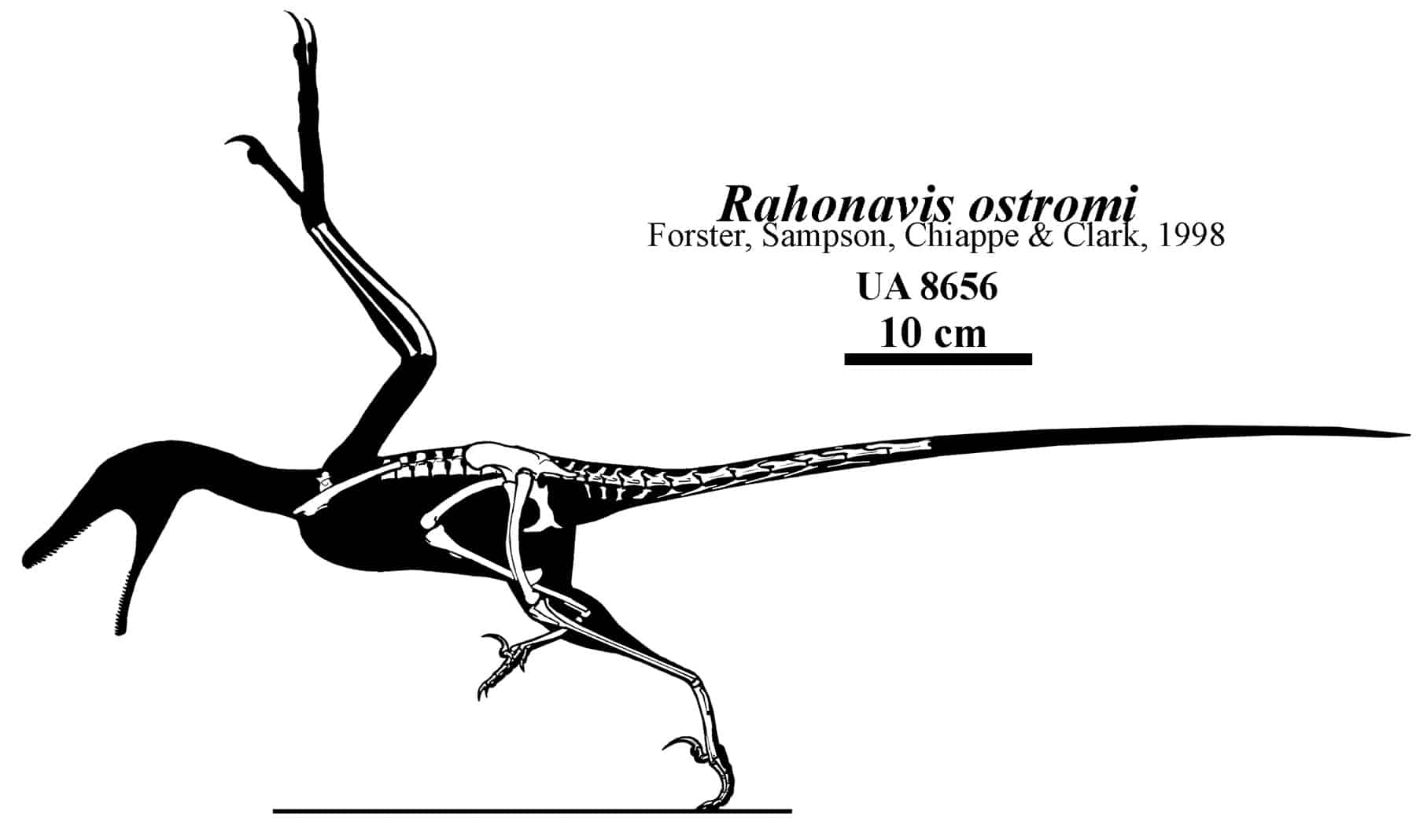

Not every bone lay in place, though. The team assigned five elements to the holotype without direct articulation, including a left femur about 1 meter (3.3 feet) away. According to the 2020 monograph, Forster’s team judged in 1998 that a different owner for the forelimb was only a remote possibility. That monograph calls the association “the soundest interpretation,” while conceding that no one has demonstrated it conclusively. A second right ulna, FMNH PR 2821, shows that at least two individuals lay in the quarry. Two partial humeri (upper arm bones) and a provisionally referred lower jaw complete the material.
Rahonavis Size and Description
Rahonavis pairs a raptor-like, sickle-clawed foot with an exceptionally long forearm.
Short description of Rahonavis
The head remains almost a blank, since the only jaw material is a provisionally referred dentary, the tooth-bearing lower jawbone, which measures 48.4 millimeters (1.9 inches) long. It held at least 15 tooth sockets, six of them with small subconical teeth or roots. Farther back, the ilium (main hip blade) reached 76.5 percent of femur length—a proportion the 2020 diagnosis calls unique among paravians. Its sacral spines fused into a continuous ridge, as in avialans, and a long, bony tail trailed behind.
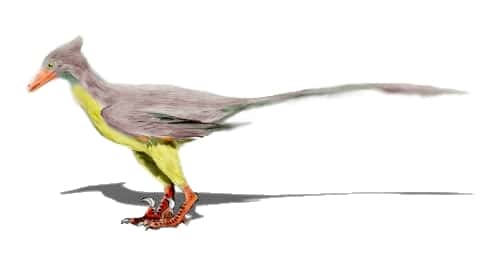
The second toe was robust and hyperextendible, and its sickle-like claw was twice the length of the toe bone before it. Meanwhile, the left foot preserves its first toe reversed—a trait the describers counted as avian. Neither skin nor feathers survive, so any discussion of its plumage is speculative.
Size and Weight of Type Species
No peer-reviewed estimate of length or hip height appears in the sources consulted. In 1998, the National Science Foundation called it a “raven-sized” bird—still the handiest modern comparison.
The body masses on record are all indirect, scaled from bones. In 2014, Benson and colleagues worked from the femoral shaft, 18.0 millimeters around, and arrived at about 1.3 pounds (0.58 kilograms). Later, Pei and colleagues calculated masses from femur length and tested a wide range of plausible values in their 2020 flight study.
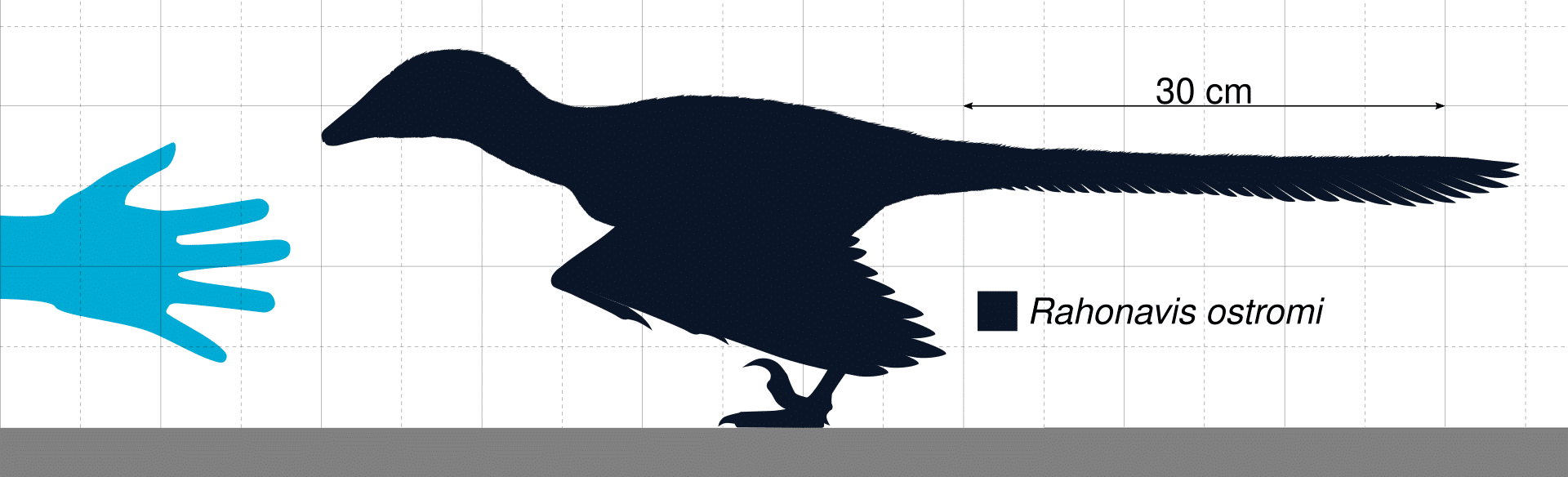

Direct bone measurements give a clearer sense of scale. The holotype’s ulna is 132.3 millimeters (5.2 inches) long, while its femur reaches only 87.6 millimeters (3.4 inches). By comparison, the bird Vorona from the same quarry had a tibiotarsus 38 percent longer than that of Rahonavis.
The Dinosaur in Detail
What sets it apart from its non-bird paravian kin is its forearm. Its ulna exceeds the femur in length by 51 percent and the tibiotarsus by 12 percent. In the Berlin specimen of Archaeopteryx, by contrast, the ulna is only about 7 percent longer than the femur. Among those sampled in 2020, only Yi comes close, and Rahonavis far outstrips Buitreraptor. Among early birds, though, its proportions sit near the median—Sapeornis, for one, has a relatively longer ulna.
Along that ulna run at least three low bumps, spaced about 15 millimeters apart. In 1998, Forster and colleagues identified them as ulnar papillae—quill knobs for secondary flight feathers. The 2020 monograph finds room for eight or nine. Similar knobs occur in Velociraptor and Dakotaraptor, yet no one has confirmed them in Archaeopteryx or any other non-ornithurine avialan.
Its placement remains a genuine split. The 1998 analysis of 113 characters recovered it beside Archaeopteryx, with or without the forelimb. Early follow-ups by Chiappe, Norell, and others kept it among birds. However, Makovicky and colleagues linked it in 2005 to Buitreraptor and Unenlagia, and many later studies agreed. In 2019, Hartman and colleagues recovered it deeply nested in Unenlagiinae. A year later, Pei and colleagues again placed it within Unenlagiinae.
Between 2011 and 2018, however, studies by Agnolín and Novas, Godefroit, Lee, Cau, and Xu placed it within Avialae. In 2020, Motta and colleagues grouped it with the Patagonian Overoraptor as the sister of all remaining avialans. Hartman’s team argued that four of Agnolín and Novas’s bird-linking characters correlate with long wings. Meanwhile, the 2020 monograph lists unenlagiine features it lacks, yet predicts its status “will likely remain as variable as the matrices.” Taken together, Rahonavis is a mosaic of primitive and derived traits whose label depends on the hypothesis employed.
Interesting Points about Rahonavis
- In 1999, researchers found that a white fibrous substance on its sickle claw reacts with antibodies to beta-keratin, suggesting remnants of the claw’s horny sheath.
- In 2020, Pei and colleagues found that Rahonavis passed all their wing-loading and lift thresholds, making it their strongest deinonychosaur candidate for flight potential.
- The same study concluded that powered flight potential evolved at least three times—in birds, in microraptorines such as Microraptor, and in unenlagiines such as Rahonavis.
- The holotype of the bird Vorona came from the same quarry, about 3 meters (10 feet) away, in the level just below.
- CT scans and 3D models of the Rahonavis bones sit in the MorphoSource online archive as Project 784.
Contemporary Dinosaurs
Prowling the same landscape was Majungasaurus, an abelisaurid theropod. Its isolated teeth turned up in Level 4 of quarry MAD 93-18, the very level that produced Rahonavis. Even so, no bite marks or other direct evidence link the two.
Joining it was Masiakasaurus, a small abelisauroid theropod. The 2020 monograph reports its isolated bones and teeth from that same level, although any contact between the two goes unrecorded.
Bulkier by far was Rapetosaurus, a titanosaurian sauropod. Excavators uncovered a disarticulated skeleton of a young individual alongside the Rahonavis holotype. That association reflects how the remains came to rest together, not any recorded interaction.
Rahonavis in its Natural Habitat
The world Rahonavis knew was a coastal lowland. Beneath its rocks lies a flood basalt about 88 million years old, linked to the onset of rifting between Madagascar and India. At the time, the basin lay near 30°S—about 15 degrees farther south than today. Its climate was semi-arid, perhaps with distinct wet and dry seasons. Broad, shallow, flood-prone channels crossed the land, and geologists read the layer holding Rahonavis as a debris flow after heavy rains.

No source consulted states what it ate. Its referred jaw carried small subconical teeth, although that bone belongs to it only provisionally. Its quarry level also yielded turtle shell, the snake Madtsoia madagascariensis, and at least five unnamed avialans. Elsewhere in the formation lived the frog Beelzebufo ampinga, the bird Falcatakely forsterae, and the mammal Vintana sertichi. The titanosaur Vahiny depereti, named in 2014, is also known from the Maevarano Formation, as its describers’ abstract confirms. The Paleobiology Database places its holotype site and a referred juvenile braincase bone in the Anembalemba Member. It lists that bone from quarry MAD 93-18. Together they paint a picture of an insular latest-Cretaceous ecosystem that held at least seven paravians.
Its daily life left no direct trace, but several studies have tested whether it could fly. Because no feathers survive, Pei and colleagues had to estimate its wing from its arm bones. In 2024, Porfiri and colleagues described it as potentially volant—able to fly. That same year, Aureliano and colleagues found that its backbone took a different path toward full pneumatization—filling with air spaces—than that of Majungasaurus. They linked this pattern to an advantage in gliding and flying among paravians. Its social life, like its diet, remains unknown.
Frequently Asked Questions
A 1998 National Science Foundation release said the original name, Rahona ostromi, meant “Ostrom’s menace from the clouds.” The April 1998 renaming added Latin avis, “bird.”
It lived in the Maastrichtian stage of the Late Cretaceous, roughly 72.2 to 66 million years ago.
A 1998 National Science Foundation release called it raven-sized, and one indirect estimate puts it at about 1.3 pounds. The sources consulted give no peer-reviewed length or height.
It was a small paravian theropod, classed either as an unenlagiine dromaeosaurid or as an early bird, depending on the analysis.
A joint expedition found it in 1995 in quarry MAD 93-18 of the Maevarano Formation, near Berivotra in northwestern Madagascar.
Its ilium reaches 76.5 percent of femur length, a proportion unique among paravians. Its ulna, 51 percent longer than its femur, is also longer relative to the leg than in any other non-avialan paravian sampled.
Sources
The information in this article is based on various sources, drawing on scientific research, fossil evidence, and expert analysis. The aim is to provide a comprehensive and accurate overview of Rahonavis. However, please be aware that our understanding of dinosaurs and their world is constantly evolving as new discoveries are made.
- https://doi.org/10.1126/science.279.5358.1915
- https://pubmed.ncbi.nlm.nih.gov/9506938/
- https://doi.org/10.1126/science.280.5361.179g
- https://doi.org/10.26879/793
- https://palaeo-electronica.org/content/pdfs/793.pdf
- https://doi.org/10.1016/j.cub.2020.06.105
- https://doi.org/10.1371/journal.pbio.1001853
- https://doi.org/10.7717/peerj.7247
- https://doi.org/10.1007/s00114-020-01682-1
- https://doi.org/10.1186/s12862-024-02247-w
- https://doi.org/10.1111/joa.14113
- https://doi.org/10.1080/02724634.1999.10011183
- https://doi.org/10.1098/rsos.210098
- https://doi.org/10.1080/02724634.2013.822874
- https://paleobiodb.org/data1.2/taxa/single.json?name=Rahonavis&show=attr,app,class,parent
- https://sciencedaily.com/releases/1998/03/980316045234.htm
This article was last fact checked: TheDinosaurs Team, 12-11-2026
Featured Image Credit: Mikailodon, CC BY-SA 4.0, via Wikimedia Commons
