
Near Rahioli village in western India’s Gujarat state, a thin rock band, the Lameta Formation, holds the bones of a horned predator. Named Rajasaurus narmadensis in 2003, this meat-eater lived during the Maastrichtian stage—the closing chapter of the Late Cretaceous. It was an abelisaurid theropod whose closest allies lay on Madagascar and in South America rather than in Africa. As paleontologist Jeffrey Wilson put it, the animal carried “a bone that protruded from the top of its head.”
Suresh Srivastava of the Geological Survey of India found the skeleton while excavating connected quarries near Rahioli between 1982 and 1984. For years the bones sat in storage. Then, in 2001, Wilson and paleontologist Paul Sereno re-examined the collection with the Indian team. Two years later, Wilson, Sereno, Srivastava, and three further colleagues named the species. Its describers called it the first Indian theropod known from associated skull and skeletal remains, although the only skull bone is the braincase.
Rajasaurus Key Facts
| Keyword | Fact |
|---|---|
| Pronunciation | Not specified |
| Meaning of name | Regal Dinosaur from the Narmada |
| Group | Theropoda (Abelisauridae) |
| Type Species | Rajasaurus narmadensis |
| Diet | Carnivore |
| When it Lived | 72 to 66 MYA |
| Period | Cretaceous |
| Epoch | Late Cretaceous (Maastrichtian stage) |
| Length | About 30 feet (9 meters), from the describers’ 2003 public statements |
| Height | About 8 feet (2.4 meters) at the hips per Sereno’s lab, or 3 meters (9.8 feet) high per co-author D.K. Bhatt |
| Weight | Not specified |
| Mobility | Not specified |
| First Discovery | 1982 to 1984 by Suresh Srivastava (Geological Survey of India) |
| Described by | 2003 by J.A. Wilson, P.C. Sereno, S. Srivastava, D.K. Bhatt, A. Khosla, and A. Sahni |
| Holotype | GSI Type No. 21141/1-33 |
| Location of first find | Temple Hill quarry near Rahioli, Lameta Formation, Kheda district, Gujarat, India |
Rajasaurus Origins, Taxonomy and Timeline
The name Rajasaurus carries royal weight. In the 2003 paper, the describers derived “raja” from the Sanskrit for “prince” or “princely” and added the Greek sauros, “lizard.” Co-author D.K. Bhatt glossed raja as “king,” and the team’s announcement rendered the full name as “regal dinosaur from the Narmada.” The species name narmadensis refers to its inferred range across the Narmada Valley, from Gujarat east to Jabalpur. Together, the name pairs rank with place, a fitting title for a large Indian predator.
As described in 2003, Rajasaurus is a new abelisaurid within Theropoda, the mostly meat-eating dinosaurs. The paper’s abstract placed it closer to Majungatholus from Madagascar—now known as Majungasaurus—and to Carnotaurus from South America than to related forms in Africa. Rajasaurus narmadensis is the type and only known species.
The describers dated the bones to the Maastrichtian. They based that age on microvertebrates, associated microfossils, and the beds’ position beneath the Deccan Traps—vast flood basalts. The Paleobiology Database places the species between about 72.2 and 66 million years ago, which simply spans the whole stage. In 2019, Wilson and colleagues noted that the basalts above the Rahioli beds erupted during a magnetic interval called C30n. That suggests a date late in the stage. Meanwhile, Bhatt gave the sediments an age of 67 million years, and the press releases spoke more loosely of 65-million-year-old bones. Either way, Rajasaurus lived near the end of the Cretaceous. By then, India had already separated from Madagascar, around 88 million years ago.
Discovery & Fossil Evidence
The type locality is a quarry at Temple Hill, about one kilometer west of Rahioli in the Balasinor area of Kheda district. The area is now a national park. Srivastava’s quarry maps from 1982–84 later let the team separate Rajasaurus from other dinosaurs. The collection was stored—and as of 2019 still is—at the Geological Survey of India’s Western Region headquarters in Jaipur.
The holotype, GSI Type No. 21141/1-33, is a partial skeleton held by the Geological Survey of India. According to the 2003 paper, it includes a braincase (the bony capsule around the brain), a cervical (neck) vertebra, partial back and tail vertebrae, and a sacrum. A partial scapula (shoulder blade), partial ilia (upper hip bones), part of the left pubis, and a right femur (thighbone) with the lower end of the left follow. Parts of a tibia and fibula, plus three metatarsals (foot bones), complete the list. However, later inventories differ. Khosla and Lucas in 2023 add jaw bones and a quadrate absent from the original list. Carrano and Sampson in 2008 omit the scapula, pubis, and femora.
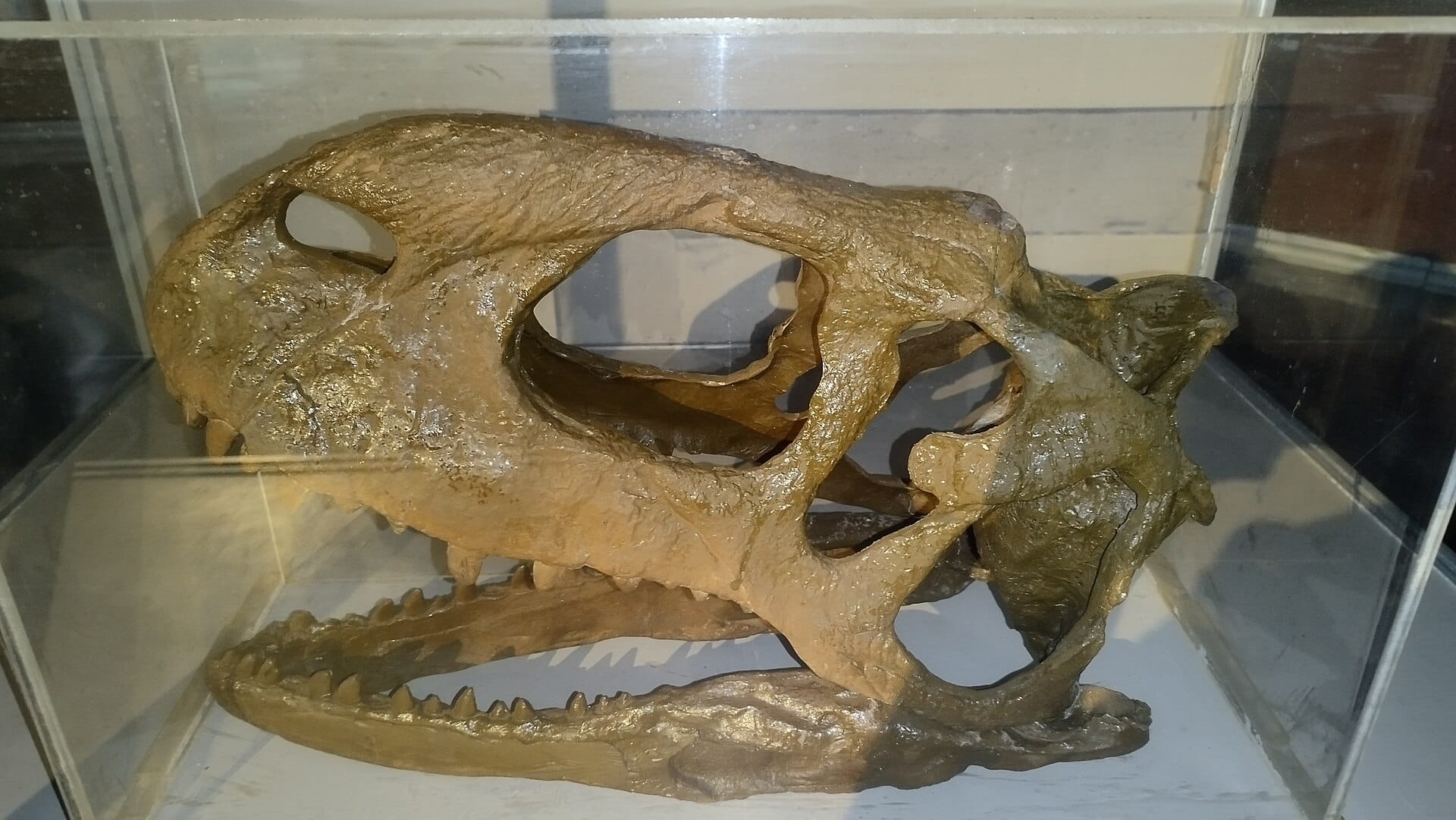

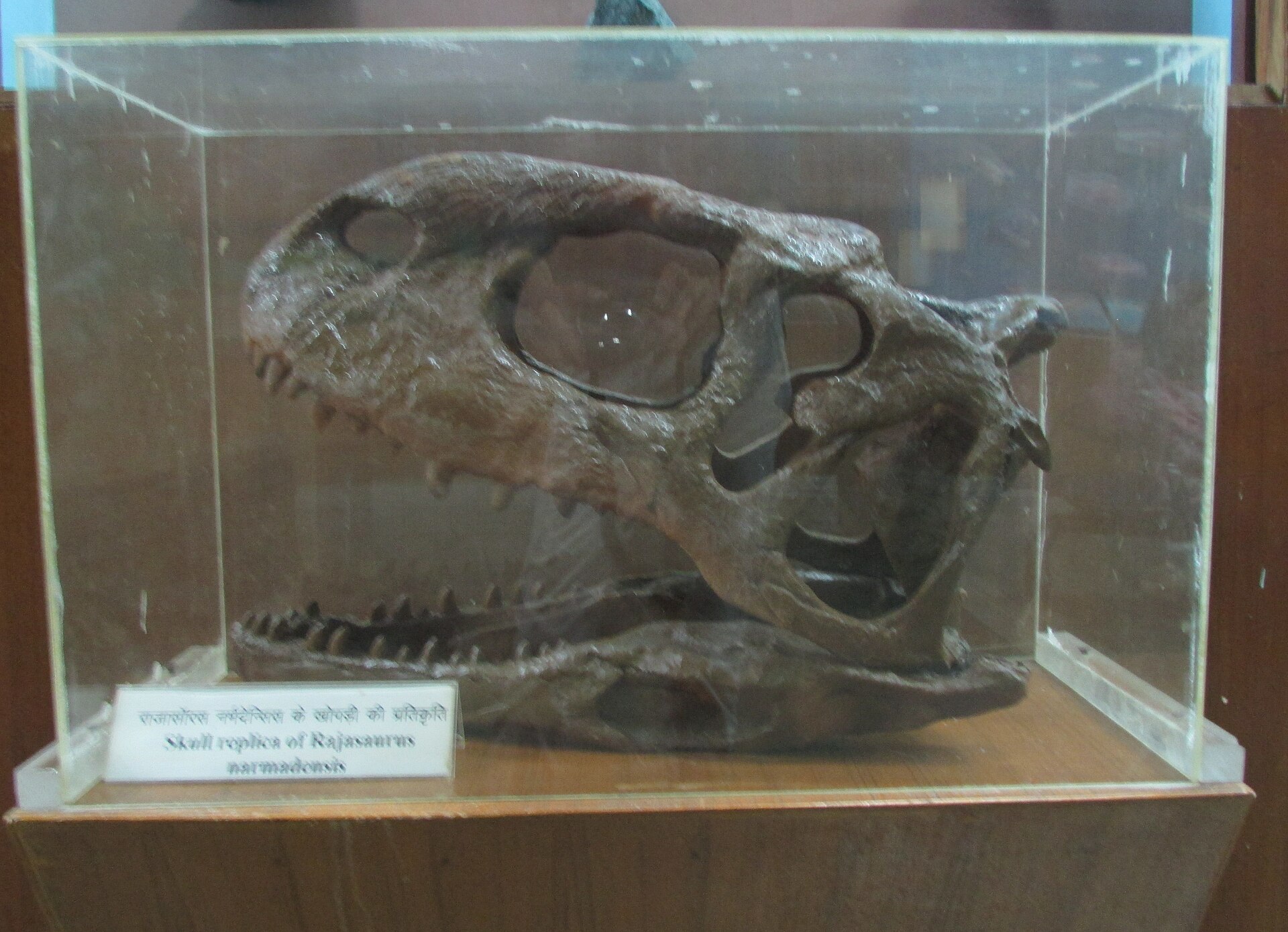
The bones lay in a conglomeratic layer—a bed of cemented pebbles and grit—beneath a calcareous sandstone that yields dinosaur teeth. They spread across about seven meters of the quarry, within a scatter of sauropod bones from several individuals. Because the theropod bones matched in relative size, the describers treated them as one animal. They also noted that the ilia and sacrum from Bara Simla, near Jabalpur, which Matley had described in 1923 as Lametasaurus, match Rajasaurus. Those bones are now lost, but the match feeds the naming puzzle described below. Today, a reconstruction of the skull stands in the Panjab University geology museum in Chandigarh.
Rajasaurus Size and Description
Only part of the skeleton survives, so any portrait leans on the skull roof and hips.
Short description of Rajasaurus
The frontals (the bones above the eyes) and parietals formed a thick skull roof. Where the nasal and frontal bones meet rose a single bony prominence, or horn. The nasals themselves are missing, but the describers inferred that they built most of it. The frontals formed only its back rim. Behind it, the upper temporal fenestrae (openings in the skull roof) were long. Each was about 150 percent as long as the frontal is wide.
Farther back, the ilium was robust. A ridge separated the brevis fossa—a hollow beneath the hip blade—from the acetabulum, or hip socket. The pubic peduncle, where the pubis joins the ilium, was broad and very short. The femur shaft was flattened front to back and widened toward the knee. Only a shallow groove separated its two condyles (the rounded knobs at its lower end). To the describers, it “appears to represent a heavy-bodied, stout-limbed abelisaurid,” and Sereno’s lab likewise describes it as “stocky.”

Any discussion of its skin or outward appearance remains speculative.
Size and Weight of Type Species
The 2003 paper gives no overall length, height, or weight—only measurements of individual bones. The figures come instead from the describers’ public statements that year. Wilson put its length at about 30 feet (9.1 meters). Bhatt gave 9 meters (29.5 feet) long and 3 meters (9.8 feet) high. Neither explained the method.
Sereno’s lab offers a different height—about 8 feet (2.4 meters) at the hips—alongside the same 30-foot length. No weight estimate appears in any of them. Wilson simply called the animal heavy and strong.
For comparison, its slender neighbor Rahiolisaurus was about 8 meters (26 feet) long—slightly shorter.
The Dinosaur in Detail
The most distinctive feature of Rajasaurus is its single midline horn. Bhatt’s 2003 news note called it a “double-crested horn.” In contrast, the paper describes one median nasofrontal prominence. Delcourt noted in 2018 that the horn lacks the “depressed lip” seen in Carnotaurus and Ceratosaurus. That absence, he suggested, points to a cornified, or horn-like, covering that did not extend upward.
The 2003 paper treated Indosaurus as a separate animal and listed Indosuchus as a third large Lameta theropod. In 2008, however, Carrano and Sampson found Majungasaurus, Rajasaurus, and Indosaurus grouped in all their trees. They even judged Indosaurus, Lametasaurus, and Rajasaurus the likeliest candidates for synonymy, which would give Matley’s older name priority. Still, they stopped short of merging them, analyzing Indosaurus and Rajasaurus separately. According to Khosla and Lucas, Novas and colleagues had already kept all four names in 2004, pending further work.
Its branch within the family has shifted, too. The 2003 paper counted it among the carnotaurines, then known only from India, Madagascar, and South America. In 2014, Tortosa and colleagues, describing the French Arcovenator, named Majungasaurinae, a clade (an ancestor and all of its descendants). According to Khosla and Lucas, their tree joined Arcovenator with Rajasaurus, Rahiolisaurus, Indosaurus, and Majungasaurus. In 2018, Delcourt, following earlier analyses, recast that clade as a tribe, Majungasaurini, within Carnotaurinae. The Paleobiology Database now lists Rajasaurus there.
These ties also fed a debate about isolation. The describers saw apparent support for Africa splitting from other southern landmasses first, yet they warned that uneven sampling “strongly cautions against this interpretation.” Bhatt called the animal “truly Indian,” but Mathur countered in 2004 that the paper stresses Madagascan and South American ties, which he linked via Antarctica. Still, its closest kin and the fate of its name remain open questions.
Interesting Points about Rajasaurus
- Its describers’ institutions call its skull the first of any dinosaur assembled in India, though it is largely a reconstruction around the braincase.
- A 2019 inventory of the Rahioli collection counted more than 350 titanosaur and abelisaur limb and girdle bones, but only one skull bone—the Rajasaurus braincase.
- The species made its public debut at a press meet in Mumbai on August 13, 2003.
- Its sacrum, the set of hip vertebrae, preserves six sacral centra (vertebral bodies).
Contemporary Dinosaurs
About 200 meters north-northwest of the Rajasaurus quarry, a second set of pits yielded Rahiolisaurus gujaratensis, a gracile abelisaurid about 8 meters (26 feet) long. Its describers, Novas and colleagues, called it sympatric with Rajasaurus—living in the same place at the same time. They placed it in a mudstone, though Wilson and colleagues in 2019 called that layer a coarse sandstone. No fossils record any encounter between the two, so they are best pictured as neighboring predators.
Far larger was Isisaurus colberti, a titanosaurian sauropod with a short, upright neck and long forelimbs. In 2010, Wilson and colleagues gave it and Jainosaurus a body size of 20 to 25 meters (66 to 82 feet). Its type skeleton comes from Dongargaon in Maharashtra. However, the Rahiolisaurus pits produced an Isisaurus braincase. Two back vertebrae found less than 5 meters from the Rajasaurus pits also closely match Isisaurus, though Wilson and colleagues stopped short of a formal referral.
Another long-necked giant was Jainosaurus septentrionalis, a titanosaur first named as a species of Antarctosaurus. Its type material comes from Bara Simla, near Jabalpur in central India. Yet the 1982–84 excavation that unearthed Rajasaurus also recovered remains later described as Jainosaurus. As a result, both titanosaurs turn up at Rahioli itself.
Rajasaurus in its Natural Habitat
The world Rajasaurus roamed was a semi-arid, tropical land with wet and dry seasons. In Gujarat the formation is only 3 to 5 meters (10 to 16 feet) thick—a relic of an ancient soil cover. It rests on much older granitoid and metamorphic rocks, and the Deccan Traps cap it. Across the formation, thousands of dinosaur eggs and hundreds of clutches mark nesting grounds of titanosaurs.
As a carnivore, Rajasaurus hunted animals rather than browsing plants. Wilson said its diet probably included the long-necked sauropods. At Temple Hill, its bones lay among sauropod bones from several individuals. However, that mix does not show who ate whom. The nesting grounds may also have offered eggs and young, but no evidence ties Rajasaurus to them.
No evidence shows whether Rajasaurus hunted alone or in groups, but it was not the only large meat-eater. Its describers counted at least three large-bodied Lameta theropods, though they called that result preliminary. With Rahiolisaurus added later, it may have been one of several big predators here—at least on the current record.
Frequently Asked Questions
Its describers derived “raja” from the Sanskrit for prince, and their announcement glossed the full name as “regal dinosaur from the Narmada.”
It lived in the Maastrichtian stage of the Late Cretaceous, about 72 to 66 million years ago, probably late in that stage.
In 2003 public statements, its describers put its length at about 30 feet (9 meters), and they gave no weight estimate.
It was a carnivore, and Jeffrey Wilson suggested that its diet included long-necked sauropods.
Its bones came from the Lameta Formation at Temple Hill, near Rahioli village in Gujarat, western India.
It had a single nasal-frontal horn, and its describers called it the first Indian theropod known from associated skull and skeletal remains.
Sources
The information in this article is based on various sources, drawing on scientific research, fossil evidence, and expert analysis. The aim is to provide a comprehensive and accurate overview of Rajasaurus. However, please be aware that our understanding of dinosaurs and their world is constantly evolving as new discoveries are made.
- https://deepblue.lib.umich.edu/handle/2027.42/48667
- https://www.currentscience.ac.in/Volumes/85/12/1661.pdf
- https://www.currentscience.ac.in/Volumes/86/06/0761.pdf
- https://repository.si.edu/handle/10088/7641
- https://link.springer.com/chapter/10.1007/978-3-642-10311-7_3
- https://www.ncbi.nlm.nih.gov/pmc/articles/PMC2830453/
- https://www.ncbi.nlm.nih.gov/pmc/articles/PMC6021374/
- https://journals.pan.pl/Content/128568/PDF/10_Khosla.pdf
- https://paleobiodb.org/data1.2/taxa/single.json?name=Rajasaurus
- https://paleobiodb.org/data1.2/occs/list.json?base_name=Rajasaurus&show=loc,strat,lith
- https://paulsereno.uchicago.edu/discoveries/rajasaurus_narmadensis
- https://news.umich.edu/u-m-researcher-co-discovers-horned-dinosaur-in-india
- https://www.sciencedaily.com/releases/2003/08/030815074441.htm
- https://par.nsf.gov/biblio/10189027
- https://doi.org/10.1016/j.annpal.2013.10.003
- https://doi.org/10.1126/science.267.5199.852
This article was last fact checked: TheDinosaurs Team, 29-10-2026
Featured Image Credit: Paleocolour, CC BY-SA 3.0, via Wikimedia Commons
