
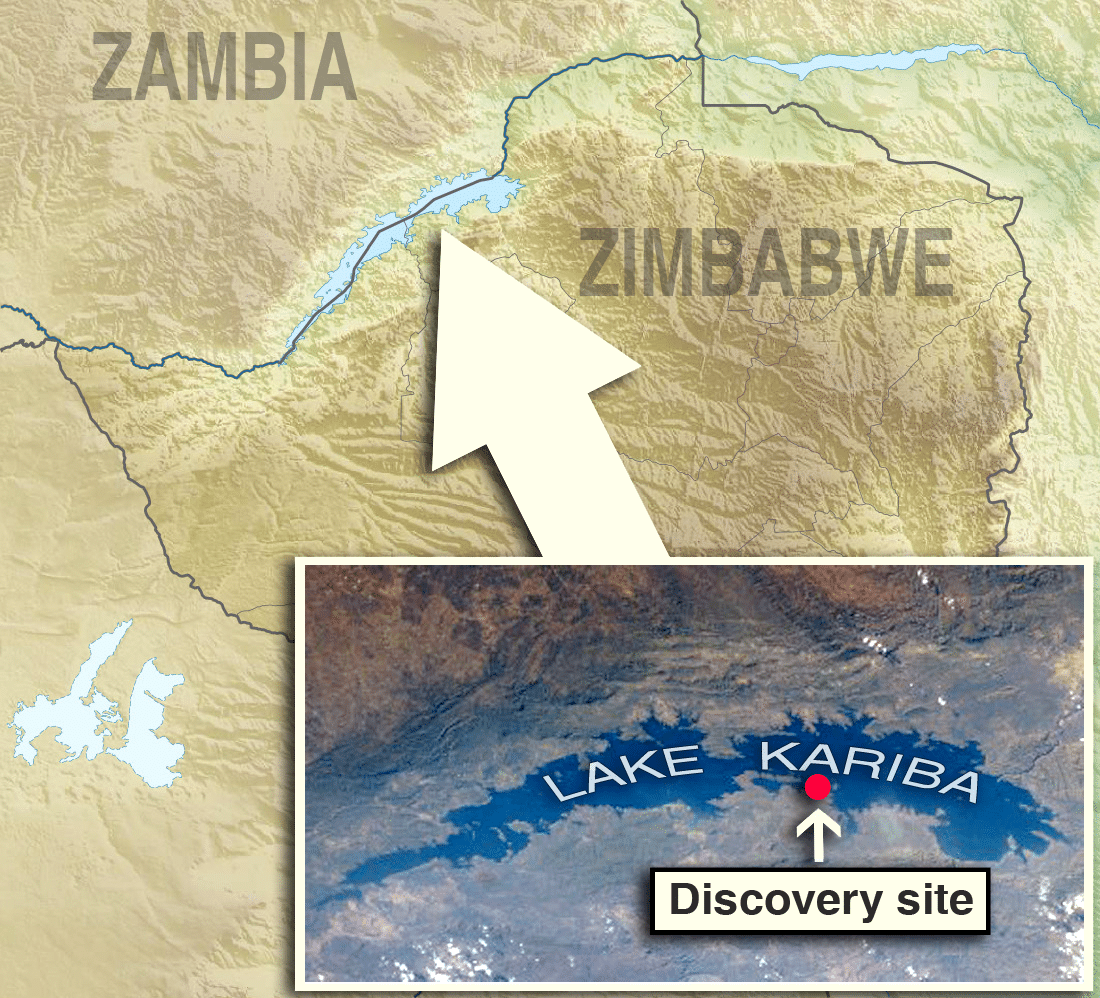
On a small island in Zimbabwe’s Lake Kariba, the uppermost layers of the Forest Sandstone hold a partial skeleton of one of the earliest known sauropods. Named Vulcanodon karibaensis in 1972, this heavy, four-legged dinosaur most likely lived in the Sinemurian and Pliensbachian stages of the Early Jurassic—roughly 199.5 to 184.2 million years ago. Its bones combine the columnar limbs of later sauropods with features inherited from older relatives, making it a key witness to how the sauropods got their start.
Lake Kariba stood at full storage for several months in 1969. When the lake level later fell, cliffs on islands just west of the Bumi estuary proved especially revealing. In 1970, geologists G. Bond and J.F. Wilson, together with museum scientist Michael A. Raath, reported a new sauropod horizon there in Nature. Raath named it two years later as sole author. Since then, researchers have revised its family, its age, and even the rock layer it came from. Its story shows how much a single partial skeleton can teach—and how often those lessons get rewritten.
Vulcanodon Key Facts
| Keyword | Fact |
|---|---|
| Pronunciation | vul-kan-oh-don (per the NHM Dino Directory) |
| Meaning of name | Volcano Tooth (per the NHM Dino Directory) |
| Group | Sauropoda |
| Type Species | Vulcanodon karibaensis |
| Diet | Herbivore (inferred) |
| When it Lived | About 199.5 to 184.2 MYA (likely) |
| Period | Jurassic |
| Epoch | Early Jurassic (Sinemurian to Pliensbachian stages) |
| Length | Not specified |
| Height | Not specified |
| Weight | About 22,700 pounds (10.3 metric tons), given in a 2018 study |
| Mobility | Moved on all four legs (quadrupedal) |
| First Discovery | Year not specified (site first reported in 1970 by G. Bond, J.F. Wilson, and M.A. Raath) |
| Described by | 1972 by M.A. Raath |
| Holotype | QG24 |
| Location of first find | Uppermost Forest Sandstone, Island 126/127 off Bumi Hills, Lake Kariba, Mid-Zambezi Basin, Zimbabwe |
Vulcanodon Origins, Taxonomy and Timeline
Raath coined the name Vulcanodon in 1972, in a paper announcing a new dinosaur “from near the Trias-Jurassic boundary.” According to the Natural History Museum’s Dino Directory, the name means “volcano tooth.” We could not consult Raath’s paper, but later papers record a lively debate over what he had found.
According to paleontologist M.R. Cooper’s 1984 account, Raath saw it as a specialized melanorosaurid prosauropod—an early sauropodomorph outside the true sauropods—converging on the sauropod body plan. Cooper notes that Cruickshank (1975), Van Heerden (1978), and his own 1980 work instead concluded it was a primitive sauropod. In 1984, Cooper went further, erecting the new sauropod family Vulcanodontidae and provisionally placing India’s Barapasaurus in it. More recently, paleontologist P.A. Viglietti and colleagues called Vulcanodon one of the earliest-branching members of Sauropoda. Vulcanodon karibaensis is the type and only known species.
Pinning down its age has proved even harder. Raath’s title placed it near the Triassic–Jurassic boundary, and many authors long treated it as Hettangian. In 2008, paleontologists R. Allain and N. Aquesbi instead followed earlier work in dating it as Toarcian, to match dates from the Karoo basalts. Then, in 2018, Viglietti and colleagues correlated the upper Forest Sandstone with South Africa’s Clarens Formation. That link implies a likely Sinemurian–Pliensbachian age, roughly 10 to 15 million years older than the Toarcian view. The Paleobiology Database places this window between 199.5 and 184.2 million years ago, early in the Jurassic period.
Discovery & Fossil Evidence
The type locality lies on Island 126/127, off Bumi Hills in Lake Kariba. Earlier work set the bones in the interbedded sandstones of the Batoka Basalt Formation—that is, between ancient lava flows. Yet in 1984, Cooper had already put them at the top of the Forest Sandstone. After a joint team relocated the quarry in 2017, Viglietti and colleagues placed Vulcanodon within the uppermost Forest Sandstone, beneath the basalts.

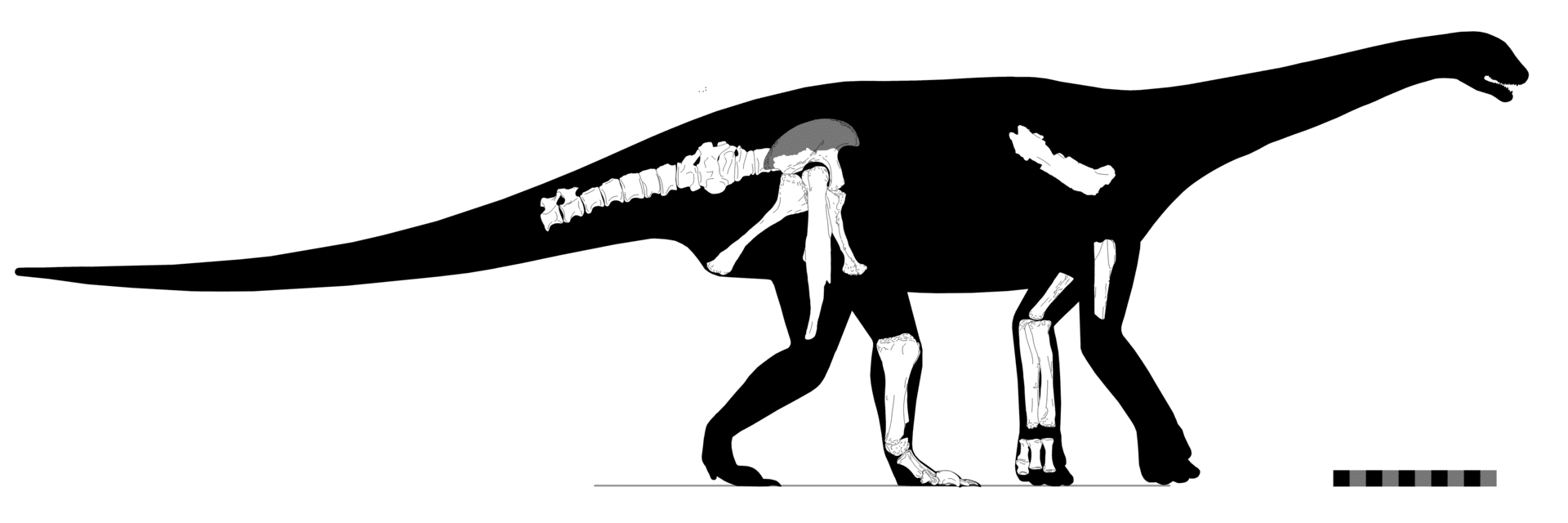
Cooper listed the holotype as QG24, at the National Museum of Zimbabwe in Bulawayo. Much of the skeleton was articulated or closely associated, and he judged that it undoubtedly came from one individual. The holotype includes the underside of the sacrum (the fused hip vertebrae) and most of the first 12 caudal (tail) vertebrae. From the forelimbs come both incomplete humeri (upper arm bones), a radius, and an ulna, while three metacarpals (hand bones) recorded by Raath had been lost by 1984. The hip bones include the ilium, pubes, and ischia. Its hind limb preserves the femur (thigh bone), tibia (shin bone), fibula, two ankle bones, all five metatarsals (foot bones), and clawed toe bones. The holotype has no skull, neck, or back vertebrae.
Later collecting by G. Bond and Cooper turned up bones from at least a second individual. Cooper treated them as topotypes—specimens from the type locality—and allowed that some may belong to the holotype. They include a right scapula (shoulder blade), QG152, while the site also yielded QG-1406, a neck vertebra fragment that Cooper called “clearly sauropodous.” As Cooper reports, Raath recorded parts of at least nine carnivorous teeth near the pubes and assigned them to Vulcanodon. Cooper doubted this, pointing to the spatulate teeth found with Barapasaurus, and suggested they “may have been lost during predation.” All of this material comes from the island locality.
Vulcanodon Size and Description
With no skull and only a scrap of neck, Vulcanodon survives mainly as hips, tail, and limbs—yet those parts say a great deal.
Short description of Vulcanodon
Starting at the hips, the sacrum shows three fused vertebral bodies on its underside, though Cooper inferred four in life—a count he treated as a sauropod character. The tail vertebrae were amphicoelous, meaning concave at both ends. They lacked pleurocoels (deep side hollows) but had hollowed sides, a condition Cooper called “incipient cavitation.” Meanwhile, the pubes formed a prominent forward-facing “apron,” almost identical to the prosauropod condition.
Straight and columnar, the femur lacked any S-shaped curve, and its fourth trochanter—a ridge for muscle attachment—sat at about mid-length. The forelimb reached 78 percent of hind-limb length, and the animal walked on all four legs. Cooper’s reconstruction borrowed its trunk and ilium from Barapasaurus. In his view, early sauropods “probably had the appearance of overgrown, quadrupedal prosauropods.”

Size and Weight of Type Species
No peer-reviewed source we consulted estimates its length or hip height, so the best size clues come from individual bones. As Cooper reported, Raath put the femur at about 3.6 feet (1.1 meters) long, even though its lower end is missing. For the incomplete humerus, Cooper offered what he called a reasonable estimate of about 2.3 feet (0.7 meters).
Cooper also estimated the topotype scapula at about 2.6 feet (784 millimeters), assuming it came from the holotype. Based on four sacral vertebrae, he sized the sacrum at roughly 22 inches (550 millimeters) long and 16 inches (400 millimeters) wide.
Weight is where Vulcanodon stands out. A 2018 study by paleontologist B.W. McPhee and colleagues gave a mass of about 22,700 pounds (10.3 metric tons). That figure places Vulcanodon well above Antetonitrus, whose immature specimen was put at about 12,300 pounds (5.6 metric tons). By contrast, the same team used limb-bone shaft circumferences to estimate Ledumahadi of South Africa at about 26,500 pounds (12 metric tons).
The Dinosaur in Detail
What sets this dinosaur apart is its hind limb—”a curious admixture of sauropod and prosauropod characters,” in Cooper’s words, citing Raath’s 1972 description. The tibia was short and robust, about 58 percent of femur length, with a low cnemial crest (the ridge on the front of the shin). The ankle lacked distal tarsals (lower ankle bones), one of Cooper’s reasons for calling it a sauropod. Yet its astragalus, the main ankle bone, remained “typically prosauropod.”
The foot tells a similar story. Its metatarsals were moderately short and of similar length, while the hallux (first toe) bore a much enlarged claw, as in prosauropods. Cooper judged the foot at least functionally four-toed. In the arm, the radius reached almost 60 percent of femur length and was slightly longer than the tibia. In 2018, McPhee and colleagues cited Vulcanodon as the prime example of early sauropod limb features, pointing also to Pulanesaura. These traits, they argued, had evolved—at least in incipient form—by the middle of the Early Jurassic.
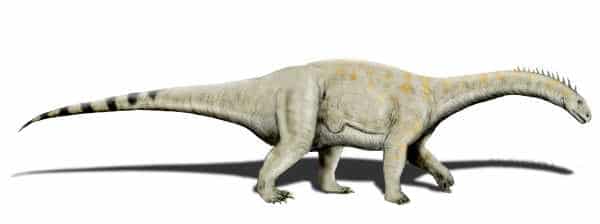

Among prosauropods, Cooper found Vulcanodon closest to Plateosaurus and Euskelosaurus. Its many retained prosauropod features, he judged, left “little doubt as to its ancestry.” He also proposed Vulcanodontidae as possible ancestral stock for the camarasaurids and diplodocids.
In 2008, Allain and Aquesbi grouped Vulcanodon with Morocco’s Tazoudasaurus in Vulcanodontidae, at the base of a new clade they named Gravisauria. Two of the family’s five supporting traits are unique in their analysis. They are a side-to-side flattened tibial shaft and top-to-bottom flattened claws on the second and third toes. As those authors noted, however, analyses by Wilson in 2005 and Yates in 2006 failed to recover the family. Taken together, the bones paint a picture of an animal caught mid-transition—already heavy and four-legged, yet still standing on an ancestral style of foot.
Interesting Points about Vulcanodon
- Alongside “Syntarsus” rhodesiensis, Mbiresaurus, and Musankwa, Vulcanodon is one of only a handful of dinosaurs named from Zimbabwe.
- Lake Kariba’s rise and fall exposed the site, and the first report on it appeared in 1970.
- Researchers have placed its age near the Triassic–Jurassic boundary, in the Hettangian, in the Toarcian, and most recently in the Sinemurian–Pliensbachian.
- New fossil sites reported in 2020–21 were the region’s first since the discovery of Vulcanodon karibaensis nearly 50 years earlier.
Contemporary Dinosaurs
No other named dinosaur from the Forest Sandstone has a confirmed age match with Vulcanodon, so this section looks south. From a neighboring region comes Massospondylus, a gracile, two-legged sauropodomorph up to about 16 feet (5 meters) long and roughly 1,200 pounds (550 kilograms). Its species M. carinatus occurs in the upper Elliot and Clarens formations of South Africa’s main Karoo Basin. In 2018, Viglietti and colleagues correlated the Clarens Formation with the upper Forest Sandstone. Moreover, Massospondylus gives its name to an assemblage zone dated Hettangian to Pliensbachian. Some Forest Sandstone bones from Zimbabwe also carry its name, though paleontologist P.M. Barrett and colleagues regard that record as tentative.
Vulcanodon in its Natural Habitat
In 1984, Cooper pictured a desert world for Vulcanodon, describing the Forest Sandstone as windblown sands of desert origin. At the quarry itself, however, bedded siltstones and sandstones are cut by an ancient river channel. Given the rift-valley setting, Cooper read these deposits as perhaps the outer reaches of alluvial fans, fringing temporary lakes during wetter spells. In 2017, Barrett and colleagues offered a damper picture, concluding that the new Kariba sites formed in wetter (more mesic) settings than their South African equivalents. Later, flood basalts capped Zimbabwe’s dinosaur-bearing basins, giving their fossils minimum ages of about 176 to 186 million years.
On diet, McPhee and colleagues noted the view that four-leggedness helped sauropods process low-quality, fibrous plant matter. While there is no direct evidence of what Vulcanodon ate, it was likely a herbivore like other sauropods. Cooper also argued that its size was no swamp adaptation, since peat swamps were “certainly absent.” Instead, sauropod gigantism may have evolved in response to harsh climates at the close of the Triassic, he suggested.
How the skeleton reached its resting place is uncertain. Cooper suggested the animal either rafted a short distance to the site or “haunted the banks of a temporary stream or wadi.” Whether it lived alone or in groups remains unknown. Elsewhere in Zimbabwe, the Forest Sandstone has also yielded the coelophysoid theropod (meat-eating dinosaur) Megapnosaurus rhodesiensis, first described as Syntarsus rhodesiensis. Its specimens come from near Nyamandhlovu and the Chitake River in the Mana Pools Basin. Because nobody has yet fixed the exact ages of those horizons, any overlap with Vulcanodon remains unconfirmed. Meanwhile, new Forest Sandstone sites in the basin have yielded unnamed non-sauropod sauropodomorphs.
Frequently Asked Questions
It most likely lived in the Sinemurian to Pliensbachian stages of the Early Jurassic, roughly 199.5 to 184.2 million years ago.
A 2018 study gives about 22,700 pounds (10.3 metric tons), but no peer-reviewed source gives its length or height.
No known teeth firmly belong to it, but like other sauropods it was likely a herbivore.
Researchers regard it as one of the earliest-branching sauropods, although Raath first described it in 1972 as a specialized prosauropod.
Its bones come from the uppermost Forest Sandstone on Island 126/127 in Lake Kariba, Zimbabwe.
Its legs mix sauropod traits, such as a straight, columnar femur, with prosauropod features like an enlarged first-toe claw.
Sources
The information in this article is based on various sources, drawing on scientific research, fossil evidence, and expert analysis. The aim is to provide a comprehensive and accurate overview of Vulcanodon. However, please be aware that our understanding of dinosaurs and their world is constantly evolving as new discoveries are made.
- https://bionames.org/names/cluster/154460
- https://www.nature.com/articles/2271339a0
- https://wiredspace.wits.ac.za/handle/10539/16126
- https://ui.adsabs.harvard.edu/abs/2018JAfES.137..149V
- https://peerj.com/preprints/3142.html
- https://www.cambridge.org/core/journals/geological-magazine/article/abs/sedimentology-and-palaeontology-of-the-upper-karoo-group-in-the-midzambezi-basin-zimbabwe-new-localities-and-their-implications-for-interbasinal-correlation/BF94CA760FCD32F6708001EF18B5299E
- https://app.pan.pl/archive/published/app69/app011002023.pdf
- https://zenodo.org/records/5371775
- https://ora.ox.ac.uk/objects/uuid:70de4052-c736-4737-a4d7-6ef8ab2b21b0
- https://researchconnect.stonybrook.edu/en/publications/biostratigraphy-of-the-massospondylus-assemblage-zone-stormberg-g/
- https://paleobiodb.org/data1.2/taxa/single.json?name=Vulcanodon
- https://paleobiodb.org/data1.2/occs/list.json?base_name=Vulcanodon&show=loc,strat,stratext,coords,time,ref
- https://www.nhm.ac.uk/discover/dino-directory/vulcanodon.html
This article was last fact checked: TheDinosaurs Team, 12-11-2026
Featured Image Credit: J-H. Jang, CC BY-SA 4.0, via Wikimedia Commons
