
On the Navajo Nation in northern Arizona, the Kayenta Formation preserves an armored dinosaur known from dozens of individuals. Named Scutellosaurus lawleri in 1981, it carried hundreds of osteoderms—small plates of bone that formed in the skin. Yet the thighbone of its holotype measures just 83.5 millimeters (about 3.3 inches). It lived in the Early Jurassic, and most studies place it as the earliest-diverging thyreophoran, or armored dinosaur. In 2025, however, Yao and colleagues recovered Lesothosaurus and Laquintasaura as early thyreophorans too, so that title is contested.
The story began in June 1971, when Museum of Northern Arizona summer intern David Lawler found a nearly complete postcranial skeleton—everything behind the head. A decade later, paleontologist Edwin H. Colbert described it as a fabrosaurid and argued that its rocks were Triassic. In 2021, paleontologist Benjamin Breeden and colleagues redescribed it in detail. They backed earlier work showing it was an obligate biped—an animal that always walked on two legs. By specimen count, it is now the most abundant dinosaur known from the Kayenta Formation. That offers a rare glimpse of an early armored dinosaur through many individuals.
Scutellosaurus Key Facts
| Keyword | Fact |
|---|---|
| Pronunciation | Not specified |
| Meaning of name | Little Shield Lizard |
| Group | Ornithischia, Thyreophora |
| Type Species | Scutellosaurus lawleri |
| Diet | Herbivore (inferred from its teeth and beaked jaws) |
| When it Lived | Around 199 to 175 MYA (a preliminary date of 183.7 MYA is a maximum age for the main bone-bearing level) |
| Period | Jurassic |
| Epoch | Early Jurassic (Sinemurian to Toarcian stages) |
| Length | Not specified |
| Height | Not specified |
| Weight | About 5.7 pounds (2.6 kilograms), from one 2014 model |
| Mobility | Moved on two legs (bipedal) |
| First Discovery | 1971 by David Lawler |
| Described by | 1981 by Edwin H. Colbert |
| Holotype | MNA.V.175 (published as MNA P1.175) |
| Location of first find | MNA Locality 219-1 (Rock Head), Ward Terrace, Kayenta Formation, Coconino County, Navajo Nation, Arizona, USA |
Scutellosaurus Origins, Taxonomy and Timeline
The name Scutellosaurus joins the Latin scutellum, “a little shield,” with the Greek sauros, “lizard” or “reptile.” The species name lawleri honors David Lawler, who discovered and collected the holotype. In 1978, field crews labeled several specimens “cf. Kayentasaurus lawleri,” a tentative name of Colbert’s that never reached print. Together, the name pairs the animal’s armor with the intern who found it.
Colbert placed Scutellosaurus in Fabrosauridae, stressing its similarities to Lesothosaurus, and called it a possible “remote ancestor” of ankylosaurs and stegosaurs. Today, however, researchers regard Fabrosauridae as polyphyletic—a grouping that does not reflect a single line of descent. Scutellosaurus now sits within Ornithischia, the “bird-hipped” dinosaurs, as an early member of Thyreophora. Breeden’s team placed it outside the narrower Thyreophoroidea, alongside the fragmentary European Emausaurus. Scutellosaurus lawleri is the type and only known species.
Dating the animal has proved harder than naming it. Colbert argued for a Triassic age, partly using larger osteoderms he attributed to aetosaurs, a group of armored reptiles. In 1989, however, paleontologist Kevin Padian referred those osteoderms to Scelidosaurus and argued for an Early Jurassic age. Tritylodontids (mammal-like cynodonts) and ostracods (tiny seed shrimp) with Early Jurassic affinities support that view. Even so, estimates range from Hettangian–Toarcian to Sinemurian–Pliensbachian, and the Paleobiology Database gives roughly 201.4 to 184.2 million years ago. A preliminary detrital-zircon date of 183.7 ± 2.7 million years comes from the Sarahsaurus quarry and so far appears only in a 2014 meeting abstract. It gives the main bone-bearing level a maximum age. Breeden’s team reads it as Pliensbachian to Toarcian, while Adam Marsh and Timothy Rowe call it Pliensbachian.
Discovery & Fossil Evidence
Lawler found the holotype at Rock Head, Museum of Northern Arizona (MNA) Locality 219-1, on Ward Terrace in Coconino County. Colbert, retired as Curator of Fossil Reptiles at the American Museum of Natural History, was by then an MNA Research Associate. In July 1977, William Amaral found a second, slightly larger skeleton at Gold Spring Wash, about 10 miles (16 kilometers) northwest of the first site. Colbert’s 1981 description rested on these two specimens.
The holotype, MNA.V.175, is a relatively complete postcranial skeleton with some cranial (skull) fragments. Breeden’s team also fixed several of his identifications, such as the left maxilla—the main upper tooth-bearing bone—which he had labeled as the right. The skeleton preserves 58 caudal (tail) vertebrae, probably nearly the whole tail.
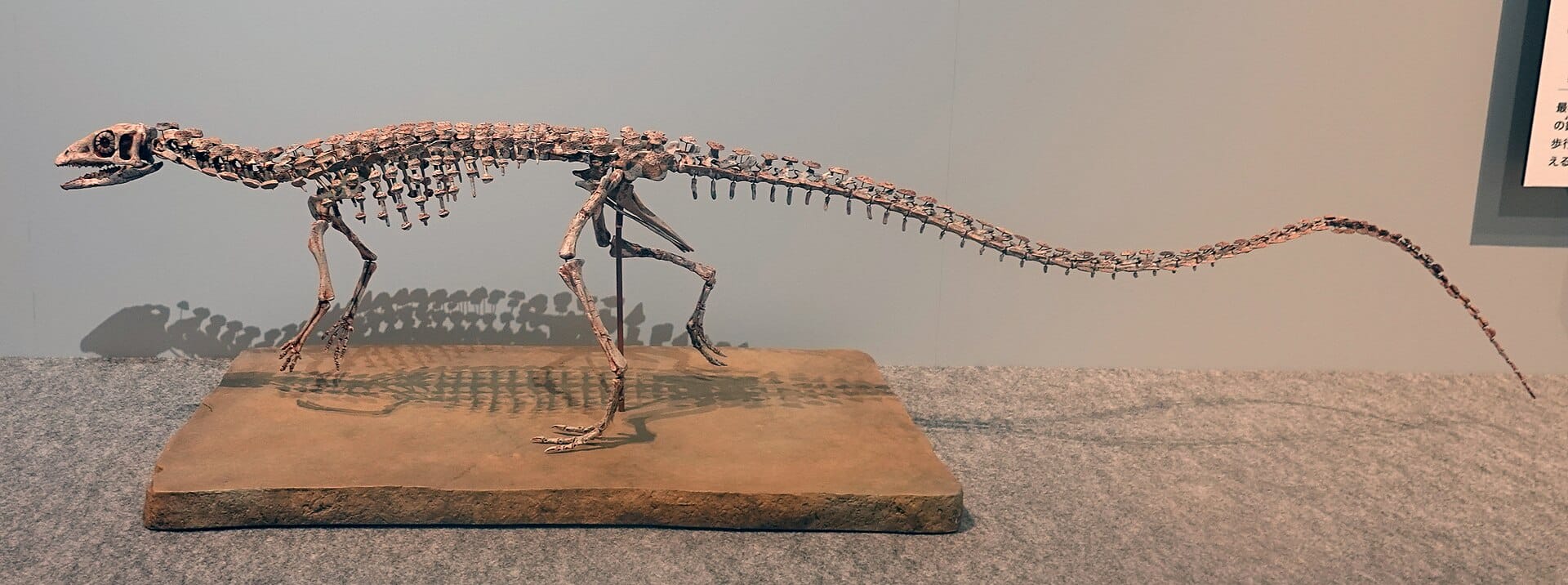

Later, University of California Museum of Paleontology (UCMP) crews led by James M. Clark found at least six more specimens in 1981 and 1983. Joint expeditions by the Museum of Comparative Zoology and the MNA added more in 1978 and 1982. University of Texas fieldwork from 1997 to 2000 then yielded over 40 new specimens. Two of these preserve parts of the skull and pelvis known from no other specimen. Breeden’s 2021 paper counts “over 70 specimens” in one place and “approximately 80” in another. All come from the silty facies in Coconino County, and all remain the property of the Navajo Nation.
Scutellosaurus Size and Description
For a dinosaur known from more than 70 specimens, Scutellosaurus has surprisingly few published body measurements.
Short description of Scutellosaurus
Its slender frontals—the bones above the eyes—were over three and a half times longer than the narrowest gap between the orbits. Of six premaxillary tooth sockets, only one holds a replacement tooth that shows its shape, a triangular crown with fine denticles (serrations). Farther back, the cheek teeth were subtriangular and symmetrical, closely resembling those of Lesothosaurus. No specimen preserves the predentary, the toothless bone at the jaw tip, but clear facets show where it attached.
One referred specimen preserves seven neck vertebrae after the axis, and the neck bones bear prominent, rugose keels underneath. In the holotype, the thighbone was 87 percent as long as the shin and 121 percent as long as the upper arm bone. At least 304 osteoderms came with the holotype and 17 with the paratype, but none lay in place, so any reconstruction of the armor is speculative.

Size and Weight of Type Species
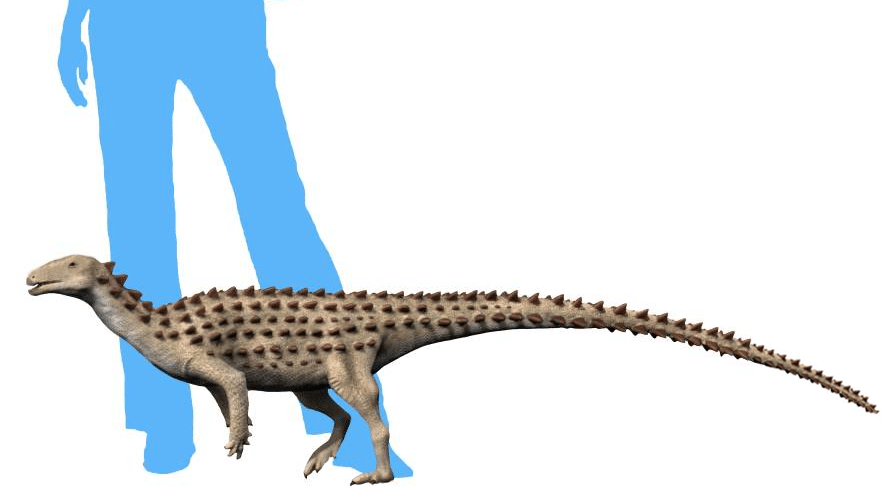
In 2014, Susannah Maidment and colleagues built a computer model with an 8-centimeter femur, close to the holotype’s. It weighed about 2.6 kilograms (5.7 pounds), and its armor made up about 7 percent of that mass. No source consulted gives a body length or hip height.
The firmest measurement is the holotype femur, which Breeden’s team measured at 83.5 millimeters, correcting Colbert. The paratype was slightly larger, while UCMP 130580 was somewhat smaller and UCMP 170829 about 20 percent larger than that specimen.
Whether these animals had finished growing is still debated. Padian and colleagues noted that growth appeared to be ceasing in UCMP 130580, which may mean it was nearly mature. In contrast, paleontologist Ronald Tykoski considered MNA.V.175 and others juveniles, apparently because of open neurocentral sutures—unfused joints in the vertebrae. Breeden’s team cautioned that suture closure is a weak guide to maturity.
The Dinosaur in Detail
What sets this dinosaur apart is its armor. Colbert recognized six osteoderm types that graded into one another—Breeden and Rowe reduced these to four in 2020. Type A is broad, flat, and keeled, while type B has a ridge and a deep hollow underneath. Type C is wider than long with two ridges, and type D is long and narrow.
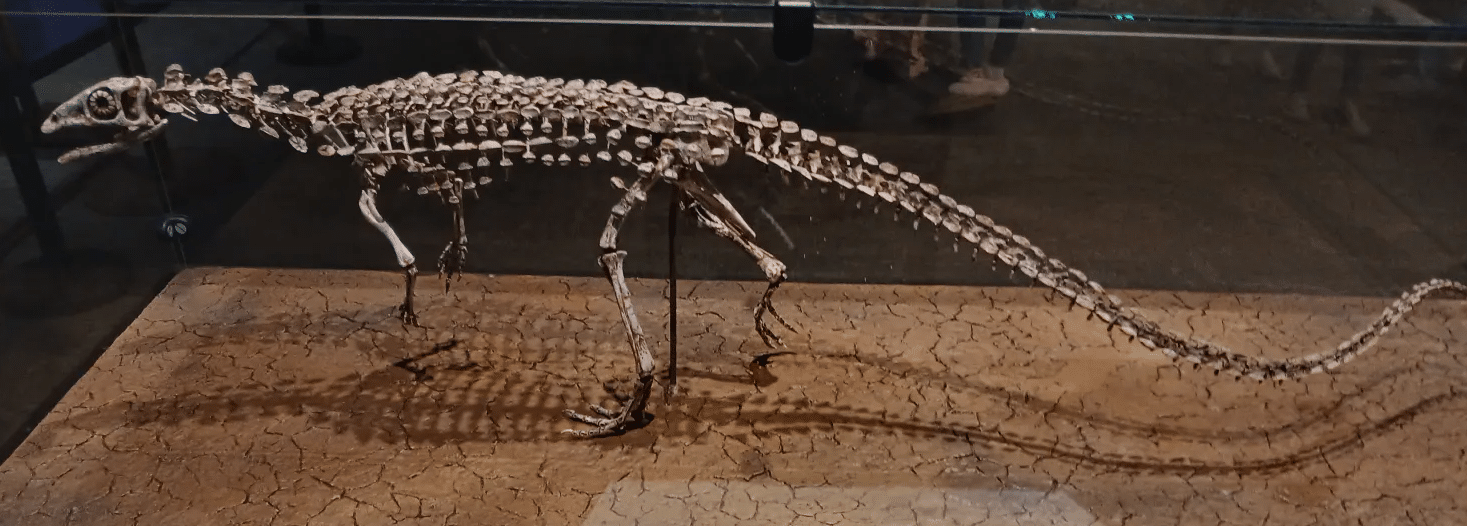

Colbert saw a facultative quadruped—an animal able to drop to all fours—partly because of the weight of its armor. However, Maidment and Paul Barrett could score only three of five signs of four-legged walking, and all three pointed to an obligate biped. Maidment’s 2014 model also tested it with its own armor and with armor like that of Stegosaurus and Euoplocephalus. Each time, the armor shifted the center of mass slightly backward. The team therefore rejected the idea that armor weight pushed it onto all fours.
Its revised diagnosis rests on four autapomorphies, or traits unique to the genus. Besides the narrow frontals and keeled neck vertebrae, the ilium (upper hip bone) has a narrow front blade with inner flanges. Breeden’s team found four of six thyreophoran synapomorphies (shared derived traits) in one data matrix and all five in another. Those traits make it “unequivocally a thyreophoran,” while its lack of every Thyreophoroidea trait places it outside that narrower group.
It also grew slowly throughout its life. Padian and colleagues found poorly vascularized or lamellar-zonal bone—tissue laid down in layers—with at least seven growth lines in one radius. Breeden’s team argued that this tissue reflects neither its small size nor its early branching position. It may instead be unique to Scutellosaurus, and they saw it as support for lower thyreophoran metabolic rates. Taken together, these traits describe a slow-growing, two-legged animal that was already unmistakably armored.
Interesting Points about Scutellosaurus
- Colbert flagged a rugose depression under the left dentary as possibly pathological, but a similar one sits on the right side.
- Colbert’s catalog number “MNA P1.175” has appeared in several garbled forms, and the museum now prefers “MNA.V.175” to match its database.
- With more than 70 specimens, Scutellosaurus is the most common tetrapod recovered from the Kayenta Formation.
- In 2025, Yao and colleagues suggested its primitive nature points to thyreophorans dispersing from North America to East Asia.
Contemporary Dinosaurs
Ranging across the same silty facies was Dilophosaurus, a large, crested theropod. Marsh and Rowe call it “the largest animal known to have lived on land in North America during the Early Jurassic.” Its fossils come from the lower and middle Kayenta, including the Sarahsaurus type quarry. Most Scutellosaurus specimens come from those middle layers, 20 to 30 meters (about 66 to 98 feet) above the base. Still, no fossil links the two directly, so picture them simply as sharing a landscape.
Adding further diversity was Sarahsaurus aurifontanalis, a sauropodomorph that Marsh and Rowe placed in Massospondylidae, the family of Massospondylus, in 2018. It is one of only three sauropodomorphs known from the Early Jurassic of North America. Its type quarry lies among the layers that yielded most Scutellosaurus fossils. In 2011, Rowe and colleagues noted that North America’s oldest known ornithischians, including Scutellosaurus, appear at the same time as Sarahsaurus in the Kayenta.
A small coelophysoid theropod with a disputed genus name, “Syntarsus” kayentakatae, also lived in the silty facies. Syntarsus had already been given to a beetle, so in 2001, Michael Ivie and colleagues proposed Megapnosaurus instead. Even so, in 2020, Marsh and Rowe kept “Syntarsus.” By contrast, Benson and colleagues list it as Coelophysis kayentakatae. Marsh and Rowe recovered it as the sister taxon to Coelophysidae. Its type locality lies 1.5 kilometers (0.9 miles) from a Rock Head sauropodomorph skull. That skull sits less than a kilometer from the Scutellosaurus holotype site.
Scutellosaurus in its Natural Habitat
The world Scutellosaurus roamed was a vast field of dunes crossed, for a time, by rivers. The climate was arid with occasional wet intervals, and the silty facies records multi-channel rivers prone to flash floods. Winds from the southeast blew Navajo dune sand into these streams. Nearby lakes and marshes held ostracods and carbonized sphenopsids (horsetails and their relatives).
Researchers usually list Scutellosaurus as a herbivore, based on its anatomy rather than direct study of its diet. Its subtriangular cheek teeth resemble those of Lesothosaurus, and a rugose snout tip points to a horny beak. While there is no direct evidence of what it ate, it may have browsed plants along these lakes and channels.
Likewise, there is no direct evidence of whether it lived alone or in groups. Its abundance stands out, though—ornithischians far outnumber theropods and sauropodomorphs in the Kayenta, unlike in southern Africa’s upper Elliot Formation or China’s Lufeng beds. Other dinosaurs lived nearby too, including a larger thyreophoran sometimes referred to Scelidosaurus and an undescribed juvenile heterodontosaurid. Tritylodontids and a crocodyliform also belonged to the community.
Frequently Asked Questions
It means “little shield lizard,” from the Latin scutellum and the Greek sauros, and lawleri honors its discoverer, David Lawler.
It lived in the Early Jurassic, probably in the Sinemurian to Toarcian stages. A preliminary date gives its main fossil level a maximum age of 183.7 million years.
No source consulted gives its length, but a 2014 computer model weighed about 2.6 kilograms (5.7 pounds), and the holotype’s thighbone measures 83.5 millimeters.
Most sources treat it as a herbivore, based on its teeth and beaked jaws rather than direct evidence such as gut contents.
All known fossils come from the Kayenta Formation in Coconino County, on the Navajo Nation in northern Arizona.
Breeden and colleagues call it the only definitive bipedal thyreophoran, and it is the most common tetrapod found in the Kayenta Formation.
Sources
The information in this article is based on various sources, drawing on scientific research, fossil evidence, and expert analysis. The aim is to provide a comprehensive and accurate overview of Scutellosaurus. However, please be aware that our understanding of dinosaurs and their world is constantly evolving as new discoveries are made.
- https://find.library.upenn.edu/catalog/99795853503681
- https://doi.org/10.1098/rsos.201676
- https://doi.org/10.6084/m9.figshare.c.5506765.v1
- https://doi.org/10.1080/02724634.2020.1791894
- https://doi.org/10.1017/jpa.2020.14
- https://doi.org/10.1371/journal.pone.0204007
- https://doi.org/10.1098/rspb.2010.1867
- https://doi.org/10.7717/peerj.12362
- https://doi.org/10.1016/j.isci.2024.111641
- https://doi.org/10.1371/journal.pbio.1001853
- https://paleobiodb.org/classic/basicTaxonInfo?taxon_no=38802
- https://musnaz.org/about/history/fellows/ed-colbert/
- https://doi.org/10.1007/s00114-014-1239-2
- https://journals.flvc.org/mundi/article/view/24958
- https://paleobiodb.org/data1.2/intervals/list.json?name=Sinemurian,Toarcian
This article was last fact checked: TheDinosaurs Team, 12-11-2026
Featured Image Credit: TotalDino, CC BY 4.0, via Wikimedia Commons
