
Northwest of Bulawayo in Zimbabwe, the pale, buff-colored rocks of the Forest Sandstone Formation preserve a slender predator from the Early Jurassic. Its type species, Megapnosaurus rhodesiensis, was a small, bipedal theropod that lived roughly 201 to 184 million years ago. It ranks among the best-represented early theropods—yet its very name is contested. In 2004, Bristowe and the species’ original describer, paleontologist Michael Raath, placed it in the same genus as Coelophysis, calling it Coelophysis rhodesiensis.
The species first entered the literature in 1969 as Syntarsus rhodesiensis. That genus name, however, already belonged to a beetle named in 1869, so in 2001 three entomologists coined the replacement Megapnosaurus. Since then, Yates in 2005 and Zahner and Brinkmann in 2019 have used the Coelophysis placement. In contrast, most of the post-2016 papers reviewed here, including a study by Griffin and Nesbitt, use Megapnosaurus. This article follows that recent majority—though the dispute itself sheds light on how hard early theropods can be to tell apart.
Megapnosaurus Key Facts
| Keyword | Fact |
|---|---|
| Pronunciation | Not specified |
| Meaning of name | Big Dead Lizard |
| Group | Theropoda |
| Type Species | Megapnosaurus rhodesiensis (originally Syntarsus rhodesiensis) |
| Diet | Carnivore |
| When it Lived | 201 to 184 MYA |
| Period | Jurassic |
| Epoch | Early Jurassic (Hettangian to Pliensbachian stages) |
| Length | Not specified |
| Height | Not specified |
| Weight | About 30 to 41 pounds (13.8 to 18.8 kilograms), indirect estimates |
| Mobility | Moved on two legs (bipedal) |
| First Discovery | Year not specified |
| Described by | 1969 by M.A. Raath (as Syntarsus), renamed Megapnosaurus in 2001 by M.A. Ivie, S.A. Ślipiński, and P. Węgrzynowicz |
| Holotype | QG 1 |
| Location of first find | Kwengula stream, Southcote Farm, Nyamandhlovu area, Forest Sandstone Formation, Matabeleland, Zimbabwe |
Megapnosaurus Origins, Taxonomy and Timeline
The name Megapnosaurus blends three Greek roots: megas (“big”), apnoos (“dead”), and sauros (“lizard”). Its authors, entomologists Michael A. Ivie, Stanisław Adam Ślipiński, and Piotr Węgrzynowicz, explained that “at the scale of an entomologist, it looks like a big dead lizard.” With dry humor, they added that it might be the first dinosaur name ever proposed in an entomological journal. The species name rhodesiensis echoes Rhodesia, the country named in the title of Raath’s 1969 paper. Together, the name pairs an entomologist’s joke with a nod to the land where the bones were found.
Raath originally described the animal as a “coelurosaurian dinosaur,” and his 1977 thesis assigned it to the family Podokesauridae. In 2004, Bristowe and Raath classified it within Theropoda, in the superfamily Coelophysoidea and the family Coelophysidae. Ivie and colleagues also moved a second species, kayentakatae, into their new genus. However, Griffin argued in 2018 that it belongs in neither Megapnosaurus nor Coelophysis. Barta and colleagues likewise noted that it is typically recovered outside the group formed by M. rhodesiensis and Coelophysis bauri. For these authors, Megapnosaurus rhodesiensis is the type and only species.
Barta and colleagues assign the Forest Sandstone to the Hettangian through Pliensbachian stages—roughly 201 to 184 million years ago. Meanwhile, the Paleobiology Database gives a narrower Hettangian to Sinemurian window, about 201 to 193 million years ago. Griffin and Nesbitt also count Megapnosaurus among dinosaurs from high paleolatitudes—regions far from the ancient equator.
Discovery & Fossil Evidence
The holotype—the name-bearing specimen—comes from the Kwengula stream on Southcote Farm, in the Nyamandhlovu area northwest of Bulawayo. Raath named the species in 1969, but the sources reviewed here do not record who found the skeleton or when. Two more Forest Sandstone sites lie in the Zambezi Valley, on the Chitake and Maura Rivers.
Cataloged as QG 1, the holotype is an almost complete articulated skeleton housed at the Natural History Museum of Zimbabwe in Bulawayo. Its sacrum (the fused hip vertebrae), scapulocoracoid (shoulder blade), and femur (thigh bone) show mature features. It is also the only M. rhodesiensis specimen with an articulated carpus, or wrist.
The Chitake River bonebed has yielded many individual specimens. Most of its collection, however, consists of isolated bones randomly mixed together. Bristowe and Raath read the site as a catastrophic mass death, with the animals buried in a thin river-laid lens within wind-blown sands. In 1972, Raath collected a detached block there holding QG165, a nearly complete juvenile skull lacking its snout. It was later CT-scanned and 3D-printed for study.
Raath first reported the species from South Africa’s Elliot Formation in 1980. In 1999, Munyikwa and Raath referred a snout and a partial pelvis to it, found by J.W. Kitching in the Free State. Yates later suggested, in 2005, that the snout might instead belong to a juvenile Dracovenator.
Megapnosaurus Size and Description
With dozens of specimens in collections, Megapnosaurus offers an unusually detailed view of a small early theropod.
Short description of Megapnosaurus
Much of the snout detail comes from Munyikwa and Raath’s 1999 comparison of a South African snout with Zimbabwean fossils—a snout Yates later suggested may belong to a young Dracovenator. In both, a small gap called a diastema separated the premaxillary teeth (at the snout tip) from the maxillary teeth behind. The joint between these two bones was loose and probably kinetic, or movable. Moreover, the South African snout carries four premaxillary teeth. As in the Zimbabwean fossils, its long, flattened maxillary teeth curve strongly backward. All of its teeth are serrated and show alternating replacement. Its serrated premaxillary teeth, though, are unlike those reported for Zimbabwean specimens. The two halves of the lower jaw also lacked a fused symphysis (chin joint), which suggests another kinetic joint.
Unlike C. bauri, it lacked even a vestigial fifth metacarpal (palm bone). As in C. bauri, its slender fourth metacarpal reached only about half to three-fifths the length of the third. A South African pelvis shows a prominent brevis shelf—a bony ledge on the hip blade—and fused rear sacral vertebrae, both closely matching the holotype. In mature animals, the tibia (shin bone) could fuse with the astragalus and calcaneum (ankle bones).
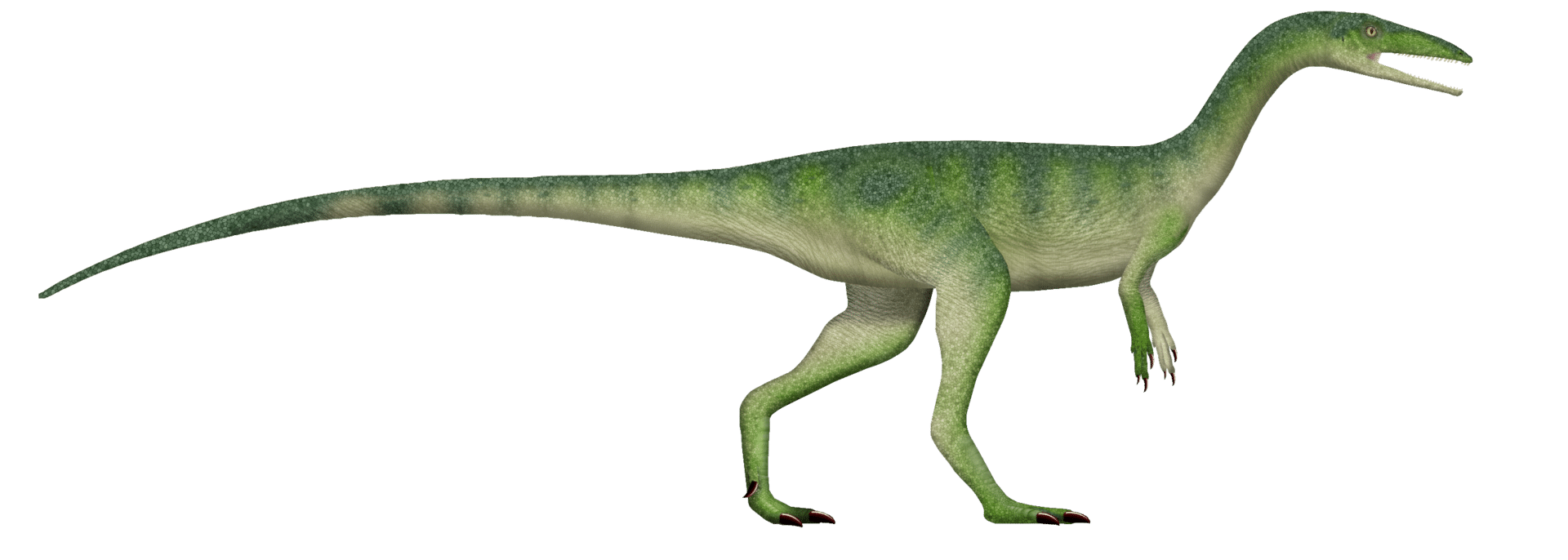

Size and Weight of Type Species
No peer-reviewed length or height estimate appears in the sources reviewed here, so both remain unknown. Mass estimates exist, though both are indirect. In 2012, O’Gorman and Hone listed about 30 pounds (13.8 kilograms) for the holotype, compiled from earlier work by Seebacher and Paul.
In 2013, Myhrvold derived a full-grown (asymptotic) mass of about 41 pounds (18.8 kilograms) from the growth equation Erickson and colleagues published in 2001. When he refit their data, he arrived at 19.0 kilograms. However, he also found that the published figure plotted points differing markedly from their sources.
Combined, the two mass estimates span roughly 30 to 41 pounds (13.8 to 18.8 kilograms). Because they come from different methods, neither should be read as a precise weight.
The Dinosaur in Detail
What sets this dinosaur apart from Coelophysis bauri is a short list of skull details. Bristowe and Raath’s revised diagnosis cites a blunt, squared front to the antorbital fossa (a hollow around the skull opening ahead of the eye). In addition, it lists a narrow base to the lacrimal (a bone in front of the eye socket) and a tooth row ending at the lacrimal’s front rim. Barta and colleagues add that its thumb was perhaps less opposable than in C. bauri.
Whether those differences justify a separate genus lies at the heart of the debate. Paul first proposed in 1988 and 1993 that Syntarsus and Coelophysis belong together. In 2003, paleontologist Oliver Rauhut kept them apart, diagnosing Syntarsus by a postnasal fenestra—an opening between three skull-roof bones. A year later, Bristowe and Raath compared 91 skull characters and found 78 identical and only 3 confirmed differences. Syntarsus, they concluded, is a junior synonym of Coelophysis, and Megapnosaurus was a “facetious” name that “should not stand.” Even so, they admitted that the foundation for their conclusions was “not as solid as we would have preferred.”
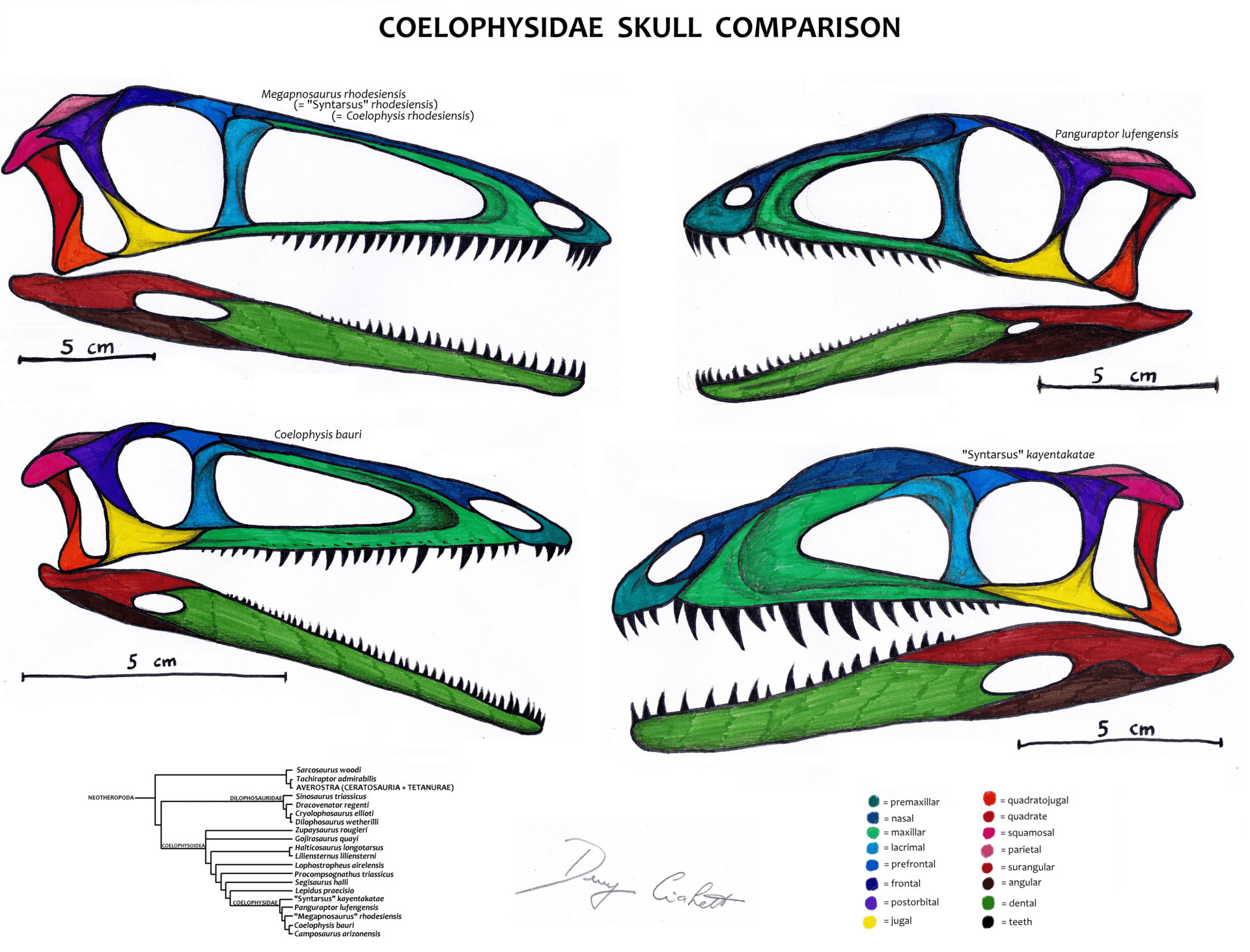

Later work revived the name. In 2018, Griffin noted that several family-tree analyses place rhodesiensis closer to Camposaurus than to C. bauri. That arrangement would make Coelophysis paraphyletic—a grouping that leaves out some descendants of its own common ancestor. Griffin therefore adopted Megapnosaurus, and Barta and colleagues made the same choice on the reasoning of Griffin and Nesbitt. Others, such as Barrett and colleagues in 2024, write “Syntarsus” in quotation marks. Taken together, these studies leave a well-documented animal with a contested label.
Interesting Points about Megapnosaurus
- By 2001, Syntarsus had also become the name of the in-house journal of Zimbabwe’s National Museums and Monuments.
- In 1990, Chinsamy counted between one and six growth rings in sectioned femora, set within fast-growing, richly vascular bone tissue.
- Bones that Raath once identified as hyoids, or tongue-supporting bones, may in fact be furculae (wishbones), as Tykoski and colleagues suggested.
- In 2016, Griffin and Nesbitt found that body size tracks maturity poorly in this species, which shows high variation in how individuals developed.
Contemporary Dinosaurs
No named dinosaur has yet been shown to share both the Forest Sandstone and the time of Megapnosaurus. Both animals below therefore come from a neighboring region—the upper Elliot and Clarens formations of South Africa.
South Africa’s upper Elliot Formation has yielded the fossils referred to Megapnosaurus there. Munyikwa and Raath note that the zone producing them is dominated by Massospondylus. It was a gracile, medium-sized, bipedal sauropodomorph—part of the wider group that includes the sauropods. In 2012, Sereno dated the upper Elliot to the earliest Jurassic (Hettangian), which overlaps the age range for Megapnosaurus. However, Barrett and colleagues regard its Zimbabwean records as tentative, so the link rests on South Africa.
Also from South Africa’s upper Elliot and Clarens formations comes Heterodontosaurus tucki. It was a heterodontosaurid ornithischian, a member of the “bird-hipped” dinosaur group. Sereno assigns these beds to the Hettangian and Sinemurian stages, about 200 to 190 million years ago. Even so, it is known only from that neighboring region, and no link to Megapnosaurus is recorded.
Megapnosaurus in its Natural Habitat
The world Megapnosaurus roamed in Zimbabwe was a dry one. The Forest Sandstone consists of wind-blown sands of desert origin, and Raath pictured a sand-dune desert with plants probably clustered around playa lakes and major watercourses. Yet the river-laid Chitake burial shows that water still crossed these dunes at times. Olsen and Galton, as cited by Bristowe and Raath, correlated the Forest Sandstone with South Africa’s upper Elliot and Clarens formations. In the upper Elliot, non-dinosaur neighbors included the cynodont (mammal relative) Tritylodon, early mammals, protosuchian crocodilians, and a turtle.
Back in Zimbabwe, the Forest Sandstone also preserves Vulcanodon karibaensis, a large-bodied early sauropod from an island in Lake Kariba. In 2018, Viglietti and colleagues placed it in the uppermost Forest Sandstone, with a suggested Sinemurian to Pliensbachian age. The two come from different localities, though, and an overlap in time with Megapnosaurus has not been confirmed.
Like other coelophysoids, Megapnosaurus is generally described as a carnivore, though no evidence specific to its own diet has been reported. Its recurved teeth would likely have suited that role. In 1990, Chinsamy argued that its rapidly deposited bone implies a high metabolic rate, possibly approaching that of modern warm-blooded animals. Rest lines in adult bone also led her to conclude that it stopped growing at a set adult size.
Single-species bonebeds such as Chitake have led Raath and others to conclude that coelophysoids were gregarious, or lived in groups. Raath also recognized gracile and robust forms and suggested that the robust ones were females. Chinsamy found large erosion cavities only in robust bones and linked them to egg-laying, which she took as support for that idea. Griffin and Nesbitt, however, argued in 2016 that such variation is better explained by individual development than by sex.
Frequently Asked Questions
It means “big dead lizard,” from Greek roots chosen by the entomologists who renamed the dinosaur in 2001.
It lived in the Early Jurassic, roughly 201 to 184 million years ago.
No length estimate appears in the peer-reviewed sources we reviewed. Indirect estimates range from about 30 to 41 pounds (13.8 to 18.8 kilograms), depending on the method.
Like other coelophysoids, it is thought to have been a carnivore, and it had long, recurved teeth.
The holotype comes from the Forest Sandstone Formation on Southcote Farm, northwest of Bulawayo in Matabeleland, Zimbabwe.
Some specialists, including its original describer, call it Coelophysis rhodesiensis. Most recent studies reviewed here keep it in its own genus, Megapnosaurus.
Sources
The information in this article is based on various sources, drawing on scientific research, fossil evidence, and expert analysis. The aim is to provide a comprehensive and accurate overview of Megapnosaurus. However, please be aware that our understanding of dinosaurs and their world is constantly evolving as new discoveries are made.
- https://journals.flvc.org/mundi/article/view/24958
- https://wiredspace.wits.ac.za/handle/10539/13320
- http://hdl.handle.net/10539/16449
- https://pmc.ncbi.nlm.nih.gov/articles/PMC5735062/
- https://pmc.ncbi.nlm.nih.gov/articles/PMC5835796/
- https://pmc.ncbi.nlm.nih.gov/articles/PMC5187714/
- https://zenodo.org/records/5123157
- http://hdl.handle.net/10539/16144
- https://wiredspace.wits.ac.za/items/76381438-0082-431d-9f06-03c48609ef3c
- https://pmc.ncbi.nlm.nih.gov/articles/PMC3526529/
- https://pmc.ncbi.nlm.nih.gov/articles/PMC3864909/
- https://doi.org/10.4202/app.01100.2023
- https://ui.adsabs.harvard.edu/abs/2018JAfES.137..149V
- http://hdl.handle.net/10539/16126
- https://zookeys.pensoft.net/article/3152/
- https://pmc.ncbi.nlm.nih.gov/articles/PMC8493203/
- https://pmc.ncbi.nlm.nih.gov/articles/PMC9569331/
- https://pmc.ncbi.nlm.nih.gov/articles/PMC6669044/
- https://pmc.ncbi.nlm.nih.gov/articles/PMC12803671/
- https://pmc.ncbi.nlm.nih.gov/articles/PMC13682567/
- https://paleobiodb.org/data1.2/taxa/single.json?name=Megapnosaurus&show=attr,app,parent
- https://stratigraphy.org/ICSchart/ChronostratChart2024-12.pdf
This article was last fact checked: TheDinosaurs Team, 12-11-2026
Featured Image Credit: TotalDino, CC BY-SA 4.0, via Wikimedia Commons