
Across South Africa and Lesotho, the red river- and wind-laid rocks of the upper Elliot Formation have yielded more of one dinosaur than any other—Massospondylus carinatus, at least as currently identified. It lived during the Hettangian and Sinemurian stages of the Early Jurassic, roughly 201 to 193 million years ago. This herbivore was a non-sauropod sauropodomorph, a member of the long-necked lineage outside the true sauropods. Researchers have referred more than 200 specimens to it, from embryos to adults, although many of those referrals are now being re-examined.
The Orpen brothers collected the first bones in the early 1850s. Richard Owen named the genus in 1854, although he took the fossils for large carnivorous reptiles. A bomb destroyed those original bones in 1941, so the species now rests on a replacement specimen chosen in 2010. Meanwhile, a nesting site in the same rocks was once described as the oldest known for any dinosaur. Together, these fossils let researchers follow Massospondylus from the egg to full size, although not every specimen can yet be tied to M. carinatus.
Massospondylus Key Facts
| Keyword | Fact |
|---|---|
| Pronunciation | Not specified |
| Meaning of name | Longer Vertebra |
| Group | Sauropodomorpha |
| Type Species | Massospondylus carinatus |
| Diet | Herbivore |
| When it Lived | 201.4 to 192.9 MYA |
| Period | Jurassic |
| Epoch | Early Jurassic (Hettangian to Sinemurian stages) |
| Length | About 16.4 feet (5 meters), estimated |
| Height | Not specified |
| Weight | About 1,197 pounds (543 kilograms), estimated for the neotype |
| Mobility | Moved on two legs (bipedal) as an adult |
| First Discovery | 1853 or 1854 by Joseph Millerd Orpen and his brothers |
| Described by | 1854 by Richard Owen |
| Holotype | None designated (neotype BP/1/4934, chosen in 2010) |
| Location of first find | Farm Beauchef Abbey 215, upper Elliot Formation, Harrismith District, Free State Province, South Africa |
Massospondylus Origins, Taxonomy and Timeline
Owen explained the name in a footnote—”masson” is Greek for “longer,” while “spondylos” means “vertebra.” He chose it because the vertebrae were proportionally longer than those of Macrospondylus, an extinct crocodile. Although Owen never explained the species name carinatus, Barrett and Chapelle suggested in 2024 that it likely refers to the keel (carina) beneath the vertebrae. Together, the name records what Owen could see—long, keeled bones.
Massospondylus belongs to Sauropodomorpha and gives its name to the family Massospondylidae, first named by von Huene in 1914. In 2018, a CT-based study by Chapelle and Choiniere grouped it with Sarahsaurus, Ignavusaurus, Leyesaurus, Adeopapposaurus, Coloradisaurus, and the Chinese Lufengosaurus. M. carinatus is the type species. A second species, M. kaalae, named by Barrett in 2009, is still treated as valid, although Chapelle and Choiniere called in 2018 for its status to be reassessed. In that same analysis, the two species did not form a single natural group—possibly because M. kaalae is so incomplete.
Barrett and colleagues regard the neotype’s horizon as earliest Jurassic, within the Hettangian to Sinemurian stages—roughly 201.4 to 192.9 million years ago. Counting records from the overlying Clarens Formation, however, stretches the range into the Pliensbachian, to about 184.2 million years ago. The rock zone named after Massospondylus records one of the oldest dinosaur-dominated ecosystems in southern Gondwana—the great southern landmass. In fact, a turnover of animals near the base of the upper Elliot could reflect the end-Triassic extinction.
Discovery & Fossil Evidence
Joseph Millerd Orpen and his brothers collected the first bones near Harrismith, on the farm now called Beauchef Abbey. Owen dated the find to 1854, while Orpen’s own 1889 letter recalled “about 1853.” The brothers sent 56 bones to their father, who passed them to Owen at the Hunterian Museum. Owen named three genera from them, but only Massospondylus endures. Pachyspondylus and Leptospondylus are now nomina dubia (doubtful names).
Owen never chose a holotype, the single name-bearing specimen. Instead, he based the name on five vertebrae, Nos. 331 to 335, and referred 13 more bones “with some reservations.” He judged No. 331 “probably from the tail” and gave its length as about 5.5 inches (140 millimeters). In 1860, Owen moved Massospondylus to the crocodiles without giving reasons. Lydekker appears to have been the first to recognize it as a dinosaur, in 1888. Later, Seeley showed in 1895 that the five vertebrae were cervicals (neck vertebrae).
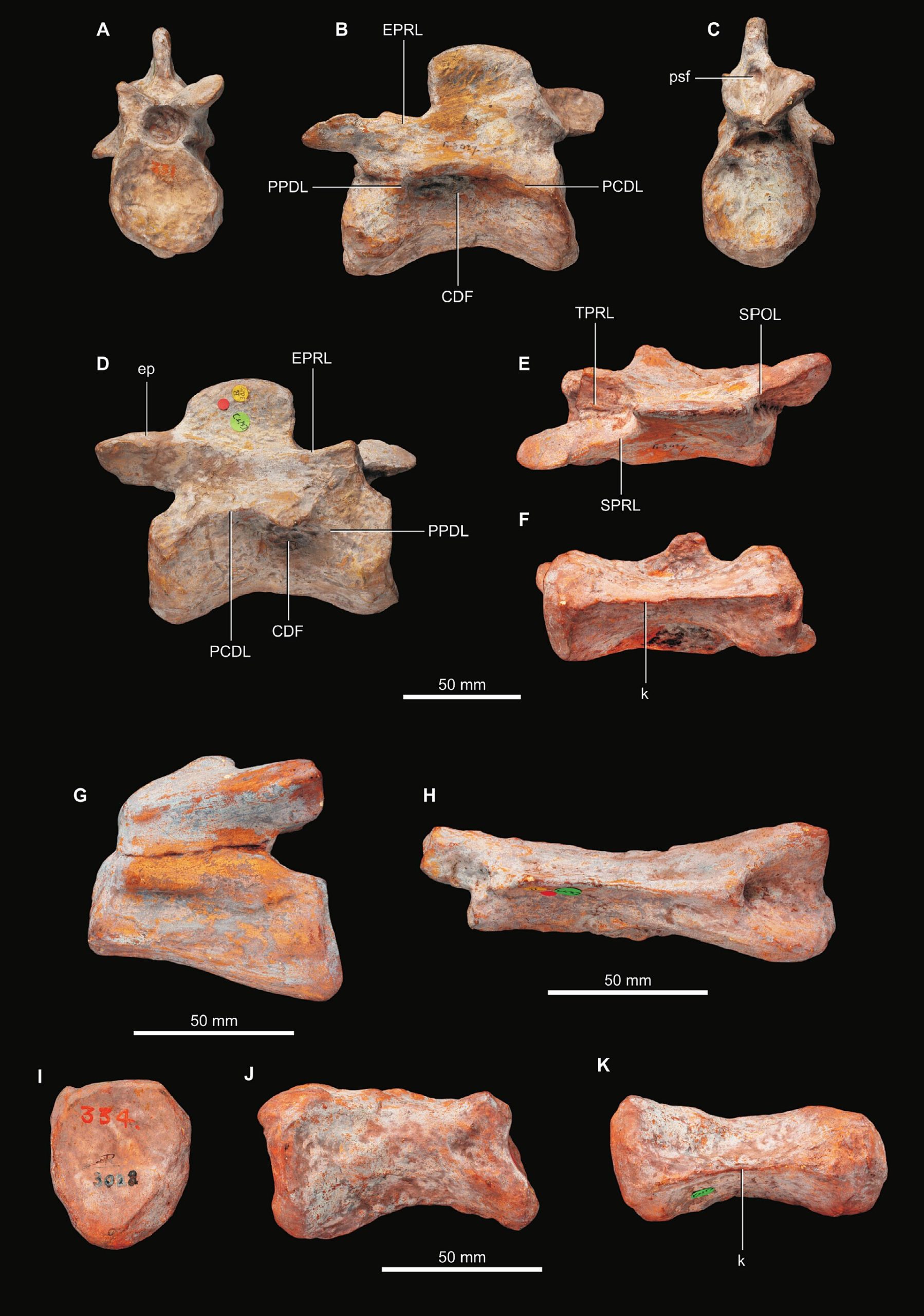

On the night of 10–11 May 1941, a high-explosive bomb struck the Hunterian Museum and destroyed all the fossil reptile material in Owen’s 1854 catalog. Only plaster casts survived, and casts cannot act as type material under the rules of zoological naming. In 2010, Yates and Barrett therefore designated BP/1/4934 as the neotype—a replacement name-bearing specimen. This formalized a 2004 suggestion by Sues and colleagues and needed no ruling from the naming commission. Lucas Huma and James Kitching had collected the skeleton in March 1980 on Bormansdrift farm, in the Clocolan District. Nicknamed “Big Momma,” although its sex is unknown, it has been on display at the University of the Witwatersrand since 1990.
Massospondylus Size and Description
Short description of Massospondylus
The neotype skull measures 218 millimeters (about 8.6 inches) long. One CT-scanned skull holds 21 tooth sockets on each side, and its crowns carry serrations along both edges. Behind the head, the front neck vertebrae had bodies more than seven times as long as tall.
In the neotype, the humerus (upper arm bone) is 270 millimeters (about 10.6 inches) long. Its deltopectoral crest, a ridge for chest and shoulder muscles, runs about 60 percent of that length. Meanwhile, the ulna (a forearm bone) is no more than 0.6 times as long as the humerus. In embryos, the large “thumb” typical of early sauropodomorphs appears to have turned to bone precociously—early in development. At the hips, the lower ends of the pubic bones were flat and unexpanded.
Unfortunately, the neotype lacks most of its hind limbs and tail. Adults likely walked on two legs, while the posture of hatchlings remains debated.

Size and Weight of Type Species
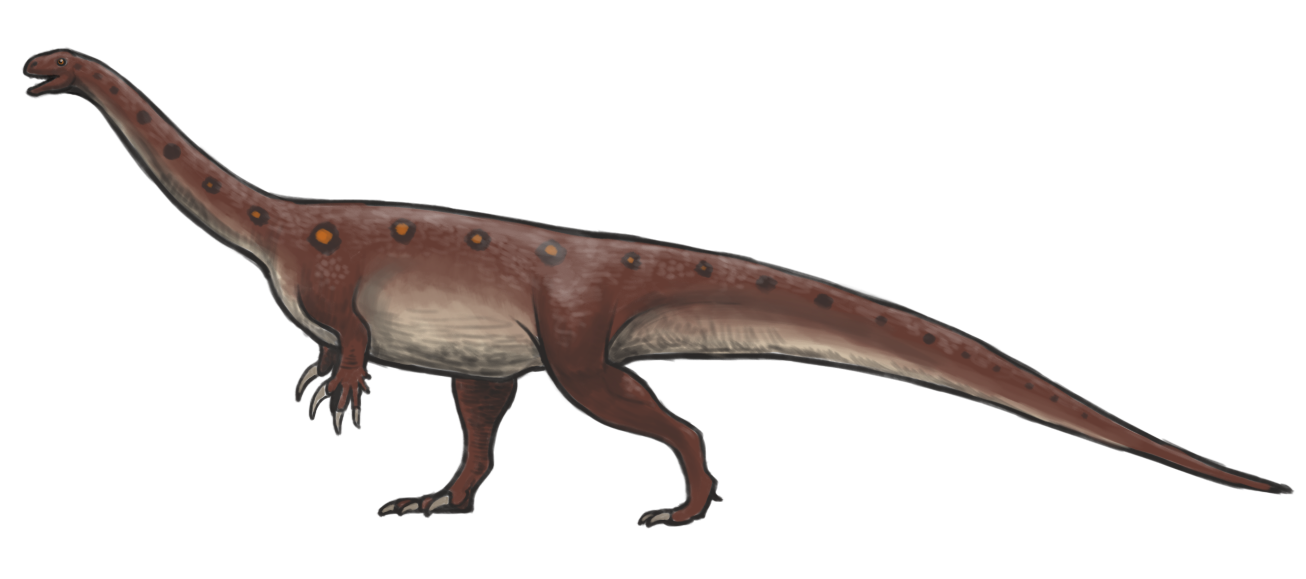
Owen gave no body-size estimate in 1854, only bone measurements. The preserved neotype runs about 11.5 feet (3.5 meters). In 2019, Barrett and colleagues extrapolated from relatives such as Lufengosaurus to reach about 16.4 feet (5 meters) in total.
None of the studies consulted here gives a height, but in 2023, Chapelle, Botha, and Choiniere used the neotype’s thigh bone to estimate weight. From its minimum circumference of 214 millimeters, they calculated about 1,197 pounds (543 kilograms)—a figure they elsewhere round to roughly 550 kilograms.
Both figures are indirect estimates, but they come from a big individual. BP/1/4934 is the largest known M. carinatus specimen, and Barrett’s team considered it skeletally mature.
The Dinosaur in Detail
What sets this dinosaur apart appears in its 2019 revised diagnosis—the formal list of its defining features. Beneath the braincase, the basipterygoid processes—struts linking the braincase to the palate—diverge at less than 60 degrees. The front neck vertebrae carry hook-like expansions on their spines, and the shoulder blade ends in a small upper and a large lower expansion. By contrast, the 2018 CT study rejected an older skull trait—width exceeding height by at least 10 percent—because it does not hold even in the neotype. That study also revealed hollow, bony orbitosphenoids (bones at the front of the braincase), a shared entry for the carotid arteries, and a reconstructed inner ear.
Bone histology adds a growth story. In 2022, Chapelle and colleagues calculated a minimum age of 20 years from a femur growth series. Yet the animal was already close to its maximum size from about 18 years of age. Erratic spacing of growth marks pointed to growth plasticity—body size and the number of growth marks matched poorly. A band of bone signaling the end of growth also suggested determinate growth, contrary to Chinsamy’s 1993 view.
The genus itself has changed shape over the years, starting in 1981, when Cooper sank many southern African names into M. carinatus. Since then, researchers have split away Ignavusaurus and Ngwevu intloko—the latter named in 2019 for a skull and partial skeleton once assigned to Massospondylus. In 2024, Barrett and Chapelle found that none of the surviving casts of Owen’s original bones shows the features now used to define the species. As a result, the name effectively rests on the neotype alone. Taken together, these studies describe a well-sampled species whose limits are still being redrawn.
Interesting Points about Massospondylus
- Owen’s footnote explains that the name means “longer vertebra,” not “massive vertebra,” as popular sources often translate it.
- A bomb destroyed the five vertebrae that originally carried the name in May 1941, leaving only casts.
- Kitching and Raath named a biozone the Massospondylus Range Zone in 1984, and Viglietti and colleagues expanded it in 2020 as the Massospondylus Assemblage Zone.
- A hatchling reportedly collected in Lesotho in 1961 once sat on museum display misidentified as Heleosaurus, before a 2025 study tentatively assigned it to Massospondylus.
- Researchers now restrict Massospondylus to southern Africa, after reassigning North American material to Sarahsaurus and Argentine material to Adeopapposaurus.
Contemporary Dinosaurs
Sharing the upper Elliot landscape was Lesothosaurus, an ornithischian dinosaur. In 2020, Viglietti and colleagues listed Lesothosaurus diagnosticus with M. carinatus as index fossils of the Massospondylus Assemblage Zone. That zone spans the upper Elliot and Clarens formations, from the Hettangian to the Pliensbachian, but no direct interaction between the two is known.
Also present was Heterodontosaurus, a small heterodontosaurid ornithischian. Sereno placed it in the upper Elliot and Clarens formations in 2012. Later dating places the upper Elliot in the Hettangian–Sinemurian and the Clarens mainly in the Pliensbachian. Curiously, one museum cataloged a large snout now referred to Heterodontosaurus as Massospondylus until recently. Beyond that mix-up, however, nothing links the two directly.
From the same rocks came Dracovenator, a medium-sized neotheropod known from a fragmentary skull. Yates described it in 2005 from the upper Elliot Formation of the Eastern Cape, within the Massospondylus Range Zone. His name refers to its “probable habit of preying on prosauropod dinosaurs,” although no direct evidence of such predation exists.
Rounding out the group was Pegomastax, a small heterodontosaurid known from a fragmentary skull consisting mainly of its lower jaws. Its holotype came from Voyizane, the upper Elliot locality that also yielded the best Heterodontosaurus skeletons. It, too, has no recorded interaction with Massospondylus.
Massospondylus in its Natural Habitat
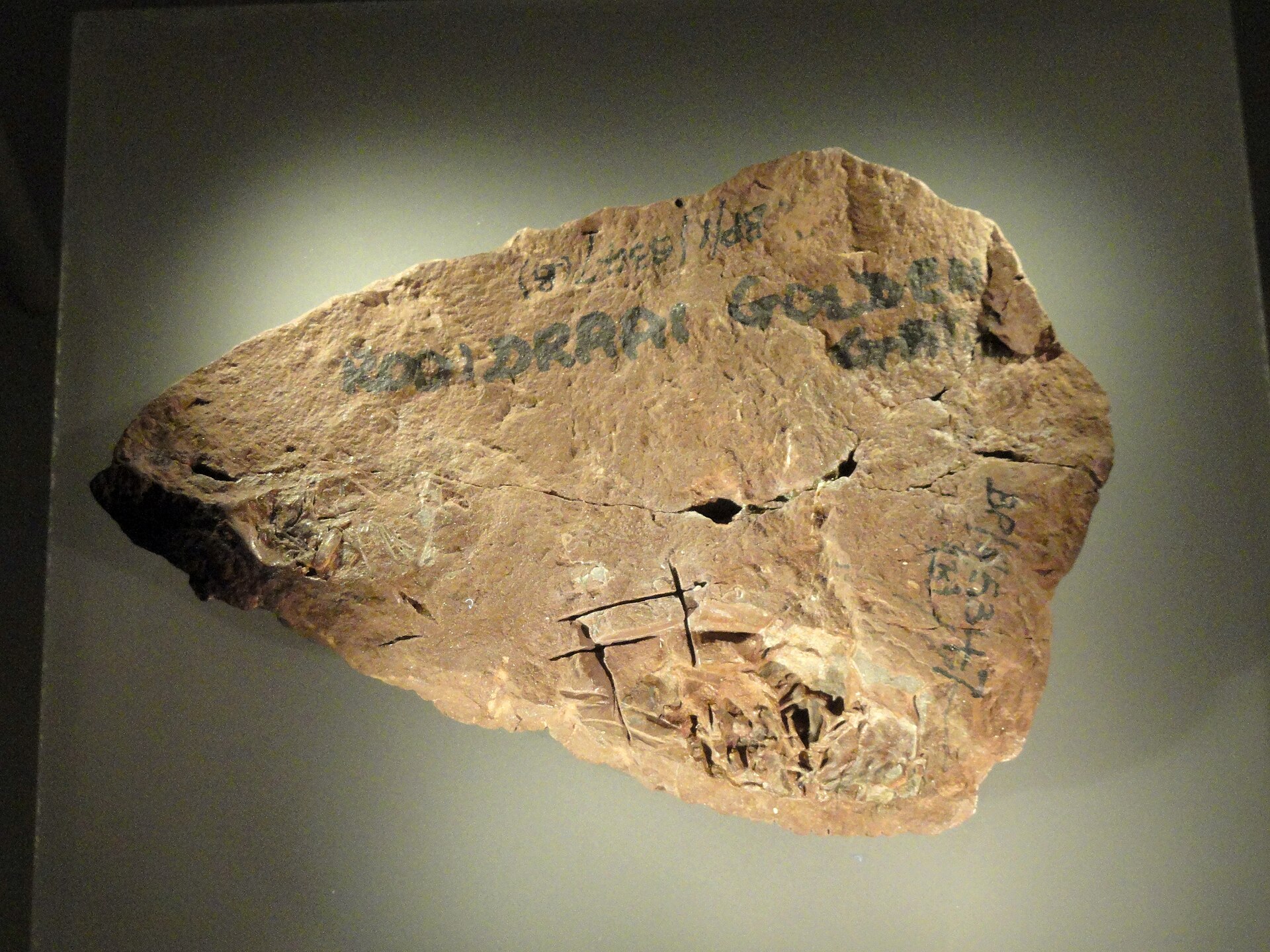
The world Massospondylus roamed took shape in red country built by rivers and wind. Citing Smith (1990), Sereno described its fauna of “smaller light-limbed forms” as living under drier conditions than those of the older lower Elliot. At the Rooidraai nesting site in Golden Gate Highlands National Park, the sediments indicate an ephemeral lake shore or river edge—likely an oxbow lake prone to flooding.
Owen and, much later, Cooper imagined a carnivore. However, most recent authors regard Massospondylus as a herbivore or a facultative omnivore—eating mostly plants but sometimes other food. In 2022, a quantitative study of tooth form by Ballell, Benton, and Rayfield consistently predicted herbivory for it.
Its nests offer a rare glimpse of early dinosaur reproduction. An incomplete clutch with embryos turned up in road-cut debris in 1976, and excavation at the site began in 2006. There, Reisz and colleagues found clutches in at least four horizons, which they read as evidence of site fidelity and colonial nesting. The eggs lay in a tightly organized single layer.
In 2025, Mooney and colleagues described the embryos and hatchlings as likely altricial—relatively undeveloped at hatching. They also backed a four-legged start for hatchlings, first proposed by Reisz’s team in 2005. However, inner-ear, limb, and bone-tissue studies from 2018 to 2022 argued against any such postural shift, so the question remains open. In 2019, Barrett and colleagues also cautioned that referring the embryos to M. carinatus still requires confirmation.

Frequently Asked Questions
It means “longer vertebra,” after its proportionally long vertebrae, according to Richard Owen’s own 1854 footnote.
It lived in the Hettangian to Sinemurian stages of the Early Jurassic, roughly 201.4 to 192.9 million years ago.
It reached an estimated 16.4 feet (5 meters) in length. The largest known specimen weighed an estimated 1,197 pounds (543 kilograms).
It was a herbivore, although some researchers regard it as a facultative omnivore.
The first bones came from the upper Elliot Formation near Harrismith, in South Africa’s Free State Province.
It is reported as the upper Elliot Formation’s most abundant dinosaur, with fossils attributed to it from embryos to adults, and its nesting site gives early evidence of colonial nesting.
Sources
The information in this article is based on various sources, drawing on scientific research, fossil evidence, and expert analysis. The aim is to provide a comprehensive and accurate overview of Massospondylus. However, please be aware that our understanding of dinosaurs and their world is constantly evolving as new discoveries are made.
- https://archive.org/details/bub_gb__0QAAAAAQAAJ
- https://hdl.handle.net/10539/13820
- https://hdl.handle.net/10539/43016
- https://hdl.handle.net/10539/26829
- https://doi.org/10.7717/peerj.4224
- https://doi.org/10.7717/peerj.7240
- https://doi.org/10.7717/peerj.13918
- https://doi.org/10.1098/rsos.221565
- https://doi.org/10.1186/s13358-025-00382-5
- https://doi.org/10.1073/pnas.1109385109
- https://doi.org/10.25131/sajg.123.0018
- https://nora.nerc.ac.uk/id/eprint/528237/
- https://zookeys.pensoft.net/article/3152/
- https://wiredspace.wits.ac.za/items/76381438-0082-431d-9f06-03c48609ef3c
- https://europepmc.org/article/PMC/PMC9757754
- https://stratigraphy.org/ICSchart/ChronostratChart2024-12.pdf
This article was last fact checked: TheDinosaurs Team, 03-11-2026
Featured Image Credit: © N. Tamura, CC BY 3.0, via Wikimedia Commons
