
Near the Uruguay River, reddish sandstones of the Guichón Formation crop out at a plateau-like site called the Meseta de Artigas. The site sits about 20 kilometers (12 miles) south of the city of Salto. There, two tail bones of a long-necked sauropod came to light. In 2026, they became the basis of a new genus and species, Mesetasaurus protector. Its describers place it among the titanosaurs, in a subgroup called Aeolosaurini. It may have lived during the late Santonian to early Campanian stages of the Late Cretaceous—roughly 84 to 80 million years ago.
Guillermo Sena and Daniel Montano found the vertebrae in the 1980s. Roughly four decades later, in July 2026, paleontologist Matías Soto Núñez and his colleagues Felipe Montenegro and Daniel Perea described them in Ameghiniana. Although the material is slim, the authors rank it among the best-preserved sauropod vertebrae known in Uruguay. It is also only the second sauropod species named from the country—and the second aeolosaurine record found there.
Mesetasaurus Key Facts
| Keyword | Fact |
|---|---|
| Pronunciation | Not specified |
| Meaning of name | Meseta Reptile |
| Group | Sauropoda (Titanosauria, Aeolosaurini) |
| Type Species | Mesetasaurus protector |
| Diet | Herbivore |
| When it Lived | 84 to 80 MYA (tentative) |
| Period | Cretaceous |
| Epoch | Late Cretaceous (late Santonian to early Campanian stages, tentative) |
| Length | Not specified |
| Height | Not specified |
| Weight | Not specified |
| Mobility | Moved on all four legs (quadrupedal) |
| First Discovery | 1980s by Guillermo Sena and Daniel Montano |
| Described by | 2026 by M. Soto Núñez, F. Montenegro, and D. Perea |
| Holotype | FC-DPV 3740 |
| Location of first find | Meseta de Artigas, Guichón Formation, northern Paysandú Department, Uruguay |
Mesetasaurus Origins, Taxonomy and Timeline
The name Mesetasaurus begins with “Meseta,” after the Meseta de Artigas locality, and ends with “saurus,” Greek for “reptile.” The species name protector is Latin for “the one who protects.” It commemorates José Artigas—a Uruguayan national hero who lived from 1764 to 1850—and his title “Protector de los Pueblos Libres” (Protector of the Free Peoples). Fittingly, a large bust of Artigas stands on top of the plateau close to the fossil site. Together, the name ties a Cretaceous reptile to a landscape and to a nation’s founding story.
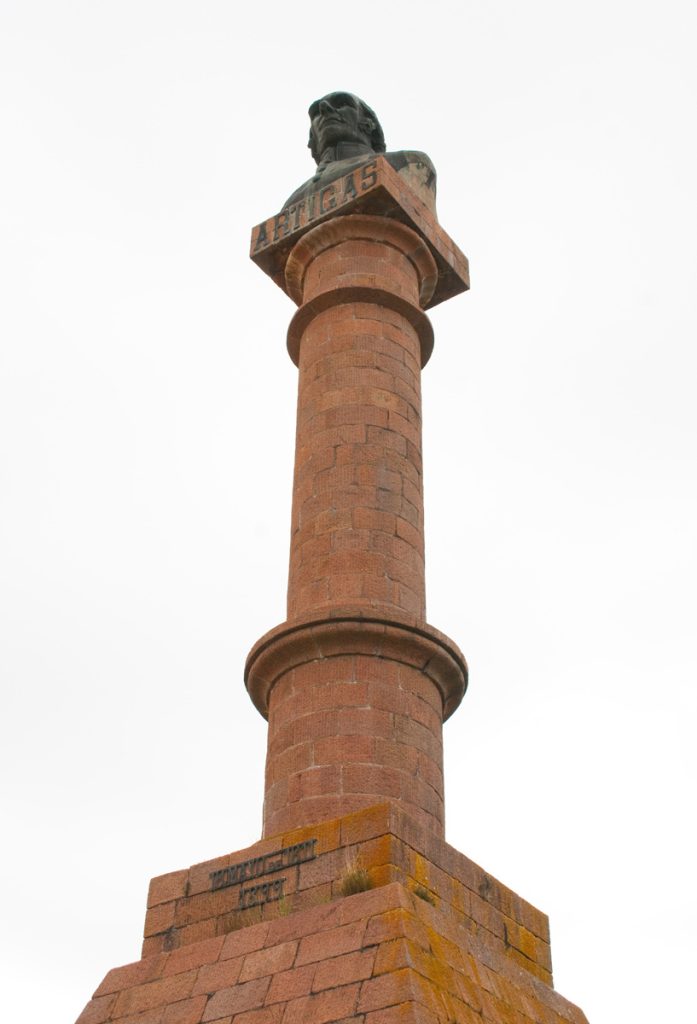

Within Sauropoda, Soto Núñez and colleagues place the new animal in Titanosauria, then in Rinconsauria, and finally in Aeolosaurini. That sets it apart from Udelartitan celeste, a saltasauroid titanosaur from the same rock unit but a different lineage. Mesetasaurus protector is the type and only known species, and both names are registered in ZooBank, the official animal-name register.
Pinning down its age, however, is harder than naming it, and the paper gives no numeric age. Earlier workers had proposed very different dates for these rocks—Cenomanian or older in 1933, and Aptian in 2003. Soto Núñez and colleagues instead suggest a late Santonian to early Campanian age. They base this mainly on the fossils the formation preserves and on the Campanian–Maastrichtian age of the overlying Mercedes Formation. On the international timescale, that is roughly 84 to 80 million years ago. Until new dating work appears, its age remains a hypothesis built on fossils rather than on a dated rock layer.
Discovery & Fossil Evidence
The vertebrae came from poorly consolidated, clay-rich reddish sandstones in a small cliff near the Uruguay River. According to the EFE news agency, two fishermen spotted them by chance after an excavator had passed through the area. The paper itself credits Guillermo Sena and Daniel Montano with the find. Today, vegetation covers that cliff, so the authors used a rock profile from an exposure to the north, described by earlier workers in 2003. Within that profile, the fossils lay toward the base.
The holotype, FC-DPV 3740, belongs to the Vertebrate Fossil Collection of the Universidad de la República’s Facultad de Ciencias in Montevideo. It consists of two anterior caudal vertebrae (front tail bones), labeled 3740A and 3740B. The two lay closely associated within less than 1 square meter (about 11 square feet) and share one holotype number. They probably sat in the third and sixth positions of the tail.
Both bones lost their neural spines—the bony blades along the top of each vertebra—as well as parts of their other projections. To explain this damage and slight abrasion, the authors infer some degree of transport by a river. Even so, they consider the surviving surfaces detailed enough to diagnose a new species. No additional specimens of Mesetasaurus have been confirmed outside this locality.
Mesetasaurus Size and Description
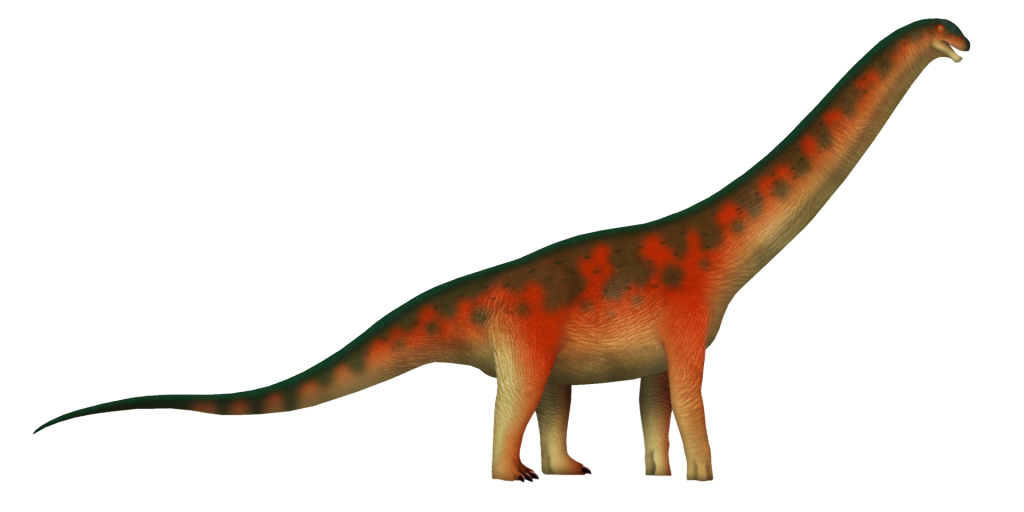
With only two tail bones to go on, the rest of Mesetasaurus must be pictured through its relatives.
Short description of Mesetasaurus
The tail centra—the spool-shaped bodies of the vertebrae—are strongly procoelous, meaning hollow at the front and ball-shaped at the back. Their undersides are flat to slightly concave from side to side, and the neural arch sits forward on each centrum. The prezygapophyses (forward-reaching joint processes) were probably long when complete, far surpassing the front edge of the centrum. From the third to the sixth vertebra, they shift from an upward angle of about 30 degrees to almost horizontal.
Beyond the tail, though, everything is borrowed from relatives. The authors’ hypothetical reconstruction stands the animal on four legs, with a downward-curving tail base modeled on Arrudatitan maximus. Its skull follows that of Inawentu oslatus, and because the limbs are unknown, modern life restorations are speculative beyond the tail.

Size and Weight of Type Species
No peer-reviewed estimate of length, height, or weight exists for Mesetasaurus. Press reports from the EFE news agency gave a length of 9 to 10 meters (about 30 to 33 feet), reportedly from comparative anatomy. Still, that figure does not appear in the paper.
The bones themselves are modest. The front vertebra is 14.5 centimeters (5.7 inches) long, including its condyle—the rounded rear ball—or just under half a standard 12-inch ruler. It stands 19.2 centimeters (7.6 inches) tall as preserved. The second vertebra is 13.2 centimeters (5.2 inches) long and 17.2 centimeters (6.8 inches) tall.
The paper does note that gigantic titanosaurs are absent from the Guichón fauna and from the younger Mercedes and Asencio faunas. However, that remark describes the fossil record rather than the size of Mesetasaurus itself. Without more of the skeleton, any body size must come from comparisons with relatives.
The Dinosaur in Detail
What sets this dinosaur apart is the position of a small hollow on its third tail vertebra. This blind fossa—a closed, dead-end pit—is an oval hollow about 3.5 centimeters (1.4 inches) long on both sides of 3740A. It sits below the centrum’s long axis and close to the condyle. The authors regard this placement as a potential autapomorphy, a trait unique to one species. In other titanosaurs, the fossa sits toward the front or just below the transverse process, but never low and rearward.
Other traits tie it to Aeolosaurini, such as a strongly forward-tilted front face on its later tail centrum. It also shares a neural arch level with the front border, a forward-leaning neural spine, and long prezygapophyses. Yet it lacks a strongly concave lower margin, a groove along the underside, and double marks for the chevrons—the small bones beneath the tail. These features mark Aeolosaurus and its closest kin. Similarly, two features of an Aeolosaurus vertebra from Uruguay’s Asencio Formation keep the two genera apart.
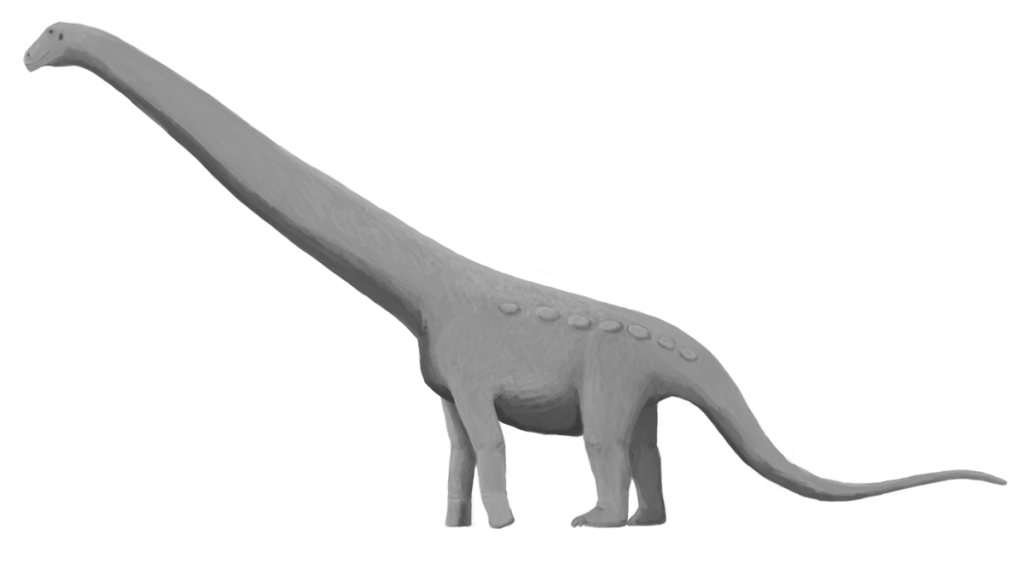

The authors’ analysis nests Mesetasaurus deeply within Aeolosaurini, in Clade B with Overosaurus, Aeolosaurus, Arrudatitan, and Punatitan. Meanwhile, Clade A holds Baurutitan, Bravasaurus, and Caieiria. Clade B shares flattened rear tail centra and strongly off-center condyles in the front and middle tail.
However, support for these groupings is very low—a Bremer support of 1 for Aeolosaurini and both clades. Bremer support counts the extra steps needed to break a grouping, and 1 is the lowest a recovered group can score. Moreover, bootstrap and jackknife resampling gave them no support at all, collapsing Eusauropoda into a large polytomy—an unresolved cluster of branches. The describers also warn that missing data introduce uncertainty. In short, the authors argue the two vertebrae justify a new species, while its exact place among aeolosaurines remains open.
Interesting Points about Mesetasaurus
- The species name honors José Artigas, whose title “Protector of the Free Peoples” inspired protector, and a large bust of him stands near the fossil site.
- The vertebrae were found in the 1980s but not formally named until 2026, roughly four decades later.
- Its describers rank the two tail bones among the best-preserved sauropod vertebrae known in Uruguay.
- Mesetasaurus is only the second sauropod species named from Uruguay, after the saltasauroid Udelartitan celeste.
- Its one possibly unique trait is an oval pit placed low on the third tail vertebra, close to the rear ball joint.
Dinosaurs from the Same Formation
Also known from the Guichón Formation (exact level relative to Mesetasaurus not known): Udelartitan. This saltasauroid titanosaur was excavated in 2006 near Araújo, also in Paysandú Department. Its remains include 60 tail vertebrae, limb and shoulder fragments, two ankle bones, six foot bones, and associated eggshell. Its 2024 describers recovered it either as a saltasaurine related to Saltasaurus or as a non-saltasaurid saltasauroid. The formation’s age is still debated and its time span is not established. As a result, these two titanosaurs may not have lived at the same time.
Mesetasaurus in its Natural Habitat
The world of the Guichón Formation was shaped by rivers. Its fine-grained reddish sandstones, conglomerates, and mudstones formed in southwest-flowing channels, though wind locally reworked some of the sand. Across the Uruguay River, the correlated Puerto Yeruá Formation of Argentina has yielded an ankylosaurian scute (bony skin plate), a theropod tooth fragment, and eggshell. Yet none of that material was found in place.
Mesetasaurus was presumably a herbivore, though this rests on its group rather than on evidence from its own bones. Since no teeth, jaws, or gut contents are known, its preferred plants remain a mystery.
The formation also holds several individuals of the notosuchian crocodyliform Uruguaysuchus aznarezi, plus a ziphodont—blade-toothed—crocodyliform tooth. Teeth of indeterminate theropods and basal iguanodontians show that other dinosaurs were present, though the iguanodontian teeth certainly do not come from hadrosaurids. In addition, eggshells referred to the oospecies Sphaerovum erbeni turned up with Udelartitan. By contrast, no abelisaurids, dromaeosaurids, or diplodocoids have been found so far.
While there is no direct evidence of whether Mesetasaurus lived alone or in groups, its wider fauna is better understood. The authors’ analysis groups the Guichón fauna with Patagonia’s Allen and Los Alamitos formations and Uruguay’s Mercedes and Asencio formations. These units share aeolosaurines and faveoloolithid eggs. However, the analysis compares only higher-level groups, and the Guichón aeolosaurine record is Mesetasaurus itself—so the link partly restates the find.
Frequently Asked Questions
It means “Meseta reptile,” after the Meseta de Artigas, while the species name protector honors Uruguayan hero José Artigas.
Its describers suggest the late Santonian to early Campanian, roughly 84 to 80 million years ago, but that age is tentative.
No peer-reviewed size estimate exists. Its larger preserved tail vertebra is 14.5 centimeters long and 19.2 centimeters tall.
It was a titanosaurian sauropod in the group Aeolosaurini, although weak support leaves its exact position uncertain.
It was found at the Meseta de Artigas in northern Paysandú Department, Uruguay, in the Guichón Formation.
An oval pit on its third tail vertebra sits low and close to the rear ball joint, a trait its describers consider likely unique.
Sources
The information in this article is based on various sources, drawing on scientific research, fossil evidence, and expert analysis. The aim is to provide a comprehensive and accurate overview of Mesetasaurus. However, please be aware that our understanding of dinosaurs and their world is constantly evolving as new discoveries are made.
- https://doi.org/10.5710/AMGH.19.06.2026.3689
- https://www.ameghiniana.org.ar/index.php/ameghiniana/libraryFiles/downloadPublic/170
- https://doi.org/10.1016/j.cretres.2024.105894
- https://ri.conicet.gov.ar/handle/11336/237411
- https://stratigraphy.org/ICSchart/ChronostratChart2024-12.pdf
- https://noticel.com/noticias/20260710/en-uruguay-descubren-al-mesetasaurus-protector-un-nuevo-dinosaurio-gigante/
- https://prensamercosur.org/2026/07/12/descubren-en-uruguay-el-mesetasaurus-protector-un-nuevo-dinosaurio-gigante-del-cretacico/
- https://www.canal26.com/ciencia-y-espacio/2026/07/10/descubrieron-en-uruguay-un-nuevo-dinosaurio-gigante-habito-hace-83-millones-de-anos-y-lo-llamaron-el-protector/
This article was last fact checked: TheDinosaurs Team, 21-11-2026
Featured Image Credit: Connor Ashbridge, CC BY 4.0, via Wikimedia Commons
