
In the canyons of Sierra Barrosa, about 19 miles (30 kilometers) northeast of Plaza Huincul in Argentina’s Neuquén Province, river sandstones of the Sierra Barrosa Formation hold a lean and puzzling predator. Named Murusraptor barrosaensis in 2016, this meat-eater lived during the Coniacian stage of the Late Cretaceous—roughly 90 to 86 million years ago. It belongs to the megaraptorids, theropods (predatory dinosaurs) whose wider place on the family tree remains in dispute. Because its skeleton preserves a complete braincase and much of the back of the skull, it ranks among the most informative members of the group.
The Argentinean-Canadian Dinosaur Project team collected the bones in 2001, recovering them from a canyon wall. Fifteen years later, paleontologists Rodolfo A. Coria and Philip J. Currie described the animal in PLOS ONE. The individual was not fully grown, yet its bones show extensive air spaces and an intact braincase. Since then, it has served as a yardstick for later megaraptorid finds such as Maip and Joaquinraptor.
Murusraptor Key Facts
| Keyword | Fact |
|---|---|
| Pronunciation | Not specified |
| Meaning of name | From Latin “Murus” (Wall) and Sierra Barrosa |
| Group | Theropoda (Megaraptora—wider placement debated) |
| Type Species | Murusraptor barrosaensis |
| Diet | Carnivore |
| When it Lived | 90 to 86 MYA |
| Period | Cretaceous |
| Epoch | Late Cretaceous (Coniacian stage) |
| Length | 19.7 to 21.3 feet (6.0 to 6.5 meters), estimated from an immature individual |
| Height | Not specified |
| Weight | Not specified |
| Mobility | Moved on two legs (bipedal) |
| First Discovery | 2001 by the Argentinean-Canadian Dinosaur Project team |
| Described by | 2016 by R.A. Coria and P.J. Currie |
| Holotype | MCF-PVPH-411 |
| Location of first find | Sierra Barrosa Formation, Sierra Barrosa, about 30 km northeast of Plaza Huincul, Neuquén Province, Argentina |
Murusraptor Origins, Taxonomy and Timeline
The name Murusraptor recalls the spot where the fossil emerged. “Murus” is Latin for “wall,” a reference to the canyon wall that held the skeleton. The species name barrosaensis alludes to Sierra Barrosa, the locality where the team collected it. Together, the name records both the rock face and the place that yielded this predator.
In their 2016 description, Coria and Currie placed Murusraptor within Theropoda, Tetanurae, Megaraptora and the family Megaraptoridae. They saw it as part of a Patagonian radiation of megaraptorids alongside Megaraptor, Aerosteon and Orkoraptor. Its broader position, however, proved harder to settle. One of their two analyses grouped megaraptorans with Neovenator among the allosauroids, while the other nested Murusraptor inside Tyrannosauroidea. The authors left that question open, yet they judged its megaraptorid status “beyond any reasonable doubt.” Murusraptor barrosaensis is the type and only known species.
In their abstract, Coria and Currie gave the formation’s age as Turonian–Coniacian, although the body of the paper calls it Coniacian. Later papers refine that wording rather than re-date the rocks. In 2020, Rozadilla and colleagues called it middle to late Coniacian from its stratigraphic position, drawing on the same 2010 study by Garrido that Coria and Currie used. Two years later, Baiano and Filippi called it middle Coniacian. On the current international timescale, the Coniacian ran from roughly 90 to 86 million years ago. Megaraptor itself comes from the older Portezuelo Formation—separated from Sierra Barrosa by the Los Bastos Formation.
Discovery & Fossil Evidence
In 2001, the Argentinean-Canadian Dinosaur Project team collected fossils on Sierra Barrosa, working under permits for the 2001 and 2002 field seasons. The skeleton lay on its right side in a sand-filled channel deposit, with bones stacked up to four layers deep. Although most of the bones had come apart, they stayed close together. Coria and Currie also noted that dermestid beetles appear to have bored into several bones.
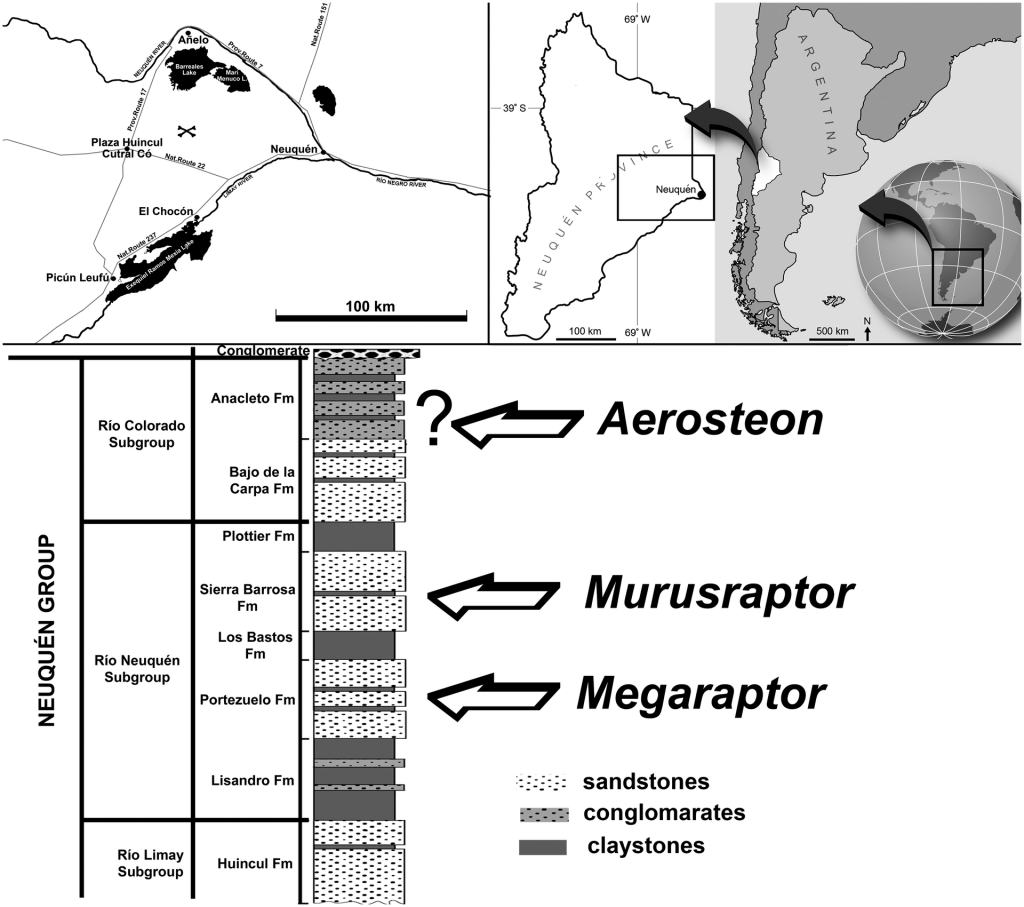

The holotype, MCF-PVPH-411, belongs to the Museo Carmen Funes in Plaza Huincul. It includes a complete braincase, along with the lacrimal, prefrontal and postorbital (bones framing the eye socket), plus the quadrate, pterygoid, ectopterygoid and teeth. Several bones from the back of the lower jaw also survive. Behind the head, the team recovered twelve vertebrae, eleven thoracic ribs, one haemal arch (a tail chevron) and several gastralia (belly ribs). The rest comprises a hand claw, parts of both ilia (upper hip bones), the ends of the pubes and ischia, the right tibia (shinbone) and a calcaneum (ankle bone).
Coria and Currie listed no referred specimens, and later studies cite only the holotype. So far, no one has identified a second specimen of Murusraptor.
Murusraptor Size and Description
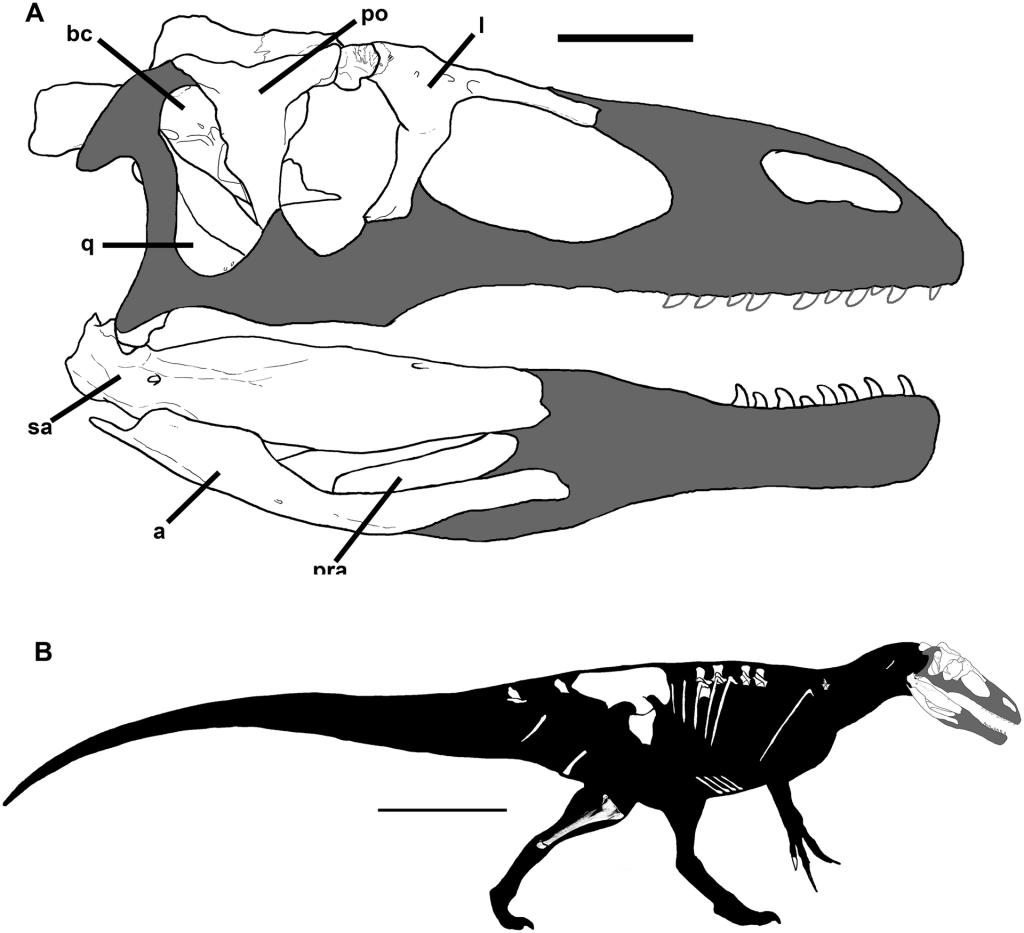
Hollow bones gave Murusraptor a light frame, and its head was probably long and narrow.
Short description of Murusraptor
The skull was probably elongate, with a long, low, narrow snout like that of Megaraptor. That reading is an inference—the team found no bones from the front of the skull. Coria and Currie described the lacrimal as T-shaped rather than the usual inverted L and found no horn on it. However, a 2019 reanalysis by Aranciaga Rolando and colleagues interpreted a cornual process (a hornlike bump) there. Behind it, the prefrontal survives as a small, separate bone, as in many Triassic and Jurassic theropods.
Moving down the body, the vertebrae, ribs and ilium were highly pneumatized, or filled with air spaces. Even the sacral ribs, which joined the spine to the hips, were hollow and tube-like. The ischia were short, with flattened and slightly expanded tips. The team found only one hand claw—small, narrow and probably about 2.4 inches (62 millimeters) long when complete. It is close in size to, though slightly smaller than, the third hand claw of a Megaraptor specimen.
Like other theropods, it presumably walked on two legs, as the authors’ body reconstruction shows. No skin impressions survive, so any discussion of its outer covering is speculative.

Size and Weight of Type Species
Coria and Currie estimated that Murusraptor was about 21.3 feet (6.5 meters) long when it was alive. In their supplement, regressions of body length against sacrum length (from 59 theropods) and tibia length (from 126 theropods) both gave 21 feet (6.4 meters). The ilium, by contrast, pointed to 20.3 feet (6.2 meters). They concluded that the animal measured between 19.7 and 21.3 feet (6.0 and 6.5 meters).
These figures are only approximations, because the lengths of the skull and tail remain largely unknown. The individual was also not fully grown when it died, although it was approaching maturity. Its tibia alone is 27.2 inches (690 millimeters) long, yet Coria and Currie gave no hip height or body mass.
Compared with its relatives, Murusraptor is more gracile than Megaraptor. It was larger than one Megaraptor skeleton, though Coria and Currie considered the Megaraptor holotype a slightly longer, more massive and more mature animal. It was also comparable in size to Aerosteon and Orkoraptor. Based on overlapping vertebrae, the describers judged Aerosteon to be no more than 10 percent larger.
The Dinosaur in Detail
One of the most distinctive features of Murusraptor is its intact, tightly sutured braincase, with most sutures still visible. In 2025, Ibiricu and colleagues called it the only almost complete megaraptoran braincase known besides that of Joaquinraptor. In 2017, CT scans by Paulina-Carabajal and Currie revealed a reptile encephalization quotient (a measure of brain size relative to body size) between those of Allosaurus and Tyrannosaurus. The pair concluded that megaraptorids have a distinct brain pattern—one that shares more with tyrannosaurids.
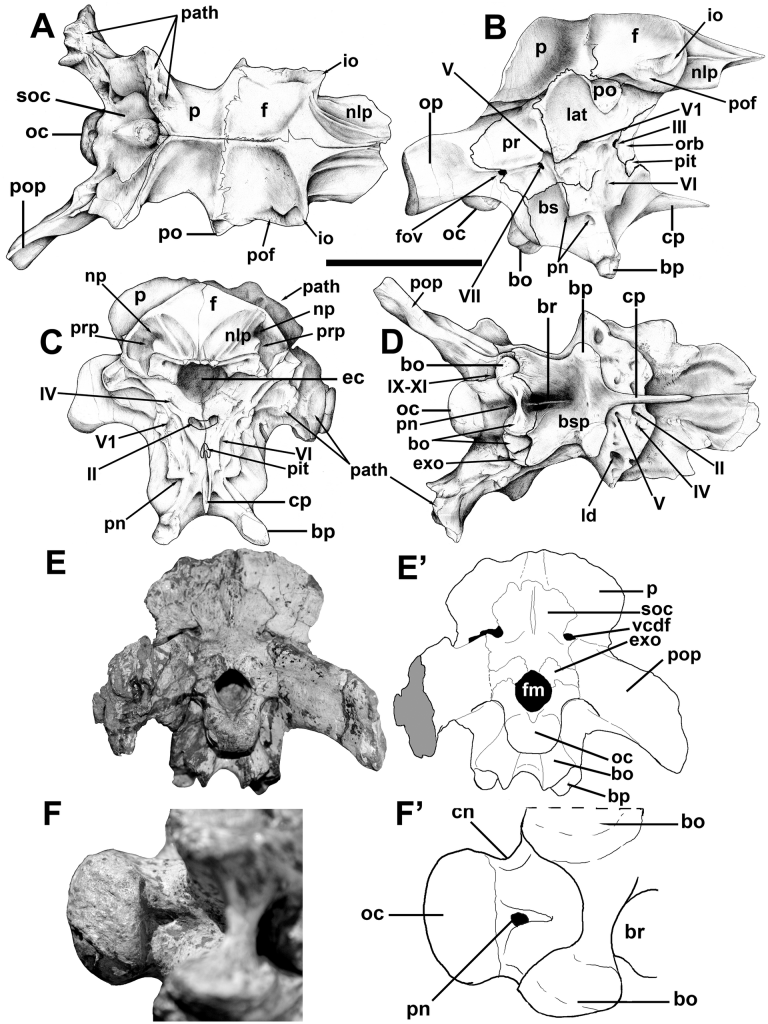

Coria and Currie defined the genus by two unique traits. First, the forward-and-upward process of the lacrimal is longer than its preorbital process is tall. Second, a thick, shelf-like ridge runs along the outer surangular, a bone at the back of the lower jaw.
The skeleton also records a hard life. Pathological bones at the back of the left braincase leave the skull asymmetrical. The left paroccipital process is 40 percent shorter than the right—and an open window exposes the ear region. “The animal clearly had a serious infection within the left adductor fossa,” the describers wrote. Several ribs also show healed cracks or fractures, one with a severe callosity around an oblique break.
In 2019, Aranciaga Rolando, Novas and Agnolín reanalyzed Murusraptor. They argued that traits it shares with juvenile tyrannosaurids make megaraptorans coelurosaurs, closest to Tyrannosauroidea. In 2022, Naish and Cau placed Megaraptora within Tyrannosauroidea without naming Murusraptor. That same year, Aranciaga Rolando and colleagues found megaraptorans to be the sister group of Tyrannosauroidea. Without fragmentary taxa, their tree grouped Murusraptor with Megaraptor—but their full analysis placed it with Aerosteon, Tratayenia and Maip. By contrast, Ibiricu’s team found it closest to an unnamed megaraptorid from the Bajo Barreal Formation. Every study that names Murusraptor treats it as a megaraptorid, while its wider family tree remains open.
Interesting Points about Murusraptor
- Its name comes from the Latin “murus,” meaning “wall,” because the team collected the skeleton from a canyon wall at Sierra Barrosa.
- The team found thirty-one teeth among its bones, yet the tallest crown measures just 1.1 inches (29 millimeters), small for a predator of its size.
- Despite coming from different formations, Murusraptor and Aerosteon have ilia that Coria and Currie found anatomically indistinguishable, although the Aerosteon ilium is 17.5 percent taller.
- The describers suggested that its heavily air-filled skeleton is consistent with a highly specialized metabolism.
- Its brain had a smaller olfactory ratio, a proxy for the sense of smell, than those of tyrannosaurids and allosauroids.
Dinosaurs from the Same Formation
Also known from the Sierra Barrosa Formation (exact level relative to Murusraptor not known): Kaijutitan, Mendozasaurus and Macrogryphosaurus. In 2019, Filippi and colleagues described Kaijutitan maui as a giant basal titanosaur—a long-necked sauropod with split spines on its front neck vertebrae—from upper Coniacian beds. Mendozasaurus neguyelap, another titanosaur, comes from several partial skeletons at a single site in Mendoza Province rather than Neuquén, as González Riga and colleagues showed in 2018. In 2020, Rozadilla and colleagues described Macrogryphosaurus gondwanicus as the largest known member of Elasmaria, a group of ornithopods. Researchers first assigned its rocks to the Portezuelo Formation and later to Sierra Barrosa—though the site’s stratigraphy was still under revision in 2020. Studies date the formation only broadly, to the middle and late Coniacian—a stage of about 4 million years—so these animals may not all have lived at the same time.
Murusraptor in its Natural Habitat
The world Murusraptor roamed was one of sinuous rivers that carried mostly sand. Its rocks range from fine, limy sandstones to mudstones laid down on floodplains, with well-developed paleosols (fossil soils). In 2020, Rozadilla and colleagues called the formation’s fossils scarce, citing turtle plates, crocodile teeth and Murusraptor, although sauropods and an ornithopod also come from it. Two years later, Baiano and Filippi described an allosauroid tibia from the formation that “could represent a new theropod taxon.” Coria and Currie also mentioned mammals and bird footprints from the Sierra Barrosa area, but these belong to other rock units. The mammal, a dryolestoid, comes from the older Los Bastos Formation, while the footprints and the titanosaur Barrosasaurus come from the younger Anacleto Formation.
While there is no direct evidence of what Murusraptor ate, Coria and Currie identified it as a meat-eating dinosaur. In their supplement, they speculated that Megaraptor and Murusraptor may have had adaptations for a semi-aquatic lifestyle. They pointed to an elongate, narrow skull reminiscent of fish-eating animals and drew a comparison with spinosaurids. Still, the authors framed this explicitly as speculation.
Its injuries add a rare personal note. The healed ribs show that this individual survived damage long enough for the bone to mend. Two holes near the nuchal crest might be puncture wounds from another theropod’s teeth—an idea the describers raised only tentatively. With a single skeleton known, nothing yet indicates whether it lived alone or in groups. In time, it falls between the older Megaraptor and the younger Aerosteon, each from a different formation.
Frequently Asked Questions
“Murus” is Latin for “wall,” after the canyon wall that held the skeleton, and barrosaensis refers to Sierra Barrosa.
It lived in the Coniacian stage of the Late Cretaceous, roughly 90 to 86 million years ago.
It was about 19.7 to 21.3 feet (6.0 to 6.5 meters) long, based on an immature individual. Its describers did not publish a weight estimate.
It was a carnivore, a meat-eating megaraptorid theropod with surprisingly small teeth for its size.
It comes from Sierra Barrosa, northeast of Plaza Huincul in Argentina’s Neuquén Province, in the Sierra Barrosa Formation.
It has one of only two nearly complete megaraptoran braincases, plus two unique traits—a long front process on the lacrimal and a thick shelf on the lower jaw.
Sources
The information in this article is based on various sources, drawing on scientific research, fossil evidence, and expert analysis. The aim is to provide a comprehensive and accurate overview of Murusraptor. However, please be aware that our understanding of dinosaurs and their world is constantly evolving as new discoveries are made.
- https://doi.org/10.1371/journal.pone.0157973
- https://doi.org/10.1371/journal.pone.0157973.s003
- https://doi.org/10.1371/journal.pone.0157973.s004
- https://doi.org/10.5710/AMGH.25.03.2017.3062
- https://doi.org/10.1038/s41598-022-09272-z
- https://doi.org/10.1038/s41467-025-63793-5
- https://doi.org/10.7717/peerj.12727
- https://doi.org/10.5710/PEAPA.25.10.2021.396
- https://doi.org/10.1016/j.cretres.2019.104311
- https://doi.org/10.1016/j.cretres.2019.03.008
- https://doi.org/10.1016/j.cretres.2019.02.021
- https://doi.org/10.1093/zoolinnean/zlx103
- https://stratigraphy.org/ICSchart/ChronostratChart2024-12.pdf
This article was last fact checked: TheDinosaurs Team, 21-11-2026
Featured Image Credit: Levi Martinez-Reza, CC BY-SA 4.0, via Wikimedia Commons
