
In Ganzhou City, in South China’s Jiangxi Province, lie the red beds of the Upper Cretaceous Lianhe Formation. From the middle of this formation comes a duck-billed dinosaur new to science. Named Gongshuilong fanwei in 2026, it is a saurolophine hadrosaurid—a member of the hadrosaur subfamily Saurolophinae. Its describers call it the first hadrosaurid genus reported from South China. That claim depends on Nanningosaurus from Guangxi, first described as a hadrosaurid. In 2014, Hai Xing and colleagues instead recovered it as a more primitive hadrosauroid. Gongshuilong‘s most striking feature sits at the back of the body—tail spines so tall that, according to the People’s Daily, they formed a sail-like structure.
According to the specialist blog Everything Dinosaur, construction workers uncovered the bones in early spring 2021. Han Yao and 15 co-authors then described the animal in the Journal of Systematic Palaeontology, online on 30 March 2026. Soon after, the People’s Daily reported it as the 15th dinosaur named from Jiangxi Province. The authors also argue that it increases the possibility of an Asian origin for its wider lineage.
Gongshuilong Key Facts
| Keyword | Fact |
|---|---|
| Pronunciation | Not specified |
| Meaning of name | Gong River Dragon (Chinese name 帆尾贡水龙, read as “sail-tail Gong River dragon”) |
| Group | Ornithopoda (Hadrosauridae, Saurolophinae) |
| Type Species | Gongshuilong fanwei |
| Diet | Herbivore |
| When it Lived | Late Cretaceous (exact age debated) |
| Period | Cretaceous |
| Epoch | Late Cretaceous (possibly Maastrichtian stage) |
| Length | Not specified |
| Height | Not specified |
| Weight | Not specified |
| Mobility | Not specified |
| First Discovery | Early spring 2021 by construction workers |
| Described by | 2026 by H. Yao, W. Qiu, J. Yu, L. Yang, H. Wang, S. Cao, K. Zhao, M. Xu, G. Shi, F. Lou, C. Zeng, P. Lu, R. Wu, X. Xu, F. Han, and H. Xing |
| Holotype | Not specified |
| Location of first find | Lianhe Formation, Shahe Town, Zhanggong District, Ganzhou City, Jiangxi Province, China |
Gongshuilong Origins, Taxonomy and Timeline
The genus name honors the Gong River near the dig site and translates as “Gong River dragon.” In the Chinese name reported by the People’s Daily, 帆尾贡水龙, 贡水 is the Gongshui, or Gong River, and 龙 means “dragon.” The first two characters, 帆尾, read as “sail-tail,” after the animal’s most famous feature. The species name fanwei is simply the pinyin of 帆尾.
Yao and colleagues placed Gongshuilong within Hadrosauridae, the duck-billed dinosaurs, and its subfamily Saurolophinae. Their analysis placed it at the base of Brachylophosaurini, the tribe that includes Maiasaura and Brachylophosaurus. Gongshuilong fanwei is the type and only known species, and no published study has yet challenged its validity. In fact, a 2026 study of troodontid teeth by Yin and colleagues cites its description among the hadrosaurid records of the Ganzhou Basin.
Pinning down when it lived is harder. The original abstract places the fossils in the middle of the Upper Cretaceous Lianhe Formation but gives no numeric age. Meanwhile, the People’s Daily report gave an age of about 70 million years. Yin and colleagues, in turn, treat that Ganzhou Basin assemblage as Maastrichtian—the last stage of the Cretaceous, roughly 72.1 to 66.0 million years ago. However, researchers still dispute the age of the rocks themselves. The Lianhe is the uppermost unit of the Guifeng Group, above the Hekou and Tangbian formations. In 2022, Lida Xing and colleagues called it the Cretaceous–Paleogene Lianhe Formation, whereas the describers call it Upper Cretaceous.
Discovery & Fossil Evidence
The fossils came from Shahe Town in Zhanggong District. News of the find reached the press through the Jiangxi Provincial Bureau of Geology.
This species rests on a series of largely disarticulated bones—skeletal parts no longer joined together. The diagnosis in the abstract names a maxilla (the main upper tooth-bearing bone) and a dentary (lower jaw bone) with its teeth. It also cites a postorbital (a bone behind the eye socket), a scapula (shoulder blade), and vertebrae from the rear of the tail. According to Everything Dinosaur, the remains represent at least two individuals. The abstract lists neither the holotype specimen number nor the full set of bones.
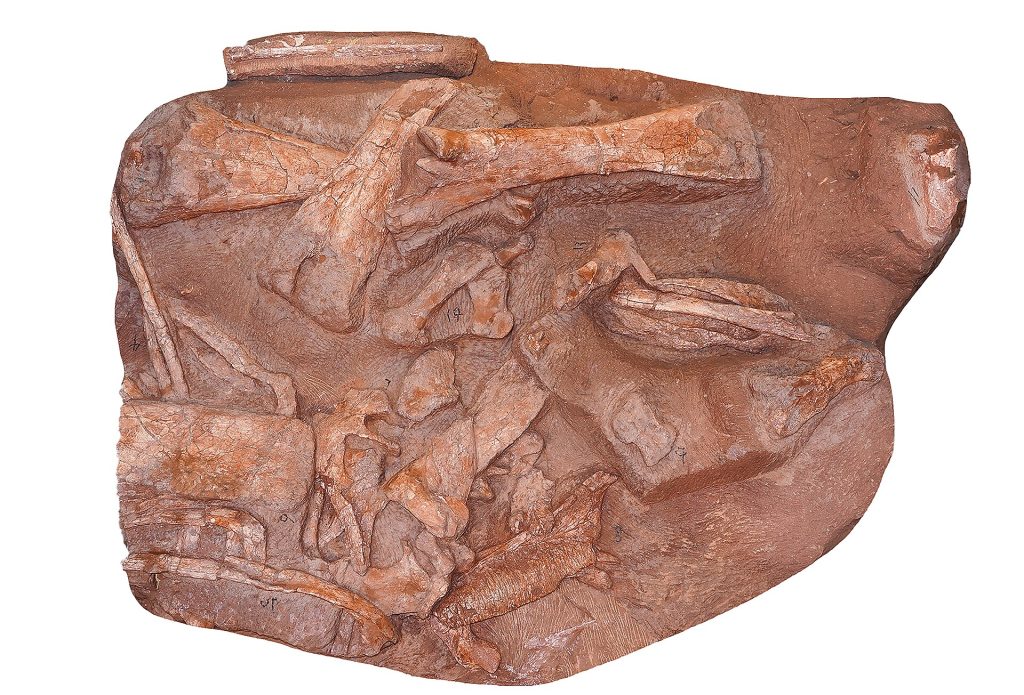

Gongshuilong was not the first hadrosaur find around Ganzhou. In 2021, Lida Xing and colleagues reported an articulated rib cage from Maastrichtian strata of the Hekou Formation. It belonged to a relatively large hadrosaurid no less than 9 meters (30 feet) long. A year later, his team described spheroolithid eggs (a fossil egg family) holding hadrosauroid embryos from the same formation. Neither find is named, and both come from a different unit.
Gongshuilong Size and Description
Because the skeleton is incomplete and disarticulated, what is known of Gongshuilong comes mainly from its diagnostic features.
Short description of Gongshuilong
Up front, the maxilla carried an elevated front upper process slightly longer than the one below it. The dentary had an extremely short toothless region at its front—the stretch of jaw between the tip and the first teeth. Its teeth bore crowns ornamented with a single central ridge and relatively small marginal denticles, the tiny bumps along the cutting edge. Behind the eye, the postorbital sent down a process that was wide from front to back.
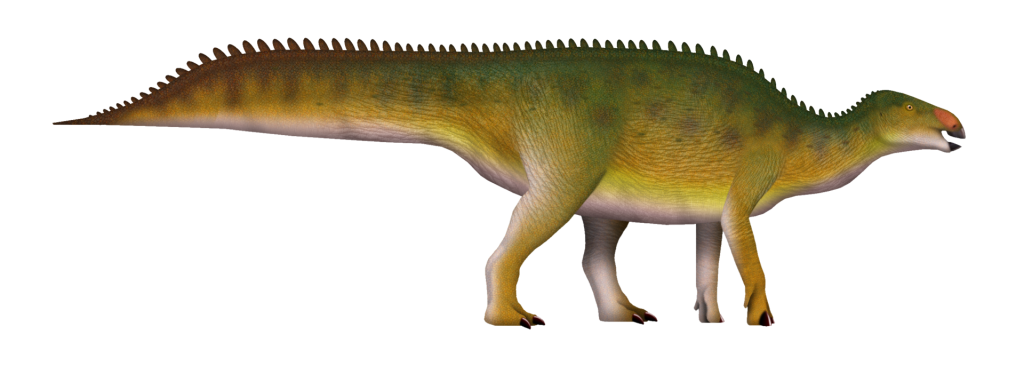
The shoulder blade had only a poorly developed deltoid ridge, a raised line where muscles attached on its outer surface. Farther back, the tail held the animal’s signature trait. Its rear neural spines—the bony blades rising from each vertebra—were markedly elongate, angled up and backward, and moderately curved. Because the abstract describes neither posture nor skin, both are reconstructed from its relatives rather than from these bones.

Size and Weight of Type Species
The original abstract gives no length, height or weight, and no published size estimate has yet been confirmed.
Everything Dinosaur gives a length of around 7 meters (23 feet) in the caption of its own life reconstruction. However, the blog does not say where that figure comes from. Until a measured estimate appears, its size is best left as not specified.
The Dinosaur in Detail
What sets this dinosaur apart is its tail. Yao and colleagues describe the rear tail spines as markedly elongate and directed up and backward. The People’s Daily went further, reporting that the spines reached several times the height of the vertebral body. In its words, they formed a sail-like structure found for the first time among known hadrosaurs. Everything Dinosaur also reported that some spines are eight and a half times the height of their centrum—the spool-shaped body of a vertebra. That figure, though, does not appear in the abstract.
The abstract proposes no function for the sail, and no published study has yet tested one. For now, the tail is best treated as a diagnostic puzzle rather than an explained adaptation.
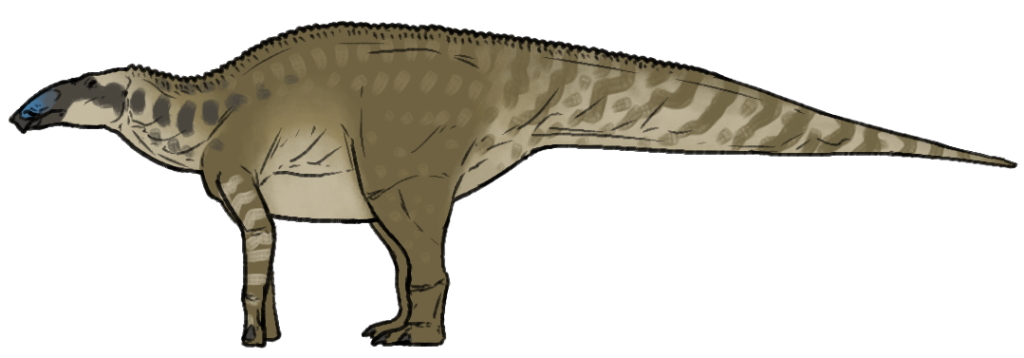

The family tree adds a second story. Yao’s team recovered Gongshuilong in an unresolved split—a polytomy—at the base of Brachylophosaurini. Alongside it in that cluster sit Wulagasaurus, Acristavus, and a group formed by Maiasaura with Probrachylophosaurus and Brachylophosaurus. They call it Asia’s second brachylophosaurin, and the only other Asian member of that polytomy is Wulagasaurus.
That position matters for biogeography. The authors ran a Bayesian ancestral-area analysis—a statistical method for estimating where ancestors lived. They concluded that the discovery increases the possibility of an Asian origin for both Saurolophinae and Brachylophosaurini.
Interesting Points about Gongshuilong
- According to its describers, Gongshuilong is the first hadrosaurid genus reported from South China, a claim that depends on how Nanningosaurus is classified.
- According to Everything Dinosaur, construction workers uncovered its fossils in early spring 2021, close to the Gong River that gave the genus its name.
- The People’s Daily reported that its tail spines formed a sail-like structure, the first of its kind among known hadrosaurs.
- The People’s Daily counted it as the 15th dinosaur named from Jiangxi Province.
- Its describers argue that it increases the possibility that saurolophines and brachylophosaurins originated in Asia.
Gongshuilong in its Natural Habitat
Only a broad outline survives of the world Gongshuilong roamed. Around Ganzhou, the red beds include the Guifeng Group, which comprises the Hekou, Tangbian and Lianhe formations. In the Ganzhou area, the Hekou Formation records rivers flowing within a proximal alluvial fan—a fan-shaped spread of sediment near its source. Mudcracks and caliche (hardened soil carbonate) are common, and researchers read the climate as subhumid. Those details, however, describe the Hekou rather than the Lianhe.
The separate Xinjiang Basin, also in Jiangxi, says more about the Lianhe. There, the formation is 2,000 to 3,000 meters (6,600 to 9,800 feet) thick. It consists mostly of purple-red conglomerates laid down by alluvial fans and braided streams. In 2023, Cao and colleagues cited a 2019 proposal by Li and colleagues that the three formations there formed at the same time. On that view, the Hekou and Lianhe are one unit in different places. Cao’s team read the whole group there as the deposit of an intermontane desert, with wind-blown dune sandstones in the middle Tangbian Formation.
The same basin frames the age debate, though Cao’s team noted that the group there lacks direct absolute age constraints. Their zircon grains from the basin gave a maximum depositional age—the oldest the rocks can be—of about 109.5 to 99.5 million years ago. They saw this as consistent with the Cenomanian to Santonian age proposed by Li and colleagues. A maximum age, however, does not rule out a much younger one. The real conflict lies between that Cenomanian–Santonian view and the paleomagnetic studies cited by Lida Xing’s team. Those studies date the group to 71.4 to 65.0 million years ago, a range running past the end of the Cretaceous. For the Hekou Formation at Ganzhou, Xing’s team noted that a Maastrichtian age is more commonly accepted.
Diet, Neighbors and Behavior
As a herbivore, Gongshuilong likely processed plants with tooth batteries like those of other hadrosaurids. In 2014, Mallon and Anderson studied the teeth of megaherbivorous dinosaurs—very large plant-eaters—from Alberta’s Campanian Dinosaur Park Formation. They found that hadrosaurid tooth batteries could both shear and crush, suggesting a broad dietary range. However, no study yet addresses what Gongshuilong itself ate.
The Lianhe Formation has yielded few named animals so far. One is Xianyuechelys yingliangi, a nanhsiungchelyid—a member of a group of large Cretaceous turtles—from the same formation in the Ganzhou Basin. Elsewhere in Ganzhou, more than 200 oviraptorosaur nests with eggs lie within about 40 square kilometers (15 square miles). Like the area’s named oviraptorosaurs, though, reports place them in the Nanxiong Formation. Yin and colleagues cite the Gongshuilong description within this Ganzhou Basin assemblage, which includes the long-snouted tyrannosaurid Qianzhousaurus and the oviraptorosaur Banji. Lida Xing’s team also notes that some researchers consider the Guifeng Group roughly coeval with the nearby Nanxiong red beds. Because they come from a different formation and the Lianhe age is unsettled, nothing shows they lived alongside Gongshuilong.
Everything Dinosaur reports at least two individuals, but that offers no direct evidence of whether Gongshuilong lived alone or in herds.
Frequently Asked Questions
It means “Gong River dragon,” and its Chinese name, 帆尾贡水龙, can be read as “sail-tail Gong River dragon.”
It lived in the Late Cretaceous, though its exact age is debated and one study treats its fauna as Maastrichtian.
No size estimate has been confirmed from the scientific literature, though one popular blog suggests about 7 meters (23 feet).
It was a herbivore, and like other hadrosaurids it likely processed plants with tooth batteries.
It was found in the Lianhe Formation at Shahe Town, Zhanggong District, Ganzhou City, in Jiangxi Province, China.
Its rear tail vertebrae carried very tall, backward-angled spines that, as reported in the press, formed a sail-like structure.
Sources
The information in this article is based on various sources, drawing on scientific research, fossil evidence, and expert analysis. The aim is to provide a comprehensive and accurate overview of Gongshuilong. However, please be aware that our understanding of dinosaurs and their world is constantly evolving as new discoveries are made.
- https://doi.org/10.1080/14772019.2026.2635569
- https://api.crossref.org/works/10.1080/14772019.2026.2635569
- https://doi.org/10.3897/sjp.145.195625
- https://pmc.ncbi.nlm.nih.gov/articles/PMC9088101/
- https://eprints.whiterose.ac.uk/id/eprint/201862/
- https://doi.org/10.1080/14772019.2024.2346838
- https://doi.org/10.1080/08912963.2020.1782397
- https://www.nature.com/articles/ncomms4788
- https://pmc.ncbi.nlm.nih.gov/articles/PMC5532250/
- https://pmc.ncbi.nlm.nih.gov/articles/PMC5103654/
- https://pmc.ncbi.nlm.nih.gov/articles/PMC4489096/
- https://pmc.ncbi.nlm.nih.gov/articles/PMC4053334/
- https://stratigraphy.org/ICSchart/ChronostratChart2024-12.pdf
- http://paper.people.com.cn/rmrb/pc/content/202604/09/content_30150058.html
- https://tech.huanqiu.com/article/4R5WK2xErsJ
- https://blog.everythingdinosaur.com/?p=68637
- https://doi.org/10.1371/journal.pone.0098821
This article was last fact checked: TheDinosaurs Team, 21-11-2026
Featured Image Credit: Connor Ashbridge, CC BY 4.0, via Wikimedia Commons
