
In the Yujingzi Basin of northern Gansu, China, gray mudstones near the bottom of the Xinminpu Group hold an outsized ostrich mimic. Named Beishanlong grandis, this theropod belongs to Ornithomimosauria—the “ostrich-mimic dinosaurs”—and lived during the Early Cretaceous, about 121 to 100.5 million years ago. Later carbon-isotope work placed the basin’s gray mudstone beds in the late Aptian, before about 113 million years ago, so the holotype is probably late Aptian too. At the time, its describers called it one of the largest definitive ornithomimosaurs yet described.
In 2009, paleontologist Peter Makovicky and five colleagues published the species online, and the printed paper followed in January 2010. Their joint field expeditions had collected three specimens of the new animal. No skull has turned up, but its leg bones and vertebrae reveal a still-growing young adult. Its describers grouped it with Suzhousaurus and the Late Cretaceous Gigantoraptor as evidence of parallel gigantism in Central Asia.
Beishanlong Key Facts
| Keyword | Fact |
|---|---|
| Pronunciation | Not specified |
| Meaning of name | Northern Mountain Dragon |
| Group | Theropoda (Ornithomimosauria) |
| Type Species | Beishanlong grandis |
| Diet | Possibly a herbivore (no direct evidence) |
| When it Lived | About 121 to 100.5 MYA (holotype probably late Aptian, before about 113 MYA) |
| Period | Cretaceous |
| Epoch | Early Cretaceous (Aptian to Albian stages) |
| Length | Not given in the original description |
| Height | Not given in the original description |
| Weight | About 827 to 1,380 pounds (375 to 626 kilograms) |
| Mobility | Moved on two legs (bipedal), as in other ornithomimosaurs |
| First Discovery | Holotype year not published, by the describers’ joint field expeditions (an isolated foot possibly referable to it was described in 2003) |
| Described by | 2010 (online 2009) by P.J. Makovicky, D. Li, K.-Q. Gao, M. Lewin, G.M. Erickson, and M.A. Norell |
| Holotype | FRDC-GS GJ (06) 01–18 |
| Location of first find | White Ghost Castle field area, gray beds of the Xinminpu Group (probably Xiagou Formation), Yujingzi Basin, Gansu, China |
Beishanlong Origins, Taxonomy and Timeline
The name Beishanlong comes from Mandarin Chinese, in which “Bei Shan” means “Northern Mountain” and “long” means “dragon.” Meanwhile, the species name grandis is Latin and refers to the animal’s large size. Together, the name describes a dragon of the northern mountains that was big even by the standards of its kin.
Within Theropoda, Beishanlong falls in Tetanurae, then Coelurosauria, and finally Ornithomimosauria. In 2010, Makovicky and colleagues recovered it as a basal ornithomimosaur, more derived than Pelecanimimus and Shenzhousaurus. However, it fell outside the toothless clade of Garudimimus and the Ornithomimidae. In their tree, it shared its position with Harpymimus, another Early Cretaceous ornithomimosaur from Mongolia. Beishanlong grandis is the type and only known species.
The original paper placed these beds in the Aptian to Albian stages—about 121 to 100.5 million years ago on today’s timescale. Later work splits them into the gray Xiagou Formation and the red Zhonggou Formation above. In 2018, Suarez and colleagues matched a carbon-isotope curve from 450 rock samples to the Paquier Episode of the late Aptian and early Albian. This put the basin’s gray mudstones in the upper Aptian and the red sandstones in the lower Albian. Since the holotype came from gray mudstones, it probably dates to the late Aptian. Even so, this age rests on correlation, and the group’s published radiometric dates come from outcrops outside the basin.
Discovery & Fossil Evidence
The holotype comes from the White Ghost Castle field area, in gray mudstones near the base of the Xinminpu Group. The describers’ joint expeditions recovered it, although the year it was collected has not been published. Earlier, in 2003, Shapiro and colleagues had described an isolated foot that Makovicky’s team called “possibly referable to this taxon.” With so little material, however, Shapiro’s group could not tell whether it belonged to a new kind of dinosaur.
The holotype, FRDC-GS GJ (06) 01–18, is a partial skeleton kept at the Fossil Research and Development Center in Lanzhou. It preserves both scapulae and coracoids—the paired bones of the shoulder girdle—while the arm survives as a humerus (upper arm bone), radius, ulna, and parts of the hand. The backbone yields neck and back fragments, eight complete caudal (tail) vertebrae, chevrons (bones beneath the tail), and partial ribs. Part of the ischium, a hip bone, also survives, though the pubes are missing. The hind limb includes the femur (thigh bone), tibia, fibula, ankle bones, metatarsus, and clawed toes.
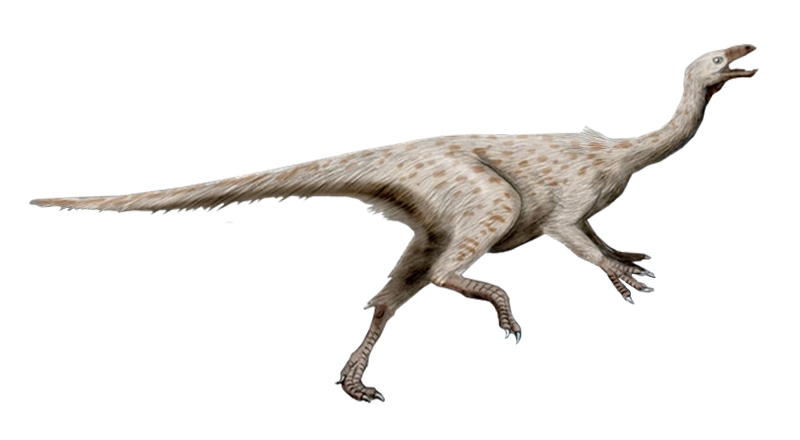

Makovicky’s team also listed two more specimens, one of them a set of hind-limb bones from a large individual with no catalog number. The other is a pair of pubes, FRDC-GS JB(07)01-01, found in 2007 near the holotype at about the same level. Because the holotype lacks its own pubes, the describers called this pair only “probably referable.” One of the three specimens also came from the overlying red beds—a setting where ornithomimosaurs are seldom found.
Beishanlong Size and Description
Short description of Beishanlong
Without a skull, the head of Beishanlong remains a blank. The shoulder offers firmer ground. Manipulating the humerus in its socket, Makovicky’s team found the arm could reach near-horizontal, although its outward swing stayed under 90 degrees.
The humerus itself was robust and curved, while the radius and ulna were nearly straight and tightly joined. A tall, mound-like olecranon—the bony point of the elbow—topped the ulna. The thumb claw was curved, whereas the third finger’s was much straighter, as in Struthiomimus and other derived ornithomimids.
The hind limb was just as sturdy. Its femur had a wing-shaped anterior trochanter—a crest for muscle attachment—with a large accessory trochanter, as in Garudimimus. Given its robust forelimbs, the describers suggested it looked stockier than Late Cretaceous ornithomimids and perhaps heavier for its femur size.
Size and Weight of Type Species
The original description gives no length or hip height. Instead, Makovicky and colleagues estimated its mass from femur length, using a 2004 equation by Christiansen and Fariña. The result, about 1,380 pounds (626 kilograms), at the time exceeded almost every other published ornithomimosaur estimate. In the describers’ words, it was also comparable to the largest known Gallimimus specimens.
Later figures differ. In 2014, Benson and colleagues listed Beishanlong at about 1,367 pounds (620 kilograms) in their study of dinosaur body-mass evolution. In 2022, however, Tsogtbaatar’s team used living-animal scaling of femoral circumference and got only about 827 pounds (375 kilograms). That figure sits close to their values for Arkansaurus and Gallimimus, and it still places Beishanlong among the earliest ornithomimosaurs to top about 770 pounds (350 kilograms). Published estimates therefore range from about 827 to 1,380 pounds.
The 2010 and 2022 figures rest on the holotype, which was still growing. A thin section of its fibula shows 13 to 14 growth lines, and their spacing narrows toward the bone surface. Open sutures in its vertebrae and unfused ankle bones point the same way, so Makovicky’s team saw a young adult approaching somatic maturity—the point where growth levels off. They considered mass estimates from such subadults probably well below those for fully grown animals. Its describers also ranked it as the second-largest theropod of the Xinminpu fauna, after the therizinosaur Suzhousaurus.
The Dinosaur in Detail
What sets this dinosaur apart shows up mainly in its tail. Near the tail’s base, one neural spine—the bony blade above the spinal cord—ends in a deep notch that appears to be unique to Beishanlong. Two mid-tail vertebrae also carry keels on their undersides, another of its defining traits.
The foot shows a mosaic of primitive and derived traits. Its third metatarsal (a long bone of the foot) narrows near the ankle yet stays visible along the front of the foot. Called subarctometatarsal, this condition also occurs in Harpymimus and Garudimimus. Makovicky’s team saw it as “an intermediate step” toward the fully pinched arctometatarsal foot of later forms. Unlike more derived ornithomimids, it also kept its first toe, or hallux, and had short, broad foot claws.
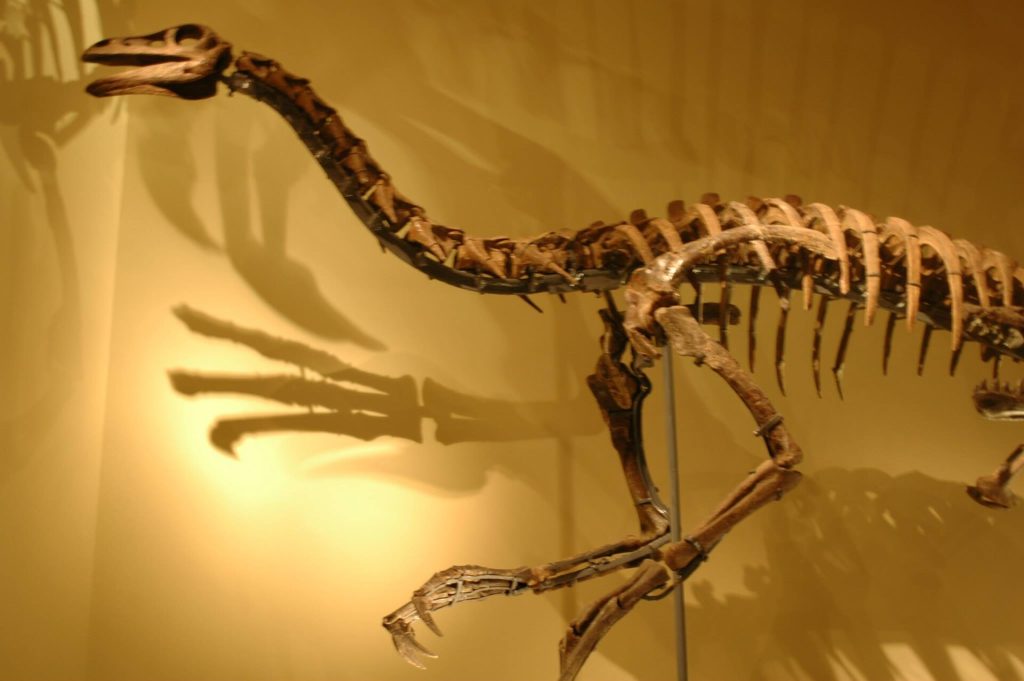

Its describers saw Harpymimus as its closest match and suggested the keeled mid-tail vertebrae “could represent a possible synapomorphy”—a shared derived trait—uniting the two as sister taxa. Still, they listed differences, including the notched tail spine and a sharper contrast in claw curvature. In their view, “probably the most significant” difference is size: Beishanlong had almost three times the estimated mass of Harpymimus.
Its exact place in the family tree is still debated. The original analysis of 293 characters in 72 theropods could not fully resolve it, because the fossils overlap too little. In 2014, Lee and colleagues grouped it in Deinocheiridae with Garudimimus and the giant Deinocheirus. In 2019, however, Hartman and colleagues rejected that grouping, finding that forcing it took 14 extra steps. Then, in 2023, Hattori and colleagues recovered Beishanlong in an unresolved cluster at the base of Ornithomimosauria, outside Deinocheiridae. These studies leave its validity unchallenged but its exact branch an open question.
Interesting Points about Beishanlong
- In 2022, researchers read its growth lines as an age of at least 13 to 14 years.
- As of 2022, it was the only large-bodied ornithomimosaur with growth data from bone histology, the study of bone tissue.
- In 2009, its describers suggested it may be the largest ornithomimosaur yet described, but later full skeletons showed Deinocheirus, at about 14,000 pounds (6,350 kilograms), to be far larger.
- One specimen came from red beds, an unusual find, since ornithomimosaur fossils turn up only rarely in dry red-bed formations.
- One of its toe bones, pedal phalanx II-1, is about 4.7 inches (120 millimeters) long.
Contemporary Dinosaurs
Sharing the same gray mudstones at White Ghost Castle was Xiongguanlong, a long-snouted tyrannosauroid—an early member of the tyrant-dinosaur lineage. In 2010, Li and colleagues estimated it at about 600 pounds (272 kilograms). Makovicky’s team called it the largest known predatory taxon of the Xinminpu fauna, yet still distinctly smaller than Beishanlong. The two shared the landscape, but no fossil records any direct interaction between them.
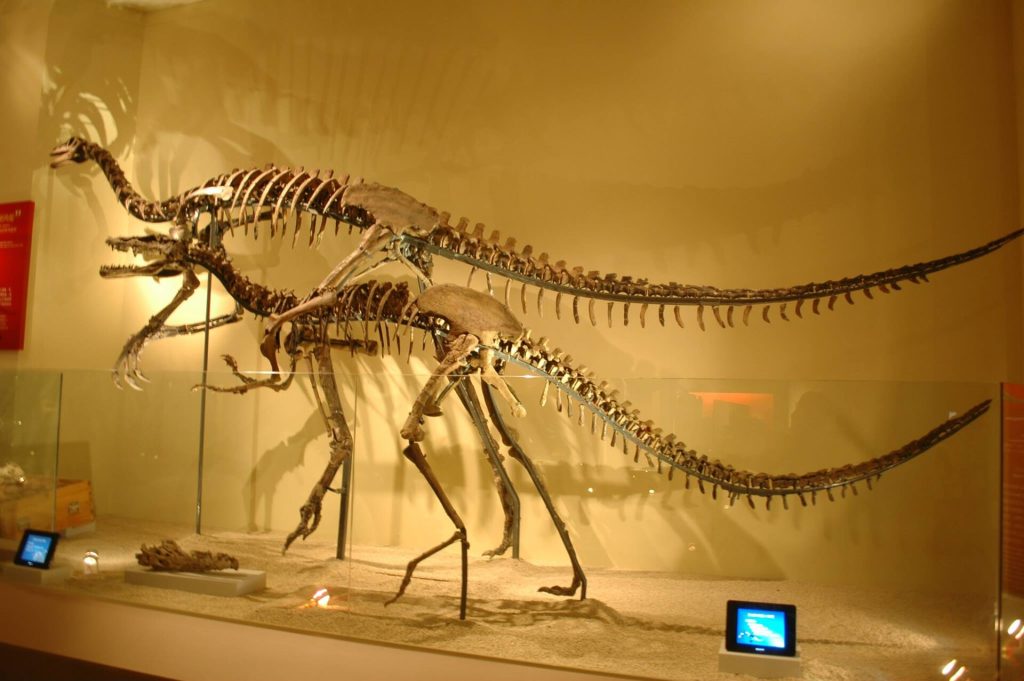

Also known from the Xiagou and Zhonggou formations of the Yujingzi Basin (exact level relative to Beishanlong not known): Suzhousaurus, Qiaowanlong, Jintasaurus, Xuwulong, and Auroraceratops. They include a giant therizinosauroid, a sauropod, two basal hadrosauriforms (early relatives of duck-billed dinosaurs), and a small early horned dinosaur. Qiaowanlong comes from the group’s middle unit, while the basin’s Auroraceratops is identified only to genus. The two formations span roughly the late Aptian to the early Albian, so these animals may not all have lived at the same time.
Beishanlong in its Natural Habitat
The world Beishanlong roamed was one of rivers, lakes, and marshes. At the basin’s White Pagoda Site, Harper and colleagues reported swelling-clay soils that point to alternating wet and dry periods. Root traces, charophytes (green algae), ostracods (tiny crustaceans), snails, and turtles also turn up in the middle beds. Their clumped-isotope work gave a mean temperature of about 58.8 °F (14.9 °C)—”very cool conditions” for the midlatitude Asian interior.
While there is no direct evidence of what Beishanlong ate, its describers placed it among possibly herbivorous coelurosaurs. Its gray mudstones held a fauna dominated by a hadrosauroid, tentatively identified as cf. Equijubus, alongside therizinosauroids, tyrannosauroids, and turtles. In the red beds above, small neoceratopsians tentatively identified as Auroraceratops dominate, joined by maniraptoran dinosaurs.
In 2018, You and colleagues described the wider Mazongshan Dinosaur Fauna of the Xiagou and Zhonggou formations as unique. Its 11 genera include large herbivorous theropods, “such as the therizinosaur Suzhousaurus and ornithomimosaur Beishanlong.” Originally, Makovicky’s team called Suzhousaurus “co-eval and sympatric” with Beishanlong. However, Suarez and colleagues reported therizinosaurs from the red beds, which their 2018 study dated to the early Albian. These overlie the late Aptian gray beds—probably the holotype’s horizon—yet one Beishanlong specimen also came from red beds. Their exact overlap in time therefore remains uncertain.
Frequently Asked Questions
It means “Northern Mountain Dragon,” and the species name grandis is Latin for its large size.
It lived in the Early Cretaceous, about 121 to 100.5 million years ago, with its holotype probably late Aptian.
Its original description gives no length, but mass estimates run from about 827 pounds (2022) to about 1,380 pounds (2010).
No direct evidence exists, but its describers grouped it with beaked and possibly herbivorous coelurosaurs.
It was an ornithomimosaur, or “ostrich-mimic” theropod, whose exact place within that group remains debated.
Its holotype comes from the White Ghost Castle field area of the Yujingzi Basin in Gansu, China.
Sources
The information in this article is based on various sources, drawing on scientific research, fossil evidence, and expert analysis. The aim is to provide a comprehensive and accurate overview of Beishanlong. However, please be aware that our understanding of dinosaurs and their world is constantly evolving as new discoveries are made.
- https://pmc.ncbi.nlm.nih.gov/articles/PMC2842665/
- https://doi.org/10.1098/rspb.2009.0236
- https://pmc.ncbi.nlm.nih.gov/articles/PMC2842666/
- https://pmc.ncbi.nlm.nih.gov/articles/PMC2825791/
- https://doi.org/10.1080/02724634.2018.1510412
- https://doi.org/10.1080/02724634.2017.1396995
- https://cp.copernicus.org/articles/17/1607/2021/cp-17-1607-2021.pdf
- https://pmc.ncbi.nlm.nih.gov/articles/PMC10484975/
- https://pmc.ncbi.nlm.nih.gov/articles/PMC9581415/
- https://pmc.ncbi.nlm.nih.gov/articles/PMC4684312/
- https://pmc.ncbi.nlm.nih.gov/articles/PMC6626525/
- https://pmc.ncbi.nlm.nih.gov/articles/PMC4011683/
- https://pmc.ncbi.nlm.nih.gov/articles/PMC5517598/
- https://doi.org/10.1139/E09-067
- https://doi.org/10.1111/j.1755-6724.2011.00377.x
- https://ivpp.cas.cn/cbw/gjzdwxb/xbwzxz/201204/t20120423_3561430.html
This article was last fact checked: TheDinosaurs Team, 21-11-2026
Featured Image Credit: SSR2000, CC BY-SA 3.0, via Wikimedia Commons
