
On the north-western edge of Romania’s Hațeg Basin, near the village of Vălioara, lie the gray mudstones of the Densuș-Ciula Formation. From them came a “duck-billed” dinosaur that lay hidden for decades. Named Kryptohadros kallaiae in 2026, it lived during the Late Cretaceous, most probably early in the Maastrichtian stage. It belongs to the hadrosauroids—the wider lineage of duck-billed plant-eaters—but sits outside the true hadrosaurids. Its discovery shows that Hațeg held at least two such animals, not one.
The site came to light in 2022, when a team led by paleontologist Gábor Botfalvai, including János Magyar, spotted a new road-cut. Over several field seasons through 2024, they dug out an associated partial skeleton, nicknamed “Jenna.” In 2026, Magyar and four colleagues described it and placed it in a new clade with two relatives. For well over a century, Hațeg hadrosauroid remains were generally lumped under one species, Telmatosaurus. This find rewrites part of that long-told story.
Kryptohadros Key Facts
| Keyword | Fact |
|---|---|
| Pronunciation | Not specified |
| Meaning of name | Hidden Hadrosauroid |
| Group | Ornithopod (Hadrosauroidea, Telmatosauridae) |
| Type Species | Kryptohadros kallaiae |
| Diet | Herbivore |
| When it Lived | Around 72 MYA (early Maastrichtian, no direct date) |
| Period | Cretaceous |
| Epoch | Late Cretaceous (Maastrichtian stage) |
| Length | Not specified |
| Height | Not specified |
| Weight | Not specified |
| Mobility | Not specified |
| First Discovery | 2022 by a team led by Gábor Botfalvai (excavated 2022 to 2024) |
| Described by | 2026 by J. Magyar, A. Ősi, Z. Csiki-Sava, S. Budai, and G. Botfalvai |
| Holotype | LPB (FGGUB) R.2882, the “Jenna specimen” |
| Location of first find | Fântânele-3, lower Middle Member of the Densuș-Ciula Formation, near Vălioara, Hațeg Basin, Hunedoara County, Romania |
Kryptohadros Origins, Taxonomy and Timeline
The name Kryptohadros means “hidden hadrosauroid.” It joins the Greek krypto, meaning “hidden,” with hadros, meaning “thick” or “bulky.” Its describers say the word fits twice over. First, a second Hațeg hadrosauroid went unrecognized for well over a century. In addition, the holotype lay hidden for decades right beside the much-excavated Fântânele microvertebrate bonebed. The species name kallaiae honors the late Csilla Kállai, the first author’s mother. Together, the name records both a long scientific oversight and a personal tribute.
Within Dinosauria, Kryptohadros belongs to Ornithischia and Ornithopoda, and more narrowly to Hadrosauroidea. Magyar’s team also erected a new clade, Telmatosauridae, to unite it with Telmatosaurus transsylvanicus from Hațeg and Tethyshadros insularis from Italy. Formally, Telmatosauridae is the largest clade containing Telmatosaurus but not Gobihadros, Hadrosaurus or Claosaurus. It sits outside Hadrosauridae, the family of true duck-billed dinosaurs. Kryptohadros kallaiae is the type and only known species.
Its type horizon dates most probably to the early part of the early Maastrichtian. The paper’s text gives no numerical age. However, its section chart, redrawn from Albert and colleagues’ 2025 study, plots the site well above the Campanian–Maastrichtian boundary. The chart labels that boundary 72.1 million years ago. The current international timescale puts that boundary at 72.2 million years ago, give or take 0.2 million years. That places Kryptohadros a little after about 72 million years ago—some 6 million years before the Cretaceous closed. At the time, the Transylvanian area formed an isolated landmass often called “Hațeg Island.”
Discovery & Fossil Evidence
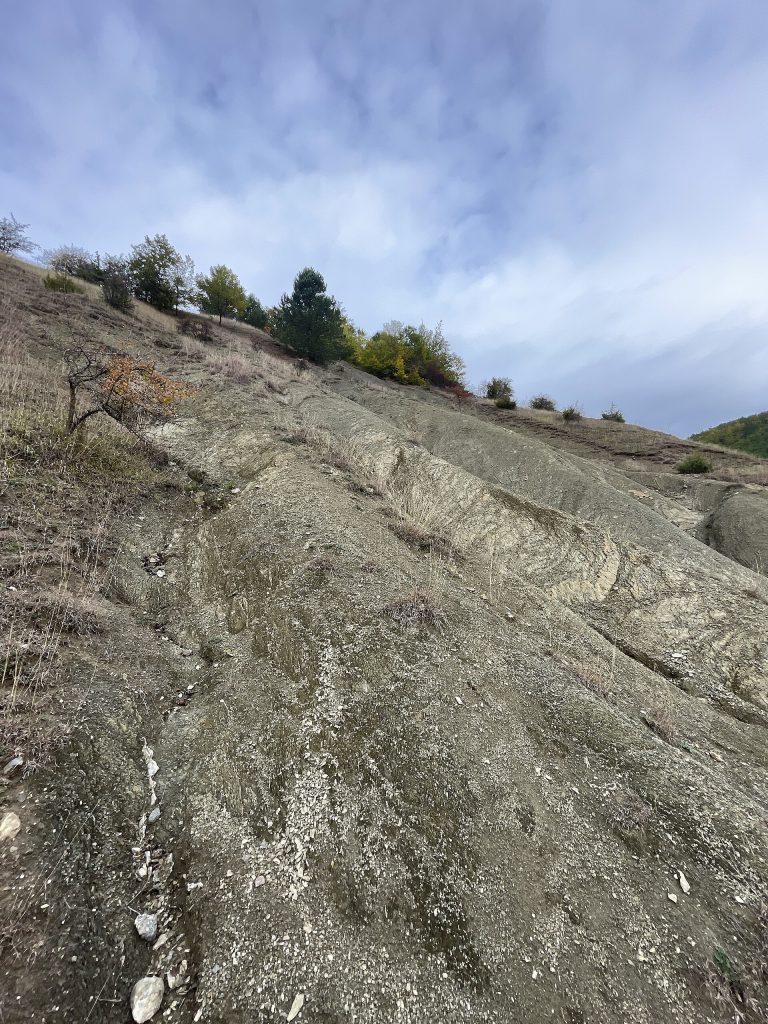
Fântânele-3 lies north-west of Vălioara, in the westernmost Hațeg Basin. The team identified it during spring fieldwork in 2022, at a new road-cut beside the Fântânele bonebed. There, the bones sat in grayish fine-grained mudstones low in the formation’s Middle Member. Behind the find lies a long debate. In 1993, Weishampel and colleagues referred all Transylvanian hadrosauroid material to Telmatosaurus. Later, Dalla Vecchia argued that only its type skull and possibly some vertebrae belong to it—and that more than one taxon might be present. Magyar’s team agrees with him.
Today the holotype, LPB (FGGUB) R.2882, is kept at the University of Bucharest’s Faculty of Geology and Geophysics. Its skull bones include parts of the right premaxilla (front upper jaw bone) and right nasal (snout bone). A middle piece of the left maxilla (main upper tooth-bearing bone) also survives. The right dentary (lower jaw bone), a scrap of the left dentary, the left surangular (rear lower-jaw bone) and ten isolated teeth add to this. So do a jugal (cheek bone) fragment and a probable right pterygoid (palate bone) fragment. Behind the head come rib fragments, 11 tail vertebrae, five chevrons, the left tibia (shin bone), and broken femora and fibulae.
None of the bones lay articulated. Still, they came from a few square meters of a single layer, match in size and preservation, and include no duplicates. For these reasons, they most probably represent one individual. Tail bones lay at the dig’s northern end, with the skull and teeth a few meters south. At the announcement, paleontologist Attila Ősi noted that skeletons combining skull, vertebrae and limb bones are very rare in the Hațeg Basin.
Kryptohadros Size and Description
Known from a single partial skeleton, Kryptohadros has to be pieced together—bone by bone—from its jaws, teeth, tail and legs.
Short description of Kryptohadros
On the back of the nasal sits a sagittal depression—a midline hollow also seen in Jinzhousaurus. Meanwhile, the maxilla carries five small, spike-like jugal tubercles (bumps) that shrink in size upward. Unlike the Telmatosaurus type skull, Kryptohadros shows no opening where the nasal meets the frontal—a match for Tethyshadros. At the front, its lower jaw turns down at about 25 degrees, against 20 degrees in Telmatosaurus.
Its maxillary teeth were tall, each with a strong, off-center ridge and densely packed denticles (small serrations) along the edges. By contrast, the isolated dentary teeth are heavily worn. Farther back, the mid-tail vertebrae show a notch above the postzygapophyses (rear joint surfaces) at the base of each spine. The left tibia is long, slender and slightly S-shaped—closer in form to distantly related Iguanodon or Gobihadros than to its nearest kin.
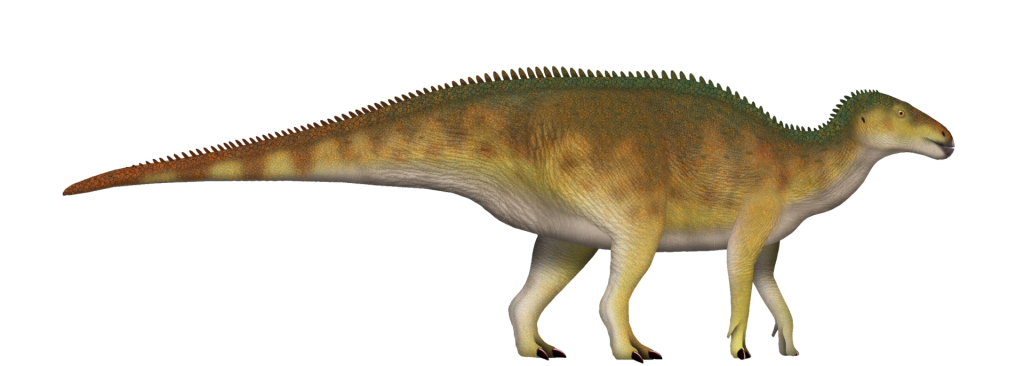
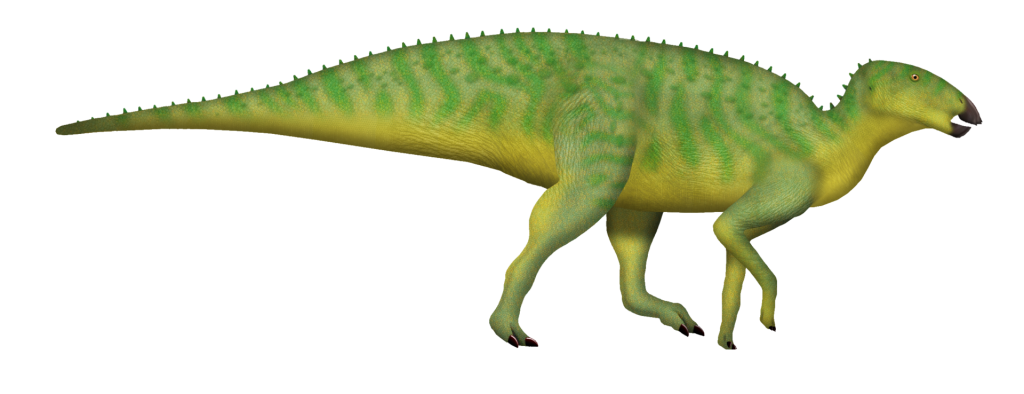
No skin impressions survive, so any discussion of its outward appearance is speculative. The paper’s skeletal reconstruction of Jenna borrows its outline from Tethyshadros—so on its own, it is not evidence.

Size and Weight of Type Species
No body length, height or weight has been published for Kryptohadros. The paper’s diagnosis of Telmatosauridae includes a body length under 19.7 feet (6 meters). However, that limit covers the whole clade, not this animal.
Measured directly, the right dentary is 8.3 inches (21.1 centimeters) long, with a tooth row of 6.5 inches (16.5 centimeters). The tibia reaches 14.1 inches (35.9 centimeters), though its lower end is missing. Thus, the dentary is about 82 percent as long as that of the Telmatosaurus type skull and 73 percent of the Tethyshadros figure. Overall, the describers call its body size “seemingly somewhat smaller” than both.
A smaller animal raises an obvious worry—that Jenna was simply a young Telmatosaurus. Magyar’s team argues otherwise. Its jaw tip is already more downturned than in the larger Telmatosaurus type skull. Likewise, its skull roof is closed where that skull’s is open. Its size and fused tail vertebrae suggest that Jenna was at least subadult, though possibly younger than the Telmatosaurus and larger Tethyshadros specimens.
The Dinosaur in Detail
What sets this dinosaur apart is a lobe on its lower jaw. At the back of the dentary’s coronoid process, the upward prong behind the tooth row, a triangular lobe extends backward. Its describers call the presence and especially the development of this lobe unique—the genus’s one full autapomorphy. Still, Tethyshadros has a smaller, rounded lobe, and Datonglong a ridge-like thickening. The authors add two “local” autapomorphies on the surangular, traits unique within one branch of the tree but found convergently elsewhere. Both are foramina (openings), a surangular foramen and a glenoid foramen.
Its tooth rows tell a similar story. The dentary shows 22 alveoli (tooth sockets), fewer than the 26 in the Telmatosaurus type skull and 25 in Tethyshadros. Likewise, the left maxilla shows 20 closely packed tooth grooves. Its tooth row curves very slightly inward, while that of Telmatosaurus runs mostly straight. A well-developed buccal shelf (a ledge beside the lower teeth) and an outward-tilted rear jaw tip, as in Amurosaurus, round out the jaw.
Placing it on the family tree proved delicate. The team’s analyses put it closer to Tethyshadros than to Telmatosaurus, but on one trait only—a slightly curved primary ridge on the dentary teeth. Without it, the three genera collapse into an unresolved polytomy. The authors rate support for Telmatosauridae as “poor to moderate” and say future work must test it. In their first analysis, the clade sits in a wider polytomy with Bactrosaurus, Gilmoreosaurus, Hadrosaurus and others. Overall, the bones describe a distinctive island hadrosauroid whose family ties remain provisional.

Interesting Points about Kryptohadros
- Its closer link to Italy’s Tethyshadros than to Hațeg’s own Telmatosaurus rests on a single tooth trait.
- Nicknamed “Jenna,” the skeleton belongs to a species that honors Csilla Kállai, the late mother of first author János Magyar.
- Its describers argue that Kryptohadros and Telmatosaurus come from lineages that diverged before reaching Hațeg Island and colonized it independently.
- According to the paper, a single dispersal from Asia before the Campanian may have brought the ancestors of Telmatosauridae into south-eastern Europe.
Dinosaurs from the Same Formation
Also known from the Densuș-Ciula Formation (exact level relative to Kryptohadros not known): Magyarosaurus and Uriash. Both titanosaurs come from the lower part of the formation’s Middle Member near Vălioara, the subunit that also yielded Kryptohadros. A 2025 scheme by Albert and colleagues puts the Uriash site in the same subunit as Fântânele-3, though probably later in the early Maastrichtian. No study ties the Magyarosaurus site to Fântânele-3’s bed. In 2025, Díez Díaz and colleagues estimated the small-bodied Magyarosaurus dacus at 1,455 to 2,143 pounds (660 to 972 kilograms). By contrast, Uriash kadici is the largest titanosaur known from the Hațeg Basin, at an estimated 11,000 to 17,600 pounds (5 to 8 metric tons). The Middle Member alone probably runs from the late Campanian into the early late Maastrichtian, so these animals may not all have lived at the same time.
Kryptohadros in its Natural Habitat
The world Kryptohadros roamed was a large alluvial fan, fed by erosion of nearby exposed metamorphic bedrock. At Fântânele-3, debris flows alternated with well-drained floodplain deposits, crossed by short-lived flood channels. The bone layer itself is a gray silt that filled an abandoned river channel as floods waned. Coalified wood, amber drops, termite coprolites (fossil droppings) and pollen point to a forested wetland with swampy ponds.
Its describers count this herbivore among Hațeg’s dinosaurian megaherbivores, though no study has examined its diet directly. Around Vălioara, the paper reports “relatively high local diversity” of plant-eaters, including two probable unnamed rhabdodontids, several titanosaurs and possibly a second, unnamed hadrosauroid. In the authors’ view, the type sites of both Hațeg telmatosaurids indicate rather waterlogged settings. That departs from a 2010 study that found no clear habitat preference among Hațeg hadrosauroids. They also suggest its unusual tibia may reflect some still-undetermined habitat-related adaptation. For comparison, Magyar’s team notes that Dalla Vecchia linked the limb anatomy of Tethyshadros to rough karst terrain.
Nothing has been published about its social life or coloration. Besides Jenna, Fântânele-3 yielded titanosaur vertebrae, small azhdarchid pterosaur bones, crocodyliform osteoderms (bony skin plates) and turtle shell fragments. The neighboring Fântânele bonebed, probably near the same horizon, adds the frog Hatzegobatrachus grigorescui, multituberculate mammals and ornithuran birds. Within the formation, records of Zalmoxes and Balaur come from Tuștea, a younger level loosely dated to the early late Maastrichtian. Balaur is usually classed as a dromaeosaurid, though in 2015, Cau and colleagues argued it may have been a flightless early bird. Kryptohadros is also most probably somewhat older than the Telmatosaurus type specimen—so the two may belong to communities that were not strictly contemporary.

Frequently Asked Questions
It means “hidden hadrosauroid,” and the species name kallaiae honors Csilla Kállai, mother of first author János Magyar.
It lived in the early Maastrichtian of the Late Cretaceous, a little after about 72 million years ago, though no direct date exists.
No body size has been published. Its dentary (lower jaw bone) is 8.3 inches long, and its describers judge it somewhat smaller than its closest relatives.
It was a herbivore, though no study has examined its diet directly.
Its skeleton came from the Fântânele-3 site near Vălioara, in the Densuș-Ciula Formation of Romania’s Hațeg Basin.
A large triangular lobe at the back of its lower jaw is better developed than in any other known dinosaur.
Sources
The information in this article is based on various sources, drawing on scientific research, fossil evidence, and expert analysis. The aim is to provide a comprehensive and accurate overview of Kryptohadros. However, please be aware that our understanding of dinosaurs and their world is constantly evolving as new discoveries are made.
- https://doi.org/10.1080/14772019.2025.2607800
- https://doi.org/10.5281/zenodo.17550540
- https://doi.org/10.1080/14772019.2024.2441516
- https://doi.org/10.1016/j.palaeo.2016.12.003
- https://doi.org/10.1016/j.cretres.2025.106095
- https://doi.org/10.7717/peerj.1032
- https://stratigraphy.org/ICSchart/ChronostratChart2024-12.pdf
- https://biologiaprod.elte.hu/en/node/321714
- https://www.sci.news/paleontology/kryptohadros-kallaiae-14850.html
This article was last fact checked: TheDinosaurs Team, 21-11-2026
Featured Image Credit: Connor Ashbridge, CC BY 4.0, via Wikimedia Commons
