
In southern Italy’s Matese Mountains, the fine-grained limestone of the Pietraroja Plattenkalk has been known for its fossils since 1798. It crops out at the village of Pietraroja, about 70 kilometers (43 miles) north-east of Naples. From this rock came Scipionyx samniticus, a small theropod of the Early Cretaceous—roughly 113 to 110 million years ago. It was the first dinosaur body fossil ever unearthed in Italy. Its only known specimen is a hatchling, yet it preserves rare soft tissues, from muscle fibers to an entire intestine.
Amateur collector Giovanni Todesco found the fossil in the spring of 1981. He kept it in his basement until 1993, when he showed it to professional paleontologists. Five years later, paleontologists Cristiano Dal Sasso and Marco Signore named it in Nature, and the find made the journal’s cover. In 2011, Dal Sasso and Simone Maganuco followed with a 281-page monograph that judged it probably under three weeks old.
Scipionyx Key Facts
| Keyword | Fact |
|---|---|
| Pronunciation | ship-e-ònyx |
| Meaning of name | Scipio’s Claw |
| Group | Theropoda |
| Type Species | Scipionyx samniticus |
| Diet | Carnivore |
| When it Lived | 113 to 110 MYA |
| Period | Cretaceous |
| Epoch | Early Cretaceous (Albian stage) |
| Length | About 1.5 feet (46 centimeters), estimated for the hatchling holotype, adult length Not specified |
| Height | Not specified |
| Weight | Up to about 0.44 pounds (0.2 kilograms), estimated for the hatchling holotype |
| Mobility | Moved on two legs (bipedal) |
| First Discovery | 1981 by Giovanni Todesco |
| Described by | 1998 by C. Dal Sasso and M. Signore |
| Holotype | SBA-SA 163760 |
| Location of first find | Le Cavere quarry, Pietraroja Plattenkalk, Pietraroja, Benevento Province, Campania, Italy |
Scipionyx Origins, Taxonomy and Timeline
The name Scipionyx joins “Scipio” with the Greek onyx, meaning “claw.” Its “Scipio” honors two men at once—Scipione Breislak, the geologist who first described the Pietraroja Plattenkalk, and Publius Cornelius Scipio “Africanus.” The species name samniticus is Latin for “of the Samnium,” the ancient region that includes Pietraroja. Unusually, the 2011 monograph even explains how to say it: “ship-e-ònyx.”
In 1998, Dal Sasso and Signore described Scipionyx as “a new maniraptoriform theropod.” By 2011, however, Dal Sasso and Maganuco had placed it in Tetanurae and Coelurosauria—successively narrower groups of theropods. Within them, they assigned it to the family Compsognathidae. Their analysis recovered it as a basal, or early-branching, member of that family. Scipionyx samniticus remains the type and only known species, although other researchers have since challenged where it belongs.
Dal Sasso and Signore originally dated the fossil to about 113 million years ago, in the Albian. Later studies of foraminifera (tiny single-celled marine organisms), summarized in the 2011 monograph, placed the rock in the early Albian. Meanwhile, the Paleobiology Database gives a range of 113.2 to 110.1 million years ago. In one passage, the monograph itself rounds the age to “some 110 million years ago.” Either way, Scipionyx lived late in the Early Cretaceous, when Pietraroja lay on a carbonate platform in the Tethys.
Discovery & Fossil Evidence
Before its formal description, two brief notes mentioned the fossil, by Leonardi and Teruzzi (1993) and by Leonardi and Avanzini (1994). Signore also made a preliminary study of it in his 1995 thesis at the University of Naples. Meanwhile, the popular magazine Oggi nicknamed it “Ciro,” a typical Neapolitan name. As Italian law requires, the fossil then passed to the Soprintendenza—the state heritage authority—for the area where it was found.
In 1994, the Museo di Storia Naturale di Milano obtained permission to prepare and study it. Sergio Rampinelli and Dal Sasso did the work in Salerno until 1997. Only as the work went on did the soft tissues come to light. The collector had also added an artificial tail of polyester resin, and removing it revealed a few genuine tail vertebrae underneath.
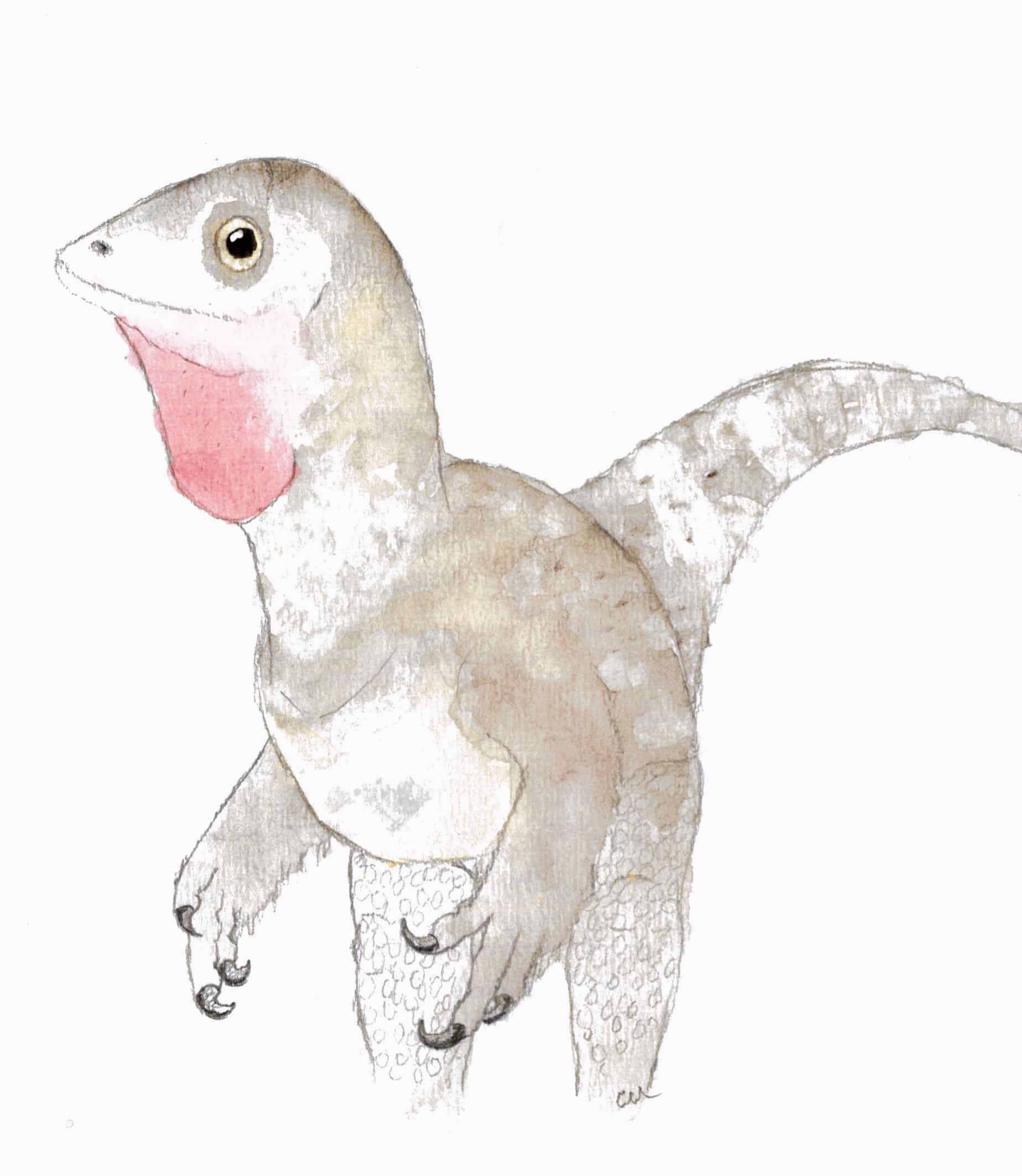

The holotype, SBA-SA 163760, is a nearly complete, articulated skeleton with fossilized soft tissues. In 2011, the then Soprintendenza per i Beni Archeologici di Salerno, Avellino, Benevento e Caserta housed it in Salerno. Today it is in the care of the Soprintendenza Archeologia, Belle Arti e Paesaggio for the provinces of Caserta and Benevento. The skeleton lies on its left side with its head upturned and its jaws open. Most of the tail, the legs below the upper shins, and one hand claw are missing—they “were simply not collected” with the adjoining slabs. Five small fish of the genus Clupavus lie in the same slab. In addition, Dal Sasso and Maganuco’s study suggests that a turbidite—an underwater flow of sediment—buried the hatchling in a single, rapid event. No additional specimens of Scipionyx have been reported.
Scipionyx Size and Description
Because the only fossil is a hatchling, every figure below describes a baby rather than a grown animal.
Short description of Scipionyx
The skull was very large—about 5 centimeters (2 inches) long and nearly half the length of the backbone in front of the hips. A short, triangular snout and large rounded orbits (eye sockets) gave the face a big-eyed look. Five teeth sat in the premaxilla (snout-tip bone) and seven in the maxilla (main upper jawbone), while the dentary (lower jawbone) held ten. All were “pointed and feebly recurved.”
Several features mark it as very young. A fontanelle, or soft spot, remained open on the skull roof, and the region in front of the eyes was short and deep. Tooth replacement had not yet begun, and no vertebra had closed neurocentral sutures (the joints between the body and arch of each vertebra).
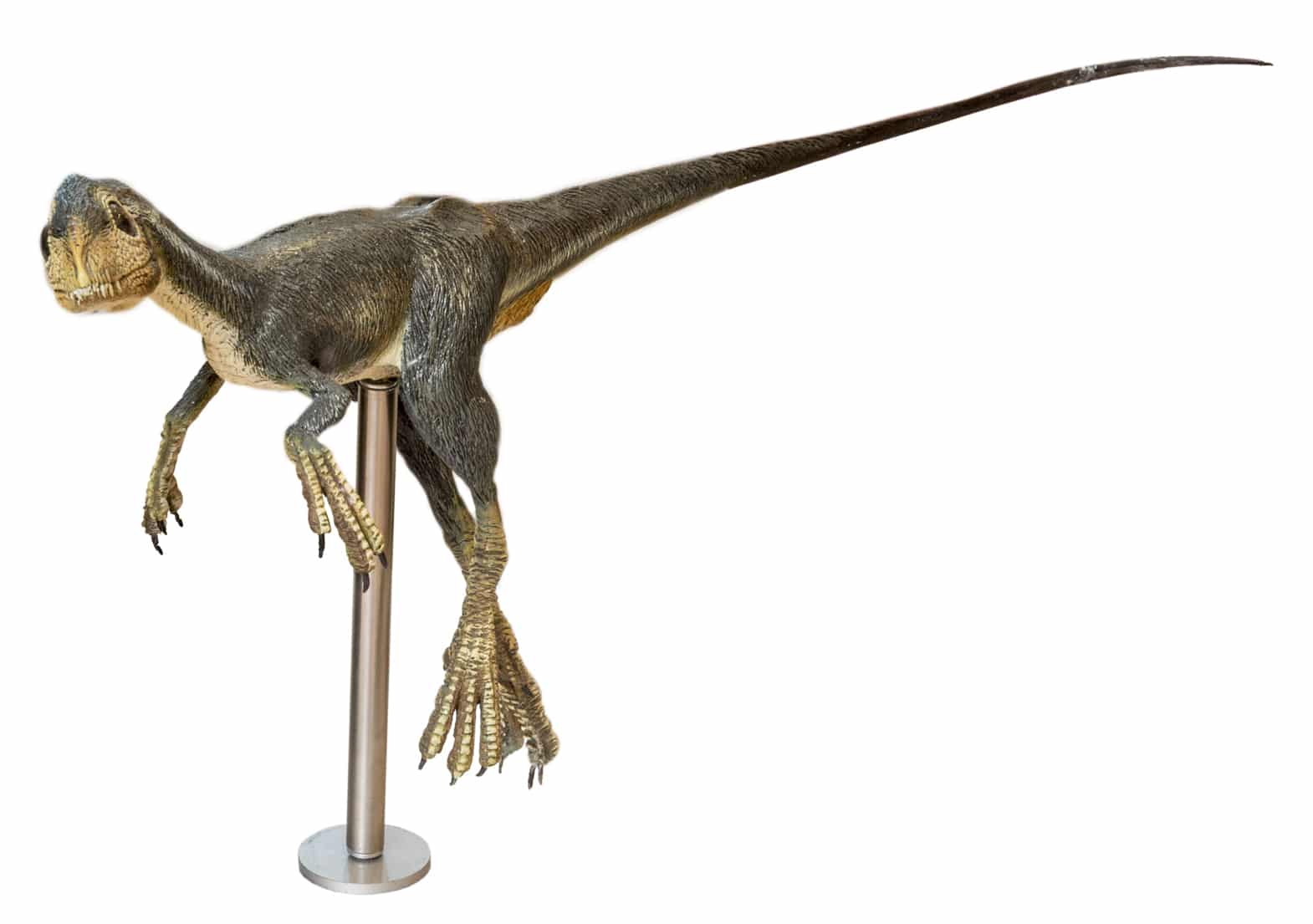
Its wrist held only two well-ossified bones, and the third finger was markedly longer than the first. The diagnosis also lists a squared-off process on the ischium (a lower hip bone). Like all theropods, it moved on two legs. No feathers or scales survive (the only external soft tissues are the horny claw sheaths), so any discussion of its body covering is speculative. Even so, Dal Sasso and Maganuco think it would have been protofeathered—covered in simple, early feathers—based on its place in the family tree.

Size and Weight of Type Species
The preserved specimen measures 237 millimeters (9.3 inches) from snout to ninth tail vertebra—a direct measurement. With the missing tail reconstructed, Dal Sasso and Maganuco estimated a total length of about 1.5 feet (46 centimeters). Elsewhere, they state that it “did not exceed 50 cm” (19.7 inches).
No hip height has been published, but the same authors tentatively suggested a weight of no more than 0.2 kilograms (about 7 ounces). They based this on the body proportions of small coelurosaurs and birds.
In 1998, Dal Sasso and Signore called the animal a “juvenile theropod.” The 2011 monograph went further, suggesting it was probably less than three weeks old. Because “there are no fossils of adult Scipionyx,” adult size remains unknown.
The Dinosaur in Detail
Soft tissue sets this dinosaur apart. In 1998, Dal Sasso and Signore reported a “perfectly fossilized intestine” and a reddish patch that might be liver remains. The 2011 restudy described ligaments, cartilage, neck muscles, part of the windpipe, gut blood vessels, and horny claw sheaths. Scanning electron microscopy even revealed banding within single muscle fibers. Dal Sasso and Maganuco call it “the most remarkably preserved dinosaur known.”
Its body cavity also sparked a breathing debate. In 1999, Ruben and colleagues—Dal Sasso and Signore among them—argued from ultraviolet-light analysis that the liver divided the body cavity and that Scipionyx apparently had diaphragm muscles. However, the 2011 monograph identified those supposed muscles as a calcite nodule and rejected a hepatic piston, or liver-assisted breathing.
Its family tree is just as contested. The 2011 analysis found it closest to Orkoraptor, which the authors regarded as a possible neovenatorid rather than a compsognathid. Earlier, Peyer (2006) had grouped it with six other compsognathids, including Compsognathus, Sinosauropteryx, and Aristosuchus. However, Butler and Upchurch (2007) found it and Juravenator more basal than a Compsognathidae of Compsognathus and Coelurus.
In 2021, paleontologist Andrea Cau called Compsognathidae an artificial grouping of immature animals from distinct lineages and related Scipionyx to some allosauroids. Then, in 2024, his “Ontogenetic State Partitioning” method placed it closer to spinosaurids such as Spinosaurus, and he interpreted it as one. In 2025, Qiu and colleagues recovered the Chinese compsognathid-like theropods as a natural group of early coelurosaurs. However, Christophe Hendrickx noted in a commentary that compsognathids may be an artificial grouping of juveniles and called for better-aged specimens. Scipionyx has thus been called a maniraptoriform, a compsognathid, an allosauroid relative, and a spinosaurid. As early as 2011, its describers warned that some growth-dependent features needed caution until a mature specimen is found.
Interesting Points about Scipionyx
- Before scientists studied it, the fossil carried a fake tail of polyester resin, and removing it revealed a few real tail vertebrae.
- It was the first dinosaur body fossil unearthed in Italy. Until then, the country’s only dinosaur traces were footprints, most of them found after 1988.
- Dal Sasso and Maganuco suggested the hatchling was probably less than three weeks old, maybe only three days, when it died.
- In 2022, Italy’s National Institute of Geophysics and Volcanology announced micro-CT scans of “Ciro” with the University of Sannio.
- Its coiled intestine was estimated at 300 to 320 millimeters (11.8 to 12.6 inches) long—longer than the 237 millimeters of skeleton collected and about two-thirds of the animal’s estimated total length.
Scipionyx in its Natural Habitat
The world Scipionyx knew was land on a carbonate platform in the Tethys. Traditional models make it an island no larger than Sardinia, perhaps as small as Corsica. Yet Dal Sasso and Maganuco point to dinosaur tracks showing that such platforms were at times linked by land to their neighbors. Leathery conifer leaves suggest a warm climate that was dry for most of the year. Plants included the conifer Brachyphyllum, the bennettitalean (an extinct seed-plant group) Podozamites, and the fern Phlebopteris. In 1998, Dal Sasso and Signore pictured a shallow lagoon, whereas the 2011 monograph favored relatively shallow, open marine waters. Even so, land plants, land reptiles, a land-dwelling amphibian, and fish genera also known from freshwater show that dry land with fresh water lay nearby.
Its last meals offer direct evidence of diet. The 2011 study found lepidosaurian reptile bones (lizards and their kin) in the stomach region. Lizard-like scales lay in the duodenum, and fish scales in the rectum. The authors took this as compelling evidence of a diet of lizards and fish, with fish as regular rather than occasional meals. Because the animal was so young, they also proposed the food might point to parental care and feeding. They weighed scavenging and active hunting as alternatives, although they found it hard to picture a hatchling catching fast prey without help.
No other dinosaur is known from Pietraroja. Fish were the most abundant vertebrates, with at least 20 species, including the very common Clupavus. The rocks have also yielded the amphibian Celtedens megacephalus and the sphenodontian (tuatara relative) Derasmosaurus pietraroiae. Lizards such as Costasaurus rusconii also appear, as do small crocodylomorphs (crocodile relatives) up to about 1.5 meters (4.9 feet) long. Shrimp-like decapods, ammonites, and small starfish shared the waters.
Frequently Asked Questions
It means “Scipio’s claw,” honoring geologist Scipione Breislak and Publius Cornelius Scipio “Africanus.”
It lived in the Albian stage of the Early Cretaceous, roughly 113 to 110 million years ago.
The hatchling holotype was about 1.5 feet long and weighed up to about 0.44 pounds, but adult size is unknown.
It was a carnivore, and its gut contents show that it ate both lizards and fish.
It was found in the Le Cavere quarry at Pietraroja, in Benevento Province in southern Italy.
Its single fossil preserves an entire intestine, muscles, and other soft tissues, and it was the first dinosaur body fossil found in Italy.
Sources
The information in this article is based on various sources, drawing on scientific research, fossil evidence, and expert analysis. The aim is to provide a comprehensive and accurate overview of Scipionyx. However, please be aware that our understanding of dinosaurs and their world is constantly evolving as new discoveries are made.
- https://www.nature.com/articles/32884
- https://archive.org/details/memoriedellasoci3712soci
- https://www.paleoitalia.it/wp-content/uploads/2024/05/01_Cau_2024_BSPI_631.pdf
- https://pubmed.ncbi.nlm.nih.gov/9915693/
- https://academic.oup.com/nsr/article/12/5/nwaf131/8104278
- https://paleobiodb.org/data1.2/occs/list.json?base_name=Scipionyx&show=strat,loc,coords
- https://www.ingv.it/en/urp-press/Press-office/Press-releases/ciro-dinosaur-new-investigations-by-INGV-on-the-first-and-most-important-dinosaur-discovered-in-Italy
- https://academic.oup.com/nsr/article/12/5/nwaf068/8030555
- https://cultura.gov.it/luogo/soprintendenza-archeologia-belle-arti-e-paesaggio-per-le-province-di-caserta-e-benevento-scipionyx-samniticus
- https://cultura.gov.it/evento/la-soprintendenza-abap-per-le-province-di-caserta-e-benevento-presenta-ciro-40-un-viaggio-immersivo-tra-realta-aumentata-e-virtuale-alla-scoperta-del-dinosauro-piu-famoso-al-mondo
This article was last fact checked: TheDinosaurs Team, 12-11-2026
Featured Image Credit: PaleoEquii, CC BY-SA 4.0, via Wikimedia Commons