
South of Lago Viedma in Argentina’s Santa Cruz Province, the river-laid rocks of Cerro Los Hornos hold the remains of a predator with a famously restless family tree. Its describers assigned these beds to the Pari Aike Formation, though most later studies call them the Cerro Fortaleza Formation. Named Orkoraptor burkei in 2008, this carnivore is now usually treated as a megaraptoran. According to a 2010 study, that group of theropods developed long, grasping forelimbs. Most recent work places it in the Campanian stage of the Late Cretaceous, though its exact age is still uncertain.
Paleontologists Fernando Novas, Martín Ezcurra, and Agustina Lecuona based their description on a few skull bones, teeth, vertebrae, and part of a shin bone. At first, they saw features that recalled maniraptorans, coelurosaurs more advanced than tyrannosaurids. Later researchers moved it into the megaraptorans, and they have argued over its exact branch ever since. Its teeth also turned out to be the first megaraptorid teeth unquestionably associated with skeletal material. For such a fragmentary animal, it carries a surprising share of its group’s story.
Orkoraptor Key Facts
| Keyword | Fact |
|---|---|
| Pronunciation | Not specified |
| Meaning of name | Toothed River Thief (according to Thomas Holtz Jr.) |
| Group | Theropoda (Megaraptora) |
| Type Species | Orkoraptor burkei |
| Diet | Carnivore |
| When it Lived | Probably Campanian (age uncertain) |
| Period | Cretaceous |
| Epoch | Late Cretaceous (Campanian stage) |
| Length | About 20 feet (6 meters) |
| Height | Not specified |
| Weight | Not specified |
| Mobility | Not specified |
| First Discovery | Year not specified |
| Described by | 2008 by F.E. Novas, M.D. Ezcurra, and A. Lecuona |
| Holotype | MPM-PV 3457 |
| Location of first find | Cerro Los Hornos, south of Lago Viedma, Cerro Fortaleza Formation (originally Pari Aike Formation), Santa Cruz Province, Argentina |
Orkoraptor Origins, Taxonomy and Timeline
According to paleontologist Thomas Holtz Jr., the name Orkoraptor means “Toothed River thief,” with “raptor” supplying the “thief.” Holtz adds that “Orr Korr” is the local-language name behind “Toothed River.” No source available to us explains who burkei honors.
Its classification has traveled far. In 2008, Novas and colleagues argued that it “exhibits characteristics of maniraptorans.” They pointed to an upturned front process on the postorbital, a bone behind the eye socket. They also compared its teeth, which lack denticles (tiny serrations) and a carina (cutting ridge) on the front edge, with those of compsognathids and deinonychosaurs. Two years later, Benson, Carrano, and Brusatte moved it to Neovenatoridae—a new clade within Allosauroidea. Their clade also held Neovenator, Megaraptor, and Aerosteon, with Orkoraptor in its subgroup Megaraptora. Then, in 2013, Novas and colleagues placed the Gondwanan megaraptorans in the new family Megaraptoridae, “deeply nested within Coelurosauria”—the branch of tyrannosaurs and birds.
Its age has proved just as slippery—the 2008 paper placed it in the Maastrichtian, the final stage of the Cretaceous. In 2013, Novas and colleagues wrote that the age of these beds “seems to be” the much older Cenomanian–Santonian. In 2019, Novas and colleagues cited 2018 zircon dating by Sickmann and colleagues for an age of around 76.2 million years. However, that is a maximum age, not a date for the holotype’s bed. By contrast, a 2021 study cited the same work for about 72 million years. Other studies say Campanian–Maastrichtian, and the 2025 Joaquinraptor study says middle Campanian.
The fossils pull the other way—the 2019 authors noted that the fauna “does not fit” the zircon ages. In 2024, Agnolín and colleagues likewise found “close similarities” with the fauna of the Cenomanian–Turonian Mata Amarilla Formation. For now, the Campanian is the likeliest answer—but not a settled one.
Discovery & Fossil Evidence
Orkoraptor comes from Cerro Los Hornos, a hill south of Lago Viedma and west of the La Leona River. No source available to us gives the year of collection or names the finder. Novas, Ezcurra, and Lecuona described the animal in Cretaceous Research, in the June 2008 issue. Later authors referred the same beds to the Mata Amarilla Formation or—more often—the Cerro Fortaleza Formation.
According to a 2025 study, the holotype, MPM-PV 3457, is housed at the Museo Padre Molina in Río Gallegos, Argentina. The original abstract lists a postorbital and a quadratojugal (a cheek bone near the jaw joint). The list continues with a possible coronoid (a small lower-jaw bone), several teeth, and parts of the first neck vertebra. Two caudal (tail) vertebrae and the upper half of the tibia, or shin bone, complete it. In their 2016 comparison, Coria and Currie also mention a nasal, chevrons (bones beneath the tail), and ribs.
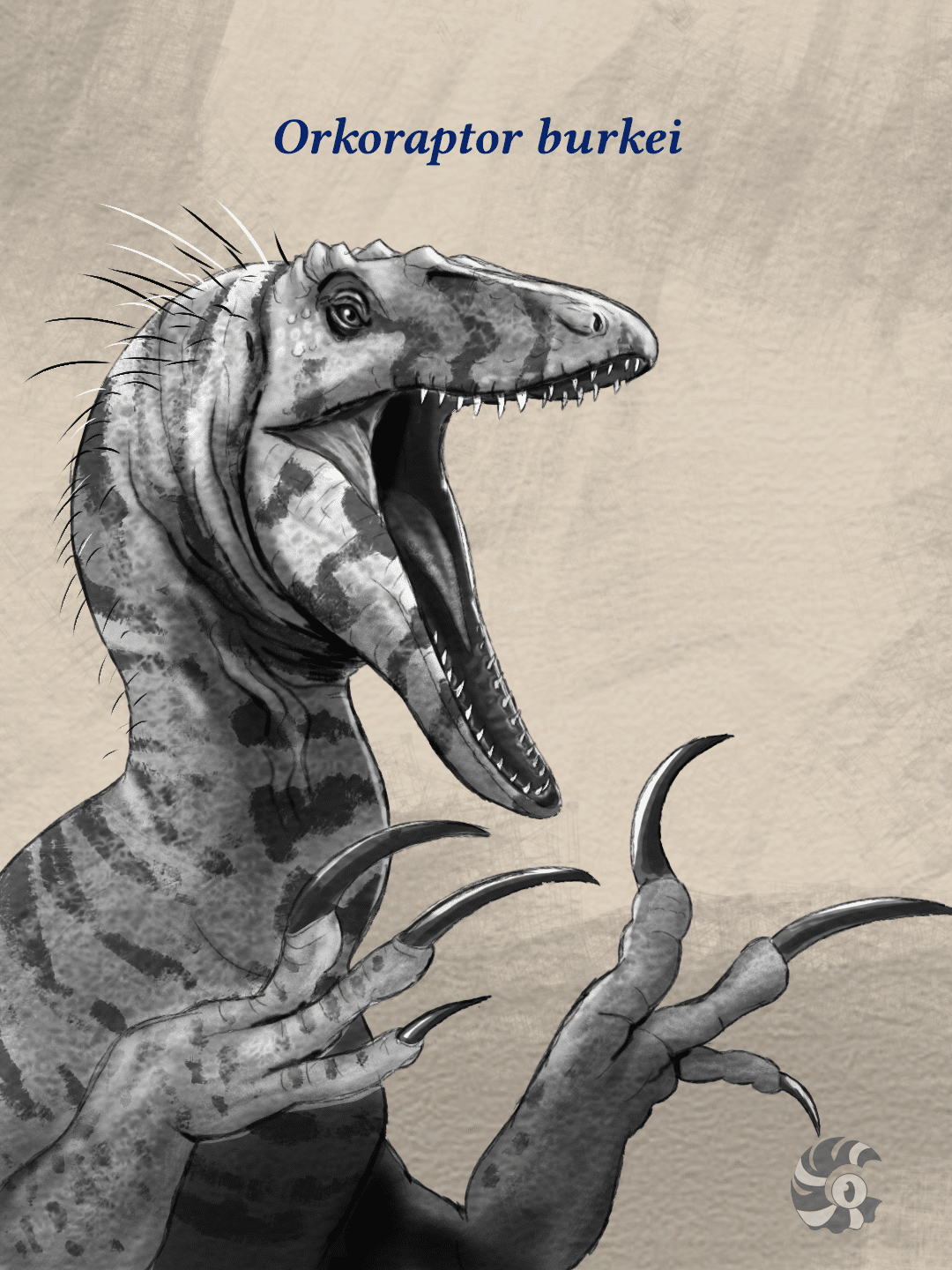

Other finds remain tentative. In 2014, Lacovara and colleagues reported shed theropod teeth “probably referable to” Orkoraptor from the quarry of the giant titanosaur Dreadnoughtus. That quarry lies at a different site in the formation. Paulina-Carabajal and colleagues later described another theropod tooth from that locality. However, it is a probable abelisauroid tooth, so it does not test the 2014 referral. According to the Paleobiology Database, Agnolín and colleagues also reported material compared with Orkoraptor from near the holotype site in 2024. For now, the 2025 study lists only the holotype as an associated specimen.
Orkoraptor Size and Description
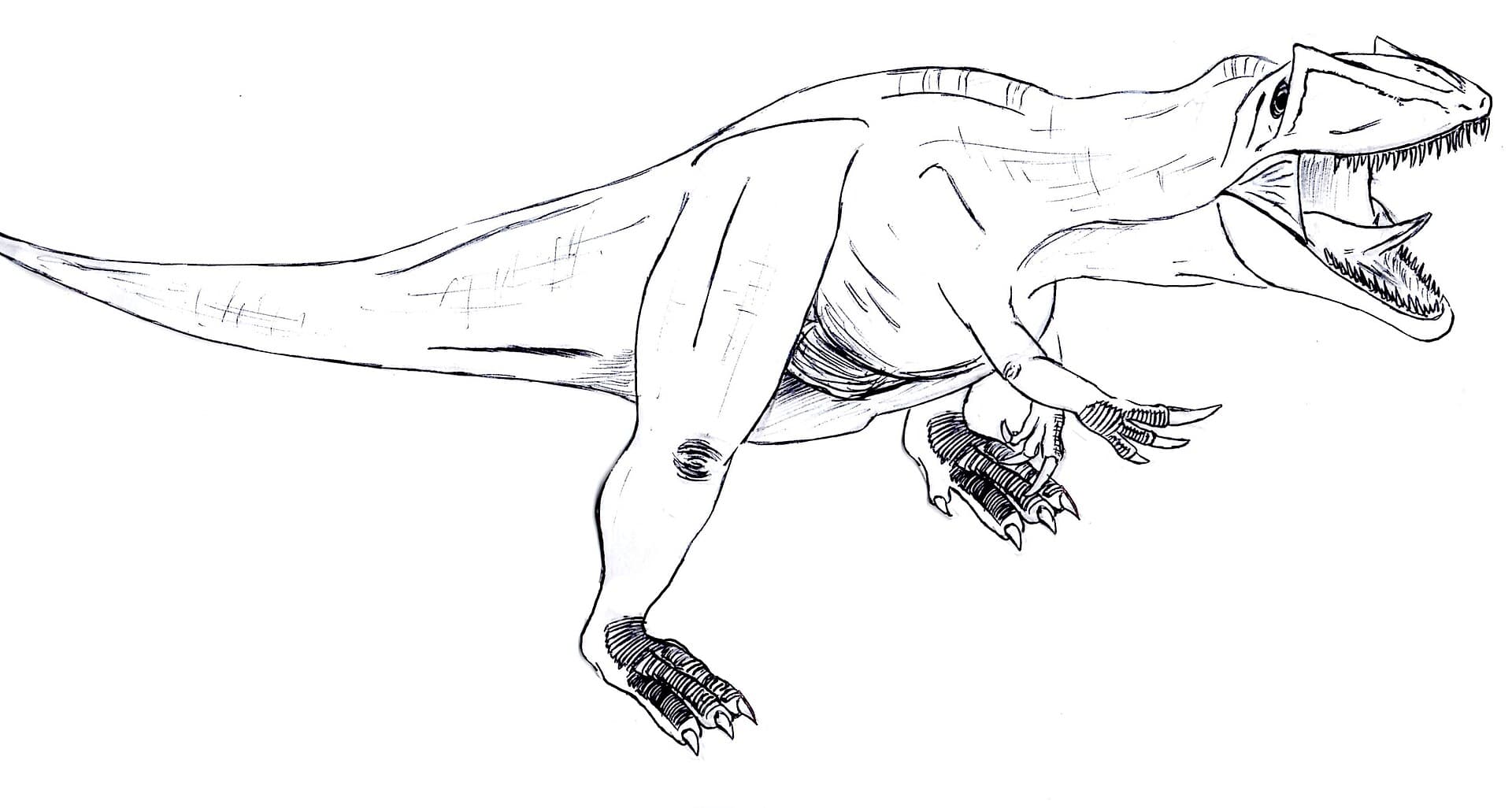
Much of Orkoraptor is missing, so any portrait of it leans on better-known relatives.
Short description of Orkoraptor
The skull is known mostly from the region around the eye. According to Coria and Currie, its postorbital is “almost identical” to that of Murusraptor, another Patagonian megaraptorid. Its lower prong is U-shaped in cross-section, a trait the two animals share. Each tooth crown has a figure-eight cross-section and a curved rear edge, which bears 3 to 4 denticles per millimeter.
The atlas, the first neck vertebra, has a crescent-shaped lower piece, while the tail vertebrae carry small openings for air sacs. Its vertebrae are also camellate—filled with a honeycomb of small internal chambers. One mid-tail vertebra is about 1.25 times as long as it is tall. Its chevrons curve slightly backward, as in Megaraptor and Aoniraptor.
The tibia shows the hook-shaped inner knob, or medial condyle, seen in other megaraptorids. Much remains unknown, including the back vertebrae, the hip, the hands, and the feet. Its posture can therefore only be inferred from relatives—according to Benson and colleagues, megaraptorans had hind limbs built for running. No skin or feathers are known, so any depiction of its body covering is speculative.

Size and Weight of Type Species
Orkoraptor was roughly 20 feet (6 meters) long—a figure Aranciaga Rolando and colleagues gave in 2022, citing the original paper. It is an estimate for the whole animal, not a measured skeleton. The 2008 title called it a “large theropod,” while the 2022 team described it as “medium-sized.”
Its tibia offers a second clue. Only the upper half survives, but the whole bone was estimated at about 60 centimeters (23.6 inches) long—”only slightly shorter” than the tibia of Murusraptor. Coria and Currie also judged Murusraptor comparable in size to Aerosteon and Orkoraptor. Meanwhile, the 2022 study contrasted its 6 meters with 9.5 meters for the much larger Maip. In other words, Orkoraptor was a smaller member of a family that also produced far bigger hunters.
No peer-reviewed source we consulted gives a weight or a hip height. In his popular genus list, Holtz gives a slightly longer 21.5 feet (6.5 meters) and places it in a horse-sized weight class.
The Dinosaur in Detail
What sets this dinosaur apart, according to its describers, is a pair of small details. Each tooth has “a median depression flanked by two longitudinal and narrow furrows.” Its tail vertebrae, meanwhile, carry “a single pair of small pleurocoels on each side”—pleurocoels being hollows linked to air sacs. In 2008, the describers used both features to separate it from other coelurosaurs.
The front edge of the teeth has caused some confusion—the original abstract describes no denticles “and carina” there. By contrast, a 2019 study and a 2021 study describe a carina without serrations, as in Megaraptor and Murusraptor. Coria and Currie, however, scored the trait as unknown, since that region “cannot be seen in any specimen.” According to Novas and colleagues, reduced or absent front denticles also appear in Australovenator and Fukuiraptor. In addition, the tiny grooves between its denticles do not extend into blood grooves, a megaraptorid condition according to the 2019 study.
Its exact branch is still debated. In 2016, Coria and Currie grouped it with Aerosteon, Megaraptor, and Murusraptor in a South American megaraptorid group. Aranciaga Rolando’s 2022 team found it in an unresolved cluster in one analysis. In a second, they placed it in an informal “Clade B” with Tratayenia, Aerosteon, and Maip. Ibiricu and colleagues, describing Joaquinraptor in 2025, instead recovered it, in one of two analyses, as “the earliest diverging member of the Argentinean clade.” Then, in 2026, Méndez and colleagues flagged it as one of the two “most unstable taxa” in their analysis.
Taken together, these studies agree that Orkoraptor belongs among the megaraptorans but not exactly where. More complete bones may one day settle the question—but for now, it remains one of the group’s wildcards.
Interesting Points about Orkoraptor
- Its teeth were the first megaraptorid teeth found unquestionably associated with skeletal material, according to Coria and Currie in 2016.
- Its describers first saw maniraptoran traits in the skull, while a 2010 study classed it as an allosauroid before most later work moved it to the coelurosaurs.
- In the 2010 analysis by Benson and colleagues, it acted as a “wildcard taxon” that jumped between positions within Megaraptora, as summarized in 2013.
- Proposed ages for its rocks have ranged from the Cenomanian to the Maastrichtian.
- Its describers called it one of the southernmost carnivorous dinosaurs yet found in South America.
Dinosaurs from the Same Formation
Also known from the Cerro Fortaleza Formation (exact level relative to Orkoraptor not known): the ornithopod Talenkauen and the giant titanosaur Puertasaurus, both from Cerro Los Hornos, the hill that yielded Orkoraptor, as well as the enigmatic theropod Austrocheirus and another giant titanosaur, Dreadnoughtus. The formation’s age range and the correlations between its scattered outcrops are poorly constrained, so these animals may not all have lived at the same time.
Orkoraptor in its Natural Habitat
The world Orkoraptor roamed was one of rivers and wet, forested lowlands, not far from the sea. Its river sands, overbank muds, and ancient soils rest on the Campanian La Anita Formation—laid down along the coast and in shallow seas. Across the formation, fossil roots, peaty soils, and abundant silicified wood point to a “poorly drained, low-lying, forested terrain.” According to Agnolín and colleagues’ 2024 survey, other fossils include lamniform sharks, gar-like fishes, the lungfish Atlantoceratodus, chelid turtles, crocodyliforms, and even mosasaur teeth. At Cerro Los Hornos, carbonized cycad and conifer remains lay with the bones of Puertasaurus.
In 2012, Varela and colleagues treated the Pari Aike as part of the Mata Amarilla Formation. Their study also listed Orkoraptor among dinosaurs giving “inconsistent and partially contradictory” age data. At the Dreadnoughtus quarry, Lacovara and colleagues reported probable tooth marks on a tail vertebra of the smaller skeleton. In their view, these “suggest” that scavenging may have removed parts of the carcass. Only the tentative tooth referral, however, links Orkoraptor to the scavenger.
While there is no direct evidence of how Orkoraptor hunted, Novas and colleagues argued that megaraptorans “shared the role of top predators” with abelisauroids and carcharodontosauroids. A probable abelisaurid tooth does turn up at the formation’s type locality, along with a probable nodosaur tooth and ankylosaur armor ossicles. A 2025 study of a bitten sauropod bone from that locality named Orkoraptor among the formation’s known theropods. Yet it pointed to abelisaurids and megaraptorids in general as the likeliest makers of most bite marks.
Frequently Asked Questions
According to paleontologist Thomas Holtz Jr., it means “Toothed River thief,” with “raptor” meaning “thief.”
Most recent studies place it in the Campanian stage of the Late Cretaceous, but its exact age is uncertain.
It was about 20 feet (6 meters) long, an estimate a 2022 study credits to its original description. No peer-reviewed weight estimate is available, though a popular genus list by Holtz places it in a horse-sized class.
It was a carnivorous theropod and a megaraptoran, though its exact position within that group is still debated.
Its fossils come from Cerro Los Hornos, south of Lago Viedma in Santa Cruz Province, Argentina.
Its describers separated it from other coelurosaurs by two traits. Each tooth bears a central groove between two narrow furrows, and each side of its tail vertebrae has a single pair of small air-sac openings.
Sources
The information in this article is based on various sources, drawing on scientific research, fossil evidence, and expert analysis. The aim is to provide a comprehensive and accurate overview of Orkoraptor. However, please be aware that our understanding of dinosaurs and their world is constantly evolving as new discoveries are made.
- https://doi.org/10.1016/j.cretres.2008.01.001
- https://dml.reptilis.net/2008Feb/msg00041.html
- https://doi.org/10.1016/j.cretres.2013.04.001
- https://ri.conicet.gov.ar/handle/11336/102037
- https://doi.org/10.1007/s00114-009-0614-x
- https://doi.org/10.1371/journal.pone.0157973
- https://doi.org/10.1038/s41598-022-09272-z
- https://doi.org/10.1038/s41467-025-63793-5
- https://doi.org/10.26879/1738
- https://doi.org/10.22179/revmacn.21.655
- https://doi.org/10.1371/journal.pone.0256233
- https://doi.org/10.1038/srep06196
- https://doi.org/10.5710/PEAPA.22.09.2024.512
- https://www.ameghiniana.org.ar/index.php/ameghiniana/article/download/804/1546
- https://doi.org/10.22179/revmacn.7.340
- https://doi.org/10.5027/andgeoV39n3-a01
- https://doi.org/10.1111/bre.12272
- https://www.geol.umd.edu/~tholtz/dinoappendix/HoltzappendixWinter2011.pdf
- https://paleobiodb.org/classic/checkTaxonInfo?taxon_no=122475
- https://doi.org/10.1016/j.cretres.2023.105735
- https://ri.conicet.gov.ar/handle/11336/231003
This article was last fact checked: TheDinosaurs Team, 14-11-2026
Featured Image Credit: Danny Cicchetti, CC BY-SA 3.0, via Wikimedia Commons
