
At Quarry 13 on Como Bluff, Wyoming, the Morrison Formation yielded a small dinosaur with remarkably hollow bones. Named Coelurus fragilis in 1879, this theropod lived in the Late Jurassic. Its rock layers belong to a formation that spans roughly 156 to 147 million years ago. Known for decades mostly from vertebrae, it still divides researchers over where it sits on the family tree.
According to the Yale Peabody Museum’s catalog, collector William H. Reed gathered the first bones in 1879. That December, paleontologist Othniel Charles Marsh named it in the American Journal of Science, calling it “apparently a Dinosaur.” Two years later he gave it an order of its own—then, in 1884, folded that order into the theropods. Since then, researchers have linked it to early tyrannosauroids (early relatives of Tyrannosaurus), to ornithomimosaurs (“bird mimics”), and to its neighbor Ornitholestes.
Coelurus Key Facts
| Keyword | Fact |
|---|---|
| Pronunciation | seel-YEW-rus, as given by the Natural History Museum, London |
| Meaning of name | Hollow Tail, as given by the Natural History Museum, London |
| Group | Theropoda |
| Type Species | Coelurus fragilis |
| Diet | Carnivore |
| When it Lived | About 156 to 147 MYA, the age span of the whole Morrison Formation—the Quarry 13 level is not precisely dated |
| Period | Jurassic |
| Epoch | Late Jurassic (Kimmeridgian to Tithonian stages) |
| Length | About 5.9 to 6.6 feet (1.8 to 2 meters), secondary estimates |
| Height | Not specified |
| Weight | About 64 pounds (29.1 kilograms), 2014 estimate from specimen YPM 2010 |
| Mobility | Moved on two legs (bipedal), as Marsh described theropods in 1884 |
| First Discovery | 1879 by William H. Reed |
| Described by | 1879 by O.C. Marsh |
| Holotype | YPM 1991, Yale Peabody Museum, New Haven |
| Location of first find | Quarry 13, Como Bluff, Morrison Formation, Albany County, Wyoming, USA |
Coelurus Origins, Taxonomy and Timeline
According to the Natural History Museum in London, the name Coelurus means “hollow tail.” Marsh explained neither the genus name nor the species name fragilis. Still, his first description dwells on the hollow vertebrae—including those at the front of the tail.
Coelurus is a theropod dinosaur, generally treated today as a small coelurosaur (the theropod group that includes tyrannosaurs and birds). Marsh’s own view shifted quickly, and in 1881 he decided it “cannot be placed in any known order.” Instead, he saw “apparently a generalized Sauropsid”—the wider group of reptiles and birds—with resemblances to dinosaurs, pterodactyls, and, more remotely, birds. Still, he judged it “a reptile and not a bird,” creating the order Cœluria and the family Cœluridæ. By 1884, Cœluria had become a sub-order of Theropoda, and Marsh counted Coelurus among four carnivorous genera from the American Jurassic.
Coelurus fragilis remains the type species. In 1887, paleontologist E.D. Cope added C. longicollis and C. bauri from New Mexico, “probably from beds of Triassic age.” Later, Gilmore equated that material with Coelophysis, and C. bauri now belongs to Coelophysis. Marsh’s own additions, C. agilis (1884) and C. gracilis (1888), have both been questioned.
At first, Marsh traced the bones to the “Atlantosaurus beds” of the Upper Jurassic of Wyoming. Museum and database records now place the site in the Morrison Formation, within the Kimmeridgian and Tithonian stages. In 2019, Susannah Maidment and Adrian Muxworthy concluded that the Morrison built up over around 9 million years. By their estimate, it spans about 156 to 147 million years ago. The climate, they note, was “significantly warmer than today.”
Discovery & Fossil Evidence
Marsh’s 1879 notice says Coelurus “left its remains in the same locality with Camptonotus dispar.” That plant-eater now goes by Camptosaurus. In 2018, paleontologists Carpenter and Galton traced the first described Camptosaurus material to the Quarry 13 bone bed. By 1881, Marsh had parts of some ten or twelve individuals—”mostly vertebræ”—but no limb bones he could assign with certainty. Marsh first figured a serrated tooth in 1896, but it came from a separate find. In 1920, paleontologist Charles W. Gilmore quoted Yale’s R.S. Lull, who judged its association “highly conjectural.”
Marsh wrote of “the type specimen,” yet he never identified a holotype—the specimen that anchors a species name—in print. Citing Lull’s 1915 letter, Gilmore identified the type as a dorsal (back) vertebra, Yale number 1991, which Marsh had marked “type.” Lull added that it was “the only bone of the so-called type specimen, the others being plesiotypes.” Today’s Yale catalog, however, lists two proximal caudal vertebrae (from near the tail base), plus a separate centrum (vertebral body) and neural arch. The catalog also notes that no type was formally designated.
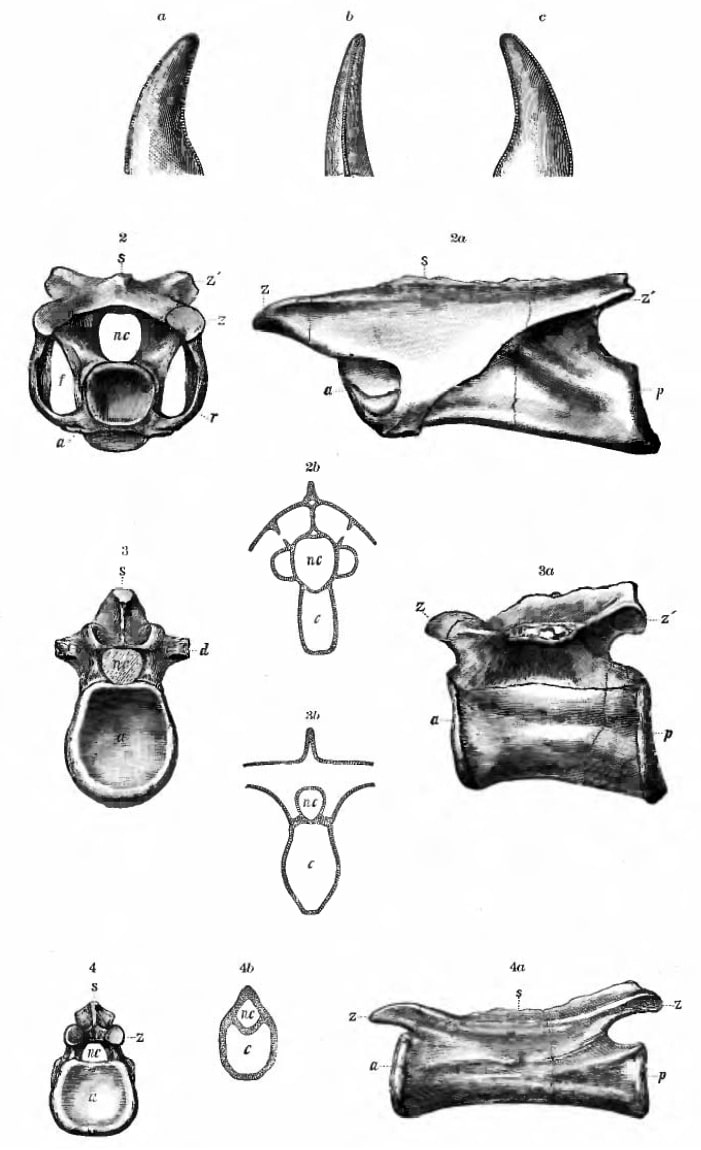

In 1884, Marsh named C. agilis from pubic (hip) bones he judged “at least three times the bulk of the type.” Its type, YPM 2010, is a partial skeleton that Reed collected at Quarry 13 in 1881. Gilmore later questioned the species, and Yale now files YPM 2010 under C. fragilis. Marsh’s later C. gracilis, meanwhile, came from the Early Cretaceous Arundel Clay of Maryland. In 2017, researcher C.D. Brownstein listed it among dubious taxa. Gilmore also listed several Smithsonian vertebrae of C. fragilis, all from Quarry 9 at Como.
Coelurus Size and Description
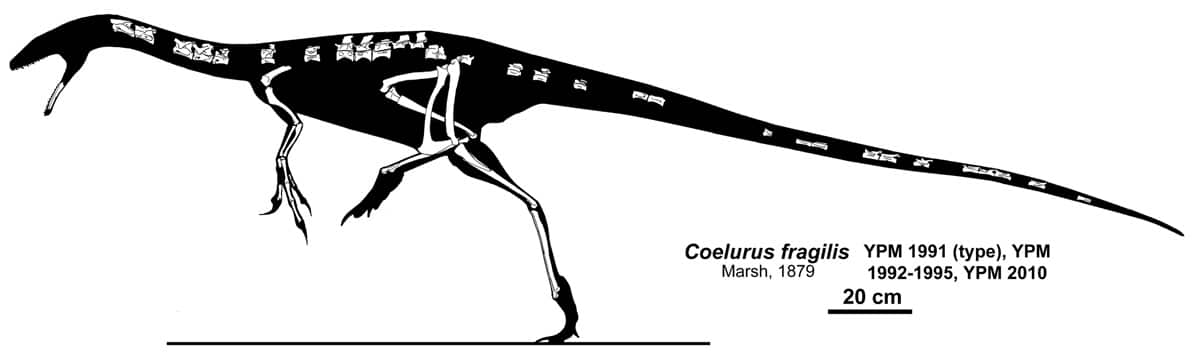
Most of what scientists know about the living animal comes from those hollow vertebrae and the YPM 2010 skeleton.
Short description of Coelurus
Citing a figure in Carpenter and colleagues’ 2005 redescription, paleontologist Scott Hartman’s team calls a referred dentary (lower jaw bone) downturned. Behind the head, Marsh described “a large and powerful neck.” Strong zygapophyses (joints between neighboring vertebrae) locked its long vertebrae together. Their angled joint faces showed that “the neck was curved.” In addition, the front neck ribs had fused to the vertebrae “as in Birds.” Comparatively large pneumatic openings—holes leading into the hollow interior—pierced the neck bones.
The trunk was of moderate size, with shorter back vertebrae and ribs that were themselves hollow. Then came “a very long weak tail” of numerous vertebrae that apparently lacked chevrons (the small bones beneath the tail). Finally, Marsh’s 1884 diagnosis adds very long, slender metatarsals (foot bones). No skin impressions or feathers have turned up.
The limbs overturned one of Marsh’s guesses. Working from vertebrae alone, he predicted in 1881 that the forelimbs “should be as large or larger than those behind.” He even mused that “an arboreal Dinosaur would not surprise anatomists.” Yet in YPM 2010, the humerus (upper arm bone) measures 119 millimeters and the tibia (shinbone) 255 millimeters—more than twice as long. In 2020, paleontologist T.A. Dececchi and colleagues ranked its hind-limb length, relative to thigh-bone thickness, only 65th in their sample.

Size and Weight of Type Species
Marsh’s first verdict was simple—the remains “indicate an animal about as large as a wolf.” None of his three papers gives a length, but London’s Natural History Museum lists about 5.9 feet (1.8 meters). Meanwhile, Blakesley and colleagues referred in 2025 to “the 2 m long Coelurus,” citing the 2005 redescription.
No published hip-height estimate has turned up. However, paleontologist Roger Benson’s 2014 dataset gives the femur (thigh bone) of YPM 2010 as 8.3 inches (210 millimeters) long.
His team estimated about 64 pounds (29.1 kilograms) with a scaling equation from living animals. The equation used the femur’s shaft circumference of 75 millimeters (about 3 inches). The figure therefore applies to YPM 2010. Marsh once thought that skeleton “at least three times the bulk of the type,” though it now sits under C. fragilis.
The Dinosaur in Detail
What sets this dinosaur apart is just how hollow its skeleton was. Marsh found the trunk vertebrae “so much excavated that the walls are reduced to a thin shell.” One lower-back centrum measured 35 millimeters (1.4 inches) long, yet its wall was only 1 millimeter thick at its thinnest. Two years later, Marsh judged these cavities proportionally larger than those of pterodactyls or birds.
Newer studies have scored finer details. In 2025, Kellermann’s team noted a forward-running ridge on a transverse process (a sideways spur of the vertebra) in YPM 1991. Otherwise, the trait is almost exclusive to Carcharodontosauridae, a family of large predatory theropods, plus a few others such as Dubreuillosaurus. While describing Moros, paleontologist Lindsay Zanno and colleagues matched a narrow fourth metatarsal in YPM 2010 with those of Gorgosaurus and Albertosaurus.
Where Coelurus belongs is still open. Paleontologists Darren Naish and Andrea Cau note that Senter and later Brusatte’s team recovered it as an early tyrannosauroid. Zanno’s team, by contrast, did not test the idea, writing that Coelurus was “grafted” there following Brusatte and colleagues. In 2022, Naish and Cau’s own study of Eotyrannus placed Coeluridae (the family named for Coelurus) inside Tyrannosauroidea. There it was the weakly supported sister group of the remaining tyrannosauroids, after a Juratyrant–Stokesosaurus pairing branched off. Brusatte and Carr instead left it out in 2016, writing that this position “has yet to be established convincingly.” In contrast, Delcourt’s team placed it within Ornithomimosauria in 2025—though they “do not expect to definitively settle this issue.” Meanwhile, the title of the 2005 redescription calls it a “small maniraptoran”—part of the group uniting birds and their closest relatives.
Interesting Points about Coelurus
- According to Marsh in 1881, its bones had more extensive hollows than those of any known vertebrate. Even its ribs were hollow.
- For a time, Marsh gave Coelurus an order of its own, Cœluria, calling it “apparently a generalized Sauropsid.”
- Database ranges that stretch Coelurus into the Early Cretaceous rest on Coelurus gracilis, a dubious species from the Arundel Clay of Maryland.
- In 1920, Gilmore doubted that Coelurus and Ornitholestes were separate genera, although later studies, including the 2005 redescription, treat them as distinct.
Contemporary Dinosaurs
Sharing the very locality that yielded Coelurus was Camptosaurus, an ornithopod that Marsh described as “herbivorous in habit.” Carpenter and Galton later called it the Morrison’s best-known neornithischian (the branch of bird-hipped dinosaurs that includes ornithopods) from its bones. Like Coelurus, it dates to the Kimmeridgian–Tithonian, but no fossil records any contact between the two.
A few miles away, at Bone Cabin Quarry near Medicine Bow, lay the remains of Ornitholestes, the “bird robber.” Paleontologist H.F. Osborn named this small theropod in 1903 and called Coelurus its “contemporary.” In 1920, Gilmore judged that it came from “approximately the same geological level as the type of Coelurus fragilis.” Osborn separated the two by teeth, shorter neck vertebrae, and less extreme hollowing, whereas Gilmore found “only minor differences.” No evidence shows whether the two ever interacted.
Coelurus in its Natural Habitat
The world Coelurus inhabited was one of rivers, floodplains, and lakes, whose deposits now crop out from Montana to New Mexico. Climate models cited by Maidment and Muxworthy point to a desert southwest where summer highs may have topped 40 °C (104 °F). Freshwater lakes or wetlands lay to the southeast, while ferns and coals in Montana record “a much wetter, cooler climate.” The Paleobiology Database lists Quarry 13 itself as a crevasse splay—sediment spilled through a break in a channel bank.
Marsh judged Coelurus “probably carnivorous.” However, there is no direct evidence of what it ate, and its first-figured tooth is of uncertain association. In 2023, Lei and colleagues grouped it with small coelurosaurs whose tooth crowns were no larger than 30 millimeters (1.2 inches). Citing that size and limited jaw power, they ruled these animals out as makers of deep tooth marks on Morrison sauropod bones.
The Paleobiology Database also credits Reed with digging at Quarry 13 from 1879 to 1887 and records about 3,000 specimens. Its Quarry 13 list includes the dinosaurs Stegosaurus, Camarasaurus, Allosaurus and Diplodocus, alongside the turtle Glyptops, the crocodyliform Goniopholis, and fishes. These are database records, not checked here against the original descriptions. Elsewhere on Como Bluff, Reed’s Quarry 10 yielded the holotype of Brontosaurus, and Quarry 5 that of Dryosaurus. Still, the behavior of Coelurus, and its role in this ecosystem, remain unknown.
Frequently Asked Questions
The Natural History Museum in London gives “hollow tail,” though Marsh himself never explained the name.
It lived in the Late Jurassic. The Morrison Formation spans roughly 156 to 147 million years ago, and databases place Quarry 13 in the Kimmeridgian–Tithonian.
Secondary sources give a length of about 5.9 to 6.6 feet (1.8 to 2 meters), and a 2014 study estimated about 64 pounds (29.1 kilograms).
Its describer, O.C. Marsh, judged it “probably carnivorous,” and the Natural History Museum lists it as a carnivore.
Its type fossils come from Quarry 13 at Como Bluff, in the Morrison Formation of Albany County, Wyoming. Other vertebrae have been referred from Quarry 9, also at Como.
It was a small coelurosaur theropod, variously placed among early tyrannosauroids, ornithomimosaurs, or maniraptorans.
Sources
The information in this article is based on various sources, drawing on scientific research, fossil evidence, and expert analysis. The aim is to provide a comprehensive and accurate overview of Coelurus. However, please be aware that our understanding of dinosaurs and their world is constantly evolving as new discoveries are made.
- https://doi.org/10.2475/ajs.s3-18.108.501
- https://zenodo.org/records/1450052
- https://zenodo.org/records/1450058
- https://zenodo.org/records/1450066
- https://archive.org/details/osteologyofcarni00gilm
- https://hdl.handle.net/2246/1502
- https://pmc.ncbi.nlm.nih.gov/articles/PMC4011683/
- https://pmc.ncbi.nlm.nih.gov/articles/PMC6626525/
- https://pmc.ncbi.nlm.nih.gov/articles/PMC9271276/
- https://pmc.ncbi.nlm.nih.gov/articles/PMC13549251/
- https://pmc.ncbi.nlm.nih.gov/articles/PMC4735739/
- https://pmc.ncbi.nlm.nih.gov/articles/PMC6385174/
- https://pmc.ncbi.nlm.nih.gov/articles/PMC7220109/
- https://pmc.ncbi.nlm.nih.gov/articles/PMC11731741/
- https://pmc.ncbi.nlm.nih.gov/articles/PMC10655710/
- https://pmc.ncbi.nlm.nih.gov/articles/PMC12441320/
- https://pmc.ncbi.nlm.nih.gov/articles/PMC5345386/
- https://giw.utahgeology.org/index.php/GIW/article/view/30
- https://pmc.ncbi.nlm.nih.gov/articles/PMC4393826/
- https://spiral.imperial.ac.uk/handle/10044/1/73346
- https://www.gbif.org/occurrence/1039417452
- https://www.gbif.org/occurrence/1039389984
- https://paleobiodb.org/classic/basicCollectionSearch?collection_no=39253
- https://www.nhm.ac.uk/discover/dino-directory/coelurus.html
- https://archive.org/details/sim_american-naturalist_1887-04_21_4
- https://www.biodiversitylibrary.org/part/14143
This article was last fact checked: TheDinosaurs Team, 12-11-2026
Featured Image Credit: Conty, CC BY 3.0, via Wikimedia Commons
