
Along the Gold Spring Wash basin in northeastern Arizona, the Silty Facies of the Kayenta Formation holds one of North America’s earliest sauropodomorphs. Named Sarahsaurus aurifontanalis, it belonged to the broad group that includes the giant sauropods. It lived in the Early Jurassic, and recent work puts it near the Pliensbachian–Toarcian boundary, roughly 186 to 181 million years ago. Its describers called it only the third diagnosable sauropodomorph from the Early Jurassic of North America, after Anchisaurus and Seitaad. That made it a key witness to how these dinosaurs reached the continent.
Elizabeth Gordon found the site in 1997, during a University of Texas and Navajo Nation EcoScouts survey. Paleontologist Timothy Rowe and a few graduate students then excavated two skeletons from a single quarry. Rowe, Hans-Dieter Sues, and Robert Reisz named the genus in a 2011 paper, published online in 2010. In 2018, a full redescription revised its family tree and its diagnosis—and reported some proportions that differ from the original. Its story shows how much one quarry can say about a whole continent.
Sarahsaurus Key Facts
| Keyword | Fact |
|---|---|
| Pronunciation | Not specified |
| Meaning of name | Sarah’s Lizard from Gold Spring |
| Group | Sauropodomorpha (probably Massospondylidae) |
| Type Species | Sarahsaurus aurifontanalis |
| Diet | Herbivore, per the describers’ 2010 press release (not addressed in peer-reviewed papers) |
| When it Lived | About 186 to 181 MYA (preliminary maximum age from detrital zircons) |
| Period | Jurassic |
| Epoch | Early Jurassic (Pliensbachian to Toarcian stages) |
| Length | About 14 feet (4.3 meters), per the describers’ 2010 press releases (not peer-reviewed). Full vertebral column estimated at over 10.2 feet (3.1 meters) |
| Height | Not specified |
| Weight | About 220 to 375 pounds (100 to 170 kilograms) in published estimates. The 2010 press releases gave about 250 pounds (113 kilograms) |
| Mobility | Moved on two legs (bipedal) |
| First Discovery | 1997 by Elizabeth Gordon, during a 1997 to 2000 University of Texas and Navajo Nation EcoScouts survey (provisionally referred Rock Head skull found 1978 by Timothy B. Rowe) |
| Described by | 2011 (published online in 2010) by T.B. Rowe, H.-D. Sues, and R.R. Reisz |
| Holotype | TMM 43646-2 |
| Location of first find | Gold Spring, Silty Facies of the Kayenta Formation, Coconino County, Navajo Nation, Arizona, USA |
Sarahsaurus Origins, Taxonomy and Timeline
The name Sarahsaurus honors Sarah Butler—”Sarah (Mrs Ernest) Butler” in the original paper—plus the Greek “sauros” (“lizard”). In 2018, paleontologist Adam Marsh and Rowe added Ernest Butler to the dedication. A 2010 press release says Rowe had promised the Austin philanthropist a dinosaur if she raised a million dollars for the “Dino Pit.” The species name joins the Latin “aurum” (“gold”) and “fontanalis” (“of the spring”), after Gold Spring, Arizona. Together, the name ties a Texas benefactor to an Arizona spring.
Within Sauropodomorpha, Rowe and colleagues got conflicting results from two data matrices. One made it the most basal North American sauropodomorph, a result they judged “probably incorrect.” The other, once incomplete taxa were pruned, put it at the base of Sauropoda. However, in 2018, Marsh and Rowe judged it “most likely a member of Massospondylidae,” a largely Gondwanan clade (a group sharing one common ancestor) of bipedal sauropodomorphs. Its closest relatives in two of their three analyses were Adeopapposaurus and Leyesaurus, with weak support. In 2019, Kimberley Chapelle and colleagues also placed it there. Then, in 2026, Moopen and colleagues found the South African Nyana to be its closest relative in some analyses. The pair fell inside Massospondylidae or just outside it. Sarahsaurus aurifontanalis is the type and only known species.
Rowe and colleagues placed the fossils in the Sinemurian to Pliensbachian—199.5 to 184.2 million years ago on the standard timescale. Marsh and Rowe later narrowed that to the late Pliensbachian, citing unpublished zircon dates. A preliminary date of 183.7 ± 2.7 million years appears only in a 2014 meeting abstract. From grains washed into the sediment, it marks only the oldest age the rock could be—about 186 million years. A 2020 study read it as Pliensbachian, while a 2021 study opted for Pliensbachian to Toarcian.
Discovery & Fossil Evidence
The type locality, TMM 43646, lies at Gold Spring in Coconino County, in the middle third of the Kayenta’s Silty Facies. Paleontologists know it as both the “Type Sarahsaurus Quarry” and the “Dilophosaurus Quarry”—a hint that a Dilophosaurus lay buried there too. Preparation was a slog, since a crust nicknamed “hematite” encased many bones and was harder than bone itself.
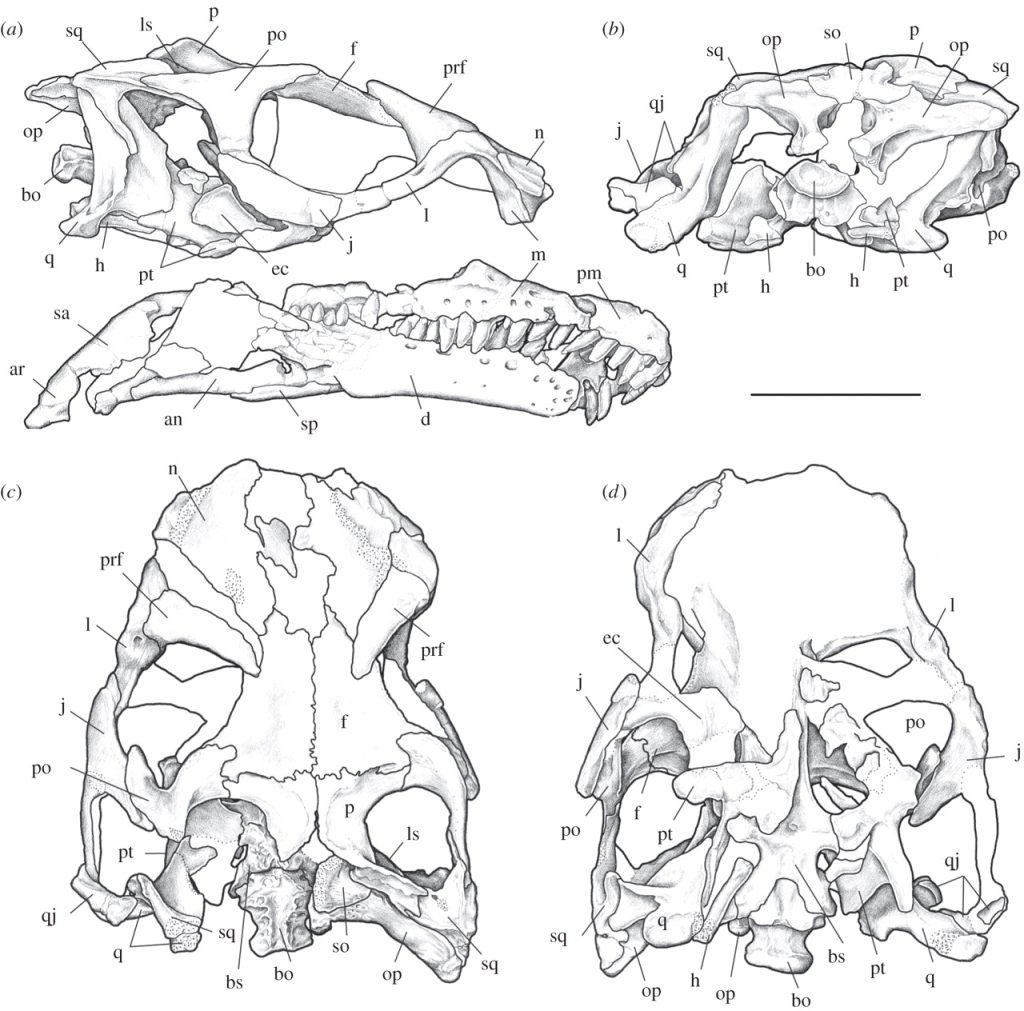
The holotype (the name-bearing specimen), TMM 43646-2, includes a partial skull and a nearly complete, largely articulated skeleton. Its skull portion preserves the premaxilla (front upper jaw bone), a frontal (skull-roof bone), a quadrate (jaw-hinge bone), and the braincase. It is held at The University of Texas at Austin, and CT scans (X-ray slices) of its braincase are on digimorph.org. A second, less mature skeleton from the same quarry, TMM 43646-3, later became the paratype.
A third specimen had come to light much earlier. In 1978, Rowe himself discovered MCZ 8893 at Rock Head, a crushed but nearly complete skull and lower jaw. It was first identified as a species of Massospondylus, but its provisional move to Sarahsaurus in 2011 confined that genus to southern Africa. Rock Head lies 8.5 kilometers (5.3 miles) south of the type locality and also lower in the section. Marsh and Rowe found no unique traits linking the skull to the holotype, yet no conflicts beyond maturity. They judged the case “equally balanced.”

Sarahsaurus Size and Description
Sarahsaurus combined a two-legged frame with a hand armed with one oversized claw.
Short description of Sarahsaurus
The referred skull carries four teeth in the premaxilla, 16 in the maxilla (upper jaw), and 20 in the dentary (lower jaw). Their crowns are flattened side to side, not recurved, and coarsely serrated with up to 20 denticles (tiny serrations). The original authors called the dentition “moderately heterodont,” meaning tooth shape varied along the jaw. Behind the head came 10 neck, 14 back, and 3 hip vertebrae, followed by about 50 in the tail. Its back vertebrae lack deep hollows for presumed air sacs.
Marsh and Rowe measured the humerus (upper arm bone) at 61 percent of the length of the femur (thigh bone). The original authors noted that its crest for the chest muscles runs half the length of the bone. The first finger ends in a large, trenchant (blade-like) claw. Marsh and Rowe reconstruct the animal with the bipedal body plan of other massospondylids. Its skin and coloration are unknown, so its outward appearance is speculative.

Size and Weight of Type Species
No peer-reviewed study gives a body length for Sarahsaurus. However, the describers’ 2010 press releases gave about 14 feet (4.3 meters) and 250 pounds (113 kilograms), without a published method. Marsh and Rowe estimate that the full vertebral column, including tail bones the holotype lacks, exceeded 10.2 feet (3.1 meters). Because that total leaves out the skull, the whole animal was longer still.
Paleontologist Thomas Holtz Jr.’s popular genus list gives about 13.1 feet (4 meters) and roughly the weight of a lion. However, that list is a book supplement with no method.
In 2014, paleontologist Roger Benson and colleagues estimated a mass of about 220 pounds (100 kilograms). Their figure is indirect—they took limb lengths from published figures and estimated the bone circumferences. Because those measurements are smaller than Marsh and Rowe’s direct ones, the estimate is uncertain. By contrast, Moopen and colleagues cite a 2018 estimate of about 375 pounds (170 kilograms) by McPhee and colleagues.
The Dinosaur in Detail
What sets this dinosaur apart begins at the hips. Its pubis, a forward-pointing hip bone, carries both an obturator foramen and a pubic foramen—a pairing of openings the describers called unique among sauropodomorphs. Their list also included “spine tables” (broadened tops on the vertebral spines), a low wall at the base of the braincase, and a hand formula of 2-3-4-2-2 bones per finger.
Marsh and Rowe later revised that list, dropping the braincase wall as “more widely distributed.” Meanwhile, the finger formula “also seems unique,” but their analyses did not bear it out. Their revised autapomorphies (traits unique to one species) start with two openings in the upper pubis. Broad spine tables on the rear neck and front back vertebrae follow, along with a first metacarpal (hand bone) set flush with the others.
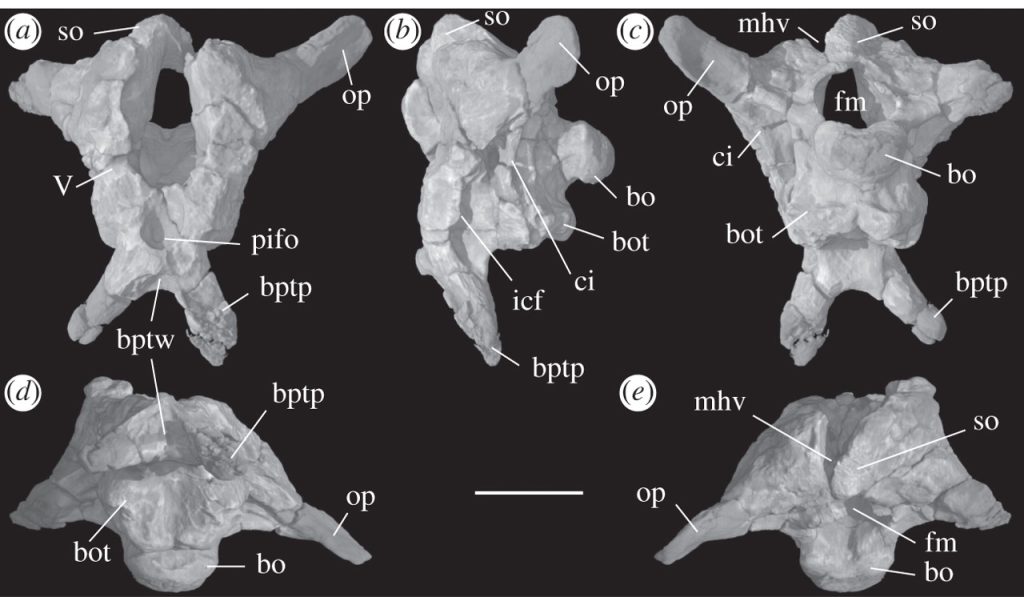

Some proportions remain unsettled. The original paper gives the tibia (shin bone) as about 84 percent of the femur’s length. Yet Marsh and Rowe give the left paratype tibia as 61 percent—a discrepancy that neither paper explains. Inside the skull, the basilar papilla—the hearing organ of the inner ear—is small and subconical. It resembles those of Massospondylus and Saturnalia rather than the longer one of sauropods. Oddly, a stray recurved quarry tooth, probably from the holotype, recalls early saurischians such as Eoraptor.
The holotype also records a hard life. Two back vertebrae are joined by a spondylarthropy (an overgrowth of rough bone)—apparently the result of an injury the animal survived. Tail vertebrae 4 and 5 are likewise fused by overgrown bone. Its anatomy points to an animal with sauropod-like touches, built on the two-legged plan of its massospondylid kin.
Interesting Points about Sarahsaurus
- The species name aurifontanalis honors Gold Spring in Arizona, although even the 2018 redescription misspells it “aurifontalis” twice.
- The first-finger claw measures 75.46 millimeters, about 1.45 times the length of the first metacarpal by Marsh and Rowe’s measurements.
- Its clavicles (collarbones) never fused, but the original authors suggested that a ligament along the midline held them close together.
- Marsh and Rowe wrote that, given its completeness, Sarahsaurus “represents the most significant increase in our knowledge of the earliest North American sauropodomorphs in a century.”
Contemporary Dinosaurs
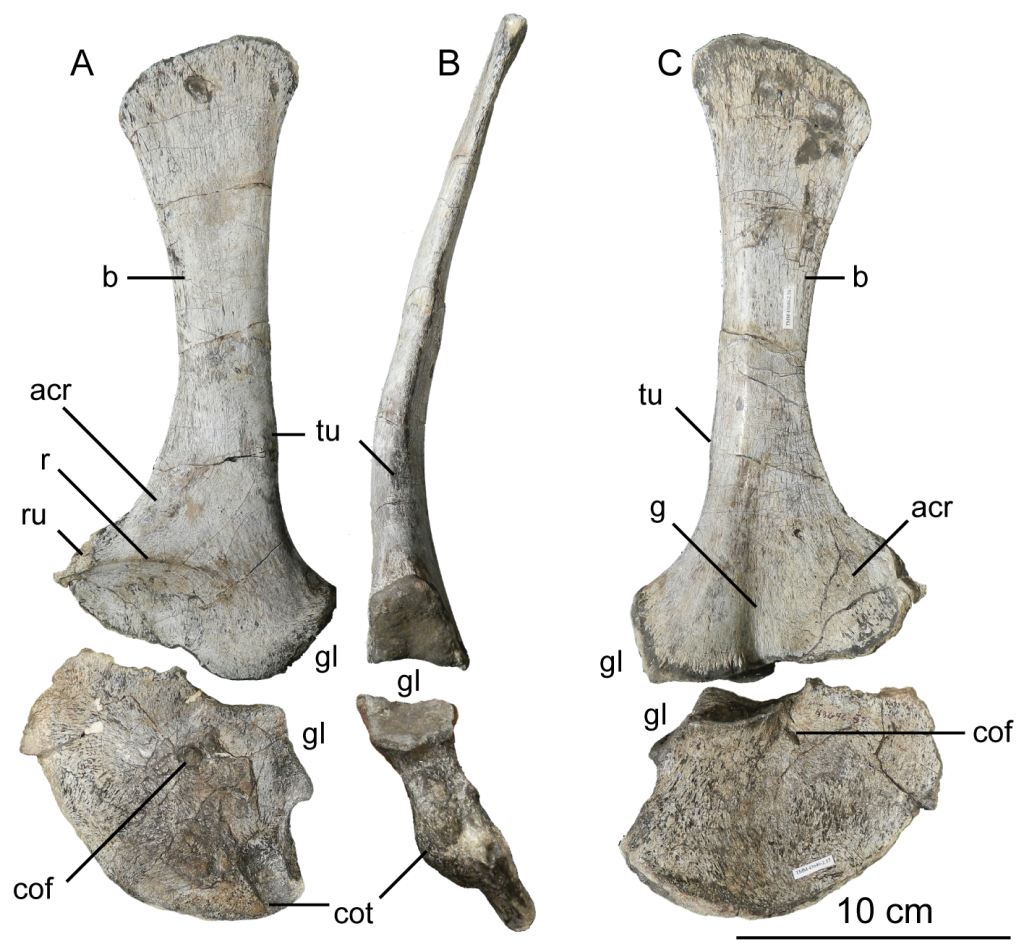
Sharing the same quarry was Dilophosaurus, a large crested theropod known here from an immature partial skeleton. Its bones lay mostly above the Sarahsaurus holotype, which in turn lay above the paratype. Many quarry bones carry bite marks, and 10 to 12 Sarahsaurus tail vertebrae were apparently lost to scavenging around death. An oval pit on the left scapula (shoulder blade) may be a theropod tooth mark. However, no study shows whether Dilophosaurus killed Sarahsaurus or only scavenged it. In 2020, Marsh and Rowe cited the bite-marked bones and shed teeth here as support for Dilophosaurus handling large prey “during predation or scavenging.”
Also known from the Kayenta Formation (exact level relative to Sarahsaurus not known): Scutellosaurus and “Syntarsus” (Megapnosaurus) kayentakatae. The first was a small early armored ornithischian, and the second a small coelophysoid theropod whose genus name is still disputed. Most Scutellosaurus specimens come from a band 20 to 30 meters (66 to 98 feet) above the formation’s base. That band includes the Sarahsaurus type locality, but no specimen has been placed in the same bed. The Silty Facies has been dated broadly to the Hettangian through Toarcian, a window of up to about 27 million years. These animals may therefore not all have lived at the same time.
Sarahsaurus in its Natural Habitat
The world Sarahsaurus roamed was a river corridor inside a desert of dunes. The Kayenta belongs to the Glen Canyon Group, land-laid sediments in a back-arc basin (a basin behind a chain of volcanoes). Across the region spread an immense, long-lived erg—a sea of sand dunes—under an arid climate broken by wet spells. Within it, the Silty Facies records a localized river interlude, with fairly straight, many-channeled rivers and frequent flash floods. Nearby lakes and marshes left blue mudstones rich in vertebrate fossils, along with ostracods (tiny shelled crustaceans) and carbonized horsetail relatives.
No peer-reviewed study states what Sarahsaurus ate, but its serrated, compressed teeth match those of other basal sauropodomorphs. While there is no direct evidence of whether it lived alone or in groups, its bite-marked bones suggest that its carcasses fed meat-eaters.
Besides named dinosaurs, the Kayenta has produced a disputed “Scelidosaurus” sp. and an undescribed “heterodontosaurid,” both ornithischians. Rowe and colleagues concluded that sauropodomorphs reached North America in at least three separate dispersals. Tritylodontid cynodonts (mammal relatives) and a goniopholidid crocodile relative lived there too—to the original authors, part of the same “pattern of apparent immigration.”
Frequently Asked Questions
It means “Sarah’s lizard,” honoring Sarah Butler, while aurifontanalis refers to Gold Spring, Arizona.
It lived in the Early Jurassic. First dated to the Sinemurian to Pliensbachian, it is now placed near the Pliensbachian–Toarcian boundary, roughly 186 to 181 million years ago.
No peer-reviewed length exists, but the describers’ press release gave about 14 feet. Published weight estimates range from about 220 to 375 pounds.
It was an early sauropodomorph, probably a massospondylid or a close relative of that largely Gondwanan group of two-legged sauropodomorphs.
No peer-reviewed study states its diet, but the describers’ press release called it a plant-eater, and its teeth resemble those of other basal sauropodomorphs.
It was found at Gold Spring in the Kayenta Formation, on the Navajo Nation in northeastern Arizona.
Sources
The information in this article is based on various sources, drawing on scientific research, fossil evidence, and expert analysis. The aim is to provide a comprehensive and accurate overview of Sarahsaurus. However, please be aware that our understanding of dinosaurs and their world is constantly evolving as new discoveries are made.
- https://doi.org/10.1098/rspb.2010.1867
- https://doi.org/10.1371/journal.pone.0204007
- https://doi.org/10.1017/jpa.2020.14
- https://doi.org/10.1098/rsos.201676
- https://doi.org/10.7717/peerj.7240
- https://doi.org/10.1371/journal.pbio.1001853
- https://paleobiodb.org/data1.2/taxa/single.json?name=Sarahsaurus&show=full
- https://paleobiodb.org/data1.2/intervals/list.txt?scale_id=1&min_ma=170&max_ma=205
- https://digimorph.ctlab.geo.utexas.edu/specimens/Sarahsaurus_aurifontanalis
- https://news.utexas.edu/2010/10/05/new-fossil-suggests-dinosaurs-not-so-fierce-after-all/
- https://www.eurekalert.org/news-releases/551849
- https://doi.org/10.1098/rsos.261002
This article was last fact checked: TheDinosaurs Team, 18-11-2026
Featured Image Credit: T.B. Rowe, H.-D. Sues, R.R. Reisz, CC BY 3.0, via Wikimedia Commons
