
In northwestern Río Negro Province, Argentina, the river sandstones of the Huincul Formation hold an unusually rich gathering of predators. Among them is Taurovenator violantei, a carcharodontosaurid—one of the family of large meat-eating theropods that includes Giganotosaurus. Its describers placed it in the middle Cenomanian to early Turonian stages of the Late Cretaceous. Remarkably, it was named from one bone—a brow bone whose horn-like projection, they argued, sits where no other member of its family has one.
That bone turned up at the Violante farm, a site with at least six theropod species. In 2016, paleontologist Matías J. Motta and six colleagues described it as a new genus and species, and debate soon followed. In 2019, paleontologist Rodolfo A. Coria and colleagues proposed that it is the same animal as Mapusaurus. Five years later, however, members of the original team referred a new partial skeleton to it. In short, its story shows how much weight one fossil can carry.
Taurovenator Key Facts
| Keyword | Fact |
|---|---|
| Pronunciation | Not specified |
| Meaning of name | Bull Hunter |
| Group | Theropoda (Carcharodontosauridae) |
| Type Species | Taurovenator violantei |
| Diet | Carnivore |
| When it Lived | About 97–92 MYA (middle Cenomanian–early Turonian). A 2024 blog post gives about 90 MYA, and a 2026 study about 106 MYA (Albian) |
| Period | Cretaceous |
| Epoch | Late Cretaceous (middle Cenomanian to early Turonian stages). A 2026 study argues for the Early Cretaceous (Albian stage) |
| Length | About 36 feet (11 meters), per a 2024 blog post. Not specified in the 2016 description (“mid-sized”) |
| Height | Not specified |
| Weight | Close to 5 tons (about 11,000 pounds if metric tons), per a 2024 blog post. Not specified in 2016 |
| Mobility | Not specified |
| First Discovery | 2013 at the Violante farm (year given in a 2024 blog post) |
| Described by | 2016 by M.J. Motta, A.M. Aranciaga Rolando, S. Rozadilla, F.E. Agnolín, N.R. Chimento, F. Brissón Egli, and F.E. Novas |
| Holotype | MPCA PV 802, an isolated right postorbital |
| Location of first find | Violante farm, Huincul Formation (Neuquén Group), northwestern Río Negro Province, Patagonia, Argentina |
Taurovenator Origins, Taxonomy and Timeline
The name Taurovenator joins two Latin words, “tauro” (bull) and “venator” (hunter). Its species name, violantei, honors Enzo Violante, owner of the farm that yielded the specimen.
In 2016, Motta and colleagues placed Taurovenator in Carcharodontosauridae, a family within the allosauroid branch of tetanuran theropods. They found that it closely resembles the derived members Carcharodontosaurus, Giganotosaurus, and Mapusaurus—but not Acrocanthosaurus or Eocarcharia. Later, the 2024 study went further and called it a giganotosaurine, part of the subgroup named after Giganotosaurus.
According to its describers, the Huincul Formation dates to the middle Cenomanian to early Turonian, roughly 97 to 92 million years ago. The 2016 paper gives no figure in millions of years. A 2024 blog post by paleontologist Alexis Aranciaga Rolando, however, puts the animal at around 90 million years ago, just younger than that range. In 2026, Ignacio J. Maniel and colleagues dated a thin tuff (volcanic ash) near the base of the formation, close to Villa El Chocón, to about 106 million years. That bed does not directly date the Violante farm. Still, they argue for an Albian, Early Cretaceous age, pushing two of the basin’s six major tetrapod faunas back by roughly 10 to 15 million years. Meanwhile, a 2022 study notes that carcharodontosaurids vanished after the Turonian, as abelisaurids and megaraptorids became Gondwana’s dominant carnivores—though exactly when is hard to pin down.
Discovery & Fossil Evidence
The holotype came from the Violante farm, southeast of the Ezequiel Ramos-Mexía lake in northwestern Río Negro Province. According to Aranciaga Rolando’s blog post, that first bone came to light in 2013. The farm proved unusually rich—the 2016 paper also reported abelisauroids, a coelurosaur, a megaraptoran, a possible unenlagiid, and a second, much larger carcharodontosaurid.
Numbered MPCA PV 802, the holotype is a single right postorbital—the bone that frames the back and top of the eye socket. The Museo Provincial “Carlos Ameghino” in Río Negro holds it in its vertebrate collection. That larger carcharodontosaurid carries the next number, MPCA-Pv 803.
That second specimen includes a dorsal centrum (back vertebra body), a rib fragment, and a partial right foot. Its right metatarsal II (a foot bone) measures 43.5 centimeters (17 inches), even with part of its lower end missing. Indeed, the foot as a whole rivals that of Mapusaurus roseae in size. Even so, its describers wrote that a referral to Mapusaurus “cannot be sustained, although it cannot be dismissed as well.”
The record grew in 2024, when Aranciaga Rolando and colleagues referred a partial skeleton to the species. His blog post places it in the Pueblo Blanco Natural Reserve, about 25 kilometers (16 miles) south of El Chocón. Expeditions in 2018 and 2019 recovered the back of the skull, several vertebrae, nearly complete arms, leg bones, and rib parts. However, the 2024 paper’s reconstruction figure labels its only postorbital as the holotype. The new skeleton therefore appears to overlap little with the type bone.
Taurovenator Size and Description
Because the holotype is a single bone, the 2024 skeleton reveals most of what is known about the body.
Short description of Taurovenator
The postorbital is heavily built and T-shaped in side view, and it seems more robust than in Eocarcharia or Mapusaurus. On the brow’s upper back corner sits a prominent, rounded boss—the horn-like prominence behind the genus’s first diagnostic trait. Toward its upper margin, the brow becomes conspicuously rugose (rough-textured), as in Giganotosaurus and Carcharodontosaurus. Meanwhile, branching vascular grooves on the bone’s lower arm suggest a rich blood supply.
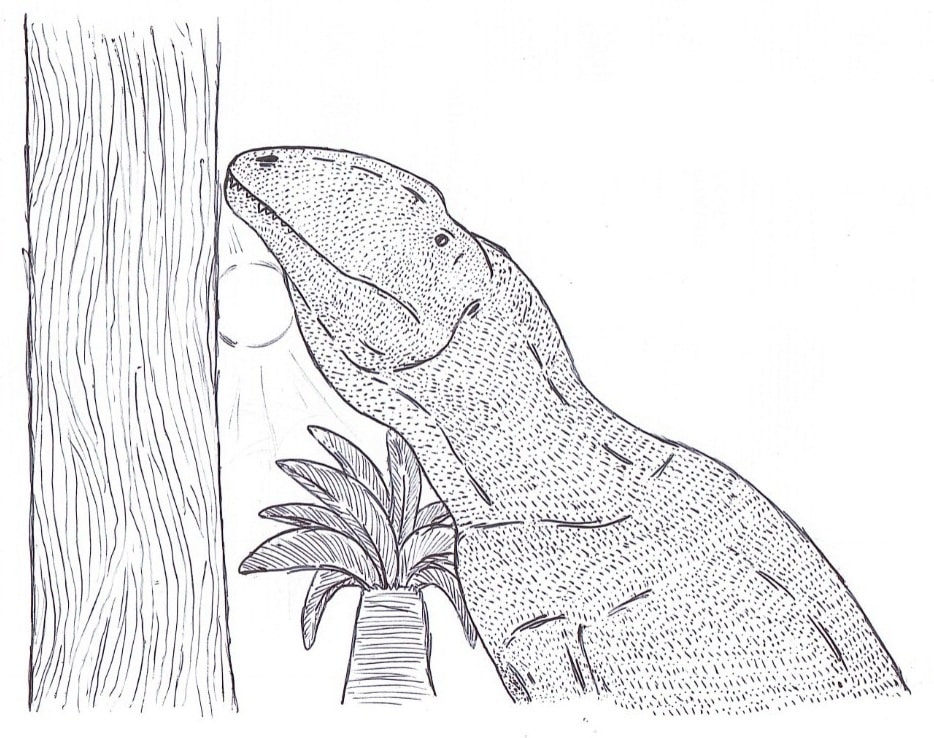

Behind the head, the 2024 skeleton preserves very tall front neck vertebrae. Their neural spines (upward bony projections) end in flange-like tips that overlap one after another—a pattern also known in Acrocanthosaurus. As in other giganotosaurines, the forelimbs were strongly reduced, yet the hand bore elongated finger bones and well-marked muscle attachments.
Size and Weight of Type Species
In 2016, Motta and colleagues gave no length or weight for Taurovenator and simply called it mid-sized. Its postorbital is notably smaller than those of Mapusaurus and Giganotosaurus, though proportionally more robust and thicker from side to side.
Larger figures, however, come from a 2024 “Behind the Paper” blog post. In it, Aranciaga Rolando estimated a length of about 36 feet (11 meters) from the new remains. He added a weight close to 5 tons (about 11,000 pounds if metric), without explaining how either figure was reached. Coauthor Federico Agnolín mentions a skull 4.3 feet (1.3 meters) long, again without saying whether it was measured or estimated.
These two pictures do not sit easily together. The 2016 paper describes a medium-sized animal, whereas the 2024 blog post ranks it among giant Argentine carnivores like Giganotosaurus and Tyrannotitan. For now, both are best read as provisional.
The Dinosaur in Detail
According to Motta and colleagues, what sets this dinosaur apart is a horn-like projection at the back outer edge of its orbital boss, a spot where no other carcharodontosaurid has one. The boss recalls that of Eocarcharia but is more prominent, more rounded, smaller, and relatively narrower. The second diagnostic trait is a deep excavation in the underside of the postorbital, unreported in other carcharodontosaurids. Its describers added that this area is broken in the Mapusaurus material they compared. Coria and colleagues, however, later reported both diagnostic traits in another Mapusaurus specimen.
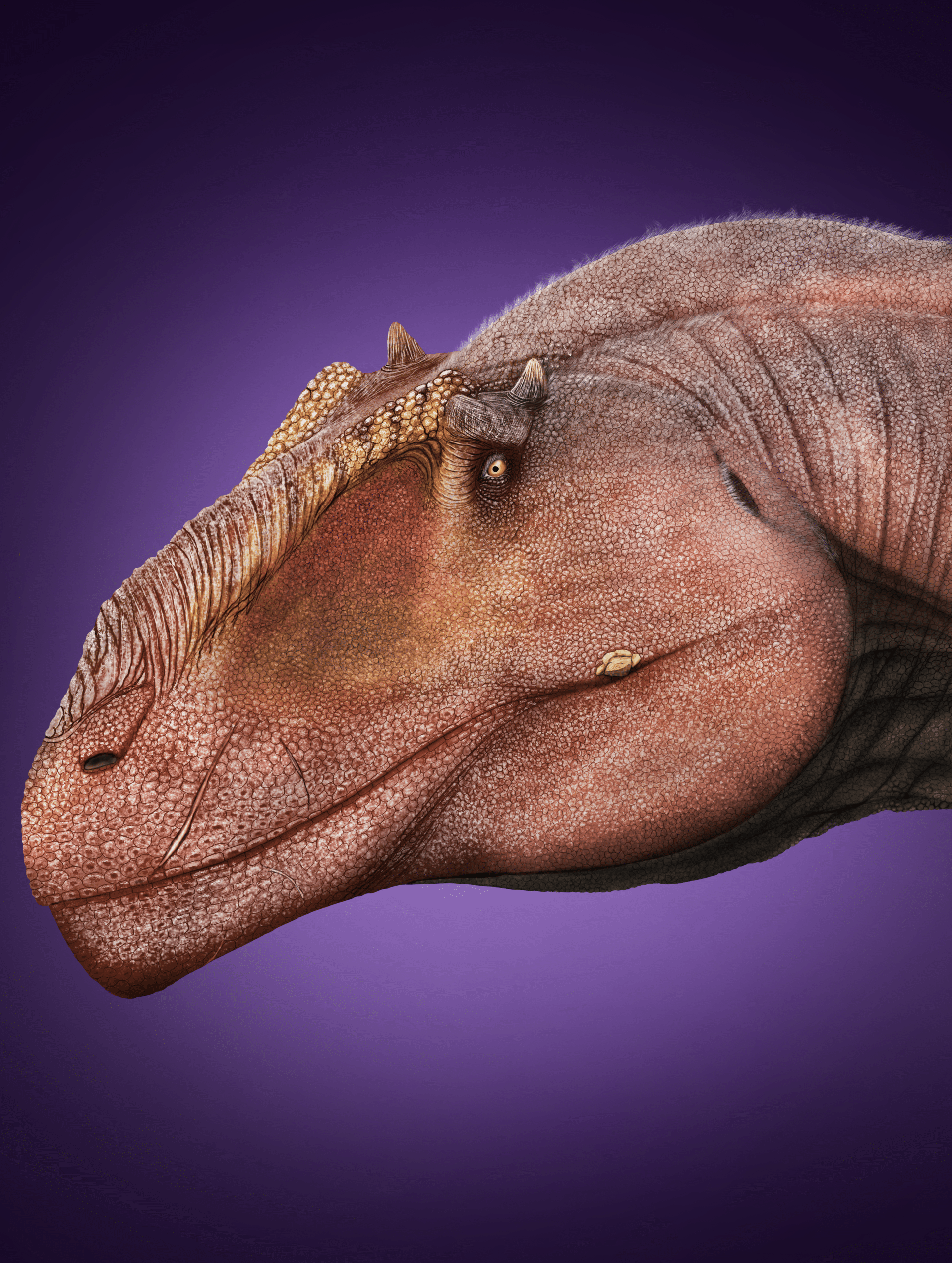

Other features mostly tie it to the derived members of its family. Its ventral ramus (lower arm of the bone) is short and wide and meets the brow at an acute angle. Meanwhile, the brow wall projects down over the eye socket, as in Mapusaurus and Acrocanthosaurus. A tall joint for the lacrimal, the bone in front of the eye, keeps the frontal (skull roof) out of the socket’s rim. At the back of the underside sits a deep pit—in the authors’ view, a pneumatopore (an entry point for air sacs).
The describers noted that paleontologists traditionally link postorbital ornaments in large theropods to competition for mates. However, there is no direct evidence of how Taurovenator used its own horn. The 2024 team wrote that the neck’s build probably limited movement within it, but not of the head. In contrast, they saw the hand as pointing to highly movable digits.
The Synonymy Debate
Coria and colleagues raised their challenge in 2019, in a paper on a different carcharodontosaurid, Lajasvenator. They argued that both diagnostic traits also occur in Mapusaurus, and in weaker form in Giganotosaurus. They added that the holotype shows the curved palpebral (a bone above the eye) margin diagnostic of Mapusaurus and comes from the same rock level. On that basis, they judged Taurovenator a junior synonym—a later name for the same animal. The 2016 describers, by contrast, had seen no sign of the fused palpebral ossification that Coria and Currie described in Mapusaurus. In 2024, members of the original team still treated the genus as valid.
In 2025, paleontologists Maximilian Kellermann, Elena Cuesta, and Oliver Rauhut found that their analyses did not support the synonymy. Even so, making the two sister taxa took only one extra step, so they did not exclude it. Coded from the postorbital alone, Taurovenator usually fell within Carcharodontosauria or Carcharodontosauridae. Equal-weight runs also allowed a position beside the abelisaurid Carnotaurus. With weighted characters, however, that result vanished, and Taurovenator often grouped with Carcharodontosaurus saharicus, inside the family. Taken together, most results place the brow bone among carcharodontosaurids—but whether it marks a separate genus remains open.
Interesting Points about Taurovenator
- From 2016 until 2024, a single isolated postorbital was all paleontologists had of Taurovenator.
- Its describers called the Violante farm probably the taxonomically richest theropod association in Patagonia.
- Two figure captions in the 2016 paper misspell the species name as “violentei,” while the text gives it as violantei.
- In a 2025 analysis, Taurovenator ranked among the most incomplete taxa, with 97.8 percent of its data missing.
Contemporary Dinosaurs
Sharing the very same farm was Aoniraptor libertatem—a megaraptoran theropod named in the same 2016 paper. Its describers estimated a length of about 20 feet (6 meters) from a skeletally immature individual. No interaction between the two is recorded.
Among the plant-eaters was Chakisaurus, an elasmarian ornithopod named in 2024 as the first ornithischian species from the Huincul Formation. It also comes from the Pueblo Blanco Natural Reserve—the reserve that yielded the referred Taurovenator skeleton, according to the 2024 blog post.
Known from the same stratigraphic unit was Mapusaurus roseae, a large carcharodontosaurid named in 2006. Whether it counts as a neighbor, though, depends on the synonymy debate. If Coria and colleagues are right, the two names describe one animal. If not, Mapusaurus was a second carcharodontosaurid in the same formation.
Rounding out the list is Meraxes, another carcharodontosaurid named in 2022. In 2025, Kellermann and colleagues listed Meraxes, Mapusaurus, and potentially Taurovenator as Huincul carcharodontosaurids, if the last proves distinct from both. In the blog post, Motta also linked the short arms of Taurovenator to similar findings in Meraxes—a possible evolutionary trend.
Taurovenator in its Natural Habitat
Rivers shaped the world Taurovenator roamed. At the Violante farm, a highly sinuous river system gradually became less winding over time. The formation itself consists of yellowish and greenish sandstones that are sometimes tuffaceous (rich in volcanic ash). The climate was warm and strongly seasonal, with cycads, conifers, and some early flowering plants recorded in the formation.
As a carcharodontosaurid, Taurovenator belonged to a family that the 2024 study calls the top predators of Gondwanan dinosaur faunas. While there is no direct evidence of what it hunted, the formation also holds turtles, crocodiles, fish, and the lungfish Ameghinoceratodus iheringi. At the Violante farm itself, very large and medium-sized carcharodontosaurids coexisted, in the describers’ view.
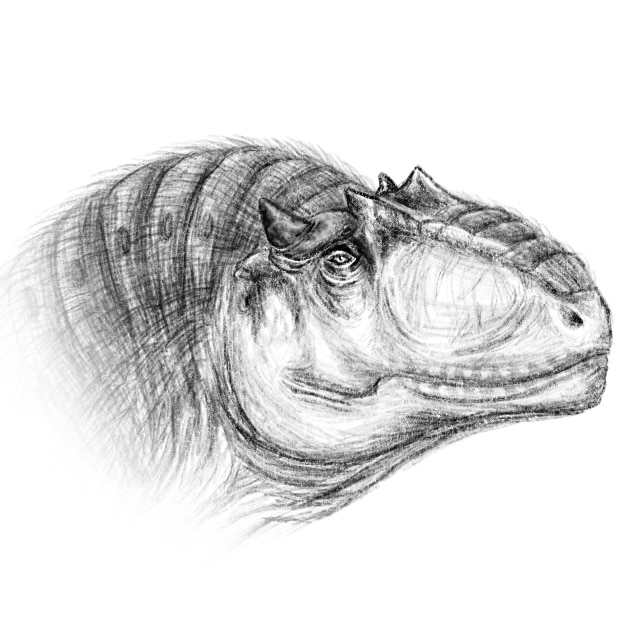

How Taurovenator behaved remains largely unknown. Aranciaga Rolando’s blog post says extra connection points between its vertebrae made the neck much stiffer. Agnolín added that this may have helped support the weight of its massive skull during movement or hunting.
Frequently Asked Questions
It means “bull hunter,” from the Latin “tauro” and “venator,” and the species name honors farm owner Enzo Violante.
Its describers placed it in the middle Cenomanian to early Turonian of the Late Cretaceous, roughly 97 to 92 million years ago. A 2024 blog post says about 90 million, and a 2026 study argues for an older, Albian age of about 106 million.
Its 2016 describers called it mid-sized, while a 2024 blog post suggests about 36 feet long and close to 5 tons.
It was a carnivore, a member of a family described as the top predators of Gondwanan dinosaur faunas.
Its holotype came from the Violante farm in the Huincul Formation of northwestern Río Negro Province, Argentina.
A 2019 study treats it as a synonym of Mapusaurus, and a 2024 study keeps it separate. A 2025 analysis found no support for merging them but did not rule it out.
Sources
The information in this article is based on various sources, drawing on scientific research, fossil evidence, and expert analysis. The aim is to provide a comprehensive and accurate overview of Taurovenator. However, please be aware that our understanding of dinosaurs and their world is constantly evolving as new discoveries are made.
- http://hdl.handle.net/11336/49904
- https://ri.conicet.gov.ar/server/api/core/bitstreams/a52a3555-a63f-46a0-b715-5e4ab5dd26a7/content
- https://doi.org/10.1007/s00114-024-01942-4
- https://doi.org/10.1016/j.cretres.2019.104319
- http://hdl.handle.net/11336/122794
- https://doi.org/10.1371/journal.pone.0311096
- https://doi.org/10.5710/PEAPA.22.04.2022.419
- https://doi.org/10.1016/j.gr.2026.06.020
- https://doi.org/10.1016/j.cretres.2024.105874
- https://doi.org/10.1111/joa.13225
- https://communities.springernature.com/posts/giant-carnivorous-dinosaur-fossils-unearthed-in-northwestern-rio-negro
This article was last fact checked: TheDinosaurs Team, 06-11-2026
Featured Image Credit: César Díaz Frías, CC BY-SA 4.0, via Wikimedia Commons
