
In Las Campanas Canyon, in Argentina’s Neuquén Province, the river-laid rocks of the Huincul Formation held a predator of startling completeness. Named Meraxes gigas in 2022, it is the most complete carcharodontosaurid—a kind of giant meat-eating theropod—yet found in the Southern Hemisphere. Its describers placed it in the late Cenomanian to Turonian stages of the Late Cretaceous. However, a 2026 dating study argues that the formation’s base is older, at roughly 106 million years. Either way, this heavyweight carried arms only about half as long as its thigh bone.
The bones first came to light in 2012, and the team then excavated them over four field seasons through 2014. In 2022, paleontologist Juan Canale and nine colleagues described the skeleton in the journal Current Biology. Their study argued that three separate lineages of giant predators shrank their arms in parallel. As a result, the short-armed look of Tyrannosaurus was far from unique.
Meraxes Key Facts
| Keyword | Fact |
|---|---|
| Pronunciation | Not specified |
| Meaning of name | Giant Meraxes (After a Dragon in A Song of Ice and Fire) |
| Group | Theropoda (Carcharodontosauridae) |
| Type Species | Meraxes gigas |
| Diet | Carnivore |
| When it Lived | Around 95 to 90 MYA per a 2022 press release (the description gives no figure), or around 106 MYA per a 2026 dating study (debated) |
| Period | Cretaceous |
| Epoch | Late Cretaceous (late Cenomanian to Turonian stages) per the 2022 description, or Early Cretaceous (Albian stage) per a 2026 study (debated) |
| Length | Not specified in the description (a 2022 press release gave about 36 feet) |
| Height | Not specified |
| Weight | About 9,400 pounds (4,263 kilograms), 2022 estimate from thigh-bone circumference |
| Mobility | Moved on two legs (bipedal) |
| First Discovery | 2012 by the field team co-led by Peter J. Makovicky, Juan I. Canale, and Sebastián Apesteguía |
| Described by | 2022 by J.I. Canale, S. Apesteguía, P.A. Gallina, J. Mitchell, N.D. Smith, T.M. Cullen, A. Shinya, A. Haluza, F.A. Gianechini, and P.J. Makovicky |
| Holotype | MMCh-PV 65 |
| Location of first find | Las Campanas Canyon, Huincul Formation (Neuquén Group), near Villa El Chocón, Neuquén Province, Argentina |
Meraxes Origins, Taxonomy and Timeline
The genus name Meraxes comes from a dragon in George R. R. Martin’s fantasy series A Song of Ice and Fire. Meanwhile, the species name gigas is Greek for “giant,” a nod to the animal’s enormous size. Together, the name pairs a fictional dragon with a plain statement of scale.
In terms of classification, Meraxes is a theropod within Allosauroidea and the family Carcharodontosauridae. More narrowly, it belongs to Giganotosaurini, a “mid” Cretaceous clade of South American carcharodontosaurids that weighed over 4 metric tons. The 2022 analysis recovered Meraxes as the earliest-diverging member of that clade. Meraxes gigas is also the type and only known species.
Its age, however, remains under debate. Canale and colleagues placed it in the late Cenomanian to Turonian. Their press release then put the rocks at around 90 to 95 million years old. Later, in 2026, Maniel and colleagues dated an ash layer just above the formation’s base near Villa El Chocón to about 106 million years. They called both the Huincul and the older Candeleros Formation Albian—an Early Cretaceous age—and named Meraxes among the dinosaurs affected. Until more work tests the new dates, both ages remain on the table.
Discovery & Fossil Evidence
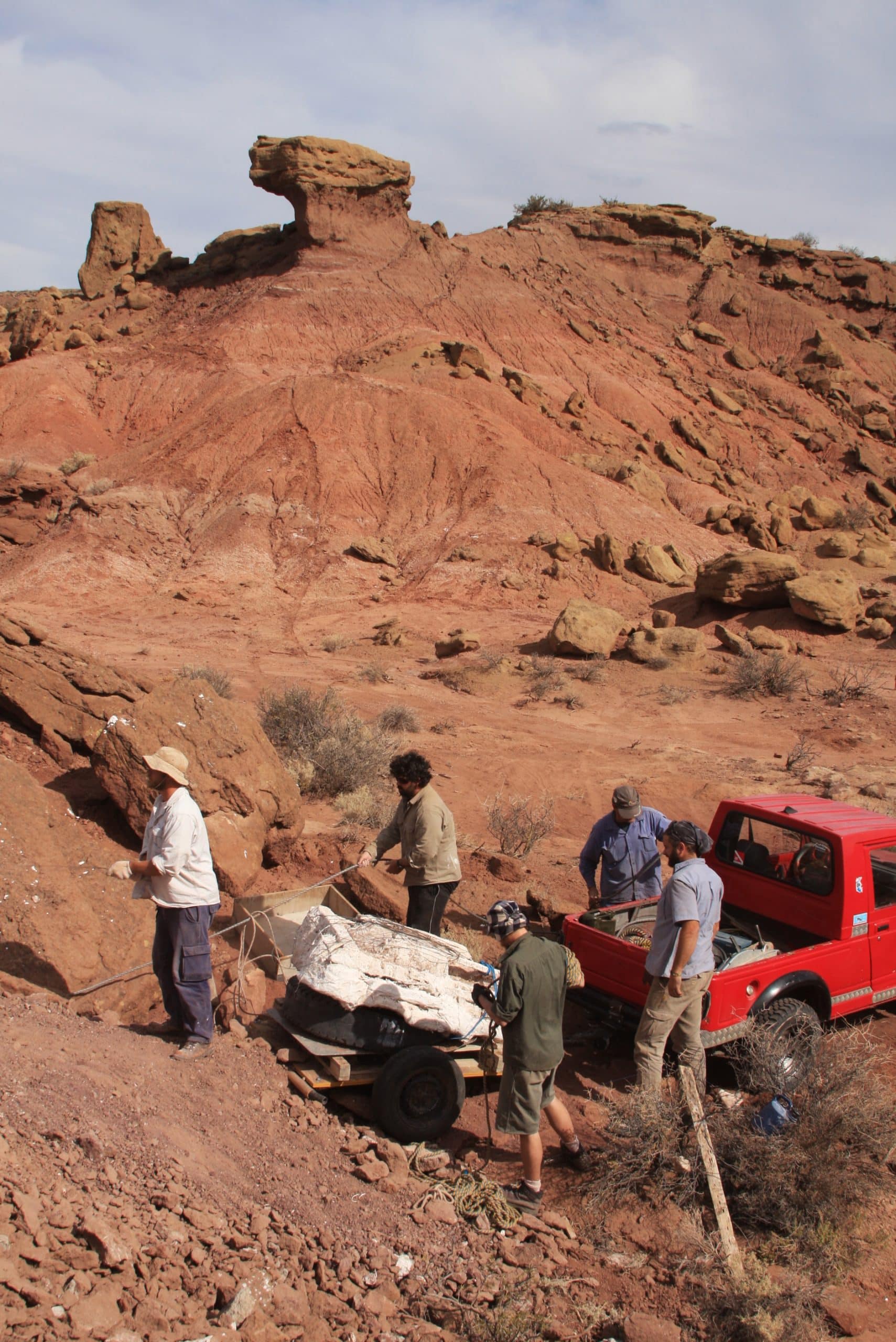
The quarry lies 25 kilometers (about 15.5 miles) southwest of Villa El Chocón. There, the skeleton sat 13 meters (about 43 feet) above the base of the Huincul Formation. The paper names no single discoverer. Instead, a University of Minnesota release credits the team co-led by Peter Makovicky, with Canale and Apesteguía. Crews cleared rock with a jackhammer, rocksaw, and picks. Because some fragile bones hung from a sandstone overhang, they even used silicone caulk as a separator before plastering them.
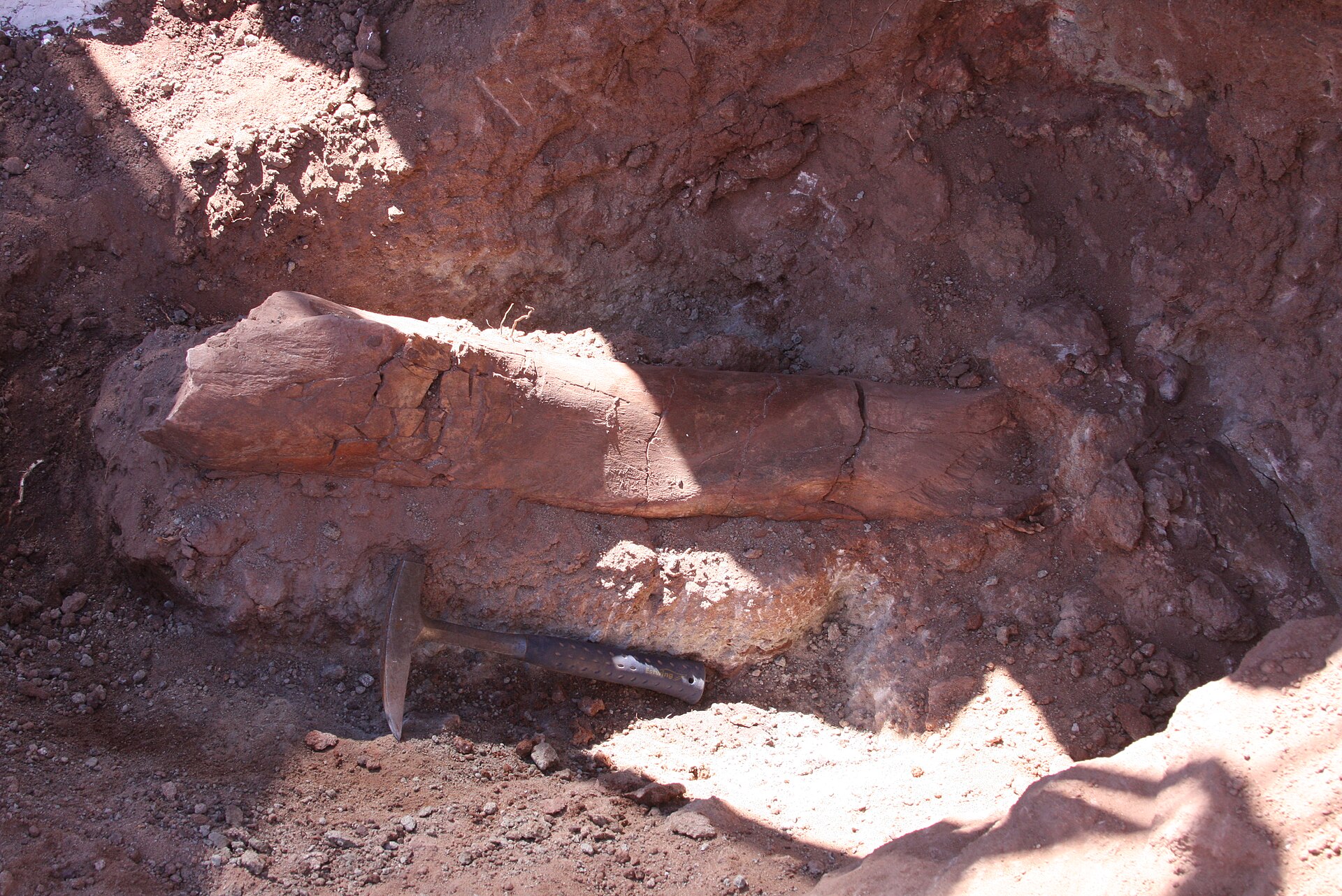

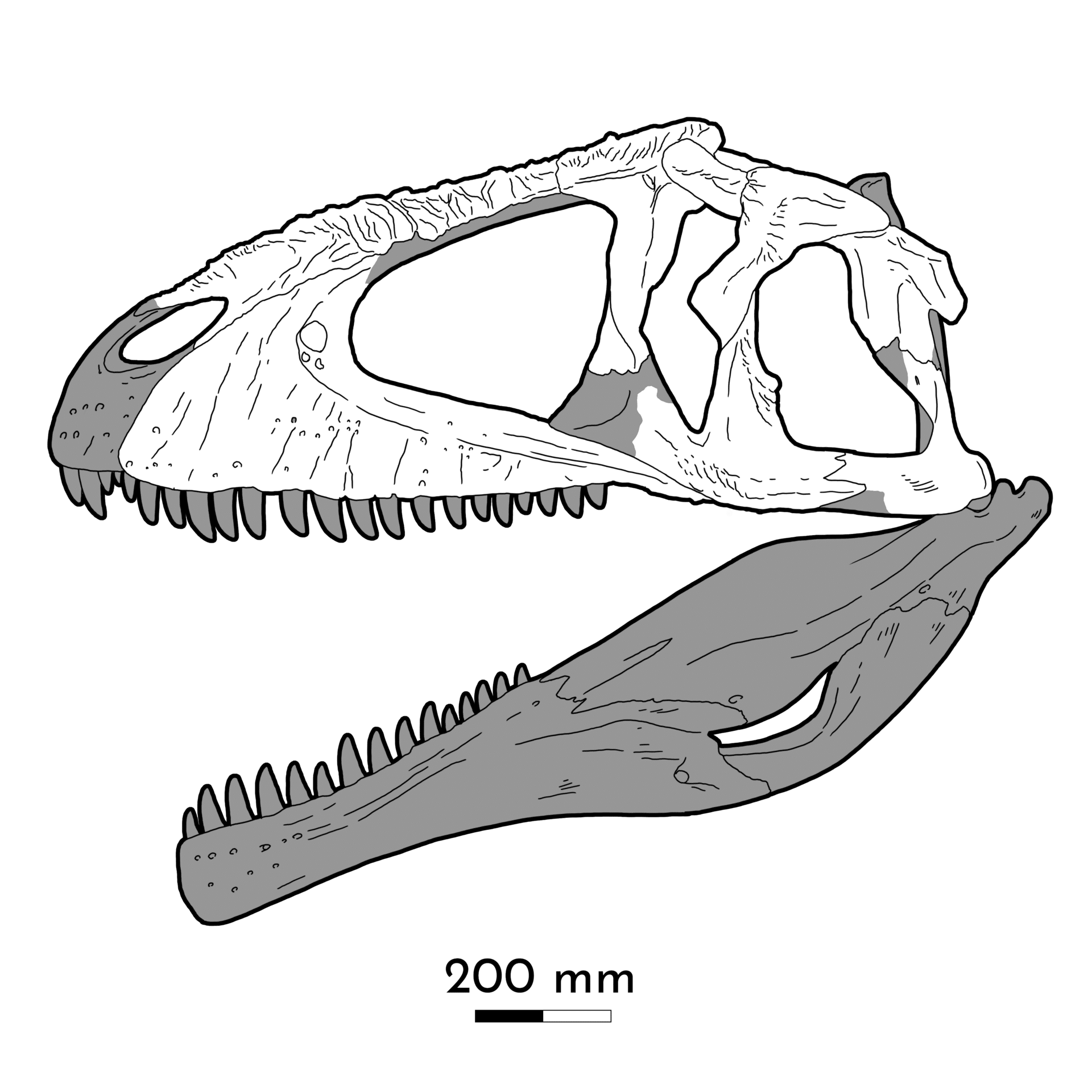
The holotype, MMCh-PV 65, belongs to the Museo Municipal “Ernesto Bachmann” in Villa El Chocón. It includes a nearly complete skull without the lower jaws, plus the shoulder and hip girdles and bones of both fore- and hind limbs. A complete sacrum (the fused hip vertebrae), fragments of neck and back vertebrae, and a run of tail vertebrae round out the skeleton. In fact, the skull lacks only the premaxillae—the bones at the tip of the snout—and minor palate bones.
The skeleton lay in a lag deposit—a layer of coarse debris left by fast water. It shared that layer with a titanosaurid and two unnamed rebbachisaurid specimens. All of them lay where an overbank mudstone meets an overlying sandstone about 2 meters (6.6 feet) thick. The authors read that sandstone as “a massive sheet flow or similar high energy flooding event.” So far, every detail in the 2022 description comes from this one skeleton.

Meraxes Size and Description
Short description of Meraxes
The skull was “long and low, with profusely ornamented dermal bones,” much like that of Acrocanthosaurus. Irregular vertical furrows and ridges lined the maxilla, the main upper tooth-bearing bone. Meanwhile, a robust brow horn jutted sideways from the postorbital—the bone behind the eye socket. In front of the eye, the maxilla’s share of a recess called the antorbital fossa held two openings.
The arms were strikingly short, at about 47 percent of the femur (thigh bone) length. Even so, the arm bones were robust, with prominent muscle attachments as in tyrannosaurids. The team recovered only two metacarpals (palm bones), along with nine finger bones and a very robust, curved claw from the first finger. Like other large theropods, it moved on two legs.
At the feet, the claw of the second toe was the largest, with a moderately sharp lower edge. It was also almost twice the length of the fourth toe’s claw. Because the description reports no skin or soft tissue, any reconstruction of its outer covering is speculative.

Size and Weight of Type Species
Canale and colleagues gave no total length, and we found no published height. However, the University of Minnesota press release offered a length—around 36 feet (about 11 meters) from snout to tail tip.
Weight rests on firmer ground. The team used a standard equation for two-legged animals and the narrowest circumference of the left femur, 452 millimeters (about 17.8 inches). The result was 4,263 kilograms (about 9,400 pounds). As an indirect estimate, it comes with a range of roughly 25 percent either way. That spans 3,196 to 5,331 kilograms (about 7,050 to 11,750 pounds). The press release, by comparison, gave roughly 9,000 pounds.
Direct measurements also give a sense of scale. The femur measures 1,260 millimeters (about 4.1 feet), whereas the humerus (upper arm bone) is just 340 millimeters (about 13.4 inches). The team put the skull at an estimated 127 centimeters (about 4 feet 2 inches)—close to the 123-centimeter skull of Acrocanthosaurus. Since they scaled the missing snout tip from Giganotosaurus, that figure is partly an estimate.
The Dinosaur in Detail
Meraxes is best known for its lavishly sculpted head. The describers suggested that facial ornament evolved quickly in these predators, “possibly linked to a social signaling role.” Its furrowed maxilla separates it from Mapusaurus, a later relative higher in the same formation whose maxilla is granular. Further back, its five sacral vertebrae fused to a degree not seen in other carcharodontosaurids. Unlike in other allosauroids, bone fully encloses the pubic foramen—an opening in the lower hip bone.
The arms carry the paper’s biggest idea. Canale and colleagues argued that abelisaurids, carcharodontosaurids, and tyrannosaurids each reduced their arms independently, with a proposed lower limit near a forelimb-to-femur ratio of 0.4. The closest match was between Meraxes and the tyrannosaur Tarbosaurus. The study also gave “some support” to arm shrinkage as a by-product of selection on other traits, likely skull size in large predators. Yet in their own regression, only femur length was a significant predictor.
Growth tells a second story. Bone tissue from the femur shows 24 annual growth marks plus four more in an external fundamental system—a tight band of layers that forms once growth stops. Citing a 2020 study by Cullen and colleagues, the 2022 authors put this mature animal at 39 to 53 years old. They therefore suggested it was “the oldest non-avian theropod known to date.” They also proposed that it reached giant size by hypermorphosis—growing for longer than other allosauroids at similar rates—and matured considerably later than Tyrannosaurus rex.
Later work agrees. In 2025, Kellermann and colleagues recovered Giganotosaurini in all eight of their analyses, always pairing Giganotosaurus with Mapusaurus. In all but one run, Tyrannotitan joined that pair and Meraxes sat just outside the trio. Taken together, these studies place Meraxes near the base of Giganotosaurini.
Interesting Points about Meraxes
- Meraxes takes its name from a dragon in the fantasy series A Song of Ice and Fire, while gigas means “giant” in Greek.
- According to its describers, the holotype—estimated at 39 to 53 years old at death—is the oldest non-avian theropod known to date.
- Its skull lacks only the snout tip and minor palate bones, although the lower jaws were not found. The skeleton is the most complete carcharodontosaurid yet found in the Southern Hemisphere.
- Its arms were about 47 percent of its femur length, comparable to the proportions of tyrannosaurids and abelisaurids.
- In the 2022 analysis, it was the earliest-diverging member of Giganotosaurini, the clade that includes Giganotosaurus and Mapusaurus.
Contemporary Dinosaurs
Sharing the lower part of the Huincul Formation near Villa El Chocón was Skorpiovenator bustingorryi, a brachyrostran abelisaurid—a member of a short-snouted abelisaur group. A 2026 study calls its skull one of the most complete known for any abelisaurid. Nothing links the two predators directly, so they shared a landscape rather than any known encounter.
Slightly lower in the same formation, at the La Antena site near the contact with the Candeleros Formation, lay Cienciargentina. This rebbachisaurid, one of a family of long-necked sauropods, came from about 2.5 kilometers (1.6 miles) southeast of the Skorpiovenator site. Two unnamed rebbachisaurid specimens also lay in the Meraxes quarry, although no study ties them to this genus.
Rounding out the cast was Gualicho shinyae, a mid-sized theropod with a two-fingered hand. Apesteguía and colleagues described it in 2016 from the Río Negro shore of the Ezequiel Ramos Mexía Reservoir, near the base of the Huincul Formation. They assigned those rocks to the late Cenomanian–early Turonian and called Gualicho “the first likely neovenatorid” from the formation. Its level comes from a figure rather than a measurement, so its exact position relative to Meraxes is uncertain.
Meraxes in its Natural Habitat
The world Meraxes roamed was a land of rivers. The Huincul Formation comprises “thick successions of Upper Cretaceous fluvial deposits,” and fine sands and muds dominate its lower section. It belongs to the Río Limay Subgroup, the lowest part of the Neuquén Group. That group is a pile of river-laid red beds about 1,200 meters (3,900 feet) thick. Little is known of its plants, although the ancient soils change between the Candeleros and Huincul. Maniel and colleagues read that contrast as a sign that global climate was warming toward mid-Cretaceous greenhouse conditions.
As a carnivore, Meraxes was a megapredator in a formation that has also yielded rebbachisaurid and titanosaurian sauropods, as well as abelisaurid and carcharodontosaurid theropods. Even so, no published study describes its prey or hunting methods, so how it fed remains an open question.
While there is no direct evidence of whether Meraxes lived alone or in groups, its ornate skull may have played a part in social display. What the fossil does show is longevity. This animal lived for an estimated four to five decades and kept growing for longer than other allosauroids. In its river-cut world, it would have been a lasting presence—formidable in size and slow to mature.
Frequently Asked Questions
Its name comes from a dragon in the fantasy series A Song of Ice and Fire, and gigas is Greek for “giant.”
Its describers placed it in the late Cenomanian to Turonian (about 95 to 90 MYA per a press release), but a 2026 study suggests about 106 MYA.
The 2022 paper estimated about 9,400 pounds but gave no length, while a press release suggested about 36 feet.
It was a carnivorous theropod in the family Carcharodontosauridae, and the earliest-diverging member of the South American clade Giganotosaurini in its 2022 analysis.
Its fossils came from Las Campanas Canyon, in the Huincul Formation near Villa El Chocón, Neuquén Province, Argentina.
It is the most complete carcharodontosaurid yet found in the Southern Hemisphere and, per its describers, the oldest non-avian theropod known.
Sources
The information in this article is based on various sources, drawing on scientific research, fossil evidence, and expert analysis. The aim is to provide a comprehensive and accurate overview of Meraxes. However, please be aware that our understanding of dinosaurs and their world is constantly evolving as new discoveries are made.
- https://doi.org/10.1016/j.cub.2022.05.057
- https://par.nsf.gov/servlets/purl/10393025
- https://ars.els-cdn.com/content/image/1-s2.0-S0960982222008600-mmc1.pdf
- https://doi.org/10.1371/journal.pone.0311096
- https://doi.org/10.1016/j.gr.2026.06.020
- https://doi.org/10.5710/AMGH.20.08.2026.3665
- https://doi.org/10.4202/app.01086.2023
- https://doi.org/10.1371/journal.pone.0157793
- https://doi.org/10.5710/PEAPA.22.04.2022.419
- https://www.eurekalert.org/news-releases/958071
- https://doi.org/10.1016/j.cretres.2025.106137
- https://doi.org/10.1098/rspb.2020.2258
This article was last fact checked: TheDinosaurs Team, 02-11-2026
Featured Image Credit: Reptileano, CC BY-SA 4.0, via Wikimedia Commons
