
About 20 kilometers (12 miles) southwest of Plaza Huincul, in Argentina’s Neuquén Province, rose-colored rocks of the Huincul Formation hold a rare kind of predator site. There, at a quarry called Cañadón del Gato, paleontologists recovered Mapusaurus roseae, a giant meat-eating theropod of the family Carcharodontosauridae. Its age is now debated—Cenomanian in the original locality data, while a 2026 study dates the base of its formation to about 106 million years ago. What sets the site apart is the company these animals kept in death—every identifiable dinosaur bone in the quarry belongs to this one species.
In 1997, members of the Argentinean-Canadian Dinosaur Project began digging what they first took to be a single giant skeleton. Instead, the bones turned out to represent at least seven individuals of different sizes. Paleontologists Rodolfo Coria and Philip Currie named the animal in 2006. This monospecific (single-species) makeup, they wrote, has implications for our understanding of the social behavior of large theropods—a question the site still raises.
Mapusaurus Key Facts
| Keyword | Fact |
|---|---|
| Pronunciation | Not specified |
| Meaning of name | Earth Reptile |
| Group | Theropoda |
| Type Species | Mapusaurus roseae |
| Diet | Carnivore |
| When it Lived | Debated: Cenomanian in the original locality data (the paper also allowed Albian to Cenomanian), but a 2026 study dates the base of the Huincul Formation to about 106 MYA |
| Period | Cretaceous |
| Epoch | Late Cretaceous (Cenomanian stage) in the original locality data, though recent dating suggests Early Cretaceous (Albian stage) |
| Length | About 16 to 36 feet (5 to 11 meters) across the bonebed individuals, with the largest computed at about 33.5 feet (10.2 meters) (Coria and Currie, 2006) |
| Height | Not specified |
| Weight | About 9,040 pounds (4,100 kilograms), 2014 estimate by Benson and colleagues |
| Mobility | Moved on two legs (bipedal), inferred for carcharodontosaurids as a group |
| First Discovery | 1997 by the Argentinean-Canadian Dinosaur Project |
| Described by | 2006 by R.A. Coria and P.J. Currie |
| Holotype | MCF-PVPH-108.1 (right nasal) |
| Location of first find | Cañadón del Gato, Cortaderas area, Huincul Formation, Neuquén Province, Argentina |
Mapusaurus Origins, Taxonomy and Timeline
The name Mapusaurus draws on “Mapu,” a Mapuche term for “Earth,” and the describers translated it as “Earth reptile.” The species name roseae does double duty. It refers to the rose-colored rocks around the site and honors Rose Letwin of Seattle, who sponsored the expeditions of 1999, 2000, and 2001.
Mapusaurus belongs to Theropoda and, within it, to Carcharodontosauridae, a family that also includes Carcharodontosaurus. In their 2006 paper, Coria and Currie also erected a subfamily, Giganotosaurinae, for carcharodontosaurids closer to Giganotosaurus and Mapusaurus than to Carcharodontosaurus. The subfamily’s defining traits sit in the femur (thigh bone). There, the fourth trochanter—a muscle-attachment ridge—is weak, and a shallow, broad groove marks the lower end. Mapusaurus roseae is the type and only known species.
Dating Mapusaurus has become surprisingly difficult. Coria and Currie’s locality entry places the Huincul Formation in the Cenomanian stage of the Late Cretaceous. Yet other passages of their paper allow an older window, from Albian to Cenomanian. Later studies generally favored a late Cenomanian to early Turonian age. In 2026, however, researchers led by I.J. Maniel dated a thin ash bed just above the formation’s base to about 106 million years ago. That would place the base in the Albian stage of the Early Cretaceous. Because the ash lies near Villa El Chocón rather than at the bonebed, it dates the formation, not the quarry itself. Notably, the Paleobiology Database already lists Mapusaurus at 110.1 to 106.3 million years ago.
Discovery & Fossil Evidence
Excavation at Cañadón del Gato ran for five consecutive field seasons, from 1997 through 2001. Preparation showed that the bones came from more than one animal. They lay disarticulated (no longer joined) and scattered through the base of an ancient river channel. According to the describers, their history included decomposition, trampling by large animals, reworking, burial, and later compaction.
The holotype, MCF-PVPH-108.1, is a single right nasal—one of the paired bones along the top of the snout. The Museo Carmen Funes in Plaza Huincul houses it along with the rest of the material. Twelve numbered paratypes, or additional reference specimens, support it. They include a maxilla (upper jaw bone), a dentary (lower jaw bone), a humerus (upper arm bone), hip bones, and a fibula from the lower leg. In all, the describers reported the species from most parts of the skeleton.

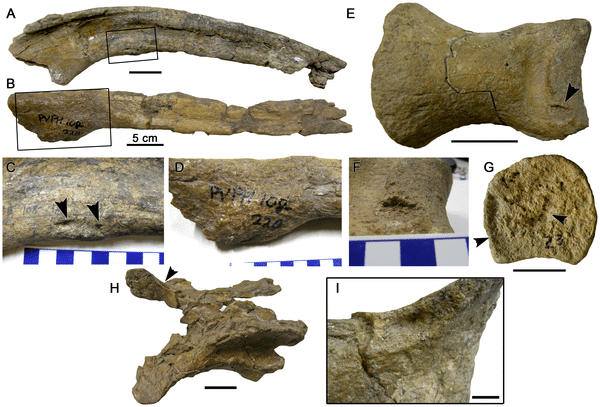
Fifteen metatarsals (foot bones) showed a minimum of seven individuals, and other elements raised that minimum to nine. In 2013, paleontologists P.R. Bell and Coria examined 176 catalogued elements and found them relatively poorly preserved, often with weathered surfaces. Even so, the quarry holds individuals from about 18 to 36 feet (5.5 to 11 meters) long within one species.
In 2006, Coria and Currie called Cañadón del Gato the only bonebed then known in the Huincul Formation, where dinosaur remains seemed extremely rare. Since then, the picture has changed. In 2022, Bellardini and colleagues listed nine theropod and five sauropod taxa from the formation.
Mapusaurus Size and Description
Short description of Mapusaurus
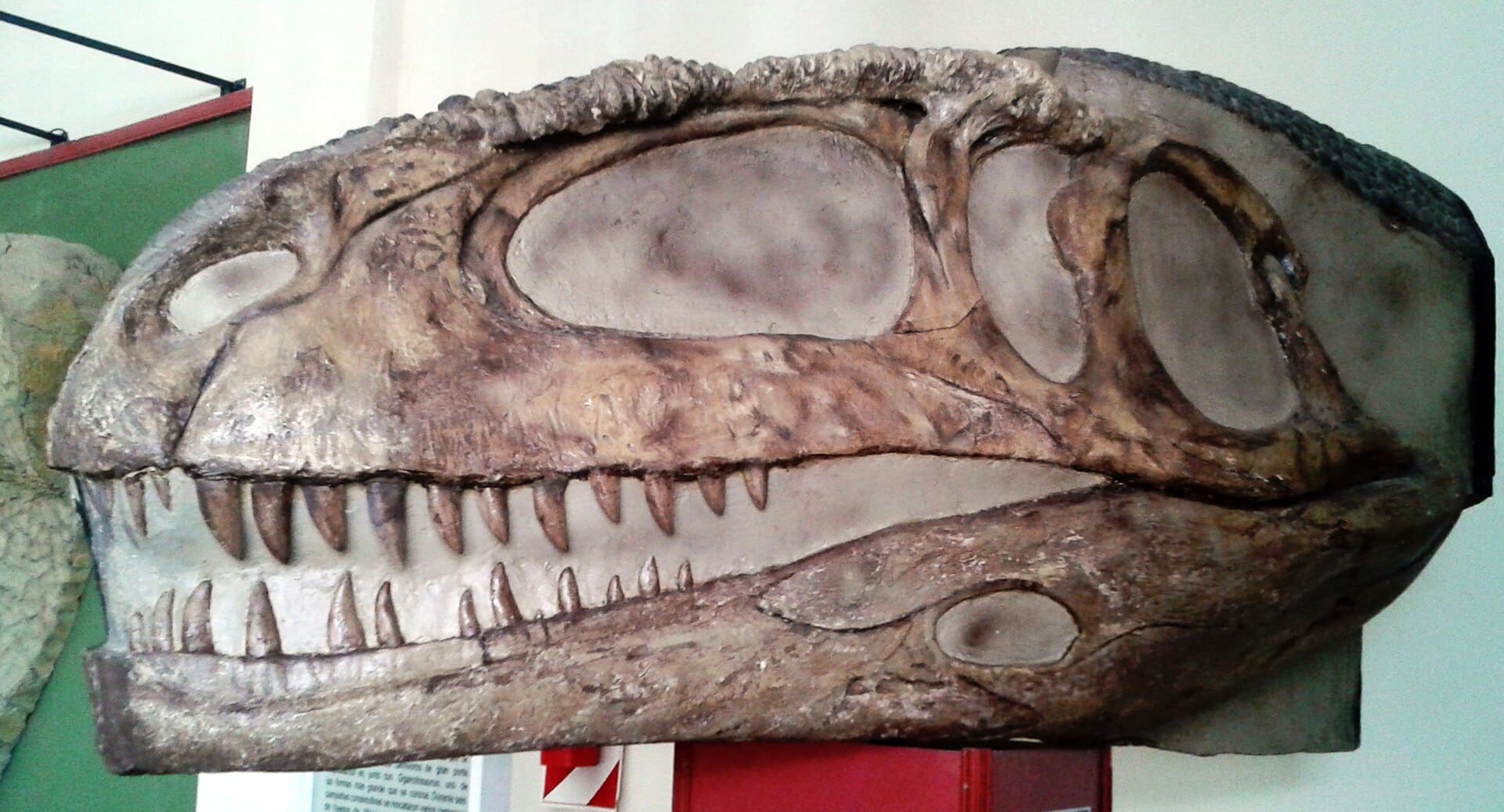
The skull was deep, short, and narrow, with large triangular antorbital fossae—hollows in front of the eye socket. A relatively small maxillary fenestra, or opening, pierced the upper jaw bone. Its nasals were narrow, unfused, and rugose (roughened). According to Coria and Currie, the skull looked deeper and narrower than that of Giganotosaurus, because the maxilla was less elongate and the nasal narrower. Heavy sculpturing covered the facial bones, and the postorbital and palpebral bones together formed a shelf over the eye. The teeth were flat, narrow blades with wrinkled enamel, much like those of other carcharodontosaurids.
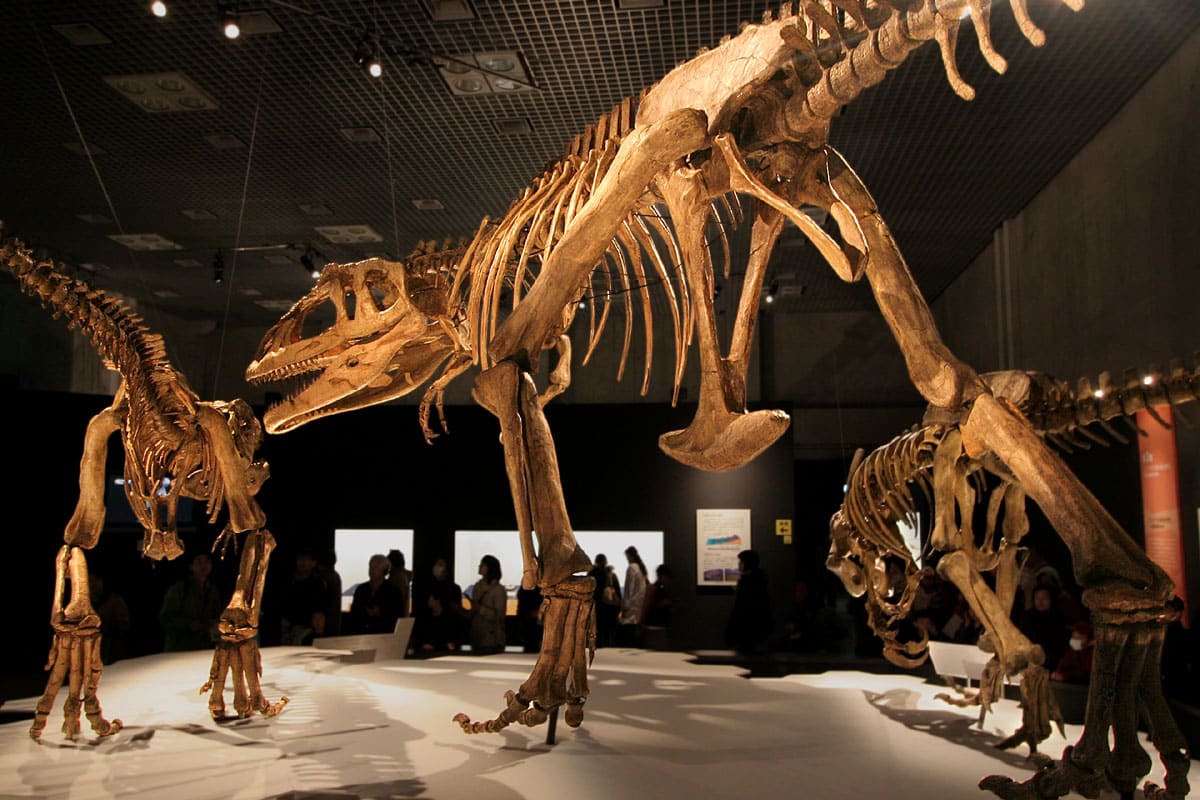
Behind the head, the neck vertebrae carried tapering projections called epipophyses, while tall spines rose from the back vertebrae. Pleurocoels—openings into the vertebral bodies—reached as far back as the first hip vertebra, and the tail vertebrae bore extra spines. The arms were relatively short. From a partial bone, the describers estimated a humerus of about 12 inches (300 millimeters), roughly a quarter the length of the femur. In 2022, paleontologist J.I. Canale and colleagues grouped carcharodontosaurids with other giant theropods that walked only on two legs.

Size and Weight of Type Species
Coria and Currie gave the bonebed individuals a size range of about 16 to 36 feet (5 to 11 meters). Their femur-based calculations, which they called very rough estimates, ran from about 18 to 33.5 feet (5.5 to 10.2 meters). Meanwhile, a juvenile lower jaw pointed to an animal of about 18 feet (5.5 meters).
No body mass appears in the original paper. In 2014, however, Benson and colleagues estimated about 9,040 pounds (4,100 kilograms) by scaling from the shaft circumference of one bonebed femur. The same study gave Giganotosaurus about 13,450 pounds (6,100 kilograms). For Carcharodontosaurus, it gave about 6,600 pounds (3,000 kilograms), based on an estimated measurement.
Coria and Currie judged Mapusaurus comparable in size to Giganotosaurus. They called that animal arguably the largest known theropod, at about 40 feet (12.2 meters). In fact, one 860-millimeter Mapusaurus fibula is 2 centimeters longer than the fibula of the Giganotosaurus holotype. Still, the same paper’s calculations put its owner at only about 29 feet (8.8 meters).
The Dinosaur in Detail
One of the most distinctive features of Mapusaurus lies in its hand. The second and third metacarpals (hand bones) were joined together—a trait the describers listed as unique to the genus. Its humerus was stout, with a broad lower end and poorly defined condyles, the rounded joint surfaces. In the upper jaw, the maxilla held 12 tooth positions, compared with 14 in Carcharodontosaurus. The largest measured tooth reached 174 millimeters (6.9 inches) including the root, with a crown of 65 millimeters. Its quadrate, the bone on which the lower jaw hinged, was pneumatic (air-filled) like those of tyrannosaurids.
The describers also identified a possible furcula, or wishbone. Although it might instead be fused gastralia—belly ribs—they favored the wishbone reading.
Coria and Currie’s analysis of 110 characters found Mapusaurus clearly nested within Carcharodontosauridae and closest to Giganotosaurus. Yet they cautioned that the evidence for that pairing was presently weak. They separated the two genera on anatomy and on rock layer, since Giganotosaurus comes from the underlying Candeleros Formation. They also observed that femora of Tyrannotitan from Chubut share the subfamily’s defining traits.
Later work has strengthened the link. In 2025, Kellermann and colleagues recovered Giganotosaurus and Mapusaurus as sister taxa (each other’s closest relatives) in all eight analyses. Tyrannotitan and then Meraxes usually joined them in a purely South American clade called Giganotosaurini. The same team noted a proposal that Taurovenator, a Huincul animal known only from a postorbital (a bone behind the eye), is actually Mapusaurus. Their analyses did not support that idea, although they did not exclude it. Taken together, these studies place Mapusaurus at the heart of a South American radiation of giant predators—its exact boundaries still being drawn.
Interesting Points about Mapusaurus
- In 2006, Coria and Currie reported Cañadón del Gato as the only bonebed then known in the Huincul Formation, and every identifiable dinosaur bone there belongs to Mapusaurus.
- The holotype is a single right nasal from the snout, even though most of the skeleton is now represented.
- The largest metatarsal is about 25 percent longer than the smallest but has a much wider shaft, showing how foot bones thickened with size.
- In 2013, Bell and Coria found abnormalities on a vertebra, two ribs, a toe bone, and a hip bone, attributed to trauma, infection, and one anomaly.
Contemporary Dinosaurs
Sharing the Huincul Formation was Meraxes gigas, another carcharodontosaurid, described in 2022 by Canale and colleagues. Canale’s team placed it in a clade with other massive South American species, and later analyses make it a close relative of Mapusaurus. However, no study we found places them at the same level, so whether they ever crossed paths is unknown.
Towering over the landscape was Argentinosaurus, a giant titanosaurian sauropod counted among the largest dinosaurs known. Coria and Currie noted that Mapusaurus shares the Huincul Formation with giant sauropods, including Argentinosaurus huinculensis. Still, no fossil we know of ties the two together directly.
Smaller predators shared the formation too, including Ilokelesia, a mid-sized abelisauroid theropod. In 2016, Apesteguía and colleagues treated it and Mapusaurus as coeval (contemporary) members of separate theropod lineages.
Adding further diversity was Cathartesaura, a rebbachisaurid sauropod. Its bones come from the lower section of the Huincul Formation at La Buitrera, in Río Negro Province. Because no study we found has fixed the level of the Mapusaurus quarry, the two share a formation rather than a proven moment. Ages for all four animals follow the same debated dating as the formation itself.
Mapusaurus in its Natural Habitat
Rivers crossed the inland basin Mapusaurus roamed, leaving thick successions of river deposits. The bonebed formed in a channel cut by an ephemeral or seasonal stream in a semiarid or arid region. According to Apesteguía and colleagues, the formation lay far from the coast, unlike nearshore units in North Africa, with no rich aquatic fauna and no spinosaurids. Yet they also noted that many Huincul dinosaurs have close relatives in mid-Cretaceous North Africa.
Mapusaurus was a carnivore, and Bell and Coria described it as an important apex predator. Across studies of large theropods, they reported bone abnormalities in 7 to 19 percent of individuals, with trauma a leading cause—evidence, in their words, of an active, often perilous lifestyle.
While there is no direct evidence of how these animals lived, the bonebed invites the question. Coria and Currie allowed that the site might be a long-term or coincidental accumulation. However, the rarity of theropods and a single species of different ages suggested to them that it was not a coincidental aggregate. They compared it with single-species bonebeds of Albertosaurus in Alberta and Daspletosaurus in Montana, adding that it may indicate some behavioral traits. Their paper stops there—it does not claim pack hunting.

Frequently Asked Questions
It means “Earth reptile,” from a Mapuche word for Earth. The species name roseae refers to rose-colored rocks and honors sponsor Rose Letwin.
Its original locality data say Cenomanian, but a 2026 study dates the base of its formation to about 106 million years ago.
Bonebed individuals ranged from about 16 to 36 feet long. A 2014 study estimated a weight of about 9,040 pounds.
It was a carnivorous theropod of the family Carcharodontosauridae, most closely related to Giganotosaurus.
Its fossils come from Cañadón del Gato, in the Huincul Formation southwest of Plaza Huincul, Neuquén Province, Argentina.
Its describers said the bonebed may indicate some behavioral traits, but their paper does not claim pack hunting.
Sources
The information in this article is based on various sources, drawing on scientific research, fossil evidence, and expert analysis. The aim is to provide a comprehensive and accurate overview of Mapusaurus. However, please be aware that our understanding of dinosaurs and their world is constantly evolving as new discoveries are made.
- https://sciencepress.mnhn.fr/en/periodiques/geodiversitas/28/1/un-nouveau-carcharodontosauride-dinosauria-theropoda-du-cretace-superieur-d-argentine
- https://sciencepress.mnhn.fr/sites/default/files/articles/pdf/g2006n1a4.pdf
- https://doi.org/10.1371/journal.pone.0063409
- https://doi.org/10.1016/j.cub.2022.05.057
- https://doi.org/10.1371/journal.pone.0311096
- https://doi.org/10.1371/journal.pone.0157793
- https://doi.org/10.5710/PEAPA.22.04.2022.419
- https://doi.org/10.1016/j.gr.2026.06.020
- https://doi.org/10.1371/journal.pbio.1001853
- https://paleobiodb.org/classic/checkTaxonInfo?taxon_no=77205
This article was last fact checked: TheDinosaurs Team, 30-10-2026
Featured Image Credit: Bidnat, CC BY-SA 4.0, via Wikimedia Commons
