
Near the west bank of Alberta’s Red Deer River, coal seams streak the uppermost layers of the Horseshoe Canyon Formation. Those beds hold the only known skeleton of Eotriceratops xerinsularis, a large horned dinosaur named in 2007. It lived during the Maastrichtian stage of the Late Cretaceous, about 68.8 million years ago. That 2020 date superseded the original estimate of 67.6 to 68.0 million years. It was a chasmosaurine, one of the long-frilled horned dinosaurs. Its describers placed it in a group with Triceratops and judged it distinctly older than any other member—an early chapter in a famous lineage. However, some later studies also place the older Titanoceratops in that group, a view that remains debated.
The story began in 2001, when Glen Guthrie noticed the bones during a joint museum expedition. Six years later, paleontologist Xiao-chun Wu and three colleagues described the skeleton in the Canadian Journal of Earth Sciences. It was the first associated vertebrate skeleton found in the formation’s uppermost 66 feet (20 meters). Most of what survives comes from the skull. Even so, Wu’s team argued that this single animal helps fill a gap between early and late Maastrichtian chasmosaurines.
Eotriceratops Key Facts
| Keyword | Fact |
|---|---|
| Pronunciation | Not specified |
| Meaning of name | Dawn Triceratops |
| Group | Ceratopsidae (Chasmosaurinae) |
| Type Species | Eotriceratops xerinsularis |
| Diet | Herbivore |
| When it Lived | Around 68.8 MYA (2020 date, superseding the original 68.0 to 67.6 MYA estimate) |
| Period | Cretaceous |
| Epoch | Late Cretaceous (Maastrichtian stage) |
| Length | Not specified |
| Height | Not specified |
| Weight | Not specified |
| Mobility | Not specified |
| First Discovery | 2001 by Glen Guthrie, on a Royal Tyrrell Museum and Canadian Museum of Nature expedition |
| Described by | 2007 by X.-C. Wu, D.B. Brinkman, D.A. Eberth, and D.R. Braman |
| Holotype | TMP 2002.057.0007 |
| Location of first find | Carbon Member, Horseshoe Canyon Formation, Dry Island Buffalo Jump Provincial Park, Alberta, Canada |
Eotriceratops Origins, Taxonomy and Timeline
The name Eotriceratops wears its ancestry openly. The prefix “eo” translates to “dawn,” while the rest borrows the name of the famous Triceratops. Together, the name means “dawn Triceratops,” fitting for an animal its describers placed early in that lineage. The meaning of the species name xerinsularis, however, could not be confirmed.
In 2007, Wu and colleagues identified Eotriceratops as a ceratopsid and, more narrowly, as a large chasmosaurine. Their analysis nested it within a clade—a group sharing a common ancestor—with Triceratops, Diceratops, and Torosaurus, all from late Maastrichtian deposits. In 2020, paleontologists Denver Fowler and Elizabeth Freedman Fowler listed it in the tribe Triceratopsini, alongside Ojoceratops, “Torosaurus,” and Triceratops. In most analyses, they noted, that tribe and Arrhinoceratops come out as very close relatives of Anchiceratops. Eotriceratops xerinsularis is the type and only known species.
Wu’s team placed the rocks in the upper Maastrichtian. The skeleton lay between two coal seams, so they inferred that it sat near the top of magnetochron 31n, an interval of Earth’s magnetic history. On that basis, they gave it an age of 67.6 to 68.0 million years. In 2020, however, researchers David Eberth and Sandra Kamo obtained high-precision uranium–lead dates from volcanic ash beds. By interpolating between them, they placed the quarry at about 68.8 million years, superseding the earlier estimate. The same study dated the formation’s type area to between 73.1 and 68.0 million years ago—late Campanian to middle Maastrichtian. The revision makes the animal roughly a million years older and places it in the middle, not late, Maastrichtian. According to paleontologist John Scannella, Eotriceratops slightly predates Montana’s Hell Creek Formation, home of later Triceratops.
Discovery & Fossil Evidence
The skeleton came to light in 2001 on a joint expedition of the Royal Tyrrell Museum and Ottawa’s Canadian Museum of Nature. The site lies in the northeastern part of Dry Island Buffalo Jump Provincial Park, about 43 miles (70 kilometers) northwest of Drumheller. Smithsonian Magazine credits the find to Glen Guthrie, while the science blog Laelaps describes the finder as a cook. According to Eberth, a co-author of the description, it was lucky that anyone noticed the poorly preserved specimen at all. Laelaps adds that Barnum Brown collected here in 1910 but seemingly passed over these bones because of their poor quality. Excavation took about a month, followed by roughly 18 months of laboratory work.
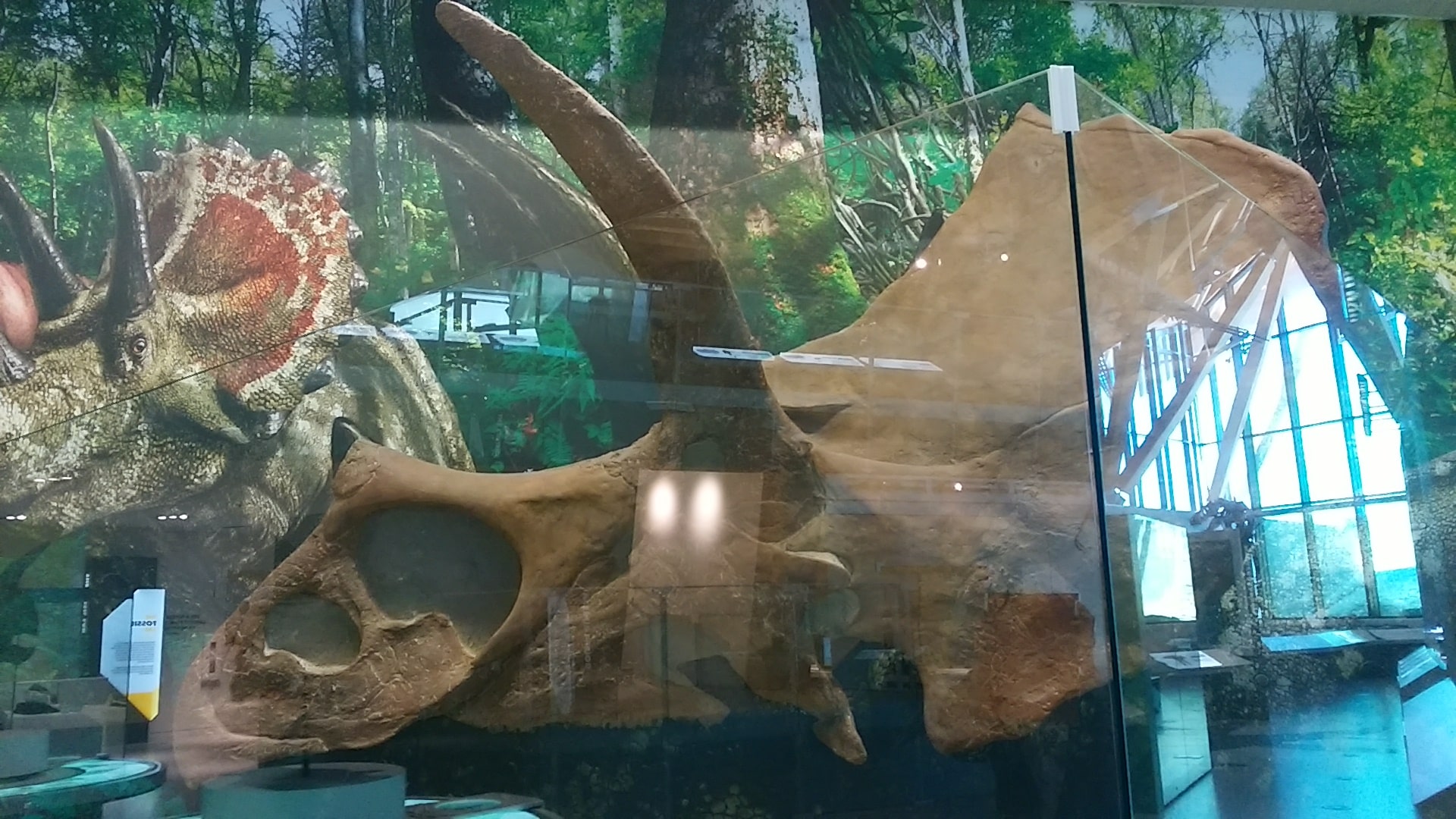
The holotype—the name-bearing specimen—carries the number TMP 2002.057.0007 and resides at the Royal Tyrrell Museum. Most of its bones belong to the skull, but a few vertebrae (backbones), ribs, and ossified ligaments—bands of connective tissue turned to bone—survive too. It lay between the Carbon and Thompson coal seams, about 44 feet (13.5 meters) above the base of a coal-rich interval called unit 5. By late 2007, its skull had just gone on display at the Royal Tyrrell Museum.
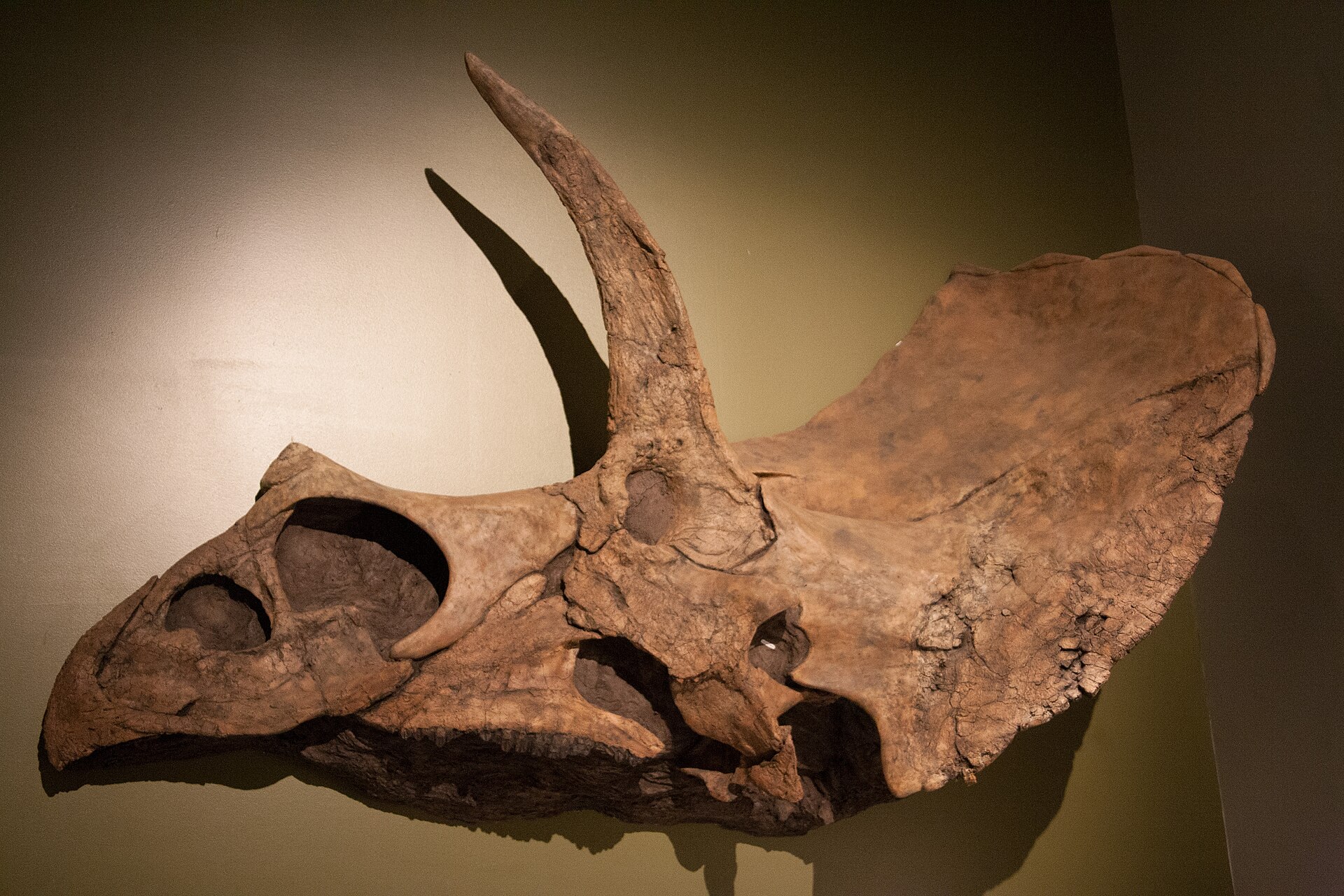

Only one specimen of Eotriceratops is known, and the Paleobiology Database likewise lists a single occurrence. That scarcity matters beyond the species itself. In 2013, Eberth and colleagues named an E. xerinsularis zone, a fossil-defined band of rock, at the top of the formation. They called it tentative, however, because it rests on one specimen and on the absence of dinosaur taxa from lower in the section. Eberth and Kamo later dated the zone to between 69.6 and 68.2 million years ago. No additional specimens of Eotriceratops have been confirmed outside this locality.
Eotriceratops Size and Description
Because the known skeleton is mostly skull, the portrait of Eotriceratops is sharpest from the neck forward.
Short description of Eotriceratops
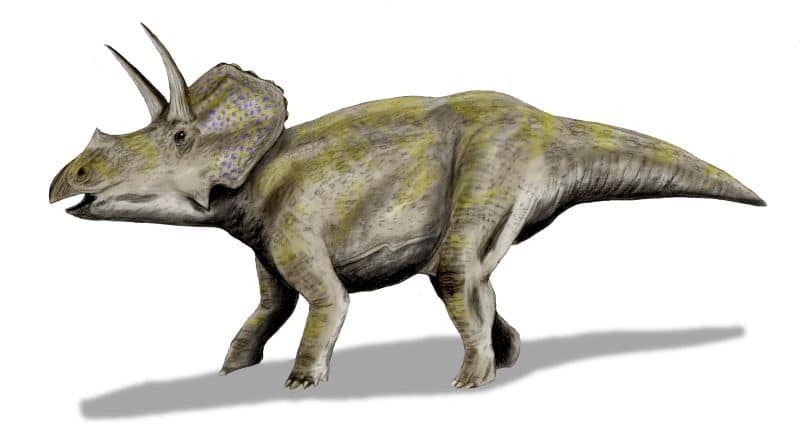
The head of Eotriceratops bore elongate brow horns, or postorbital horn cores, and a small horn on the nose. The premaxilla, a large bone just behind the beak, shaped much of the snout. Its narial process—later called the triangular process—rose extremely tall and unrecessed inside the nasal opening. In 2020, Scannella described a different prong, the nasal process of the premaxilla, which meets the nasal bone behind the nostril. In Eotriceratops it is narrow, strongly inclined backward, and forked into two peaks. At the back of the skull, the frill’s side bones, or squamosals, bore spindle-shaped epoccipitals—bony scallops along the frill edge.
Each cheek carried a sharply conical epijugal, a separate bony spike. Scannella also noted flattened frill ornaments and forward-curving horn cores, which he treats as markers of relative maturity. Its paired premaxillae nonetheless remained unfused. Below the neck, however, the evidence thins quickly. Skin impressions or soft tissue are not reported, so any discussion of its outer covering is speculative. Its posture is not described in the available sources either, so restorations must lean on better-known relatives.

Size and Weight of Type Species
No body length, hip height, or weight for Eotriceratops appears in the peer-reviewed sources available to us. Without a more complete skeleton, any full-size estimate would rest on comparisons with relatives.
The skull is another matter. In 2007, Laelaps reported the describers’ estimate of about 9.8 feet (3 meters), based on the available bones. That figure is an estimate, not a measurement of a complete skull.
Everything Dinosaur reported that the skull approached 3 meters, longer than any Triceratops skull found in Canada. Scannella likewise calls Eotriceratops a very large animal, echoing the original description of a large chasmosaurine. For now, that skull remains the best gauge of the animal’s size.
The Dinosaur in Detail
What sets this dinosaur apart are the fine details of its snout and frill. Wu and colleagues diagnosed it by a unique set of features in the premaxilla, nasal horn core, squamosal frill, and epijugal. Besides the tall narial process and long epoccipitals, they listed a deep fossa, or depression, under the front of the squamosal. They also noted separate epijugal facets for two cheek bones and an oblique blood-vessel groove on the nasal horn core.
Scannella compared the holotype with premaxillae from Montana’s Hell Creek Formation. He focused on the triangular process—the tall prong Wu’s team called the narial process—which in Eotriceratops is unrecessed. That trait separates it from every Hell Creek specimen recorded so far. As Scannella summarizes, the premaxilla is the main feature separating Eotriceratops from Triceratops.

Its place in the family tree has proved less stable. In 2016, paleontologist Jordan Mallon and colleagues pruned it and Bravoceratops from both analyses as wildcard taxa, whose position shifts from tree to tree. Mallon’s team had already flagged it this way in a 2014 study of Arrhinoceratops. In contrast, Scannella’s specimen-level analysis found it the most basal, or earliest-branching, member of his ingroup, though unresolved relative to Arrhinoceratops.
He also described a Hell Creek premaxilla, MOR 1122 7-22-00-1, whose forked nasal process appears intermediate between Eotriceratops and later Hell Creek specimens. In his reading, Eotriceratops is a slightly earlier triceratopsin. Taken together, these studies sketch an animal close to the root of the Triceratops lineage—though exactly how close remains open.
Interesting Points about Eotriceratops
- Its name means “dawn Triceratops,” and its describers judged it the group’s oldest member, a claim now clouded by debate over Titanoceratops.
- Before 2007, no member of the Triceratops group, such as Triceratops or Torosaurus, had been described from the Horseshoe Canyon Formation.
- A single skeleton anchors a whole fossil zone at the top of the formation, one reason Eberth and colleagues call that zone tentative.
- In 2007, Everything Dinosaur reported a skull approaching 3 meters long, longer than any Triceratops skull found in Canada.
Eotriceratops in its Natural Habitat
The world Eotriceratops roamed was a warm, wet alluvial plain—a lowland built from river-laid sediment. Eberth and Kamo date that landscape’s onset to about 69.6 million years ago, the start of the Eotriceratops zone. Before then, starting 71.5 million years ago, it had been a cooler, seasonally wet-dry coastal plain. The skeleton comes from the Carbon Member, second of seven from the top, within the Carbon–Thompson coal zone. In 2013, Eberth and colleagues speculated that a return of wetter, warmer climates and poorly drained ground drove this faunal change.
While there is no direct evidence of what Eotriceratops ate, it belonged to Ceratopsidae. Mallon and colleagues describe that group as megaherbivorous—large plant-eating—dinosaurs. Its teeth and feeding habits are undescribed in accessible sources, so any picture of its diet rests on the group.
The formation also preserves older animals. Lower down, the Tolman Member holds a mass-mortality site of at least 12 Albertosaurus, known as the Albertosaurus Bonebed. It also yields sparse remains of Hypacrosaurus and Albertonykus. Dated to about 70.1 million years ago, that assemblage is older than Eotriceratops, so these dinosaurs do not count as its neighbors. Below the Eotriceratops zone, the middle zone takes its name from Hypacrosaurus and Saurolophus, and the lower zone from Edmontosaurus and Pachyrhinosaurus. In the sources available to us, no other dinosaur or bird is documented from the Eotriceratops level. Whether it lived alone or in herds is unknown, since a single skeleton cannot reveal social habits.
Frequently Asked Questions
It means “dawn Triceratops,” from “eo” (“dawn”), though the meaning of the species name xerinsularis remains unconfirmed.
It lived in the Late Cretaceous (Maastrichtian stage), about 68.8 million years ago. A 2020 study replaced the original 2007 estimate of 68.0 to 67.6 million years.
Its body length and weight are not specified, but 2007 reports gave an estimated skull length of about 9.8 feet (3 meters).
It was a herbivore, a ceratopsid belonging to a group of large plant-eating dinosaurs.
It was found near the Red Deer River in Dry Island Buffalo Jump Provincial Park, Alberta, in the Horseshoe Canyon Formation’s Carbon Member.
Its describers highlighted an extremely tall narial process on the premaxilla and greatly elongate, spindle-shaped epoccipitals on the frill.
Sources
The information in this article is based on various sources, drawing on scientific research, fossil evidence, and expert analysis. The aim is to provide a comprehensive and accurate overview of Eotriceratops. However, please be aware that our understanding of dinosaurs and their world is constantly evolving as new discoveries are made.
- https://doi.org/10.1139/E07-011
- https://doi.org/10.1139/cjes-2019-0019
- https://doi.org/10.1139/cjes-2012-0185
- https://doi.org/10.1139/e2012-035
- https://doi.org/10.1139/e10-045
- https://journals.library.ualberta.ca/vamp/index.php/VAMP/article/download/29366/21423/78283
- https://pmc.ncbi.nlm.nih.gov/articles/PMC4104892/
- https://peerj.com/articles/9251/
- https://doi.org/10.1371/journal.pone.0154218
- https://paleobiodb.org/data1.2/taxa/single.json?name=Eotriceratops&show=attr,app,parent,ref
- https://paleobiodb.org/data1.2/occs/list.json?base_name=Eotriceratops&show=loc,strat,stratext,ref,coords,time
- https://www.smithsonianmag.com/science-nature/e-is-for-eotriceratops-118421651/
- https://scienceblogs.com/laelaps/2007/11/29/eotriceratops-xerinsularis
- https://blog.everythingdinosaur.com/blog/_archives/2007/11/23
This article was last fact checked: TheDinosaurs Team, 13-11-2026
Featured Image Credit: TotalDino, CC BY 4.0, via Wikimedia Commons
