
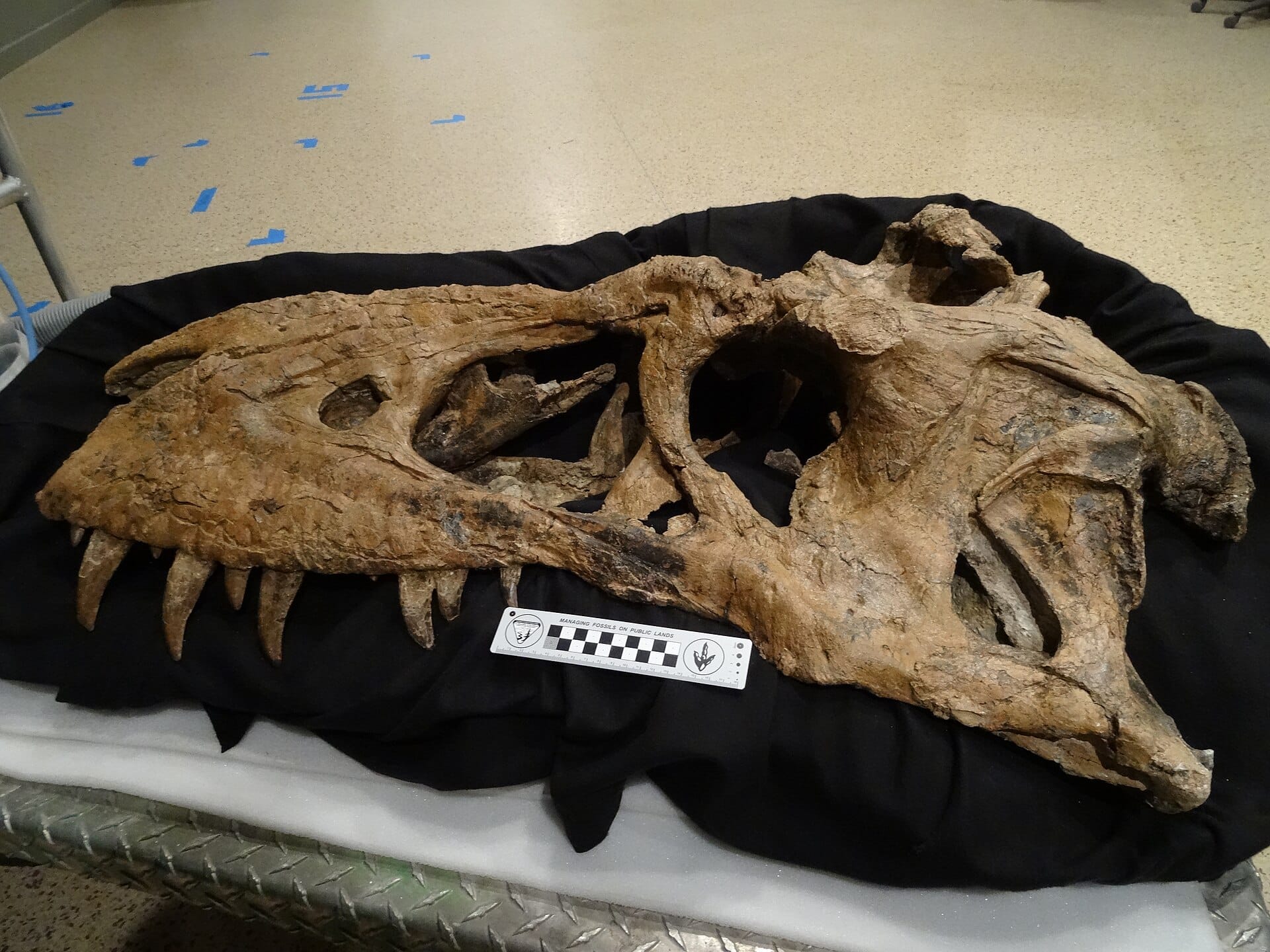
In the Bisti/De-na-zin Wilderness of northwestern New Mexico, the Kirtland Formation’s Hunter Wash Member holds the bones of a striking tyrant dinosaur. Named Bistahieversor sealeyi in 2010, it lived in the late Campanian of the Late Cretaceous—roughly 75 to 74 million years ago. Its describers tied it to “the origin of deep snouts in Tyrannosauroidea”—the wider group of tyrannosaurs and their kin. Indeed, that snout showed that deep faces were not unique to the most advanced tyrannosaurids.
Paul Sealey, a field volunteer for the New Mexico Museum of Natural History and Science, found the skeleton, and crews collected it in 1997 and 1998. It became the first paleontological excavation from a federal wilderness area. Afterward, a New Mexico Army National Guard helicopter lifted the bones out of the badlands. Paleontologists Thomas D. Carr and Thomas E. Williamson then named the animal in 2010, more than a decade after the dig. Today the adult skull is a highlight of the museum’s public galleries. Since 2010, however, its place beside the tyrannosaur family has shifted back and forth—a debate that remains open.
Bistahieversor Key Facts
| Keyword | Fact |
|---|---|
| Pronunciation | Not specified |
| Meaning of name | Sealey’s Destroyer from the Adobe Formations |
| Group | Theropoda (Tyrannosauroidea) |
| Type Species | Bistahieversor sealeyi |
| Diet | Carnivore |
| When it Lived | 75 to 74 MYA |
| Period | Cretaceous |
| Epoch | Late Cretaceous (Campanian stage) |
| Length | About 29.5 feet (9 meters), popular-book estimate |
| Height | Not specified |
| Weight | About 5,500 pounds (2.5 metric tons), popular-book estimate, with 2.3 to 3.0 metric tons for a tentatively referred skeleton |
| Mobility | Not specified |
| First Discovery | Holotype found by Paul Sealey and excavated 1997 to 1998, earliest referred specimen collected 1940 |
| Described by | 2010 by T.D. Carr and T.E. Williamson |
| Holotype | NMMNH P-27469 |
| Location of first find | Hunter Wash Member, Kirtland Formation, Bisti/De-na-zin Wilderness Area, San Juan County, New Mexico, USA |
Bistahieversor Origins, Taxonomy and Timeline
The name Bistahieversor draws on the badlands that yielded it. A 2024 news release from Carthage College, Carr’s university, says the full name means “Sealey’s destroyer from the adobe formations.” It also notes that the name includes the Navajo word “Bisti,” which refers to the badlands where Sealey found the fossil. Meanwhile, the species name sealeyi honors Sealey himself. Together, the name ties the animal to its badlands home and to the volunteer who first spotted it.
In 2010, Carr and Williamson described Bistahieversor as a new genus and species of tyrannosauroid. Before that, they had tentatively identified the skeleton as an Albertosaurus in a 1999 abstract. By 2002, however, they called the material “a new genus of basal tyrannosauroid.” Later papers report that the 2010 analysis made it the sister taxon of Tyrannosauridae—the family’s nearest outside relative. Bistahieversor sealeyi is the type species, and later studies treat it as valid.
The holotype comes from the Hunter Wash Member, which paleontologist Nicholas R. Longrich and colleagues put in 2026 at “about 74–75” million years ago. In 2024, by comparison, Rowe and Rayfield gave a slightly different window of 75.5 to 74.5 million years ago. Dated volcanic ash beds also place the San Juan Basin’s fossil-bearing interval at about 75.2 to 73.5 million years ago. Consequently, it is younger than the main fossil beds of the Kaiparowits, Judith River, and Dinosaur Park Formations farther north. Longrich’s team, however, treats the Hunter Wash Member as roughly the same age as the uppermost Two Medicine Formation.
Discovery & Fossil Evidence
Sealey found the skeleton at Hunter Wash, now locality NMMNH L-3506. The Paleobiology Database credits Williamson with collecting it in 1997 and 1998, though the sources do not date Sealey’s find. The dig ran under a Bureau of Land Management permit—the first issued for a federally designated wilderness. Announcing the name in 2010, Williamson called it “the first valid new genus and species of tyrannosaur to be named from western North America in over 30 years.”
The museum’s holotype, NMMNH P-27469, includes a nearly complete skull and lower jaws plus a partial skeleton. In fact, the Paleobiology Database quotes the 2010 description as “an articulated skull and skeleton.” By contrast, an early 1999 abstract put it at 40 to 60 percent complete, listing jaw bones, vertebrae, ribs, a partial femur (thigh bone), and much of the pelvis.

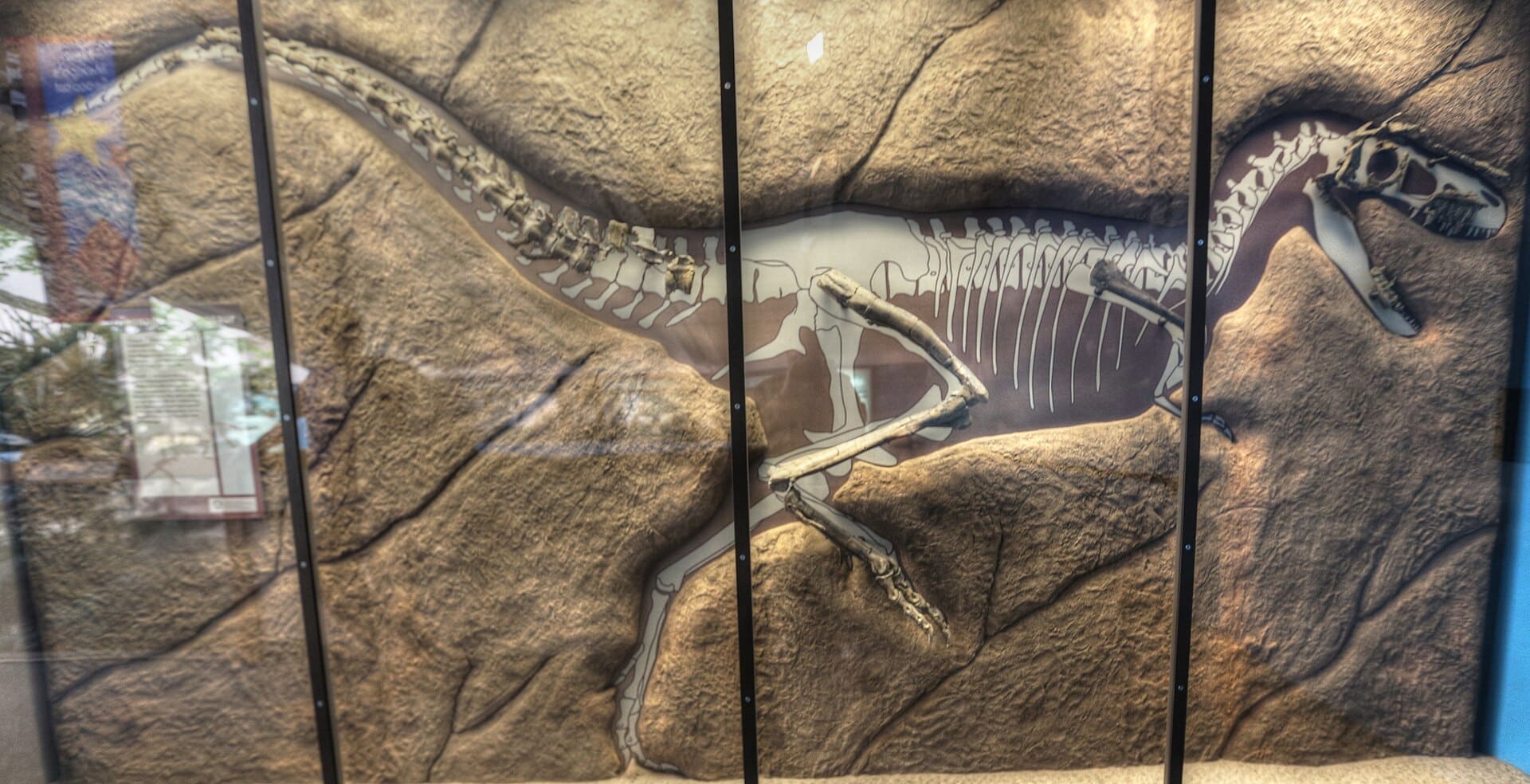
In 1940, Stovall and Savage collected a partial skeleton, OMNH 10131, from the Fruitland or lower Kirtland Formation, probably near Ah-Shi-Sle-Pah Wash—its exact site and level went unrecorded. Later, in 1990, Lehman and Carpenter called it Aublysodon. Carr and Williamson then referred it to Bistahieversor in 2010, whereas Longrich’s team treats it only tentatively as cf. Bistahieversor.
The juvenile NMMNH P-25049 had a tangled path. Taken illegally from Navajo Nation lands, it first appeared in print in 1992, and researchers relocated its site in 1995. Williamson called it Albertosaurus in 1996, and in 2002 he and Carr made it a juvenile of a new Daspletosaurus species. By 2006, however, they saw it as a subadult of the new tyrannosaur, and their 2010 description referred it to B. sealeyi. In 2026, Longrich’s team suggested it “might represent a distinct taxon of small-bodied tyrannosauroid,” noting features seen in relatives of Nanotyrannus. To date, all known material comes from the Fruitland and Kirtland Formations.
Bistahieversor Size and Description
Bistahieversor was a mid-sized tyrannosauroid—larger than Alioramus but smaller than Tyrannosaurus.
Short description of Bistahieversor
Its most celebrated feature is a deep snout, which Rowe and Rayfield note was not exclusive to derived tyrannosaurids. Each maxilla (upper jaw bone) held 11 alveoli (tooth sockets), fewer than the 14 to 16 of Albertosaurus and the 12 to 13 of Tyrannosaurus. Press coverage in 2010 also noted an extra opening above the eye, a complex “forehead” joint, and a lower-jaw keel.
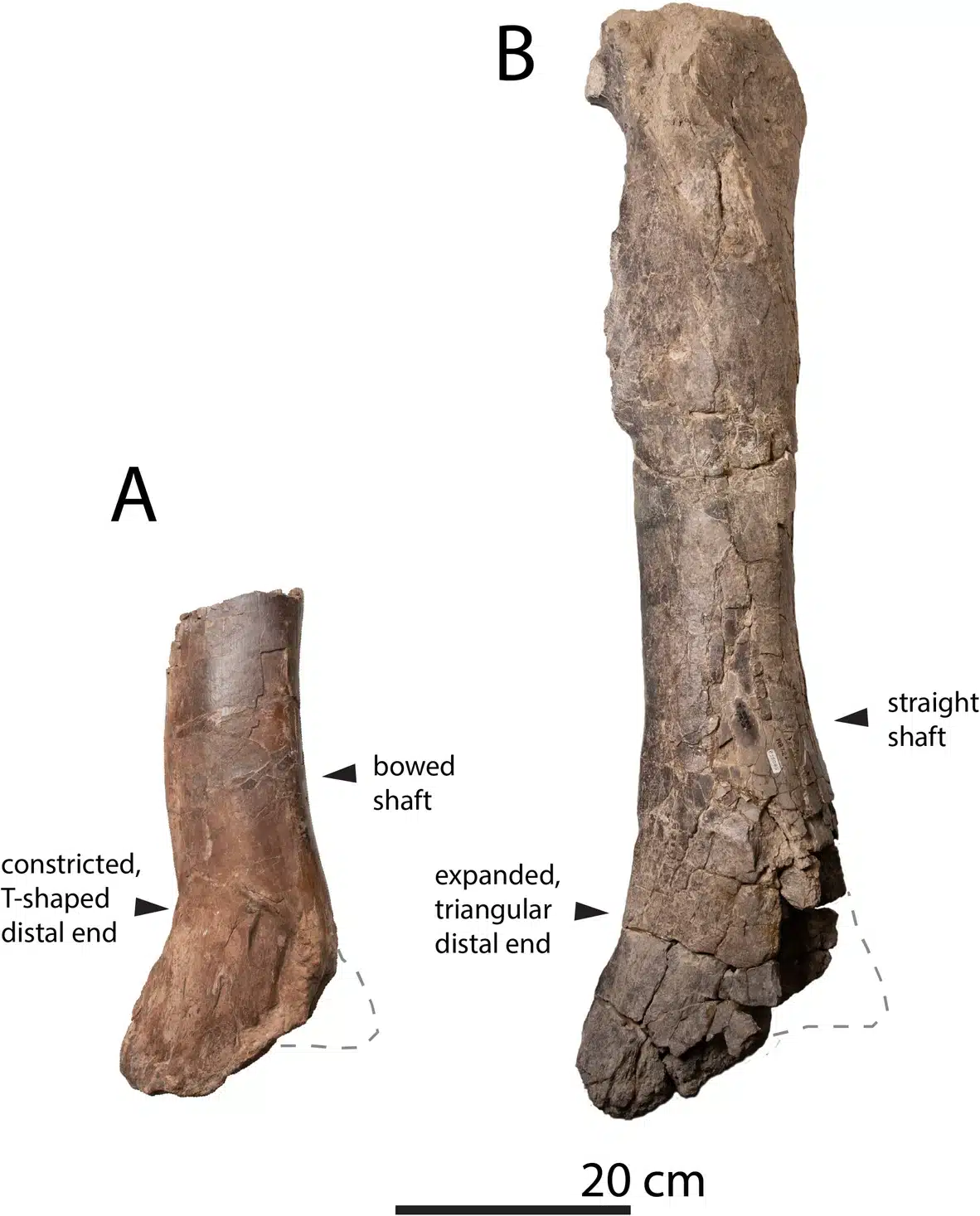
Although the 1999 abstract lists a partial femur, Longrich’s team states that the holotype lacks limbs. Their limb comparisons therefore rely on OMNH 10131, whose tibia (shin bone) has a strongly curved shaft. Its body covering, meanwhile, remains speculative.

Size and Weight of Type Species
Of all the figures, the firmest is a direct one. According to the Paleobiology Database record of the 2010 description, the holotype skull measures 1,070 millimeters (about 3.5 feet) long. Total length is less certain, however, because Rowe and Rayfield take their 29.5 feet (9 meters) from a 2019 popular book by Molina-Pérez and Larramendi.
For weight, Gregory S. Paul’s 2016 field guide suggested about 5,500 pounds (2.5 metric tons), as cited by Longrich and colleagues. The same team then estimated the mass of OMNH 10131 from its limbs. Scaling its tibia against the Tyrannosaurus specimen “Sue” gives about 3 metric tons, while a femur-circumference equation gives 2.3 metric tons—roughly 5,070 to 6,610 pounds in all. Both are indirect estimates, and published femur circumferences for that specimen also differ, at 344 and 368 millimeters.
Longrich’s team added that the rugose, or roughened, skulls of two individuals suggest they were near full size. Even so, Bistahieversor remained a middle-sized tyrant—formidable, yet far from the scale of its later giant relatives.
The Dinosaur in Detail
What sets this dinosaur apart is a skull that mixes features seen across different tyrannosaur lineages. In 2013, paleontologist Mark A. Loewen and colleagues noted a concave outer edge on its dentary (lower jaw bone). That trait and a broad postorbital process of the jugal (cheek bone) link it with Lythronax, Tyrannosaurus, and Tarbosaurus. Similarly, its skull roof peaks at the midline about as high as the nuchal crest (rear skull ridge), as in Teratophoneus.
Inside the head, the picture is just as revealing. In 2020, McKeown and colleagues used CT scans to study its braincase and sinuses. They found a system “nearly identical” to that of tyrannosaurids, with large olfactory bulbs (scent-processing regions), long straight cochlear ducts, and voluminous sinuses. In their reading, tyrannosaurid-style sinuses arrived with large body size, after the tyrannosaurid-style brain had already evolved.

Its place on the family tree remains the liveliest question of all. As later papers report, the 2010 analysis originally recovered Bistahieversor as the sister taxon of Tyrannosauridae. Loewen’s team, however, placed it inside Tyrannosaurinae in 2013, alongside Teratophoneus, Lythronax, Tarbosaurus, and Tyrannosaurus. Three years later, Stephen L. Brusatte and Carr put it “just outside Tyrannosauridae” again, suggesting that the 2013 result may reflect redundant skull-proportion characters. Most recently, Longrich’s 2026 study called it a tyrannosaurid and paired it with Labocania, alongside Teratophoneus and Dynamoterror. Taken together, these studies agree that the genus is valid but not on where it sits.
Interesting Points about Bistahieversor
- Its excavation was the first paleontological dig in a federal wilderness area, and a helicopter airlifted the fossil out.
- A conference abstract by Carr and Williamson lists six injuries on the adult holotype, affecting the skull, lower jaw, and a rib.
- A Bureau of Land Management photo caption notes that the animal is “affectionately known as the Bisti Beast.”
- The names of both Bistahieversor sealeyi and the horned dinosaur Terminocavus sealeyi honor Paul Sealey, who found both holotypes.
- A 2026 study argues that a second, more robust tyrannosaur, known from one large tibia, also lived in the Hunter Wash Member.
Contemporary Dinosaurs
From the lowermost part of the same Hunter Wash Member comes Navajoceratops sullivani, a chasmosaurine ceratopsid—a type of horned dinosaur. In 2020, Denver W. Fowler and Elizabeth A. Freedman Fowler placed its holotype, SMP VP-1500 from Ahshislepah Wash, at about 75.0 million years ago. The sources used here do not give the tyrant’s exact level within the member, and no fossil evidence records any interaction between the two.
Higher up, from the middle of the same Hunter Wash Member, comes Terminocavus sealeyi, another chasmosaurine ceratopsid. Paul Sealey—the same volunteer who found Bistahieversor—collected its holotype, NMMNH P-27468, in 1997. Lying between ash beds dated to 75.02 and 74.57 million years ago, it is about 74.7 million years old. As with Navajoceratops, no direct evidence links this horned dinosaur to the tyrant.
Bistahieversor in its Natural Habitat
The world Bistahieversor roamed was a low coastal landscape that shifted over time. The coal-bearing Fruitland Formation, built of sandstones, siltstones, and carbon-rich shales, formed in a nearshore swamp setting. Upward, it grades into the mostly river-laid sandstones and shales of the Kirtland. At one Fruitland site, the 2010 description, as quoted by the Paleobiology Database, records “a well-drained upper delta plain environment.” Near Hunter Wash, the traditional “Hunter Wash local fauna” comes from the upper 40 feet (12.2 meters) of the Fruitland and the lower 55 feet (16.8 meters) of the Kirtland.
Researchers treat Bistahieversor as a carnivore, and Longrich’s team describes tyrannosaurids as the dominant large predators of their time. Because most of the holotype’s skull injuries involve the mouth and throat, Carr and Williamson suggested they may relate to prey capture or feeding. In 2024, Rowe and Rayfield’s computer models of its lower jaw showed relatively high stresses. As a result, they doubted that mid-sized tyrants could withstand a bite like that of Tyrannosaurus. However, heavy digital reconstruction, they cautioned, may partly explain those stresses. In 2014, Williamson and Brusatte assigned small shed teeth from these rocks to young Bistahieversor, since only one tyrannosaur was then known—a reading that Longrich’s 2026 study reopens to debate.
There is no direct evidence of whether Bistahieversor lived alone or in groups. Until recently, it was the only tyrannosaurid known from the Hunter Wash Member, but Longrich’s team now argues for two distinct tyrannosaurs in the Fruitland–Kirtland rocks. More broadly, Loewen’s team tied its origin to separate northern and southern populations in Laramidia—western North America’s island continent. In 2020, however, Fowler and Freedman Fowler accepted only a gradual north–south difference, not strict endemism. Fowler had earlier tied many differences to age, a view that Ramezani and colleagues’ 2022 dating disputes.
Frequently Asked Questions
According to Carthage College, it means “Sealey’s destroyer from the adobe formations,” honoring its finder, Paul Sealey.
It lived in the late Campanian stage of the Late Cretaceous, roughly 75 to 74 million years ago.
Popular-book estimates suggest about 29.5 feet long and 5,500 pounds, while estimates from a tentatively referred skeleton give 5,070 to 6,610 pounds.
Researchers treat it as a carnivore, and injuries around its mouth may relate to prey capture or feeding.
It comes from the Hunter Wash Member of the Kirtland Formation, in the Bisti/De-na-zin Wilderness of northwestern New Mexico.
Its deep snout showed that this trait was not exclusive to derived tyrannosaurids, and its family-tree position remains debated.
Sources
The information in this article is based on various sources, drawing on scientific research, fossil evidence, and expert analysis. The aim is to provide a comprehensive and accurate overview of Bistahieversor. However, please be aware that our understanding of dinosaurs and their world is constantly evolving as new discoveries are made.
- https://doi.org/10.1080/02724630903413032
- https://nmgs.nmt.edu/meeting/abstracts/view.cfm?aid=1548
- https://nmgs.nmt.edu/meeting/abstracts/view.cfm?aid=1119
- https://nmgs.nmt.edu/meeting/abstracts/view.cfm?aid=948
- https://nmgs.nmt.edu/meeting/abstracts/view.cfm?aid=1677
- https://doi.org/10.1017/S0022336000019843
- https://doi.org/10.1371/journal.pone.0079420
- https://doi.org/10.1038/srep20252
- https://doi.org/10.7717/peerj.5749
- https://doi.org/10.1002/ar.24374
- https://doi.org/10.1371/journal.pone.0093190
- https://doi.org/10.1016/j.isci.2024.110679
- https://doi.org/10.1038/s41598-026-38600-w
- https://doi.org/10.1371/journal.pone.0188426
- https://doi.org/10.1038/s41598-022-19896-w
- https://doi.org/10.7717/peerj.9251
- https://doi.org/10.7717/peerj.10669
- https://pmc.ncbi.nlm.nih.gov/articles/PMC10784284/
- https://paleobiodb.org/classic/basicTaxonInfo?taxon_no=163807
- https://carthage.edu/_ingredients/templates/details/news.php?id=50239
- https://www.rdworldonline.com/new-species-of-tyrannosaur-discovered-in-southwestern-u-s/
- https://commons.wikimedia.org/wiki/File:Bistahieversor_skull.jpg
This article was last fact checked: TheDinosaurs Team, 03-11-2026
Featured Image Credit: Petrodactylus, CC BY-SA 4.0, via Wikimedia Commons
