
In Kalasin Province of northeastern Thailand, the river-laid rocks of the lower Phu Kradung Formation surface at a fossil site called Phu Noi. There, paleontologists recovered a sauropod known from a single back bone. Its describers rank Phu Noi among the most prolific non-marine vertebrate fossil sites in Southeast Asia. Named Uragasaurus kalasinensis in 2026, the animal lived during what they call the latest Jurassic. It is also the first mamenchisaurid—a sauropod family with extremely elongated neck vertebrae—formally named from Thailand.
Teams from the Palaeontological Research and Education Centre (PRC) at Mahasarakham University and the Sirindhorn Museum both excavate at Phu Noi. Paleontologist Varavudh Suteethorn led the digs that yielded this fossil. However, no published record gives the year it came out of the ground, though PRC crews have worked the site since 2008. In July 2026, Apirut Nilpanapan and three colleagues named the animal in Scientific Reports. Soon after, Thai media and the government reported it as the country’s 15th formally named dinosaur species. One vertebra cannot reveal a whole animal—yet its describers argue that it firmly establishes this long-necked family in mainland Southeast Asia, where only fragmentary hints had turned up before.
Uragasaurus Key Facts
| Keyword | Fact |
|---|---|
| Pronunciation | Not specified |
| Meaning of name | Serpent Lizard |
| Group | Sauropoda |
| Type Species | Uragasaurus kalasinensis |
| Diet | Herbivore |
| When it Lived | Not specified for the fossil level (a 2026 study dates the formation’s fauna to about 155 to 140 MYA) |
| Period | Jurassic |
| Epoch | Late Jurassic (stage not specified) |
| Length | Not specified by the describers (news reports give about 59 to 66 feet, a figure not backed by the paper) |
| Height | Not specified |
| Weight | Not specified |
| Mobility | Moved on all four legs (quadrupedal) |
| First Discovery | Year not specified, excavations led by Varavudh Suteethorn |
| Described by | 2026 by A. Nilpanapan, S. Manitkoon, V. Suteethorn, and K. Lauprasert |
| Holotype | PRC 460 |
| Location of first find | Phu Noi Locality, lower Phu Kradung Formation, Kham Muang District, Kalasin Province, Thailand |
Uragasaurus Origins, Taxonomy and Timeline
The name Uragasaurus reaches back to Sanskrit. “Uraga” comes from the word for “snake” or “serpent,” a choice the authors tied to the family’s distinctive long neck. The ending comes from the Greek saûros, meaning “lizard.” Meanwhile, the species name kalasinensis refers to Kalasin Province, the source of the specimens. Together, the name links a serpent’s neck to a corner of northeastern Thailand.
Uragasaurus is a saurischian sauropodomorph within Sauropoda, the long-necked giants. More narrowly, it belongs to Eusauropoda (“true sauropods”) and then to the family Mamenchisauridae. The describers recovered it as an early-diverging mamenchisaurid, placed basal to a group containing Qijianglong and more derived members. Still, they caution that its precise placement is weakly supported. Uragasaurus kalasinensis is the type and only known species.
Its describers place the fossil level in the latest Jurassic but name no stage, since precise age limits remain uncertain. Because the formation lacks layers suitable for radiometric dating, earlier age estimates leaned on regional correlation, vertebrate fossils, and detrital zircons—tough mineral grains washed in from older rocks. In 2026, Licht and colleagues used such zircons to date the fauna of the Phu Kradung Formation to the Kimmeridgian through early Berriasian stages, roughly 155 to 140 million years ago. That window covers the formation’s fauna as a whole, so it does not pin down the lower part alone. Its describers, at least, place Uragasaurus near the end of the Jurassic.
Discovery & Fossil Evidence
The holotype—the name-bearing specimen—came from the Phu Noi Locality in Ban Din Chi village, Kham Muang District. At Phu Noi, an ancient river channel preserves three fossil-bearing horizons, and the Uragasaurus holotype comes from the middle one. That level, about 33 feet (10 meters) above the lowest, consists of brownish-purple and greenish-gray sandy siltstone and mudstone. According to the Thai government, Phu Noi has produced more than 6,000 fossils so far.
Catalogued as PRC 460, the holotype is a single anterior dorsal vertebra—a bone from the front of the back. Apart from heavy front-to-back compression, the bone survives complete, and preparators freed it with pneumatic tools and fine brushes. In its position along the spine, it matches the second back vertebra of Mamenchisaurus hochuanensis and M. youngi.
Several other disarticulated sauropod bones lay within a few meters of the holotype. They include two neural arches (the bony arches above the spinal cord), a coracoid from the shoulder, a left fibula (lower leg bone), a neck vertebra, and a neck rib. By contrast, two more back vertebrae came from farther afield—one lay far away on the bone map, the other in an unrecorded spot. The authors treat all of these as associated sauropod material, not parts of the holotype individual, so the diagnosis rests on PRC 460 alone. In the supplementary information, they describe one neural arch as an additional Omeisaurus-like eusauropod type. That hints at more than one kind of sauropod at the site.
So far, researchers have referred no other specimen to Uragasaurus. Even a vertebra from Phu Dan Ma, higher in the formation, lacks the overlapping parts needed for referral. In 2013, Suravech Suteethorn and colleagues described that bone as the formation’s first mamenchisaurid evidence and referred it to Mamenchisaurus itself—a derived member of the family.
Uragasaurus Size and Description
With only one vertebra, Uragasaurus reveals far more about its back than about its overall shape.
Short description of Uragasaurus
The vertebra’s centrum, or vertebral body, is opisthocoelous—convex in front and concave behind—and wider than it is high, with no keel underneath. On each side sits a shallow, indistinct, subtriangular pleurocoel (a hollow on the side of the centrum). It has no openings inside it and no internal dividing wall. Above it, the neural spine is short and split into a U shape, with no small bump at its center. Meanwhile, the transverse processes, which project sideways toward the ribs, carry several pneumatic (air-sac) fossae, or shallow pits. The authors read a rough platform near the tip of each process as the attachment for a back muscle, the longissimus dorsi.
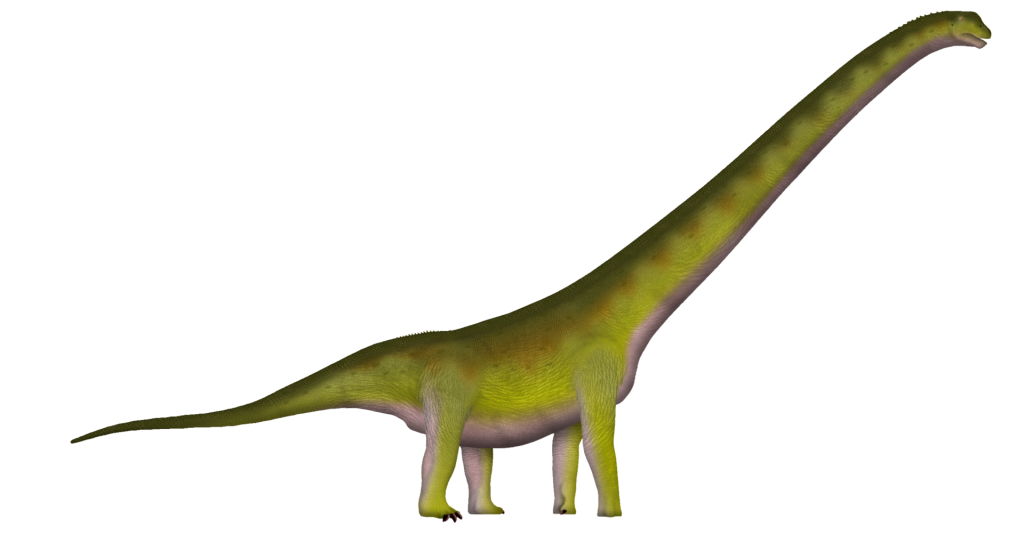
As a group, mamenchisaurids had extremely long neck vertebrae riddled with air spaces. For Uragasaurus itself, however, no neck bone is known. Skin impressions or soft tissue are not preserved, so any picture of its outward appearance is speculative.

Size and Weight of Type Species
Without a skeleton to compare, the describers offer no length, height, or weight for Uragasaurus. Even so, the Thai news site Khaosod English reported a length of about 59 to 66 feet (18 to 20 meters). Likewise, the Everything Dinosaur blog gave a figure of around 66 feet (20 meters). Neither figure comes from the paper or is backed by it.
Instead, the paper measures the vertebra itself. As preserved, PRC 460 stands about 21.6 inches (55 centimeters) tall. Its neural arch spans roughly 27.5 inches (70 centimeters) across. Because of the heavy compression, however, the describers flag every one of these measurements as possibly distorted.
In overall form, the vertebra most closely resembles the front back vertebrae of M. youngi and M. hochuanensis. Beyond that, any comparison of body size would be guesswork for now.
The Dinosaur in Detail
What sets this dinosaur apart is a cluster of pits near the tips of its transverse processes. There, prominent, elongated teardrop-shaped pneumatic fossae form the trait the describers treat as unique to Uragasaurus. On the front face of each process are three fossae—one large and stretched sideways, plus two small teardrops. By contrast, the back face bears a single teardrop fossa, larger than the front ones according to the describers.
A second clue lies between the prezygapophyses, the forward-facing joints that linked one vertebra to the next. There, thin bony struts called laminae meet below in a Y-shaped arrangement that includes a single vertical lamina. According to the authors, this pattern has not been reported in other mamenchisaurids to date. Instead, a superficially similar condition arose independently in Europasaurus holgeri.
The split neural spine offers another comparison. Its short U shape resembles that of Klamelisaurus, whereas M. anyuensis, M. hochuanensis, and M. youngi have V-shaped split spines. Inside, CT scans revealed a camellate structure—a honeycomb of numerous small, irregular chambers. The authors describe this as typical of mamenchisaurids and a sign of relatively advanced air-sac invasion in the group’s vertebrae. Camellate bone also appears convergently in neosauropods, particularly somphospondylans and titanosaurs.
For the family-tree analysis, the team could score Uragasaurus for only 10 of 449 characters. As a result, it behaved as a wildcard taxon—one whose position shifts among the equally optimal trees. Moreover, the analysis found no unambiguous synapomorphies (shared derived traits) for it. Nevertheless, it sits within a group supported by three such traits, including split neural spines in the neck and front of the back. Overall, the single bone points to an early branch of the mamenchisaurid lineage, though its exact twig remains unsettled.
Interesting Points about Uragasaurus
- The genus name draws on the Sanskrit word for “serpent,” fitting for the long necks that mark its family.
- Uragasaurus is the first mamenchisaurid formally named from Thailand, although fragmentary vertebrae from Krabi and the Phu Kradung Formation had already hinted at the family.
- Its entire diagnosis rests on one compressed back vertebra, catalogued as PRC 460 and housed at Mahasarakham University.
- A 3D model of the holotype, built from CT scans, is freely available online through Figshare.
Contemporary Dinosaurs
The same Phu Noi beds produced Minimocursor phunoiensis, named in 2023. It was a small basal neornithischian—a member of the bird-hipped group that includes ornithopods. Its holotype, a partially articulated skeleton, belonged to an animal about 2 feet (0.6 meters) long. Based on the longest thigh bone from the site, its describers suggest adults may have reached about 6.6 feet (2 meters). In 2024, Wongwech Chowchuvech and colleagues published a fossil column of Phu Noi that places a mamenchisaurid sauropod and Minimocursor in the same fossil-bearing interval. Similarly, the Uragasaurus describers report neornithischians from its horizon.
Uragasaurus in its Natural Habitat
The world Uragasaurus roamed was one of meandering rivers crossing a continental basin. High-energy currents ran along the channels, followed by quieter floodplain and lake deposits. At Phu Noi, the beds record a channel sequence from its floor up to the nearby floodplain. There, the Minimocursor skeleton lay in siltstone laid down on a low-energy natural levee. The paper’s life restoration sets its herd in a Late Jurassic forest, but that scene is artwork rather than a reconstruction of the local plants or climate.
Besides sauropods, the middle horizon yields hybodont sharks, gar-like ginglymodian fishes, lungfishes, basal eucryptodiran turtles, teleosaurid crocodyliforms, and neornithischian dinosaurs. In 2019, Samathi and colleagues reported metriacanthosaurid theropods from Phu Noi. Later, in 2021, Nonsrirach and colleagues added a brachyopid temnospondyl—an amphibian—and in 2024, Chowchuvech and colleagues described teeth of a basal tyrannosauroid. Meanwhile, a rhamphorhynchoid pterosaur remains under study. Nearby, a stegosaur back vertebra turned up at Ban Khok Sanam, about 2 miles (3 kilometers) from Phu Noi. According to the authors, the assemblage shows strong affinities with faunas of the Junggar, Turpan, and Sichuan basins in China.
A single vertebra holds no direct clue to its diet, but like all sauropods, Uragasaurus was a plant-eater. While there is no direct evidence of its social life, the herd in the paper’s artwork is an artist’s choice rather than a finding. More broadly, the authors suggest that its Chinese relatives point to faunal links across the East Asian landmass. They also see the find as consistent with regional diversification during the Late Jurassic, rather than a sharp turnover at the Jurassic–Cretaceous boundary.
Frequently Asked Questions
It joins the Sanskrit “uraga,” meaning snake or serpent, with the Greek for “lizard,” and kalasinensis refers to Kalasin Province.
Its describers place it in the latest Jurassic. A 2026 study dates the formation’s fauna to roughly 155 to 140 million years ago.
The describers give no size estimate, and media reports of 59 to 66 feet (18 to 20 meters) are not backed by the paper. Its only known bone stands about 21.6 inches (55 centimeters) tall as preserved.
It was a plant-eating sauropod, recovered as an early-diverging member of the long-necked family Mamenchisauridae.
Its bone came from the Phu Noi Locality in Kalasin Province, within the lower Phu Kradung Formation of northeastern Thailand.
Teardrop-shaped air pockets on its transverse processes and a Y-shaped set of bony struts, unknown in other mamenchisaurids, set it apart.
Sources
The information in this article is based on various sources, drawing on scientific research, fossil evidence, and expert analysis. The aim is to provide a comprehensive and accurate overview of Uragasaurus. However, please be aware that our understanding of dinosaurs and their world is constantly evolving as new discoveries are made.
- https://doi.org/10.1038/s41598-026-49822-3
- https://www.nature.com/articles/s41598-026-49822-3/tables/1
- https://static-content.springer.com/esm/art%3A10.1038%2Fs41598-026-49822-3/MediaObjects/41598_2026_49822_MOESM5_ESM.docx
- https://doi.org/10.1038/s43247-026-04096-5
- https://www.mdpi.com/1424-2818/15/7/851
- https://app.pan.pl/article/item/app20090155.html
- https://doi.org/10.58837/tnh.24.1.261261
- https://www.khaosodenglish.com/featured/2026/07/09/thailand-names-new-long-necked-dinosaur-from-kalasin/
- https://blog.everythingdinosaur.com/blog/_archives/2026/07/15/uragasaurus-kalasinensis-mamenchisaurid-from-thailand.html
- https://thailand.go.th/event-detail/kalasin-province-discovers-15th-dinosaur-species
This article was last fact checked: TheDinosaurs Team, 18-11-2026
Featured Image Credit: Connor Ashbridge, CC BY 4.0, via Wikimedia Commons
