
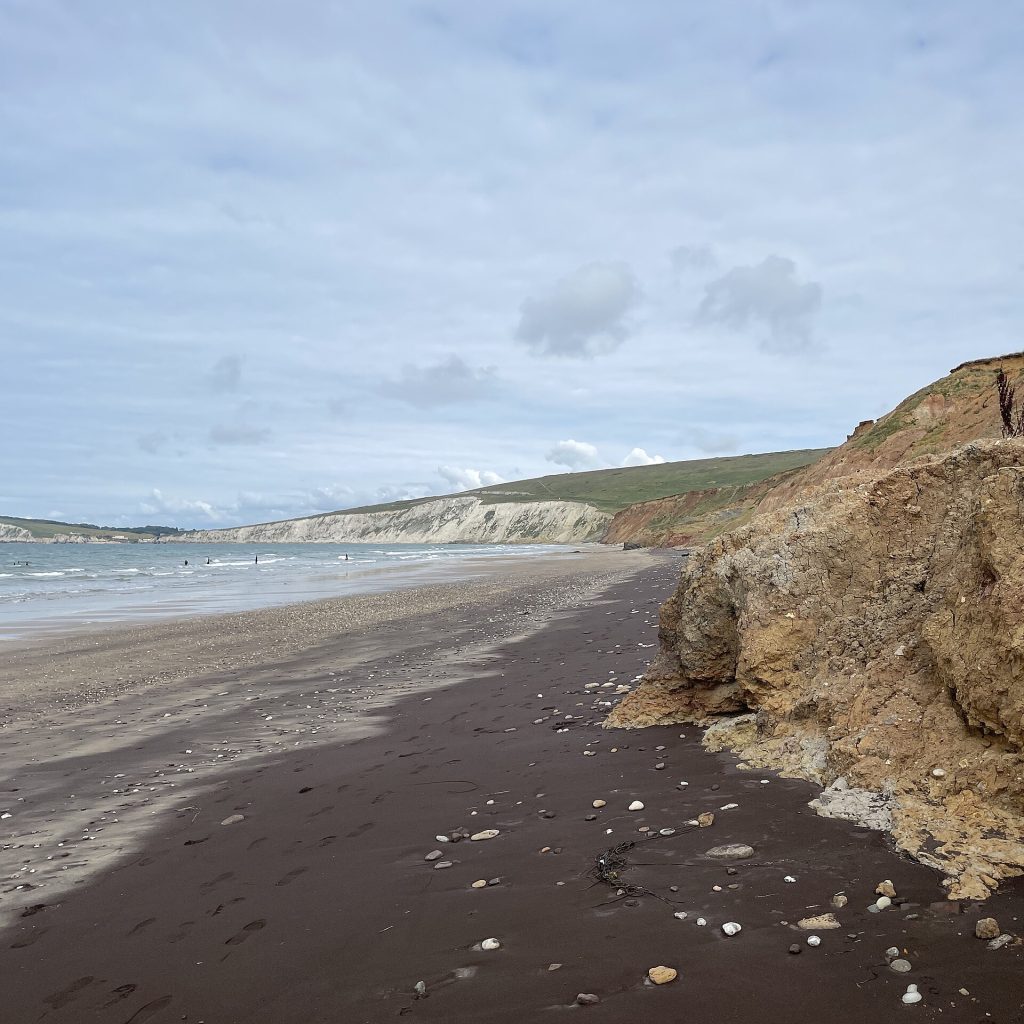
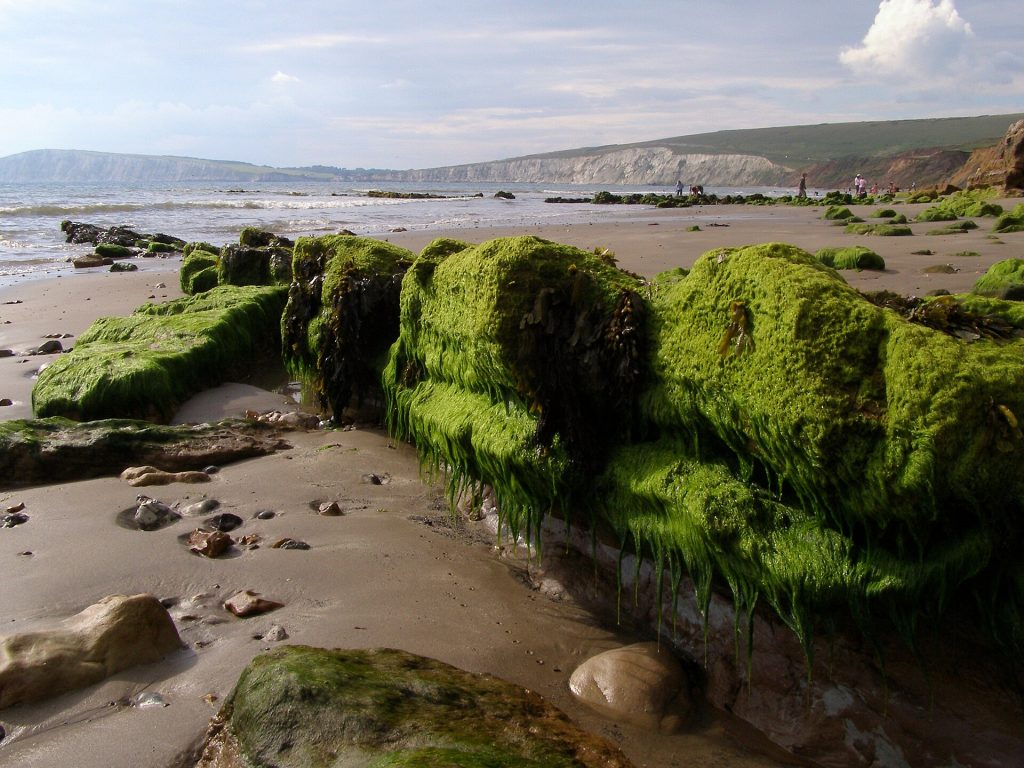
On the southwest coast of the Isle of Wight, red and purple cliffs of the Wessex Formation crumble steadily into the English Channel. Each fall can bring Early Cretaceous bones down to the beach. The National Trust, which looks after Compton Bay, calls the island the richest source of dinosaur remains in Europe. Its rocks have produced Neovenator, Hypsilophodon, Polacanthus and a growing list of plant-eating iguanodontians.
The pace of discovery is the real surprise. According to the University of Portsmouth, only four new dinosaur species came from the island in the whole of the 1900s. However, eight more followed in the five years to July 2024, and further names arrived in 2025 and 2026. Many of them rest on bones that local collectors picked up on the shore—or that sat for decades in museum drawers.
Where the Dinosaur Rocks Crop Out
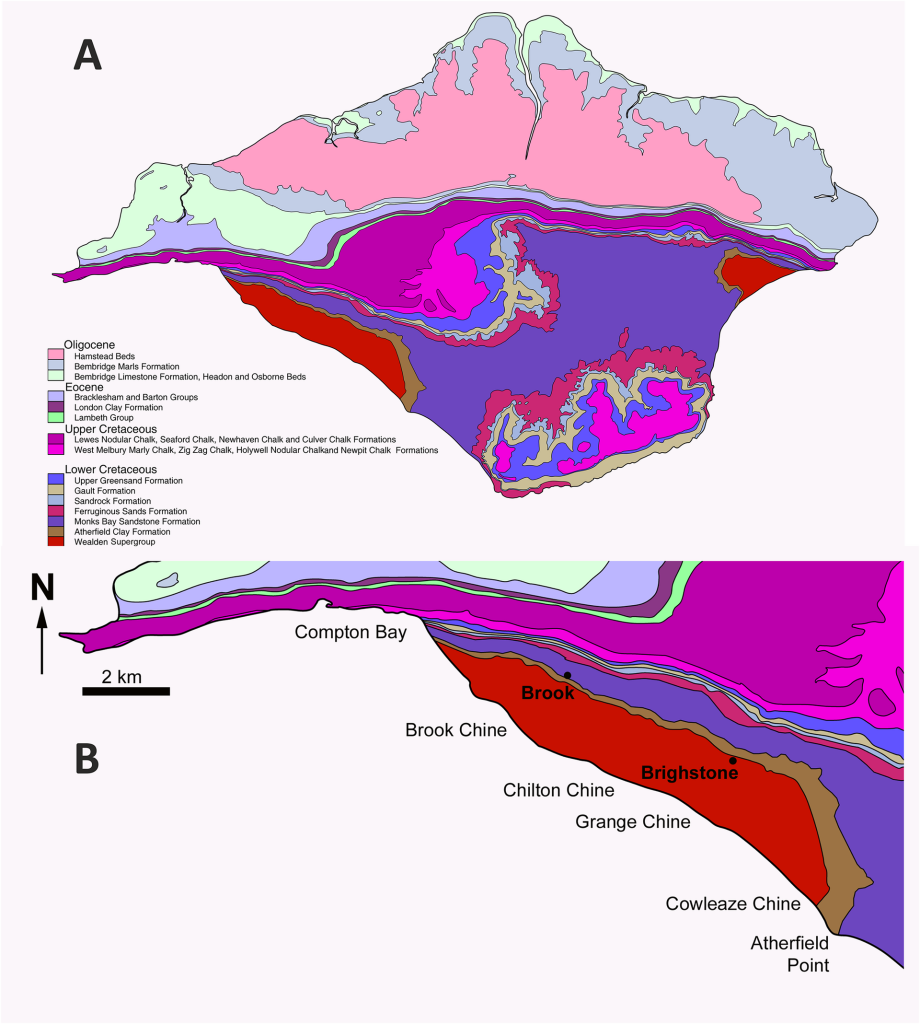
The dinosaurs come from the Wealden Group, a stack of mostly non-marine rocks from the Early Cretaceous. On the island it has two parts—the Wessex Formation below and the Vectis Formation above. Both crop out along the southwest coast, while a smaller exposure lies on the east coast at Yaverland. These exposures form the cores of two anticlines (upward folds), one centered on Brighstone Bay and the other on Sandown Bay.
According to the British Geological Survey, the degraded cliffs from Atherfield Point to Hanover Point show the whole exposed Wealden Group. The Vectis Formation then appears again northwest of Hanover Point, along Compton Bay. In the east, meanwhile, the reference section runs from Yaverland to Red Cliff. Natural England adds that the beach between Brook Bay and Compton Bay “is thought to be the best place to look for dinosaur remains” on the island.

Floodplain, Lagoon and the Age of the Beds
Only the upper part of the Wessex Formation is exposed on the island—roughly 180 meters (590 feet). The British Geological Survey puts the whole formation, known from a borehole, at 580 meters (1,900 feet). It consists of sandstones and varicolored mudstones, laid down mostly by a river. That river, as paleontologist Chris Barker and colleagues described it in 2021, was perennial, winding and flowed from west to east. During the Barremian stage, the area lay between 35 and 40 degrees north. The evidence points to a warm-to-hot climate with periods of aridity.
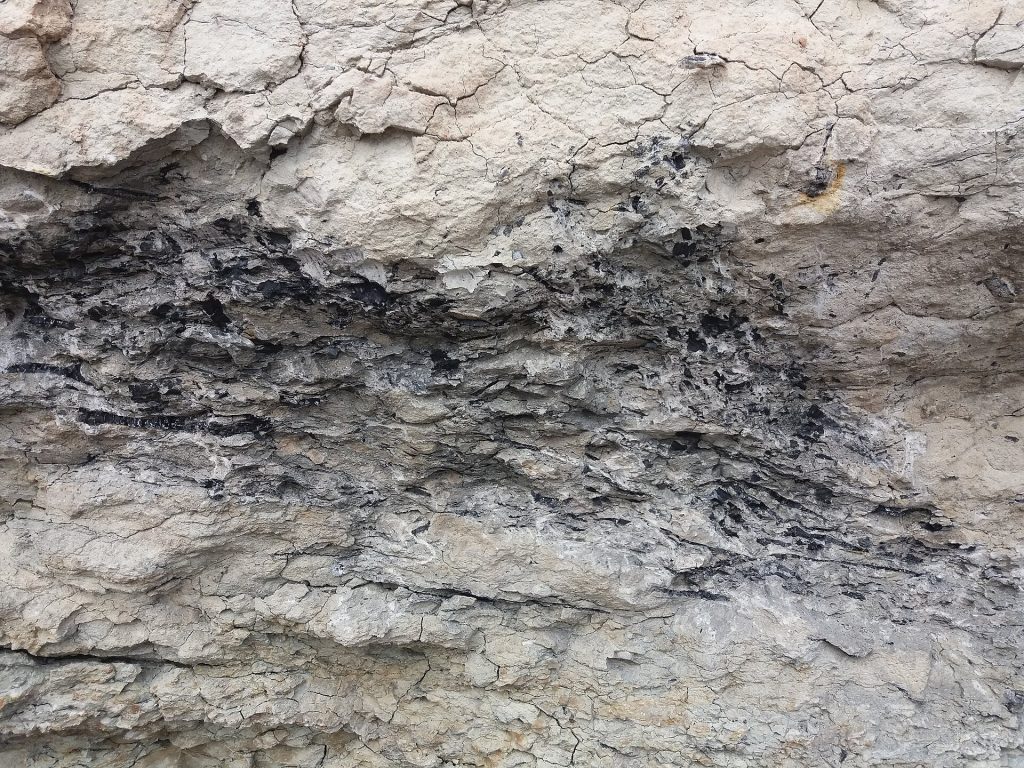
Most bones, however, come from dark layers called plant debris beds. They are thin, yet they are the main source of the island’s dinosaurs. A 2010 study of the beds interpreted each one as a local sheet flood that turned into a debris flow on the floodplain. As a result, logs, plant fragments and bones ended up buried together.

Above the Wessex beds lies the Vectis Formation, at most about 66 meters (217 feet) of dark gray mudstones and siltstones. It records a coastal lagoon of fluctuating salinity. Dinosaur bones are rare in it—although a few important ones have turned up.
How Old Are the Beds?
Barker’s team described the Wessex Formation as entirely Barremian and the Vectis Formation as late Barremian to early Aptian. Other studies, however, place the base of the exposed Wessex beds in the Hauterivian, the stage before. The international time scale dates the Barremian to roughly 125.8–121.4 million years ago. In 2023, calcite inside a fossil turtle shell from Brook Bay gave the formation its first radiometric date—127.3 ± 2.7 million years.
A Coast That Keeps Giving
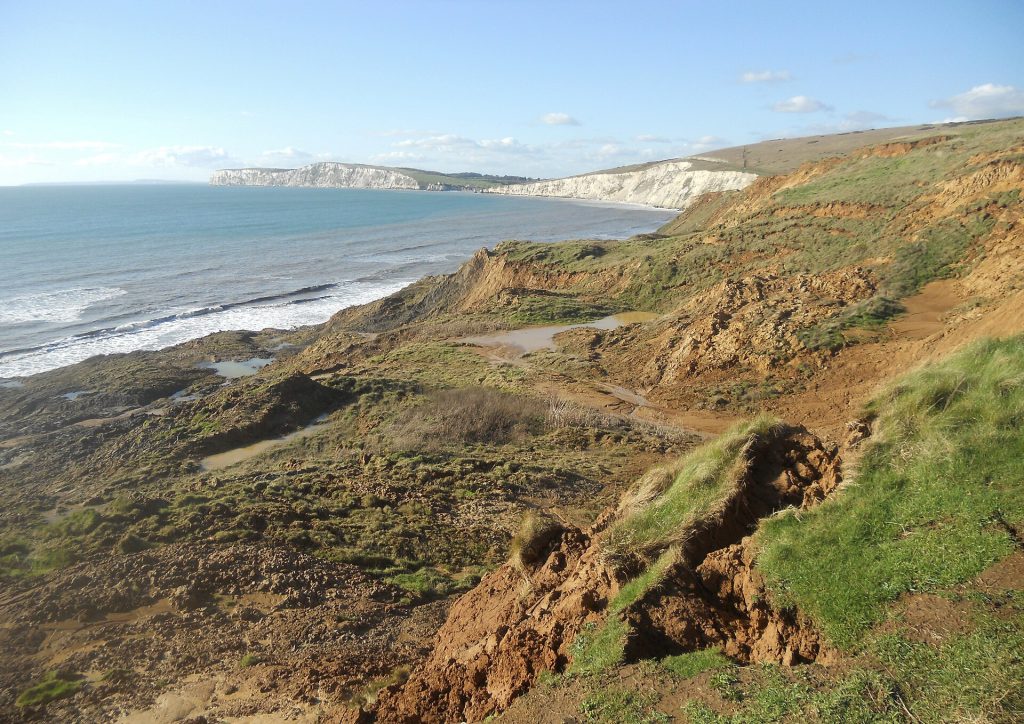
Soft rock explains the steady supply. Atlantic storms sweeping into the English Channel mean that this coast “is eroding fast,” as the National Trust puts it. Its parking lot at Hanover Point, for example, loses spaces at regular intervals. When the sea and strong waves erode the cliffs, dinosaur remains often fall onto the beach.
Geologists have also measured the loss. Between Cowleaze Chine and Barnes High, the cliffs retreated by an average of 73 meters (240 feet) between 1862 and 2022. Slumping adds to the confusion. At Chilton Chine, for instance, the strata have experienced a substantial rotational slump, which complicates the layering.
Consequently, the locality never stays the same for long. Marie Marsden and colleagues, who measured the retreat, suggested that the bed behind one early Hypsilophodon find may since have eroded away. New rock, meanwhile, keeps coming into view—and with it, new bone.

Two Centuries of Collectors
Victorian Pioneers
The island entered dinosaur science early. In 1829, William Buckland compared a large phalanx (a finger or toe bone) from Sandown Bay with Gideon Mantell’s newly described Iguanodon. Later, an iguanodontian sacrum from Brook Bay helped spur Richard Owen to coin the name Dinosauria in 1842. Mantell knew the island well too, and in 1847 he published a guidebook to its geology.
The best-known local collector, however, was the Reverend William Fox of Brighstone. In 1865, he excavated a partial skeleton of an armored dinosaur at Barnes High, and it became the type of Polacanthus foxii. Thomas Huxley then described Hypsilophodon foxii in 1869 from another of Fox’s specimens. Fox even named the first Wealden theropod himself in 1866—Calamospondylus oweni, whose holotype has since gone missing.
Reginald Walter Hooley continued the tradition. After a cliff fall in 1914, he obtained the skeleton now known as Mantellisaurus. It came from the Vectis Formation, unlike most of the island’s dinosaurs.
Modern Finders and Museum Drawers
Amateur collectors still supply many of the key specimens. Gavin Leng, for example, found Eotyrannus near Grange Chine in September 1997. Keith Simmonds helped find and excavate the skeleton that became Brighstoneus, and Nick Chase found Comptonatus in the cliffs of Compton Bay in 2013. Similarly, Mick Green found, prepared and donated bones of Vectiraptor.
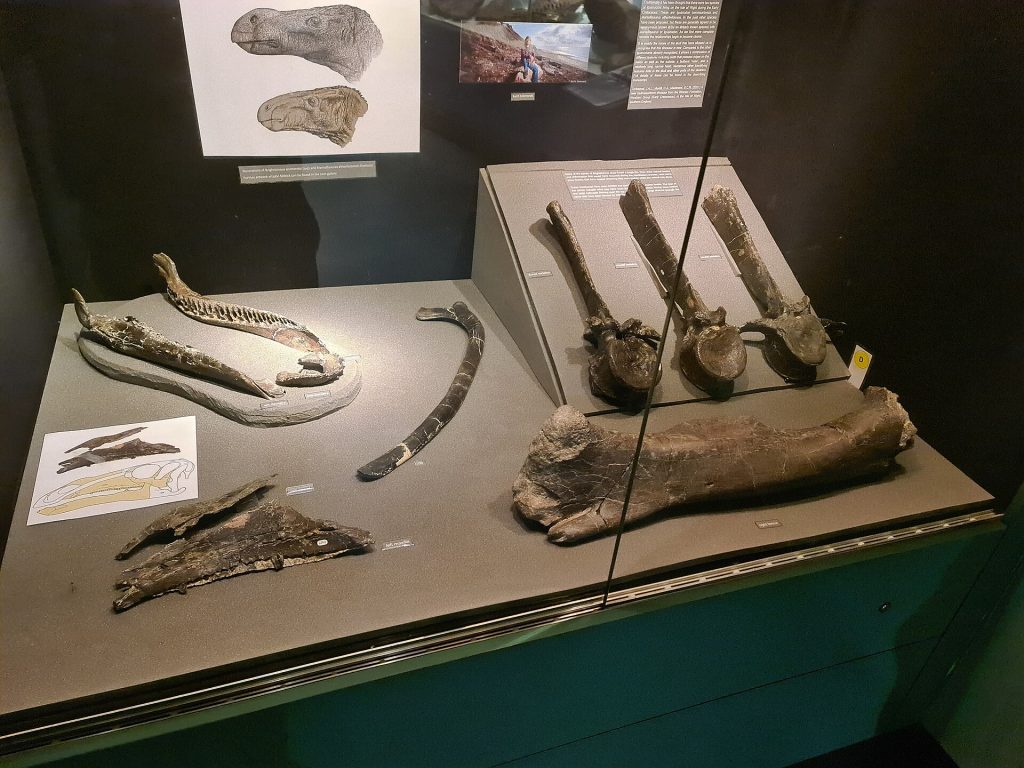
Other discoveries happen indoors—in museum collections. Jeremy Lockwood, a retired family doctor, named Istiorachis after re-examining bones in the collection of the Dinosaur Isle museum. In the words of paleontologist Susannah Maidment, he has “single-handedly quadrupled the known diversity of the smaller iguanodontians” on the island. Likewise, the braincase of Invictibellatrix had been in London’s Natural History Museum since 1924 before anyone described it.
The Dinosaurs of the Isle of Wight
Predators
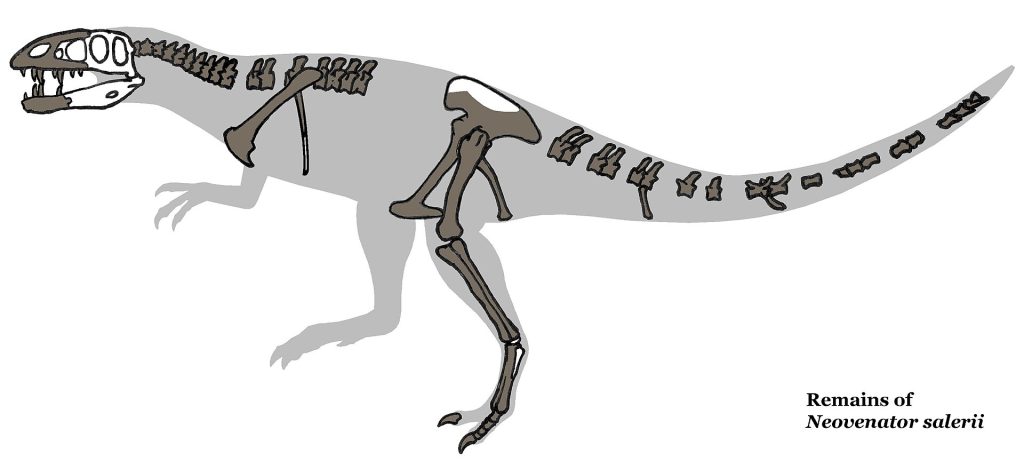
Neovenator salerii, named in 1996, is an allosauroid that its describers introduced as a gracile predator about 7.5 meters (24.6 feet) long. Its holotype was discovered in 1978, in the same small plot as the bones of Brighstoneus—just 3 by 6 meters (10 by 20 feet). Eotyrannus lengi, described in 2001, is a tyrannosauroid known from one subadult roughly 4.5 meters (14.8 feet) long.
Two spinosaurids joined them in 2021—Riparovenator milnerae and Ceratosuchops inferodios. Collectors picked up their bones at beach level near Chilton Chine between 2013 and 2017. Both are baryonychines, the group that includes Baryonyx from mainland England. A still larger spinosaurid comes from the base of the Vectis Formation near Compton Chine. Its describers, however, left it unnamed, even though its dimensions exceed those of the largest European theropods previously reported.

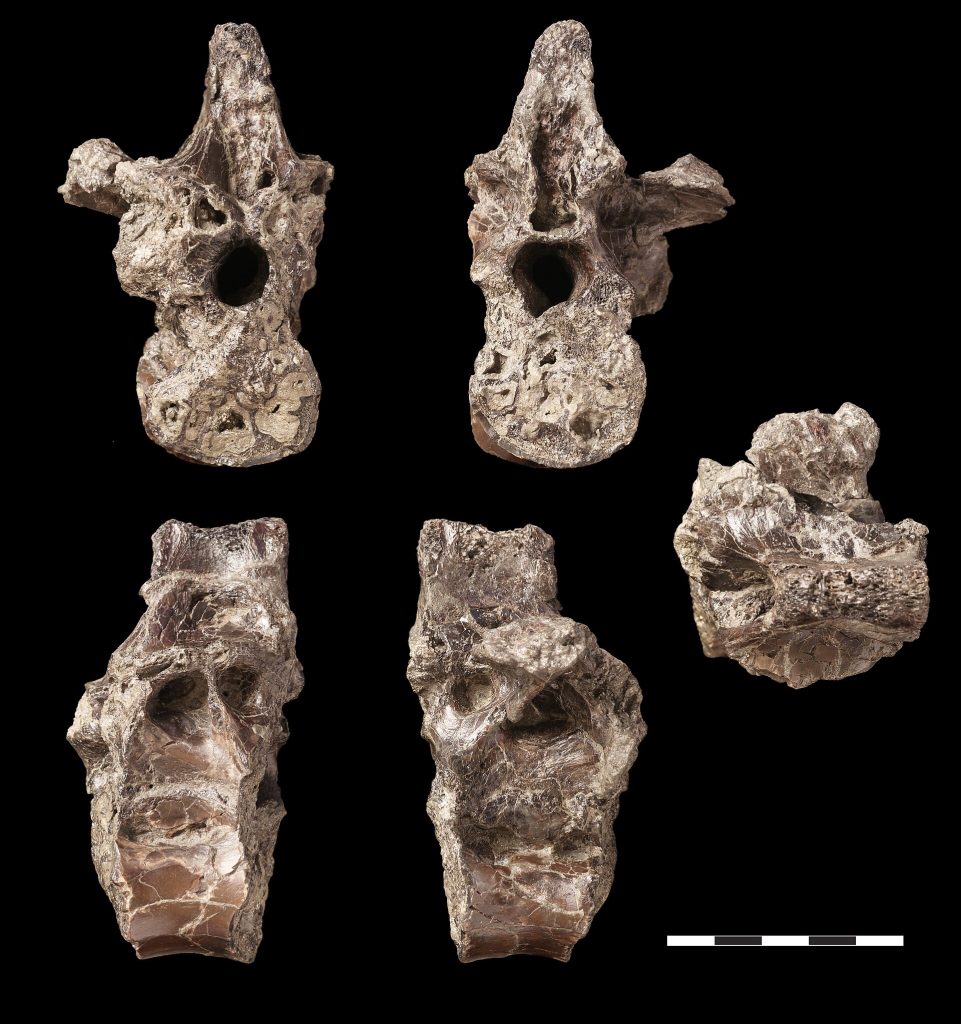
Smaller hunters are harder to pin down. Vectiraptor greeni is a dromaeosaurid based on back vertebrae and a partial sacrum—the fused vertebrae above the hips. Invictibellatrix amberina followed in October 2026, based on a braincase from Sudmoor Point. It is the first megaraptoran described from Europe, and at an estimated 3–4 meters (10–13 feet) long it is likely among the smallest. Later megaraptorans, however, grew larger and became top predators on the southern continents.
Plant-Eaters
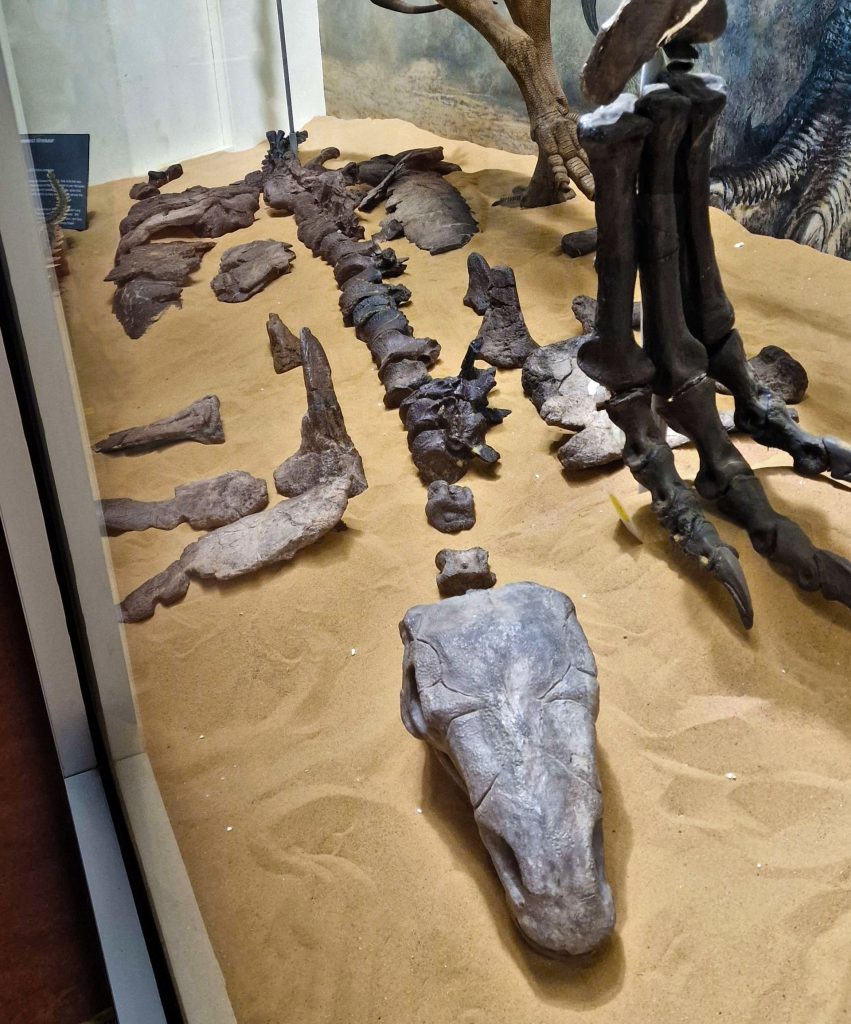
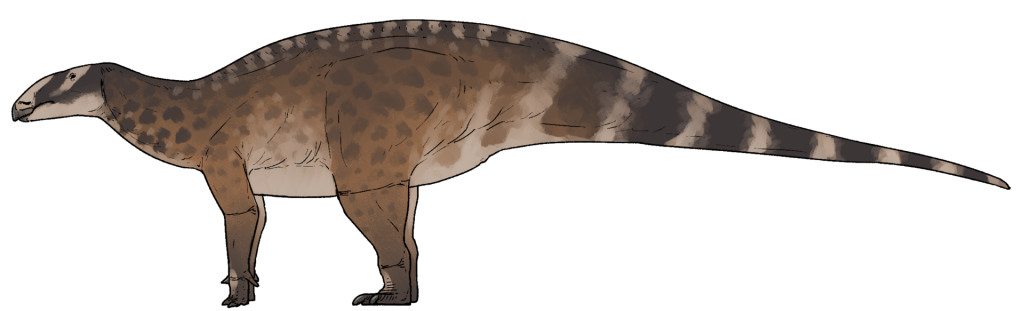
Large iguanodontians dominated this ecosystem, and their remains heavily outnumber those of other four-limbed animals. For almost a century, researchers sorted these bones into just two species—the robust Iguanodon bernissartensis and the lighter Mantellisaurus atherfieldensis. That picture has since changed. Brighstoneus simmondsi followed in 2021, and Comptonatus chasei in 2024. The latter rests on 149 bones, and the University of Portsmouth called it the most complete dinosaur discovered in the UK in the last 100 years.
Istiorachis macarthurae, named in 2025, adds something new—a possible sail along its back. Its name honors the round-the-world sailor Dame Ellen MacArthur, and Lockwood’s team thinks the tall spines most likely served for display. In addition, the dryosaurid Valdosaurus canaliculatus is known from less common remains.
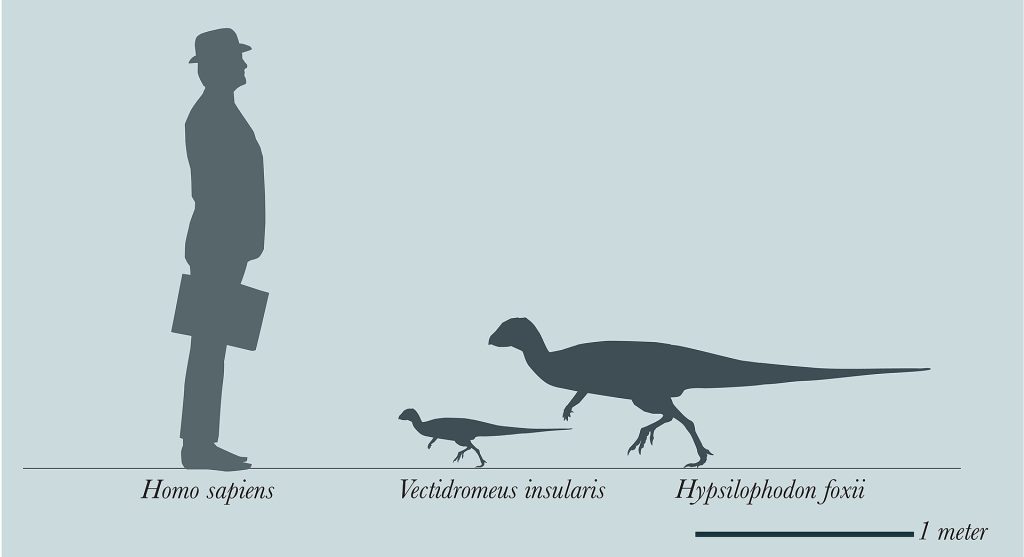
Among the small plant-eaters, Hypsilophodon foxii comes from a bed just 1–2 meters (3–7 feet) thick at the top of the Wessex Formation. Vectidromeus insularis, in contrast, was found near Sudmoor Point, some 150 meters (490 feet) lower in the sequence. The armored dinosaurs also doubled in number. Vectipelta barretti joined Polacanthus in 2023—according to the Natural History Museum, the first ankylosaur described from the island in about 142 years. Sauropods, finally, are represented by rebbachisaurid and titanosauriform remains.
Doubtful Names and Other Neighbors
Not every old name has survived. Calamospondylus oweni is a nomen dubium (a name not tied to diagnostic material), and Thecocoelurus is of uncertain status. Researchers still treat two other old names as valid, although the animals behind them are poorly known. Aristosuchus pusillus, based on a sacrum and partial pelvis, has been read as a compsognathid or a possible tyrannosauroid. Ornithodesmus, named for six fused sacral vertebrae, most likely represents a dromaeosaurid.
Dinosaurs were not alone, of course. The same beds also yield amphibians, crocodiles, pterosaurs, turtles, lizards, fish and even mammals.
Footprints on the Beach
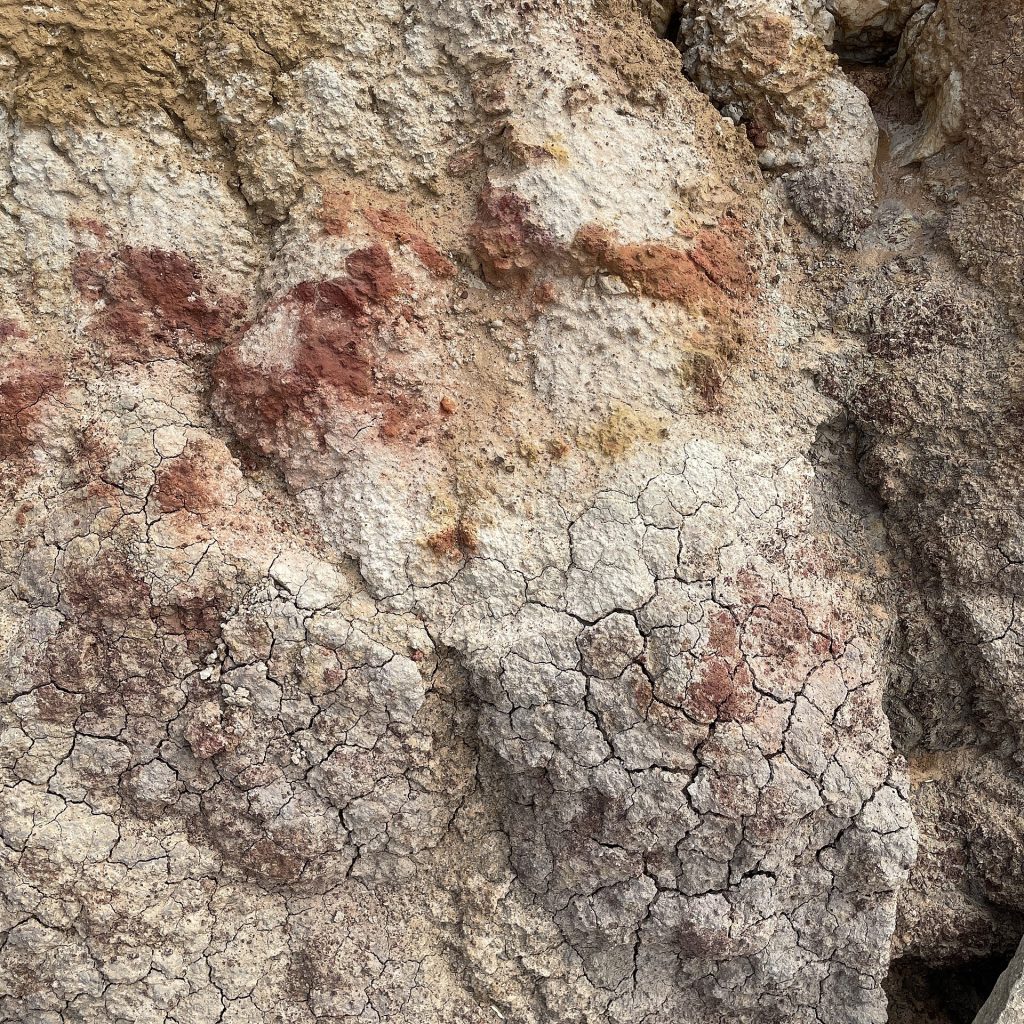
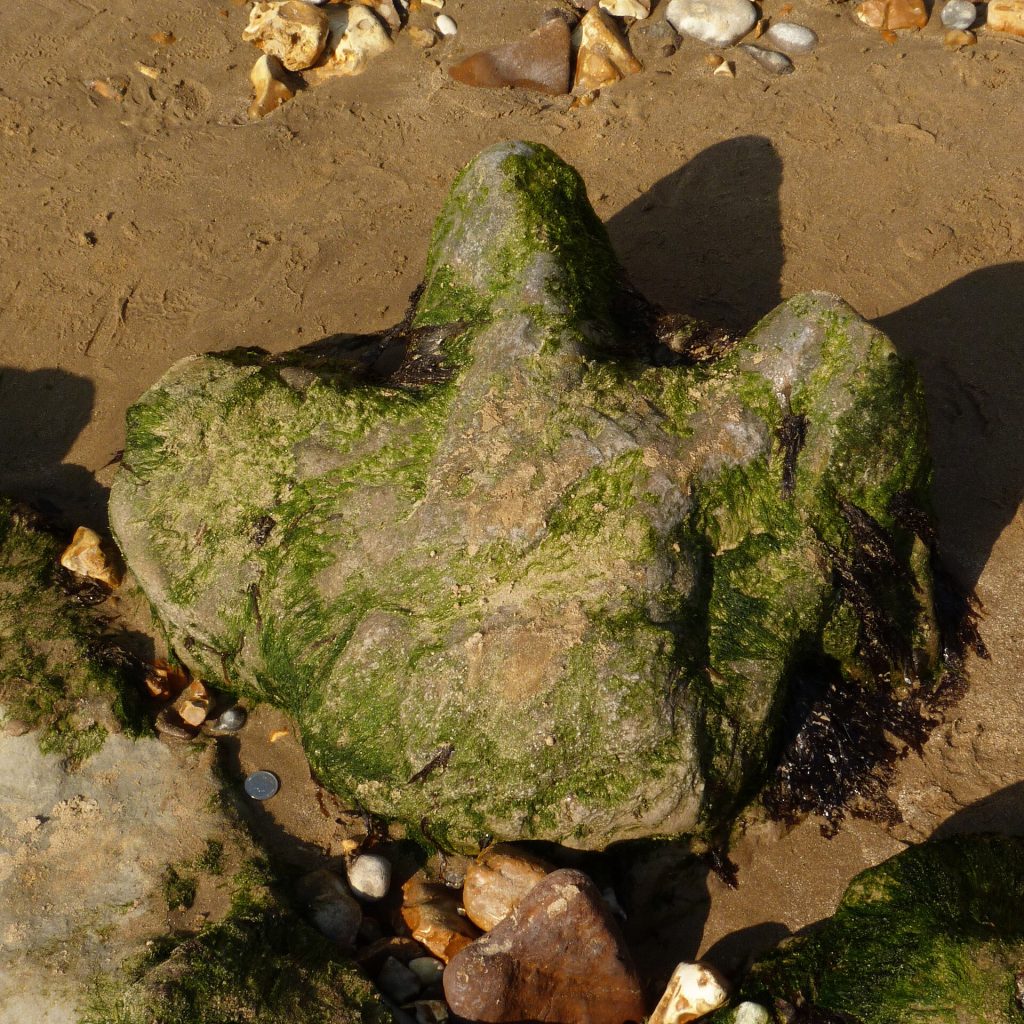
Bones are only part of the record. At Hanover Point, large three-toed foot casts lie at the base of the cliffs, each 30–60 centimeters (12–24 inches) across. The National Trust attributes them to iguanodontians. They formed when sediment filled footprints in floodplain mud and later hardened. Because the casts are tougher than the mudstone around them, they drop out as the cliff breaks down.
According to Visit Isle of Wight, about 300 foot casts are on record there. The National Trust adds that casts from meat-eating dinosaurs are rarer and have narrower, more pointed toes. Farther southeast, near Cowleaze Chine, impressions up to a meter (3.3 feet) wide mark the top of the Wessex Formation. Sauropods likely made them.

Visiting and the Fossil Rules
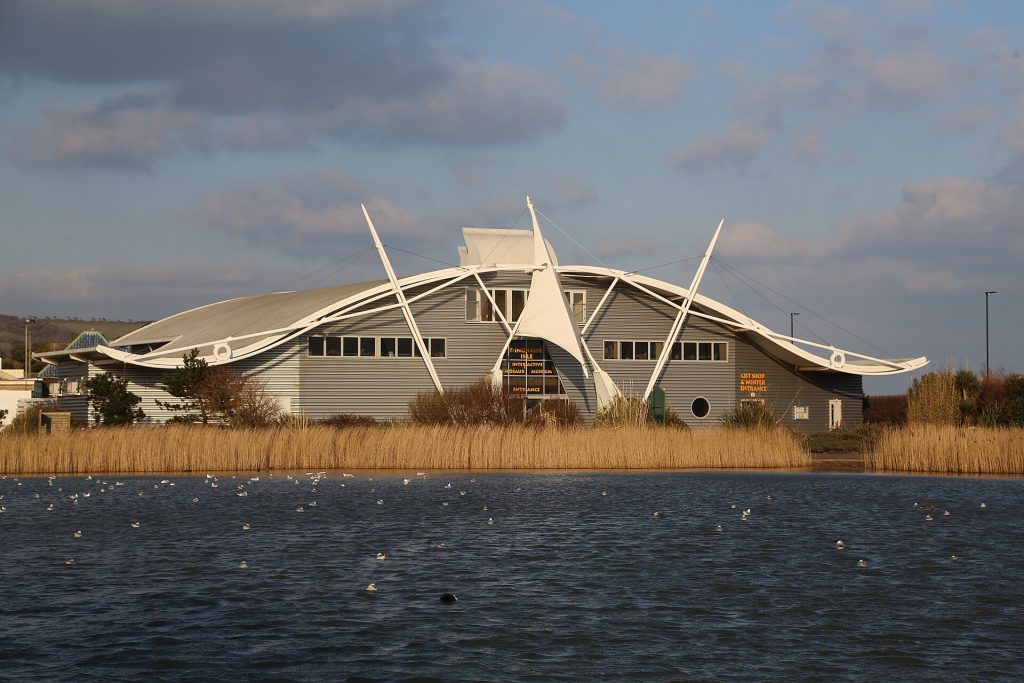
Most visits start at Dinosaur Isle in Sandown, billed as Britain’s first purpose-built dinosaur attraction. The museum stands just over the seawall from the beach, in a building shaped like a pterosaur. Inside, visitors can watch staff and volunteers prepare recent finds. A paleontologist is usually on hand to identify fossils, too. The museum team also leads fossil walks at Yaverland and Shanklin, which must be booked in advance.

On the southwest coast, the National Trust recommends searching between Brook Bay and Compton Bay at low tide. Its advice is to look in loose gravel on parts of the beach the sea has recently covered. Fossil bone there is usually black and shiny, with a honeycomb texture.
The rules are short and firm. The cliffs are unstable, so visitors should not climb them or sit too close. Hammers and digging are not allowed, and the tide can cut walkers off. Anything interesting in the cliff should stay in place, and the finder should photograph and report it. The foot casts, likewise, stay on the beach for everyone to enjoy. Much of this shore also lies within the Compton Chine to Steephill Cove Site of Special Scientific Interest. Natural England lists Wealden geology and Jurassic–Cretaceous reptiles among its protected features.
Isle of Wight Dinosaur Gallery
More views of the island’s fossil coast and of the animals found there.








Frequently Asked Questions
Yes. Erosion regularly drops bones, teeth and foot casts onto the beaches, and the National Trust says fossils of more than 20 dinosaur species have been found around Compton Bay.
Hanover Point, just east of the Compton Bay parking lot, is the best-known spot. Large three-toed foot casts lie at the base of the cliffs there, and low tide is the time to look.
They include the predators Neovenator, Eotyrannus, Riparovenator, Ceratosuchops, Vectiraptor and Invictibellatrix. Plant-eaters include Iguanodon, Mantellisaurus, Brighstoneus, Comptonatus, Istiorachis, Valdosaurus, Hypsilophodon, Vectidromeus, Polacanthus and Vectipelta, along with sauropods.
Most come from the Wessex Formation, which dates largely to the Barremian stage, roughly 125.8–121.4 million years ago. The overlying Vectis Formation, however, reaches into the early Aptian.
Visitors may search the loose beach material at National Trust sites such as Compton Bay. However, hammers and digging are not allowed there. Finds in the cliff should be left in place, photographed and reported.
Dinosaur Isle in Sandown displays many of the real bones and holds specimens such as Comptonatus. The Natural History Museum in London, meanwhile, cares for historic finds, including the Invictibellatrix braincase.
Sources
The information in this article is based on various sources, drawing on scientific research, fossil evidence, and expert analysis. The aim is to provide a comprehensive and accurate overview of the Isle of Wight’s dinosaurs. However, please be aware that our understanding of dinosaurs and their world is constantly evolving as new discoveries are made.
- https://doi.org/10.1038/s41598-021-97870-8
- https://doi.org/10.1080/14772019.2021.1978005
- https://doi.org/10.1144/jgs2024-046
- https://doi.org/10.7717/peerj.12727
- https://doi.org/10.7717/peerj.13543
- https://doi.org/10.1098/rsos.260937
- https://doi.org/10.1016/j.cretres.2023.105590
- https://doi.org/10.1016/j.cretres.2021.105123
- https://researchportal.bath.ac.uk/en/publications/a-new-dromaeosaurid-dinosaur-from-the-wessex-formation-lower-cret
- https://doi.org/10.1016/j.cretres.2023.105707
- https://researchportal.bath.ac.uk/en/publications/ivectidromeus-insularisi-a-new-hypsilophodontid-dinosaur-from-the/
- https://doi.org/10.1080/14772019.2024.2346573
- https://www.sciencedaily.com/releases/2024/07/240710130921.htm
- https://doi.org/10.1080/14772019.2023.2210577
- https://www.nhm.ac.uk/discover/news/2023/june/new-species-of-dinosaur-named-after-museum-scientist-paul-barrett.html
- https://doi.org/10.1002/spp2.70034
- https://www.nhm.ac.uk/press-office/press-releases/-striking-sail–may-have-helped-dinosaurs-find-mates–new-fossil.html
- https://www.nhm.ac.uk/discover/news/2025/august/new-sail-backed-dinosaur-species-unearthed-isle-of-wight.html
- https://www.nhm.ac.uk/press-office/press-releases/uk-dinosaur-fossil-identified-as-new-long-clawed-predator.html
- https://www.biodiversitylibrary.org/part/173868
- https://www.schweizerbart.de/papers/njgpm/detail/1996/92309/The_first_European_allosaurid_dinosaur_Lower_Creta
- https://webapps.bgs.ac.uk/lexicon/lexicon.cfm?pub=VTIS
- https://webapps.bgs.ac.uk/lexicon/lexicon.cfm?pub=WSEX
- https://doi.org/10.1016/j.palaeo.2010.03.055
- https://stratigraphy.org/ICSchart/ChronostratChart2024-12.pdf
- https://www.nationaltrust.org.uk/visit/isle-of-wight/compton-bay-and-downs/fossil-hunting-and-geology-at-compton-bay-and-downs
- https://assets.publishing.service.gov.uk/media/5e70b58786650c72713d24ed/isle-of-wight-nature-conservation-assessment.pdf
- https://www.visitisleofwight.co.uk/things-to-do/dinosaur-isle-p143561
- https://www.visitisleofwight.co.uk/things-to-do/attractions/dinosaurs-and-fossils
- https://www.visitsoutheastengland.com/events/fossil-walks-with-dinosaur-isle-p2411151
This article was last fact checked: TheDinosaurs Team, 24-11-2026
Featured Image Credit: Mypix, CC BY-SA 4.0, via Wikimedia Commons
