
In Morocco’s Oulad Abdoun Basin, the Sidi Chennane mine has yielded the first dinosaur known from a phosphate layer called Lower Couche III. Named Phosphatotitan khouribgaensis in 2026, this titanosaur probably lived in the late, but not latest, Maastrichtian—the final stage of the Cretaceous. According to its describers, its closest relatives were South American giants such as the colossal Argentinosaurus.
In April 2026, paleontologist Nicholas R. Longrich and five colleagues described it from one partial skeleton. Their analysis places it in Argentinosauridae, a family best known for South American giants, yet at an estimated 3.5 to 4.3 metric tons it was small for its kind. The bones also shed light on a latest-Cretaceous Moroccan fauna that its describers argue was endemic—found nowhere else.
Phosphatotitan Key Facts
| Keyword | Fact |
|---|---|
| Pronunciation | Not specified |
| Meaning of name | Phosphate Giant |
| Group | Sauropoda |
| Type Species | Phosphatotitan khouribgaensis |
| Diet | Herbivore |
| When it Lived | Late but not latest Maastrichtian (no numeric age given), a stage the international timescale dates to 72.1 to 66.0 MYA |
| Period | Cretaceous |
| Epoch | Late Cretaceous (Maastrichtian stage) |
| Length | Not specified (about one-third the length of giant relatives such as Patagotitan) |
| Height | Not specified |
| Weight | About 7,700 to 9,500 pounds (3.5 to 4.3 metric tons), or 3.5 to 4 metric tons in the abstract |
| Mobility | Not specified |
| First Discovery | Year and finder not specified |
| Described by | 2026 by N.R. Longrich, A. Pérez-Moreno, V. Díez Díaz, X. Pereda-Suberbiola, N. Bardet, and N.-E. Jalil |
| Holotype | MHNM.KHG.888 |
| Location of first find | Lower Couche III, Sidi Chennane mine, Oulad Abdoun Basin, Khouribga Province, Morocco |
Phosphatotitan Origins, Taxonomy and Timeline
The name Phosphatotitan pairs geology with grandeur. Its first part refers to the phosphate deposits of Morocco, while titan is Greek for “giant.” The species name khouribgaensis refers to Khouribga Province, the region that holds the Sidi Chennane mine. Together, the name roots the animal in the very rock that preserved it.
In terms of classification, Phosphatotitan belongs to Sauropoda, the long-necked dinosaurs, and sits within Titanosauria. More narrowly, it falls in Lognkosauria and the family Argentinosauridae, which in the authors’ results includes Argentinosaurus, Patagotitan, Phosphatotitan, and the Daoui titanosaur, an unnamed Moroccan hind limb. Longrich and colleagues found it closer to Argentinosaurus than to Aeolosaurus or Rinconsaurus. Their tree also made Argentinosauria the sister group of Aeolosaurini, together forming Colossosauria. However, that pairing did not hold up consistently under implied weighting—a method that downweights frequently changing traits. Phosphatotitan khouribgaensis is the type and only known species.
The describers date Lower Couche III to the late, but not latest, Maastrichtian, a stage spanning roughly 72.1 to 66.0 million years ago on the international timescale. The paper gives no numeric age for the layer, and its precise age is unknown. Instead, the dating rests on a shark fauna that resembles the one in Upper Couche III. That upper layer covers the Maastrichtian’s final million years and is at least a million years younger than the lower beds. Phosphatotitan therefore lived late in the Cretaceous’s last stage, though before the period’s very end.
Discovery & Fossil Evidence
The skeleton comes from the Sidi Chennane mine, in the Oulad Abdoun Basin of Khouribga Province, and Mick Green and Shaun Smith helped prepare it. Before this find, every described dinosaur from the phosphates came from the upper part of the Cretaceous beds. Likewise, the only described sauropod material was a partial titanosaur hind limb from Sidi Daoui, reported in 2004 by Pereda-Suberbiola and colleagues. It is now informally called the Daoui titanosaur. That makes the new skeleton a first for its layer and a rare sauropod record for the phosphates.
The Muséum d’Histoire naturelle de Marrakech in Morocco houses the holotype, MHNM.KHG.888. It preserves associated dorsal (back), sacral (hip), and caudal (tail) vertebrae. Alongside them lie fragments of the ilium—the main hip blade—plus both pubes and a probable ischium, the lower pelvic bones. The bones show crushing, shearing, and cracking, and the ilium survives only as front and back fragments. Longrich and colleagues combine them in an interpretive reconstruction.
The main text names no referred specimens, so the species rests on the holotype alone. That Sidi Daoui hind limb groups with Phosphatotitan in the analysis. Even so, it comes from a younger level, the uppermost Maastrichtian of Sidi Daoui, so the authors consider it unlikely to be the same species. No additional specimens of Phosphatotitan have been confirmed outside the Sidi Chennane mine.

Phosphatotitan Size and Description
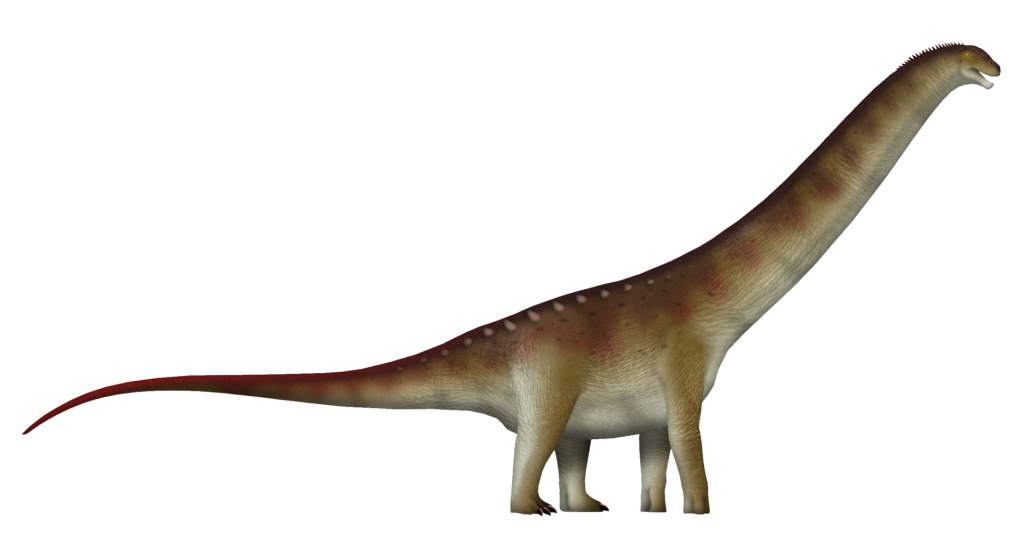
Only part of the skeleton survives, so any portrait of Phosphatotitan leans on its better-known South American relatives.
Short description of Phosphatotitan
No skull, neck, or limb bones are known, so a description must start at the back. One dorsal vertebra, probably from the rear of the back, has a centrum (vertebral body) about 8.1 inches (205 millimeters) wide. The centrum is 6.3 inches (159 millimeters) high, and the whole vertebra stands about 17.8 inches (452 millimeters) tall. Its neural spine—the blade rising from the top—was strongly broadened by a pair of wing-like side processes. In fact, the spine is wider than the centrum itself. A small, triangular pleurocoel (air-sac opening) sat high on the front of the centrum.
At the hips, at least four vertebrae formed a sacrum shaped like a slender bar. Inside, it was camellate—filled with many small air chambers—and the ilium fragments share that structure. The pubes were remarkably short and broad, ending in a very large “boot” with a hooked projection. Meanwhile, the L-shaped probable ischium carried a long, narrow blade dotted with tiny air openings.
A caudal vertebra from the tail base, possibly the first in the series, stands about 19.2 inches (487 millimeters) tall. Yet its centrum is only about 2.2 inches (55 millimeters) long. Skin, posture, and coloration are unknown, so any restoration of its outward appearance is speculative.
Size and Weight of Type Species
The 2026 paper gives no length in feet or meters. Instead, it describes Phosphatotitan and the Daoui titanosaur as around one-third the length of their giant relatives. For scale, the authors give Patagotitan a length of about 98 to 131 feet (30 to 40 meters).
Weight is better constrained, though it remains an indirect estimate. Longrich and colleagues scaled from dorsal centrum height—6.3 inches (15.9 centimeters) in Phosphatotitan against an average of about 15.7 inches (40 centimeters) in Patagotitan. Assuming isometric scaling, or the same proportions at every size, they put it at 6.28 percent of Patagotitan‘s mass. With reference masses of 57 and 69 metric tons for Patagotitan, the result is about 7,700 to 9,500 pounds (3.5 to 4.3 metric tons). Their abstract, however, rounds the range to 3.5 to 4 metric tons.
By comparison, the Daoui titanosaur had a femur, or thigh bone, about 3.3 feet (100 centimeters) long and an estimated mass of 4 to 5.1 metric tons. Both Moroccan animals, the authors note, were much smaller than other argentinosaurs—modest members of a family famous for giants.
The Dinosaur in Detail
What sets this dinosaur apart shows up mostly in its spines and hips. Its describers diagnose it by a unique combination of characters, several of them autapomorphies—traits found in no other species. In the back, the neural spine is wider than the centrum and flanked by wing-like processes. At the same time, the prezygapophyses (forward joints between vertebrae) sit nearly horizontal in front view. Farther back, the tail’s neural spine is spoon-shaped, broadened sideways, and curved forward. The pubic boot carries a hooked side projection, and the pubic foramen (an opening in the pubis) sits unusually low. The probable ischium adds many small pneumatopores, or air-sac openings.
Several of these features echo South American relatives. The expanded dorsal spine and its side wings also appear, though less extremely, in Patagotitan, and to a lesser degree in Argentinosaurus. Similarly, the plate-like neural arch of the tail vertebra occurs in Patagotitan and Mendozasaurus but not in the basal argentinosaur Notocolossus. Overall, the closest anatomical match is Patagotitan, with short centra, a broad pubis, and expanded neural spines. Still, the pubis of Patagotitan is somewhat narrower.
To test these links, the team ran a New Technology Search in the phylogenetics program TNT. The result was a strict consensus of five most parsimonious trees—the simplest branching patterns that fit the data—with a length of 1,978 steps. Within it, Phosphatotitan sits among giants from the middle Cretaceous of South America.
The authors call a faunal connection between Morocco and South America “perhaps unsurprising.” Yet they label their scenarios for how the lineage spread, by dispersal or by vicariance (separation as landmasses split), as hypothetical. The bones describe a smaller African cousin of South America’s giants—with its route to Morocco still an open question.
Interesting Points about Phosphatotitan
- It is the first dinosaur known from Lower Couche III, since all earlier phosphate dinosaurs came from the upper beds.
- Its name refers to Morocco’s phosphate deposits and the Greek word for “giant,” while the species name refers to Khouribga Province.
- Its estimated weight of 3.5 to 4.3 metric tons comes from scaling one back vertebra against the far larger Patagotitan.
- Although found in North Africa, it groups with South American giants such as Argentinosaurus and Patagotitan in the phylogenetic analysis.
- Its back vertebra carries a neural spine wider than the centrum itself, flanked by wing-like processes more extreme than those of Patagotitan.
Phosphatotitan in its Natural Habitat
The rocks that hold Phosphatotitan formed in a warm, shallow epicontinental sea—a sea spread across part of a continent. Researchers interpret the nearby Ganntour basin as a highly productive, low-latitude upwelling zone, where deep, nutrient-rich water rises toward the surface. The Khouribga deposits presumably formed under similar conditions. Couche III is exceptional for its abundant, diverse vertebrates, from sharks and bony fish to plesiosaurs, turtles, mosasaurs, crocodiles, and pterosaurs. However, the paper does not say whether these animals shared the holotype’s bed, so they belong to the wider Couche III picture.
Dinosaurs are relatively rare here, occurring within a marine assemblage dominated by dissociated remains. While there is no direct evidence of what Phosphatotitan ate, it was probably a plant-eater like other sauropods. The authors write that argentinosaurs appear to have persisted in Morocco as the dominant large herbivores. Its teeth and jaws remain unknown, since no skull survives.
Its social behavior is unknown. Instead, the authors suggest a lineage selected for small size and consider why Moroccan titanosaurs stayed so small. One possibility is that landmass area constrained the maximum size of herbivores, and another is a shift toward smaller herbivores. The paper frames both as possible explanations rather than conclusions. The authors also argue that Morocco supported a unique, endemic fauna in the latest Cretaceous.
Elsewhere in the mine, the upper beds of Couche III yielded the abelisaurid theropod (predatory dinosaur) Chenanisaurus. Those beds are at least a million years younger than the layer that held Phosphatotitan. Three hadrosaurids (duck-billed dinosaurs)—Ajnabia, Minqaria, and Taleta—come from the same younger beds. They therefore lived later than Phosphatotitan, not alongside it.
Frequently Asked Questions
It means “phosphate giant,” after Morocco’s phosphate deposits, and the species name refers to Khouribga Province.
It probably lived in the late, but not latest, Maastrichtian stage of the Late Cretaceous, though its describers give no numeric age.
Its describers estimated 7,700 to 9,500 pounds (3.5 to 4.3 metric tons) and one-third the length of giant relatives.
It was a titanosaurian sauropod in the family Argentinosauridae, related to South America’s Argentinosaurus and Patagotitan.
Its only known skeleton comes from Lower Couche III at the Sidi Chennane mine in Morocco’s Khouribga Province.
It had wing-like back spines, a spoon-shaped tail spine, and a hooked pubic boot. It is also the first dinosaur known from Lower Couche III.
Sources
The information in this article is based on various sources, drawing on scientific research, fossil evidence, and expert analysis. The aim is to provide a comprehensive and accurate overview of Phosphatotitan. However, please be aware that our understanding of dinosaurs and their world is constantly evolving as new discoveries are made.
- https://doi.org/10.3390/d18050241
- https://www.mdpi.com/1424-2818/18/5/241
- https://doi.org/10.1016/j.cretres.2017.03.021
- https://doi.org/10.1016/j.jafrearsci.2004.07.002
- https://stratigraphy.org/chart
This article was last fact checked: TheDinosaurs Team, 18-11-2026
Featured Image Credit: Connor Ashbridge, CC BY 4.0, via Wikimedia Commons
