
In Yuanmou County, in China’s Yunnan Province, the red siltstones of the Zhanghe Formation have yielded a sauropod known from just six vertebrae. Named Yantaloong lini in 2026, it lived during the Middle Jurassic, probably in the Aalenian or Bajocian stages—roughly 175 to 168 million years ago. Its describers argue that it probably represents the first turiasaurian sauropod known from China, and even from East Asia. That claim stands out because, in the describers’ words, China’s Middle Jurassic dinosaur fauna is “dominated by mamenchisaurid sauropods.” This is the family of long-necked giants that includes Mamenchisaurus, though the same fauna also holds some early-diverging eusauropods and neosauropods.
According to the Chinese news agency Xinhua, researchers found the bones in 2006 during a field survey near Jiangyi Township. Twenty years later, Xiao-Qin Zhang of Chuxiong Normal University and eleven colleagues described them in the Zoological Journal of the Linnean Society. The team came from universities, museums, and research institutes in Yunnan and Beijing. Although only six vertebrae survive, they preserve a striking blend of early and later sauropod features. According to its describers, no transitional form between mamenchisaurids and neosauropods had previously been confirmed in East Asia.
Yantaloong Key Facts
| Keyword | Fact |
|---|---|
| Pronunciation | Not specified |
| Meaning of name | Not specified (Chinese name 林氏雁塔龙) |
| Group | Sauropod (Eusauropoda, possibly Turiasauria) |
| Type Species | Yantaloong lini |
| Diet | Herbivore (inferred from other sauropods) |
| When it Lived | About 175 to 168 MYA |
| Period | Jurassic |
| Epoch | Middle Jurassic (Aalenian to Bajocian stages) |
| Length | Not specified |
| Height | Not specified |
| Weight | Not specified |
| Mobility | Moved on all four legs (quadrupedal), inferred from other sauropods |
| First Discovery | 2006, during a field survey (finder not named) |
| Described by | 2026 by X.-Q. Zhang, Y.-M. Wang, Z.-J. Wang, Y.-C. Wang, T. Wang, G.-F. Wang, Y. Zou, Q.-X. Dong, X. Su, H. Jiang, Y.-J. Wang, and H.-L. You |
| Holotype | LFGT-ZLJ0073 (six presacral vertebrae) |
| Location of first find | Zhanghe Formation, near Jiangyi Township, Yuanmou County, Chuxiong Yi Autonomous Prefecture, Yunnan Province, China |
Yantaloong Origins, Taxonomy and Timeline
Read character by character, the animal’s Chinese name, 林氏雁塔龙, translates as “Lin’s Yanta dragon,” while 雁塔 alone means “wild goose pagoda.” The species name lini likewise appears to honor someone surnamed Lin. Together, the name pairs a surname with “Yanta”—a word whose specific meaning here remains unexplained.
Yantaloong is a sauropod, and more precisely a member of Eusauropoda, the “true sauropods.” Most of the describers’ phylogenetic analyses (computer-built family trees based on anatomical traits) recover it within what they call a “non-traditional Turiasauria clade.” That group also includes Jobaria, Lapparentosaurus, and Atlasaurus. However, other results place it either outside the traditional Turiasauria as a non-neosauropod eusauropod or within Neosauropoda itself—options the authors call “less favoured.” Their analyses drew on two large datasets, one scoring 551 characters for 128 taxa and the other 449 characters for 112 taxa. Yantaloong lini is the type and only known species.
Yantaloong comes from the Middle Jurassic Zhanghe Formation. In 2015, Xing and colleagues assigned that formation to the Aalenian and Bajocian stages, and Zou and colleagues did the same in 2025. Both followed Yunnan’s 1990 regional geological survey. On the current timescale, that interval runs from roughly 175 to 168 million years ago. Even so, Zou’s team notes that the formation’s absolute age “remains unclear.” One news report, from Sci.News, gives 174 to 161 million years ago, but that figure covers the whole Middle Jurassic. Xing’s team also notes that the Zhanghe rocks predate the well-documented sauropod fauna of the Shaximiao Formation in Sichuan. In 2018, Wang and colleagues dated zircon grains from the lower Shaximiao beds. Those beds proved no older than about 159 million years—already Late Jurassic. In other words, Yantaloong belongs to an earlier chapter of Chinese sauropod history.
Discovery & Fossil Evidence
According to Xinhua, researchers came across the specimen in 2006 during a field survey at Zhongbanqing Village, in Jiangyi Township, Yuanmou County. The original paper’s location map places the site around Jiangyi Township, within Yunnan’s Chuxiong Yi Autonomous Prefecture. Formal naming followed in 2026—a gap of about 20 years.
The specimen, cataloged as LFGT-ZLJ0073, consists of six presacral vertebrae—the backbones in front of the hips. Xinhua reports that these include one cervical (neck) vertebra and five dorsal (back) vertebrae. Because the genus and species rest on this single specimen, every statement about the animal traces back to these six bones.
After preparation and assembly, the vertebrae went on display in 2017 at the Lufeng Dinosaur Fossil Science Education Base, according to Xinhua. The holotype includes no skull, limb, or tail bones, so only part of the backbone survives. So far, no one has reported additional specimens of Yantaloong.
Yantaloong Size and Description
With only six vertebrae to go on, Yantaloong is better known for the details of its backbone than for its overall shape.
Short description of Yantaloong
Because no skull or limbs survive, any full-body picture of Yantaloong rests on comparisons with other sauropods. As a sauropod, it most likely walked on all four legs, although its known bones cannot show this directly. Its surviving bones come from the neck and the back, according to news reports of the specimen.
Two features of these vertebrae stand out, starting with pneumatization—air spaces built into the bone. The second is the hyposphene–hypantrum complex, a set of extra joints between neighboring vertebrae. Speaking to Xinhua, Zhang described its vertebrae as showing a unique combination of air-chamber structures. By Zhang’s account, that combination joins early eusauropod traits with features of later sauropods—diplodocoids and titanosaurs among them.
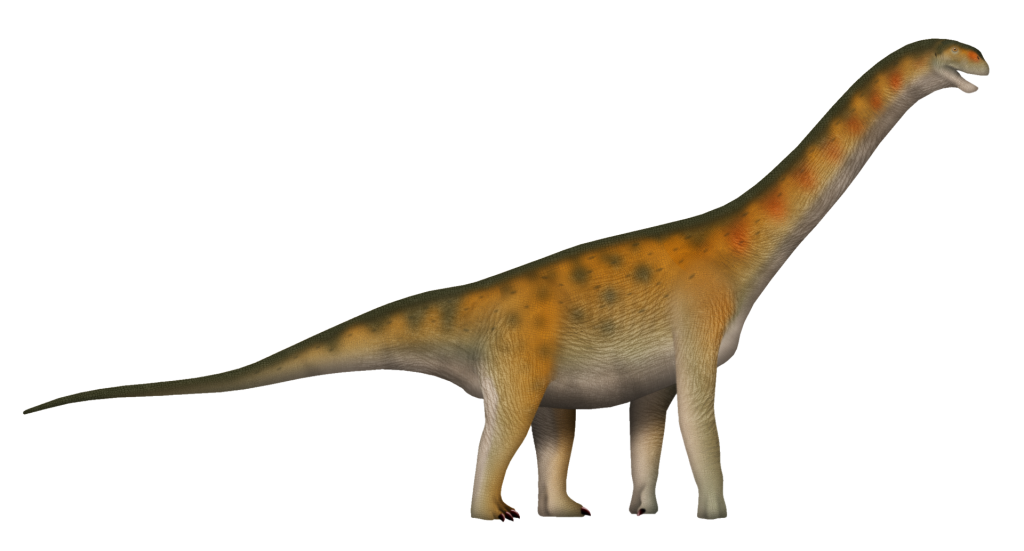
Skin impressions or soft tissue are not preserved, so any discussion of its outward appearance is speculative. Instead, artists’ reconstructions fill in the missing body from better-known relatives.

Size and Weight of Type Species
A published size estimate for Yantaloong has yet to surface. Likewise, the news coverage from Xinhua and Sci.News offers no length, height, or weight figures.
Without a more complete skeleton, any estimate would have to come from scaling the vertebrae against better-known relatives. As a result, its true bulk remains a matter for future study of the bones themselves.
For now, its size remains an open question—so life reconstructions are artistic interpretations, not measured portraits.
The Dinosaur in Detail
What sets this dinosaur apart is its mix of old and new features. The describers note a “unique mixture” of derived characters typical of derived dicraeosaurines and even titanosaurs, along with plesiomorphic traits characteristic of basal eusauropods. Here, “derived” means later-evolved and “plesiomorphic” means ancestral. Put simply, some of its vertebral traits recall the dicraeosaurines, the group that includes Dicraeosaurus, and the titanosaurs, while others resemble far earlier sauropods.
The authors argue that its pneumatization and hyposphene–hypantrum complex support reading Yantaloong as “a form transitional towards Neosauropoda.” Neosauropoda is the lineage that includes the later diplodocoids and titanosaurs. In that sense, the vertebrae capture a step that East Asian fossils had not previously confirmed.
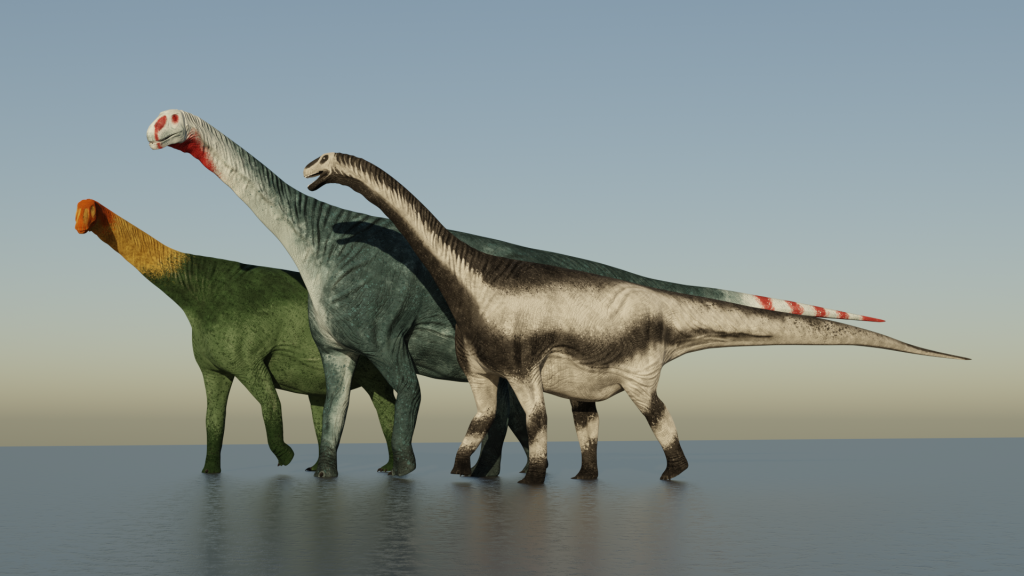

That step matters for China in particular. Before this study, the describers note, mamenchisaurids dominated China’s Middle Jurassic fauna, with some early-diverging eusauropods and neosauropods. None of them, however, was a confirmed transitional form leading toward neosauropods. In Xinhua’s report, corresponding author Ya-Ming Wang went further, suggesting that Yantaloong and other recent Chinese finds show something broader. In his reading, neosauropods and their close relatives were already diverse and widespread in Middle Jurassic East Asia.
Its exact placement, however, remains unsettled. Most analyses group it with Jobaria, Lapparentosaurus, and Atlasaurus in a broadened Turiasauria. However, less favored results place it outside the traditional Turiasauria or inside Neosauropoda. These vertebrae point to an animal caught between lineages—its true branch still open to debate.
Interesting Points about Yantaloong
- Although researchers found its bones in 2006, Yantaloong did not receive its formal name until 2026, about 20 years later.
- Its vertebrae went on public display at the Lufeng Dinosaur Fossil Science Education Base in 2017, years before the species had a scientific name.
- The entire species rests on six presacral vertebrae, cataloged together as the specimen LFGT-ZLJ0073.
- Its describers say it probably represents the first turiasaurian sauropod discovered in China, and even in East Asia.
- Corresponding author Ya-Ming Wang told Xinhua that the find fills a research gap for this evolutionary stage in East Asia.
Dinosaurs from the Same Formation
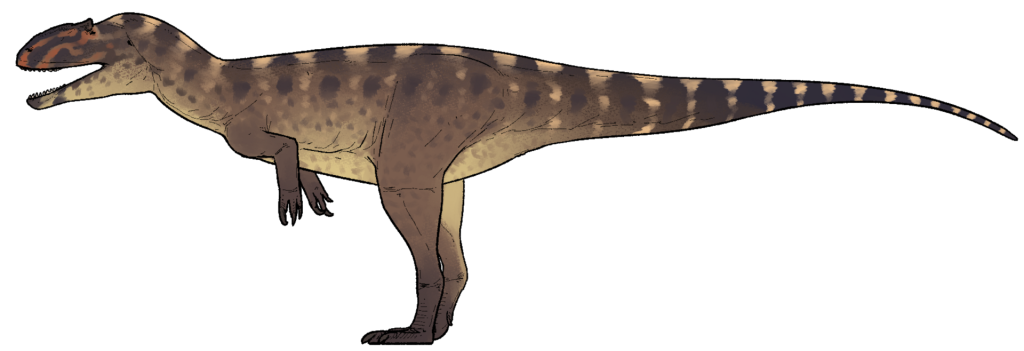
Also known from the Zhanghe Formation (exact level relative to Yantaloong not known): the metriacanthosaurid theropod Yuanmouraptor, the basal eusauropod Nebulasaurus, and the mamenchisaurids Eomamenchisaurus and Yuanmousaurus. Yuanmouraptor comes from a nearly complete skull with its lower jaw and 11 front vertebrae. Nebulasaurus, by contrast, is known only from a braincase. Both come from Xiabanjing, a different village in the same Jiangyi Township. In 2015, Xing and colleagues placed Eomamenchisaurus and Yuanmousaurus among the mamenchisaurids but marked the taxonomic status of both as uncertain. The formation’s two stages together cover several million years, so these animals may not all have lived at the same time.

Yantaloong in its Natural Habitat
The world Yantaloong roamed survives today as thick red rock. During the Jurassic, central Yunnan received continental deposits that built up a suite of thick red siltstone beds. The Zhanghe Formation is the representative Middle Jurassic deposit of the Chuxiong subregion in central Yunnan. A regional survey team first established it at Zhanghe Village in Xiangyun County in 1961 or 1965. Around Jiangyi, it consists of red argillaceous (clay-rich) siltstone with red sandstone layers between. It rests conformably—without a major break—on the Early Jurassic Fengjiahe Formation.
While there is no direct evidence of what Yantaloong ate, sauropods as a group were plant-eaters, and it was most likely a herbivore too. Its six vertebrae reveal nothing about its feeding height or favorite plants. Without a skull or teeth, even the basics of its diet come from relatives—an inference rather than an observation.
According to Xing and colleagues, the Zhanghe Formation holds a “highly heterogeneous sauropodomorph fauna” that preceded the mamenchisaurid dominance of the Late Jurassic in East Asia. Their list included the sauropodomorph Yunnanosaurus youngi. In 2025, however, Zou and colleagues assigned it to the underlying Early Jurassic Fengjiahe Formation. Whether Yantaloong lived alone or in herds is beyond what six vertebrae can show. For now, its significance is evolutionary rather than ecological—in its describers’ view, a form on the way toward the neosauropods to come.
Frequently Asked Questions
Its Chinese name 林氏雁塔龙 reads literally as “Lin’s Yanta dragon,” and the species name probably honors someone surnamed Lin.
It lived in the Middle Jurassic, probably the Aalenian to Bajocian stages, roughly 175 to 168 million years ago.
No published size estimate is available, largely because the animal is known from only six vertebrae.
Like other sauropods, it was most likely a herbivore, although no skull or teeth survive to confirm it.
Its fossils come from the Zhanghe Formation near Jiangyi Township, Yuanmou County, in Yunnan Province, China.
Its vertebrae mix early eusauropod traits with features of later sauropods. Its describers consider it probably East Asia’s first known turiasaurian.
Sources
The information in this article is based on various sources, drawing on scientific research, fossil evidence, and expert analysis. The aim is to provide a comprehensive and accurate overview of Yantaloong. However, please be aware that our understanding of dinosaurs and their world is constantly evolving as new discoveries are made.
- https://doi.org/10.1093/zoolinnean/zlaf201
- https://academic.oup.com/zoolinnean/article/doi/10.1093/zoolinnean/zlaf201/8456546
- https://doi.org/10.7717/peerj.19218
- https://doi.org/10.4202/app.2012.0151
- https://doi.org/10.1130/B31910.1
- https://stratigraphy.org/ICSchart/ChronostratChart2024-12.pdf
- https://www.news.cn/local/20260205/89d44b9621464bf3b2a49bdb38c6199e/c.html
- https://www.stdaily.com/web/gdxw/2026-02/05/content_470900.html
- https://china.huanqiu.com/article/4QGrPm7yXJk
- https://www.sci.news/paleontology/yantaloong-lini-14966.html
This article was last fact checked: TheDinosaurs Team, 21-11-2026
Featured Image Credit: Connor Ashbridge, CC BY 4.0, via Wikimedia Commons
