
Southwest of Rincón de los Sauces, in Argentina’s Neuquén Province, the sandstones and red mudstones of the Bajo de la Carpa Formation crop out at Cerro Overo. The site lies about 31 miles (50 kilometers) from town. There, paleontologists recovered the bones of a large predatory dinosaur—named Rinconraptor pipoae in 2026. It lived during the Santonian stage of the Late Cretaceous, roughly 86 to 84 million years ago. Its describers also count megaraptorids like it among the two apex-predator groups of this ancient ecosystem.
The holotype is modest—pieces of 10 tail vertebrae, the lower end of an upper arm bone, and the top of a shin bone. Even so, its tail ranks among the most complete megaraptoran tail series known, although only the vertebral bodies survive. In 2026, paleontologist A.H. Méndez and 17 colleagues described the animal in the journal Palaeontologia Electronica. Their find also adds to a rich fossil area. Cerro Overo–La Invernada already stands out for unusually abundant abelisaurids, the region’s other big predators, and for the Neuquén Basin’s greatest Santonian titanosaur diversity.
Rinconraptor Key Facts
| Keyword | Fact |
|---|---|
| Pronunciation | Not specified |
| Meaning of name | Rincón Thief |
| Group | Theropoda (Megaraptora) |
| Type Species | Rinconraptor pipoae |
| Diet | Carnivore |
| When it Lived | 86 to 84 MYA |
| Period | Cretaceous |
| Epoch | Late Cretaceous (Santonian stage) |
| Length | About 23 feet (7 meters), estimated from a single tail vertebra |
| Height | Not specified |
| Weight | Not specified |
| Mobility | Not specified |
| First Discovery | Before 2020 (exact season not specified) |
| Described by | 2026 by A.H. Méndez, A. Paulina-Carabajal, L.S. Filippi, F.A. Gianechini, J. González-Dionis, L.F. Vettorazzi, E.E. Seculi-Pereyra, K. Ulloa-Guaiquin, F.T. Barrios, P. Cruzado-Caballero, F. Bellardini, M.E. Previtera, H. Valdez, A.M. Heredia, M. Cárdenas, A.C. Garrido, D.-K. Kim, and Y.-N. Lee |
| Holotype | MAU-Pv-CO-659 |
| Location of first find | Cerro Overo, Bajo de la Carpa Formation, near Rincón de los Sauces, Neuquén Province, Argentina |
Rinconraptor Origins, Taxonomy and Timeline
The name Rinconraptor joins a place and a profession. “Rincón” refers to the Patagonian locality of Rincón de los Sauces, while “raptor” is Latin for “thief.” The species name pipoae honors the late Laura Pipo, a Ph.D. student and friend of the team. She took part in the fieldwork that led to the discovery but died suddenly in 2020. Together, the name ties the dinosaur to its home ground and to a colleague who helped find it.
Broadly, Rinconraptor is a theropod within Tetanurae, a large branch of meat-eating dinosaurs. More narrowly, it belongs to Megaraptora and the family Megaraptoridae. Its describers call it a “median to large megaraptoran.” Where megaraptorans belong has long divided researchers. Some grouped them with allosauroids (relatives of Allosaurus), while others saw them as early tyrannosauroids—the lineage that later produced Tyrannosaurus. Several recent analyses, however, place Megaraptora as the sister group of Tyrannosauroidea. The 2026 study supports that close relationship, although the question is not fully settled. Rinconraptor pipoae is the type and only known species. Another megaraptorid, Tratayenia rosalesi, comes from the same formation near the town of Añelo, also in Neuquén Province.
Researchers generally interpret the Bajo de la Carpa Formation as Santonian. On the international timescale, that stage runs from about 85.7 to 83.6 million years ago—roughly 86 to 84 million years ago. According to the describers, the area’s large megaraptorids also fit a wider pattern. In 2020, paleontologist M.C. Lamanna and colleagues proposed that megaraptorids grew larger in the second half of the Late Cretaceous.
Discovery & Fossil Evidence
The bones come from Cerro Overo, part of the wider Cerro Overo–La Invernada fossil area. The specimens described in the study were collected during field seasons in 2014, 2015, 2019, 2023, and 2025. Laura Pipo took part in the discovery, which places the holotype find before her death in 2020. All of its bones lay within an area of about 43 square feet (4 square meters). The tibia was still in place in the rock, while the other pieces lay scattered on the surface. Afterward, the Museo Municipal “Argentino Urquiza” in Rincón de los Sauces prepared them mechanically.
Since then, that museum has housed the holotype, MAU-Pv-CO-659. It consists of 10 isolated caudal centra (the spool-shaped bodies of tail vertebrae). There is also the upper end of a haemal arch, or chevron—a small bone that hung beneath the tail. Completing the set are the lower end of the left humerus (upper arm bone) and the upper end of the right tibia (shin bone). However, no skull, teeth, or hand bones are part of it.
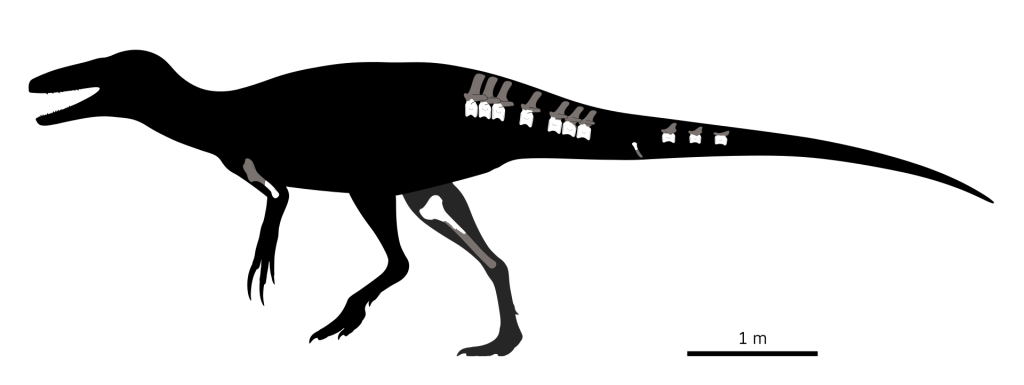

The same area has produced other megaraptorid bones as well. They include an anterior back vertebra, a tail centrum, a first-finger (thumb) bone, probably from the left hand, and part of an ulna (forearm bone). Méndez and colleagues identified these only as Megaraptoridae indeterminate—not identifiable to a genus. They placed one more back vertebra in Tetanurae, although it probably came from a megaraptorid too. So far, the species rests on its holotype alone.
Rinconraptor Size and Description
With bones from just three parts of the skeleton, Rinconraptor reveals itself mainly through its tail—and through comparison with its relatives.
Short description of Rinconraptor
Without a skull, teeth, or hands, any restoration of the head and arms borrows from other megaraptorids. The preserved lower end of the humerus is 5.4 inches (137 millimeters) wide and 6.2 inches (157 millimeters) long. Its ulnar condyle, the rounded knob that met the ulna, appears larger than the radial condyle beside it. At the knee, the preserved part of the tibia is 15.6 inches (395 millimeters) long. Its cnemial crest—a bony ridge at the front of the upper shin—is large, as in Aerosteon.
The tail shows a striking pattern. From front to back, the centra barely change in length, staying between about 3.2 and 3.6 inches (82 and 92 millimeters). Meanwhile, their height almost halves, falling from about 4.4 to 2.1 inches (111 to 54 millimeters). Where the outer bone is missing, camellate tissue shows through—a honeycomb of small internal air spaces. The seven front centra each carry a large, deep pneumatic foramen, an opening where air sacs entered the bone, as in other megaraptorans. The last three appear to bear smaller ones. No skin or feathers survive, so any discussion of its outer covering is speculative.
Size and Weight of Type Species
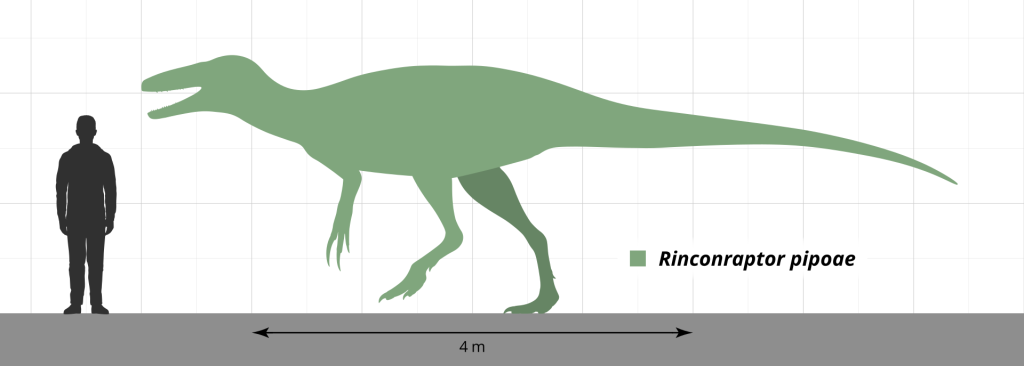
Méndez and colleagues estimated Rinconraptor at about 23 feet (7 meters) long—roughly the length of four tall adults lying head to toe. Without a complete skeleton, they reached that figure indirectly by scaling what they identified as its first tail centrum against the same bone in Aerosteon. For that relative, they used a length of 27 feet (8.3 meters) from a 2022 study by paleontologist A.M. Aranciaga-Rolando and colleagues. The figure is therefore an estimate built on proportions, not a measurement of a skeleton.
So far, no published study gives a hip height or body mass for Rinconraptor. As a result, its weight will likely stay open until more of the skeleton turns up.
By comparison, the area’s other megaraptorid bones point to animals of roughly 20 to 26 feet (6 to 8 meters). According to the describers, these are the largest theropods recorded so far at Cerro Overo–La Invernada. For scale, they compared them with Maip macrothorax, which they call “the largest megaraptorid recorded to date.” The same 2022 study placed Maip at 31 feet (9.5 meters).

The Dinosaur in Detail
What sets this dinosaur apart are details of its arm and shin. The describers list five diagnostic traits, and three of them are autapomorphies—features found in no other species. On the humerus, the ectepicondyle, a bony bump on the outer side of the elbow, sits unusually far from the bone’s lower end. Seen from above, the tibia has a straight outer margin and a squarish cnemial crest and inner condyle (joint knob).
Each of the other two traits, by contrast, appears in just one relative. An anterodistal ridge, which runs along the front of the lower humerus, otherwise occurs only in Megaraptor. In addition, a notch at the top of the shin called the incisura tibialis forms a right angle—a shape shared only by Japan’s Fukuiraptor.
Along the tail series, the ratio of centrum length to height rises from 0.74 in the first preserved bone to 1.57 in the last. Plotted against other theropods, that trend overlaps those of Tyrannosaurus and Allosaurus. Because the ratios resemble Tyrannosaurus, the authors estimate that the tail would have had more than 40 to 45 vertebrae.
To place the new genus, the team used a matrix of 357 characters scored across 60 taxa and specimens. The main analysis found 850 equally short family trees, and their consensus recovered Megaraptora but not Megaraptoridae. Rinconraptor emerged as the sister taxon of Megaraptor. Removing two unstable genera, Aoniraptor and Orkoraptor, restored Megaraptoridae with Australian forms branching earliest. A second method, implied weighting, placed Asian taxa such as Fukuiraptor at the base of Megaraptora. However, the authors caution that many Megaraptor skull characters come from a juvenile. The results anchor Rinconraptor among the Argentine megaraptorids—although its pairing with Megaraptor sits in a cluster the authors call tentative.
Interesting Points about Rinconraptor
- The species name pipoae honors Laura Pipo, a Ph.D. student who joined the fieldwork and died suddenly in 2020.
- Although only the vertebral bodies survive, its tail is one of the most complete caudal series known for any megaraptoran.
- Its tail bones reveal honeycomb-like camellate tissue, and the front seven each carry a large opening for air sacs.
- Its estimated length of about 23 feet comes from scaling a single tail vertebra against Aerosteon, not from a skeleton.
- In the main analysis, Rinconraptor came out as the closest relative of Megaraptor, which also shares its ridge on the upper arm bone.
Dinosaurs from the Same Formation
Also known from the Bajo de la Carpa Formation in the Cerro Overo–La Invernada area (exact level relative to Rinconraptor not known): the abelisaurids Viavenator and Llukalkan, the ornithopod Mahuidacursor, and the titanosaurs Inawentu, Yeneen, and Overosaurus. Mahuidacursor comes from the Cerro Overo site itself, but from the formation’s upper third. Paleontologist Rodolfo Coria and colleagues described Overosaurus from the Anacleto Formation in 2013, but later work moved it to the Bajo de la Carpa. The formation dates only to the Santonian, which lasted about 2 million years. As a result, these animals may not all have lived at the same time.
Rinconraptor in its Natural Habitat
Imagine a warm, semiarid landscape crossed by rivers—the kind of climate under which the Bajo de la Carpa Formation formed. Low-sinuosity rivers laid down most of it, with wind-blown sands in places near Neuquén city. At Cerro Overo–La Invernada, the rivers formed an anastomosed system—a web of branching and rejoining channels—with sandy channels and wide, muddy floodplains. Peirosaurid crocodyliforms (extinct crocodile relatives) such as Kinesuchus, chelid turtles, and a lungfish shared these waters and banks.
While there is no direct evidence of what Rinconraptor ate, its describers count megaraptorids, along with abelisaurids, among the apex predators of this ecosystem. Indeed, the fossil record holds no teeth, gut contents, or bite marks for the genus. Plant-eaters in the area included small to large titanosaur sauropods and medium-sized elasmarian ornithopods, but no fossil ties either group to Rinconraptor.
The authors suggest that two groups of apex predators sharing time and space may have competed for resources. They add that the fossil record could indicate some partitioning of the ecological niche—a possibility rather than a tested result. Unnamed fossils fill out the picture, from several large megaraptorid bones to unusually plentiful abelisaurid remains. Whether Rinconraptor lived alone or in groups remains unknown, at least according to the current fossil record.
Frequently Asked Questions
It means “Rincón thief,” after Rincón de los Sauces, and the species name pipoae honors the late Laura Pipo.
It lived in the Santonian stage of the Late Cretaceous, roughly 86 to 84 million years ago.
Its describers estimated about 23 feet (7 meters) from a single tail vertebra, but no weight estimate exists yet.
It was a carnivore. Its describers count megaraptorids among its ecosystem’s apex predators, though no direct diet evidence exists.
Its bones came from Cerro Overo, 31 miles (50 kilometers) southwest of Rincón de los Sauces, Argentina.
Three traits of its upper arm and shin bones occur in no other species, and its tail is among the most complete known for a megaraptoran.
Sources
The information in this article is based on various sources, drawing on scientific research, fossil evidence, and expert analysis. The aim is to provide a comprehensive and accurate overview of Rinconraptor. However, please be aware that our understanding of dinosaurs and their world is constantly evolving as new discoveries are made.
- https://doi.org/10.26879/1738
- https://palaeo-electronica.org/content/2026/5975-new-megaraptorid-from-patagonia
- https://stratigraphy.org/ICSchart/ChronostratChart2024-12.pdf
- https://pmc.ncbi.nlm.nih.gov/articles/PMC11177497/
- https://doi.org/10.5710/PEAPA/24.02.2024.484
- https://doi.org/10.1016/j.cretres.2019.02.014
- https://doi.org/10.1016/j.cretres.2017.07.022
- https://doi.org/10.1016/j.cretres.2017.10.021
- https://doi.org/10.1080/02724634.2020.1877151
- https://doi.org/10.1016/j.cretres.2021.104989
- https://doi.org/10.1016/j.cretres.2023.105754
- https://doi.org/10.1080/08912963.2025.2584707
- https://doi.org/10.11646/zootaxa.3683.4.2
- https://doi.org/10.1016/j.cretres.2015.12.018
- https://doi.org/10.1016/j.cretres.2018.03.014
This article was last fact checked: TheDinosaurs Team, 21-11-2026
Featured Image Credit: Connor Ashbridge, CC BY 4.0, via Wikimedia Commons
