
About 50 kilometers (31 miles) southwest of Rincón de los Sauces, in Argentina’s Neuquén Province, the sandstones and red mudstones of the Bajo de la Carpa Formation reach the surface at a fossil area called Cerro Overo – La Invernada. From La Invernada comes Yeneen houssayi, a titanosaur—one of the long-necked, plant-eating sauropods—named in 2026. It lived during the Santonian stage of the Late Cretaceous, roughly 86 to 84 million years ago. According to its describers, no other Santonian area in the Neuquén Basin has yielded as many kinds of titanosaurs.
The story began in 2003, when an officer of Argentina’s Gendarmería Nacional reported fossils at the site. Difficult access, however, kept anyone from recovering the bones at the time. Only in 2013 did new roads open the area. Over two field campaigns in 2013 and 2014, a team led by paleontologist Leonardo Filippi excavated the skeleton. In January 2026, Filippi and four colleagues described it in the journal Historical Biology. Their analysis found it closely related to Narambuenatitan and Overosaurus. Known mainly from its backbone, it is the third titanosaur named from this area. That tally hints at how rich in giant plant-eaters this corner of Santonian Patagonia may have been.
Yeneen Key Facts
| Keyword | Fact |
|---|---|
| Pronunciation | Not specified |
| Meaning of name | Winter Spirit (a Tehuelche spirit or entity related to winter) |
| Group | Sauropoda (Titanosauria, Saltasauroidea) |
| Type Species | Yeneen houssayi |
| Diet | Herbivore |
| When it Lived | 86 to 84 MYA |
| Period | Cretaceous |
| Epoch | Late Cretaceous (Santonian stage) |
| Length | About 33 to 39 feet (10 to 12 meters), describers’ estimate |
| Height | Not specified |
| Weight | About 8.8 to 11 tons (8 to 10 metric tonnes), describers’ estimate |
| Mobility | Moved on all four legs (quadrupedal) |
| First Discovery | 2003, reported by an officer of the Gendarmería Nacional, and excavated 2013 to 2014 by L.S. Filippi’s team |
| Described by | 2026 by L.S. Filippi, F. Bellardini, J.L. Carballido, A.H. Méndez, and A.C. Garrido |
| Holotype | MAU-Pv-LI-538 |
| Location of first find | La Invernada, Cerro Overo – La Invernada area, Bajo de la Carpa Formation, Neuquén Province, Argentina |
Yeneen Origins, Taxonomy and Timeline
According to press reports of the paper, the genus name comes from the tradition of the Tehuelche, or Aonikenk, people. In that tradition, Yeneen is a spirit or entity related to winter—a fitting choice for La Invernada, the site where the skeleton lay. The species name houssayi honors Bernardo Houssay, winner of the 1947 Nobel Prize in Physiology or Medicine. Houssay also helped found CONICET, Argentina’s national research council. Together, the name pairs a Patagonian winter spirit with a pioneer of Argentine science.
Within Titanosauria, the describers placed Yeneen in Saltasauroidea, the group named after Saltasaurus. More precisely, it sits at the base of an unnamed group they call “Clade A.” This clade gathers derived saltasauroids that fall outside Lithostrotia, a large subgroup of titanosaurs. Filippi and colleagues had named this clade in a paper on Inawentu, another La Invernada titanosaur, published online in late 2023. In that analysis, one branch held Inawentu, Antarctosaurus, and Bonitasaura, while the other included Narambuenatitan, Rinconsaurus, and Overosaurus. Different analyses place these animals differently, however—when Rodolfo Coria and colleagues named Overosaurus in 2013, they described it as a lithostrotian. Yeneen houssayi is the type and only known species.
The Bajo de la Carpa Formation dates to the Santonian. On the 2024 international timescale, that stage ran from about 85.7 to 83.6 million years ago. That places Yeneen roughly 18 to 20 million years before the end of the Cretaceous, 66 million years ago. Press reports, by contrast, gave a slightly younger age of about 83 million years. The formation lies above the Plottier Formation and below the Anacleto Formation, within the Río Colorado Subgroup of the Neuquén Group. In the describers’ view, at least two titanosaur lineages—Colossosauria, which includes Patagotitan, and Saltasauroidea—coexisted in this area during the Santonian.
Discovery & Fossil Evidence
As Argentine press accounts tell it, the 2003 report came from an officer of the Gendarmería’s Squadron 30, based in Chos Malal. However, the report did not lead straight to a dig. Access to La Invernada proved difficult. Researchers rediscovered the site only in 2013, after work with the energy company ExxonMobil opened new roads. The plaster jackets—known locally as “bochones”—were so heavy that the team needed a truck-mounted crane to move them. Preparation at the Museo Municipal Argentino Urquiza (MAU) then took several months.
Today the holotype, MAU-Pv-LI-538, belongs to that same museum in Rincón de los Sauces. According to press coverage of the paper, it includes six cervical (neck) vertebrae and ten dorsal (back) vertebrae with associated ribs. It also preserves the sacrum—the fused vertebrae of the hips—with both ilia (upper hip bones), plus the first caudal (tail) vertebra. The holotype includes no skull or limb bones, so much of the skeleton remains unknown.

Two more specimens turned up nearby, including a small hip bone that represents a second, juvenile individual. A few meters away, a third specimen with vertebrae and limb bones appears to be a different, as yet undescribed titanosaur. According to Filippi, it shows notable differences from Yeneen, and his team plans to study it in the future.
Yeneen Size and Description
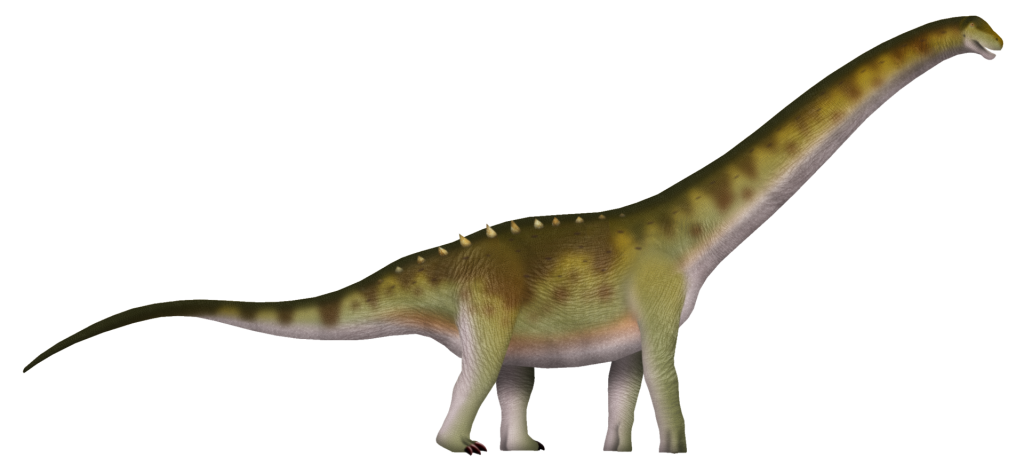
With no skull or limb bones in the holotype, any portrait of Yeneen must rest largely on its spine.
Short description of Yeneen
Filippi described Yeneen as having a small head relative to the rest of its body. No skull bones are known, however, so the head itself remains unknown. Behind it stretched a long neck, represented in the holotype by six cervical vertebrae. How many neck vertebrae it had in life is unknown.
Farther back, ten dorsal vertebrae, still associated with their ribs, record the trunk. According to Filippi, these make up the complete dorsal series, so the back is the best-represented part of the skeleton. At the hips, the sacrum survives together with both ilia, which shows how the pelvis joined the spine. Because only the first tail vertebra survives, the length and shape of the tail remain open questions.
Like other titanosaurs, Yeneen walked on all four legs. No skin or soft tissue is known, so any reconstruction of its outer appearance is speculative.

Size and Weight of Type Species
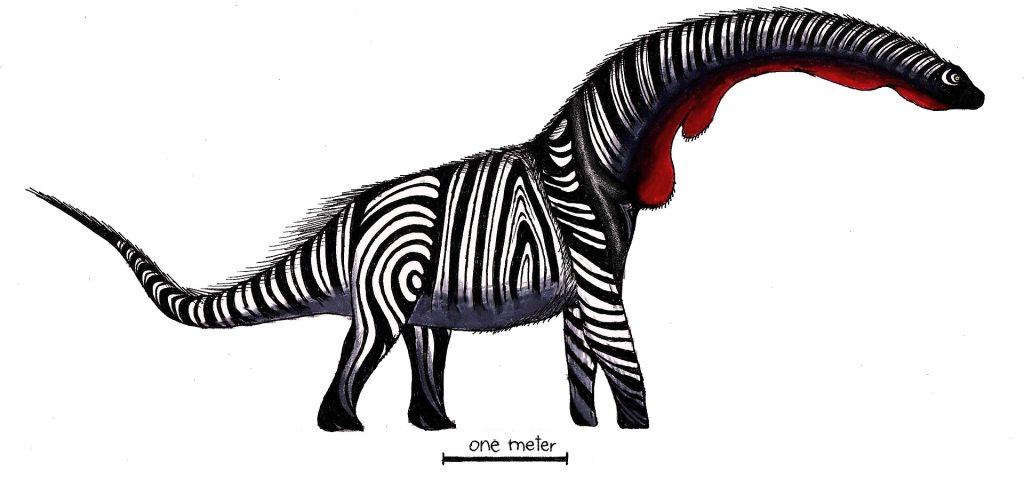
The research team estimated that Yeneen reached about 33 to 39 feet (10 to 12 meters) in length. Filippi gave this range himself, in the same press statement in which he described the animal’s small head. The team also gave a weight of roughly 8.8 to 11 tons (8 to 10 metric tonnes). Press coverage likened its volume to that of a city bus.
Those statements to the press did not explain the method behind the figures. With no limb bones in the holotype, the key evidence for body size is missing, so readers should treat the numbers as rough, indirect estimates. No study has yet published a height at the hips.
The Dinosaur in Detail
What sets this dinosaur apart is its backbone. In the original description, its distinctive features lie in the dorsal, sacral, and caudal vertebrae—the same stretch of spine that makes up most of the holotype.
A later study added one more detail. In 2026, paleontologist Samantha Beeston and colleagues used CT scans to study air spaces in sauropod tail bones. For Yeneen, they drew on a figure from the original description. They noted that the neural arch of the first tail vertebra—the bony arch above the spinal cord—carries deep, extensive fossae (pits) or subfossae. Its centrum, the spool-shaped body of the vertebra, shows no external sign of pneumaticity, the invasion of bone by air sacs. On that basis, they grouped Yeneen with several other titanosaurs that share this pattern.
Its neighbors make a useful contrast. Inawentu, also from La Invernada, was a broad-snouted, short-necked member of Clade A. Overosaurus, in contrast, was treated by several earlier studies as an aeolosaurian, part of a derived lineage within Rinconsauria, a group of mid-sized South American titanosaurs. Both animals come from the same area as Yeneen, and the Inawentu analysis recovered both in Clade A.
The evidence places Yeneen close to Narambuenatitan and Overosaurus, near the base of Clade A. Earlier, Filippi and colleagues described the clade’s members as deeply nested titanosaurs that, in South America, were restricted to the last stages of the Late Cretaceous. With Yeneen added, the describers now see Cerro Overo – La Invernada as an exceptional area for understanding how dinosaur faunas evolved during the Santonian.
Interesting Points about Yeneen
- The genus name refers to a Tehuelche spirit of winter, chosen because the skeleton came from La Invernada, a site whose Spanish name also evokes winter.
- An officer of Argentina’s Gendarmería Nacional first reported the fossils in 2003, but excavation did not begin until 2013.
- The plaster jackets protecting the bones were so heavy that moving them required a truck-mounted crane, and preparing them took several months.
- Press coverage reported that Yeneen is the third distinct titanosaur species named from its area, after Overosaurus and Inawentu.
- Before Yeneen, the Bajo de la Carpa Formation had produced five named titanosaurs: Rinconsaurus, Bonitasaura, Traukutitan, Overosaurus, and Inawentu.
Dinosaurs from the Same Formation
Also known from the Bajo de la Carpa Formation at Cerro Overo – La Invernada (exact level relative to Yeneen not known): the titanosaurs Overosaurus and Inawentu, the abelisaurid predators Viavenator and Llukalkan, the medium-sized ornithopod Mahuidacursor, and the megaraptorid predator Rinconraptor. Overosaurus was first reported from the overlying Anacleto Formation, but in 2015 Filippi and colleagues reassigned its site to the Bajo de la Carpa. The formation is dated only to the Santonian, a stage that lasted about 2 million years. Its own duration has not been measured, so these animals may not all have lived at the same time. Inawentu, for example, came from 11.1 meters below the base of the overlying Anacleto Formation, in a local section almost 130 meters thick. Filippi has also said that the area’s titanosaurs come from different levels, possibly separated by thousands or even millions of years.
Yeneen in its Natural Habitat
Imagine a warm, semiarid landscape crossed by rivers. At Cerro Overo – La Invernada, the rocks record an anastomosed river system—a web of branching, interconnected channels—with sandy channels running through muddy floodplains. Elsewhere in the formation, near the city of Neuquén, some deposits are wind-blown. The area has also yielded the crocodyliform Kinesuchus overoi, the lungfish Rinconodus salvadori, chelid (side-necked) turtles, and several unnamed megaraptorid specimens. Across the formation as a whole, birds such as Neuquenornis and Patagopteryx turn up too, along with nests and eggs.
As a titanosaur, Yeneen was a herbivore. Its describers have offered two explanations for why so many titanosaur species turn up in one area. In their view, the local diversity may reflect different feeding strategies—or, alternatively, a faunal replacement over time within the formation. Its neighbor Inawentu, for one, had a broad snout, and its describers called it “rebbachisaurid-mimicking,” after a family of broad-mouthed sauropods. In 2026, however, Luca Matteoni and colleagues found titanosaurs compatible with both colossosaurs and saltasaurids in a single horizon at Los Bastos, another Bajo de la Carpa site near Senillosa. To them, that pattern suggests gradual, overlapping diversification rather than rapid faunal replacement.
A small juvenile hip bone from the same site shows that a second, younger individual is preserved there too. Still, there is no evidence of herd life, and fossils from different levels here may be separated by thousands or even millions of years. The area is rich in predators as well. According to the describers, it holds the Neuquén Basin’s greatest known Santonian diversity of abelisaurids. In 2024, Filippi and colleagues linked this faunal richness to a particular paleoenvironmental development that still needs further study. For now, Yeneen stands as one more clue to how this river landscape supported so many giants.
Frequently Asked Questions
Yeneen refers to a Tehuelche spirit related to winter, and the species name honors Nobel laureate Bernardo A. Houssay.
It lived during the Santonian stage of the Late Cretaceous, roughly 86 to 84 million years ago.
Its describers estimated a length of about 33 to 39 feet and a weight of about 8.8 to 11 tons.
It was a herbivorous titanosaur sauropod, placed near the base of a saltasauroid group called “Clade A.”
Its fossils come from La Invernada, in the Bajo de la Carpa Formation of Neuquén Province, Argentina.
Its describers identified distinctive features in its dorsal, sacral, and caudal vertebrae that set it apart from other titanosaurs.
Sources
The information in this article is based on various sources, drawing on scientific research, fossil evidence, and expert analysis. The aim is to provide a comprehensive and accurate overview of Yeneen. However, please be aware that our understanding of dinosaurs and their world is constantly evolving as new discoveries are made.
- https://doi.org/10.1080/08912963.2025.2584707
- https://doi.org/10.1016/j.cretres.2023.105754
- https://doi.org/10.5710/PEAPA.24.02.2024.484
- https://doi.org/10.26879/1738
- https://doi.org/10.1111/joa.70177
- https://doi.org/10.1186/s12862-024-02247-w
- https://doi.org/10.1080/02724634.2020.1877151
- https://doi.org/10.1016/j.cretres.2019.02.014
- https://doi.org/10.1016/j.cretres.2017.07.019
- https://doi.org/10.3301/IJG.2026.08
- https://doi.org/10.11646/zootaxa.3683.4.2
- https://stratigraphy.org/ICSchart/ChronostratChart2024-12.pdf
- https://www.lmneuquen.com/neuquen/investigadores-del-conicet-descubrieron-un-nuevo-dinosaurio-neuquen-como-era-n1224613
- https://www.tiempoar.com.ar/ta_article/yeneen-houssayi-dinosaurio-83/
- https://www.sci.news/paleontology/yeneen-houssayi-14510.html
- https://www.batimes.com.ar/news/culture/new-species-of-sauropod-dinosaur-found-in-argentina.phtml
- https://www.ellitoral.com/informacion-general/dinosaurio-neuquen-sauropodo-titanosaurio-yeneen-tehuelche-houssay-conicet_0_LQ10q0Ydz3.html
This article was last fact checked: TheDinosaurs Team, 21-11-2026
Featured Image Credit: Connor Ashbridge, CC BY 4.0, via Wikimedia Commons
