
West of Saltillo, in the Mexican state of Coahuila, the Cerro del Pueblo Formation preserves the coastal plain of a vanished Late Cretaceous world. From its La Parrita locality came a weathered braincase that became the holotype of Xenovenator espinosai in 2026. This troodontid lived about 73 million years ago, near the very end of the Campanian stage. Troodontids were lightly built, feathered maniraptoran theropods, and what makes this one remarkable is its skull roof. Its bones are thick, domed, and tightly interlocked—a build its describers read as gear for fighting rather than for show.
Paleontologist Martha C. Aguillón-Martínez picked up the specimen from the surface during fieldwork at La Parrita. In 2023, she and Héctor E. Rivera-Sylva described it without a name, calling it an indeterminate troodontid because weathering had blurred its details. Three years later, Rivera-Sylva led a six-author team, including Nicholas R. Longrich, that named the animal in the journal Diversity. According to their study, adaptations for combat within a species had never before been described in a non-avian maniraptoran. Until the 2023 report, Mexico’s troodontid record consisted of teeth alone, so this braincase helps fill a real gap.
Xenovenator Key Facts
| Keyword | Fact |
|---|---|
| Pronunciation | Not specified |
| Meaning of name | Strange Hunter |
| Group | Theropoda (Troodontidae) |
| Type Species | Xenovenator espinosai |
| Diet | Not specified |
| When it Lived | Around 73 MYA |
| Period | Cretaceous |
| Epoch | Late Cretaceous (Campanian stage) |
| Length | About 8.5 feet (2.6 meters), an indirect 2023 estimate from skull length |
| Height | Not specified |
| Weight | Not specified |
| Mobility | Not specified |
| First Discovery | Year not specified (sources give 2000 or 2007) by Martha C. Aguillón-Martínez |
| Described by | 2026 by H.E. Rivera-Sylva, M.C. Aguillón-Martinez, J. Flores-Ventura, I.E. Sánchez-Uribe, J.R. Guzman-Gutierrez, and N.R. Longrich |
| Holotype | CPC 2973 |
| Location of first find | La Parrita locality, Cerro del Pueblo Formation, General Cepeda, Coahuila, Mexico |
Xenovenator Origins, Taxonomy and Timeline
The name Xenovenator blends two languages, joining the Greek “xenos” (“strange”) with the Latin “venator” (“hunter”). Its species name, espinosai, honors Luis Espinosa. The authors describe him as a pioneer in the study of Mexican dinosaurs and a mentor to many generations of paleontologists. Together, the name pairs an unusual animal with a pioneer of Mexican paleontology.
Rivera-Sylva and colleagues placed Xenovenator within Maniraptora, then Deinonychosauria, and finally Troodontidae. Deeper still, it falls in Troodontinae and in Troodontini—a clade the team defined as all taxa closer to Troodon formosus than to Saurornithoides mongoliensis. In their main analysis, its closest relative was a second, tentatively referred species, Xenovenator(?) robustus, followed by Albertavenator curriei. A broader alternative analysis also kept it in Troodontidae, though with a different family tree. After a later revision, Xenovenator espinosai stands as the type and only known species.
The authors assign the holotype to the uppermost Campanian stage of the Late Cretaceous. Their date of 73 million years, give or take one million, comes from strontium isotopes in oyster shells. Those shells come from Las Águilas, another Cerro del Pueblo locality. However, magnetostratigraphy (dating by ancient magnetic reversals) points to a slightly younger maximum of about 72.5 million years near Saltillo. Either way, Xenovenator lived near the end of the Campanian, which ran from roughly 83.6 to 72.2 million years ago.
Discovery & Fossil Evidence
The holotype came from La Parrita, about 54 kilometers (34 miles) west of Saltillo in the municipality of General Cepeda. Because Aguillón-Martínez collected it from the surface, the papers give no bed for it. However, the date is less certain than the place. The 2026 paper puts the find in summer 2000, but the 2023 description gives March 2007—and neither paper reconciles the two.
Cataloged as CPC 2973, the holotype is a braincase—the bony box that held the brain. It includes the frontals and parietals (the main skull-roof bones), plus the orbitosphenoids and laterosphenoids at its front. Behind and below them sit the exoccipitals, prootics, basisphenoid, and basioccipital, which form the back, sides, and floor of the braincase. The specimen now resides in the Museo del Desierto in Saltillo. Weathering and a coat of desert varnish—a dark mineral film—obscure many of its sutures, yet the fossil remains relatively complete. The team prepared it with pneumatic tools, dental picks, and pin vises, and later CT scans confirmed its thickened skull bones.
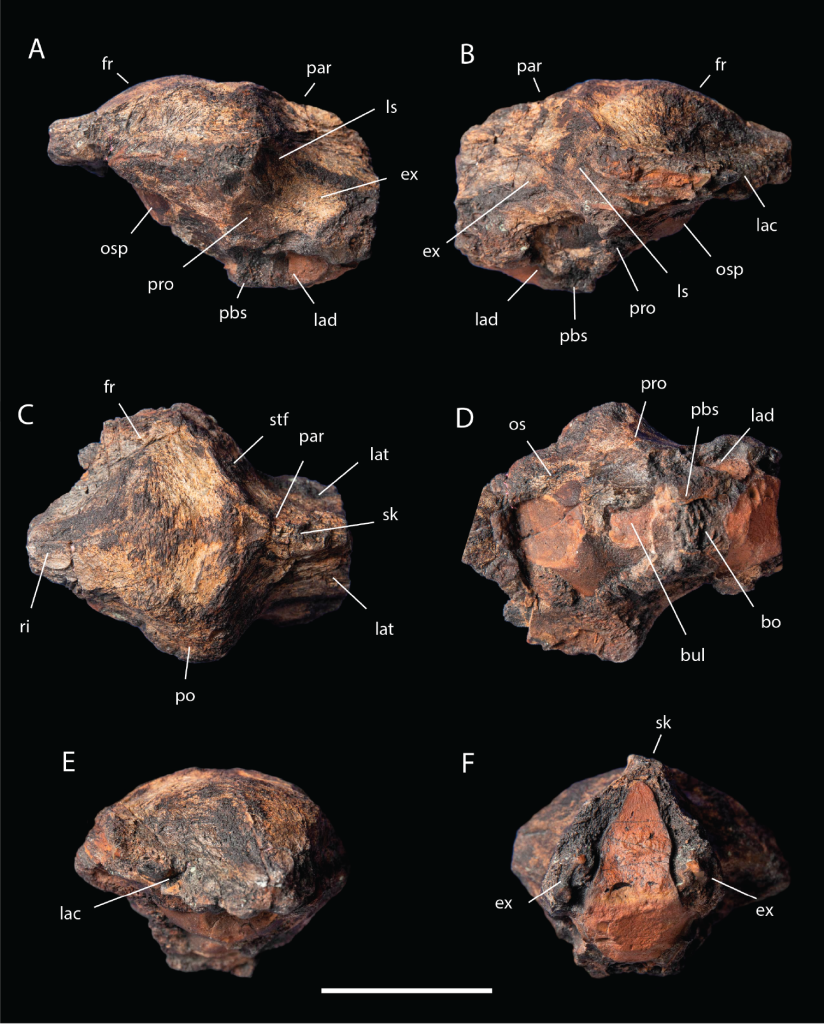

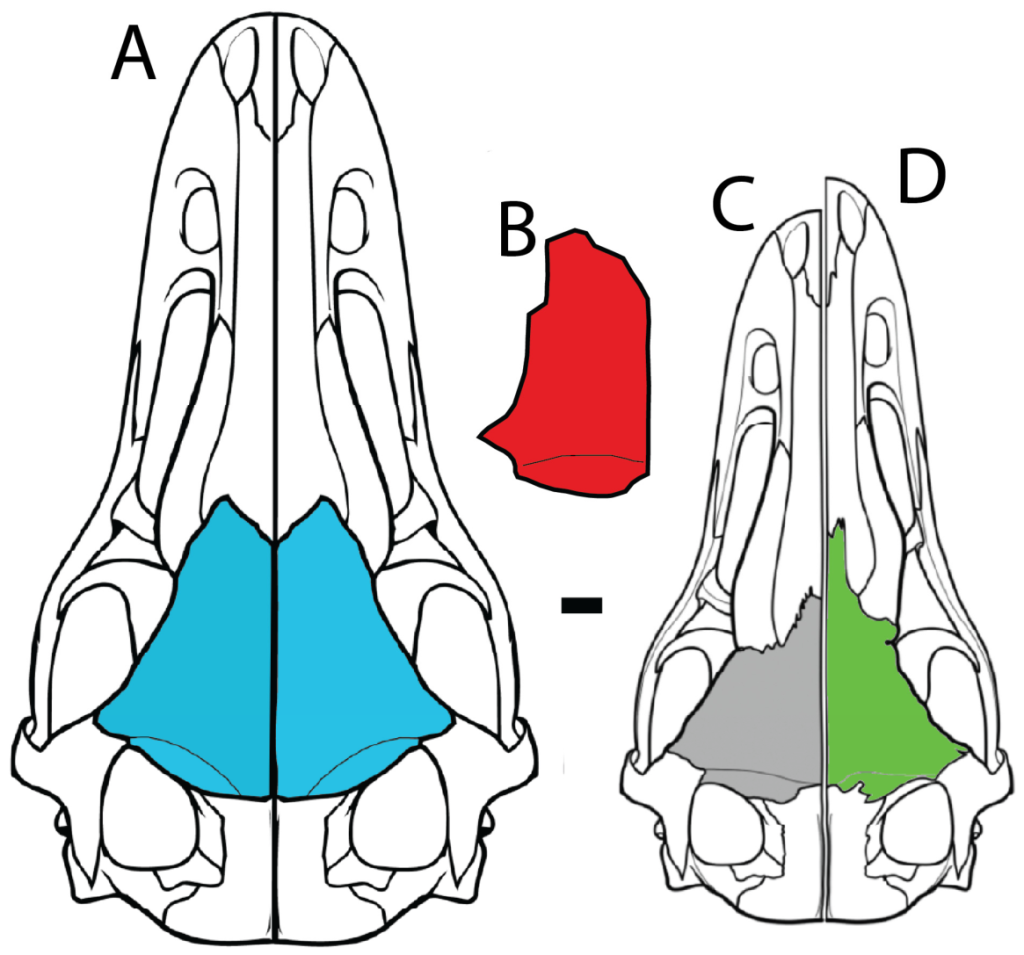
The authors also referred two isolated frontals to the species. CPC 2976, a left frontal, came from La Parrita in 2004. In contrast, CPC 3112, a right frontal, was collected at Ejido Trincheras in 2002 and later donated anonymously. That second site lies about 109 kilometers (68 miles) west of Saltillo, in Parras de la Fuente municipality. These three specimens are the species’ entire known record—and every one comes from the skull.
Xenovenator Size and Description
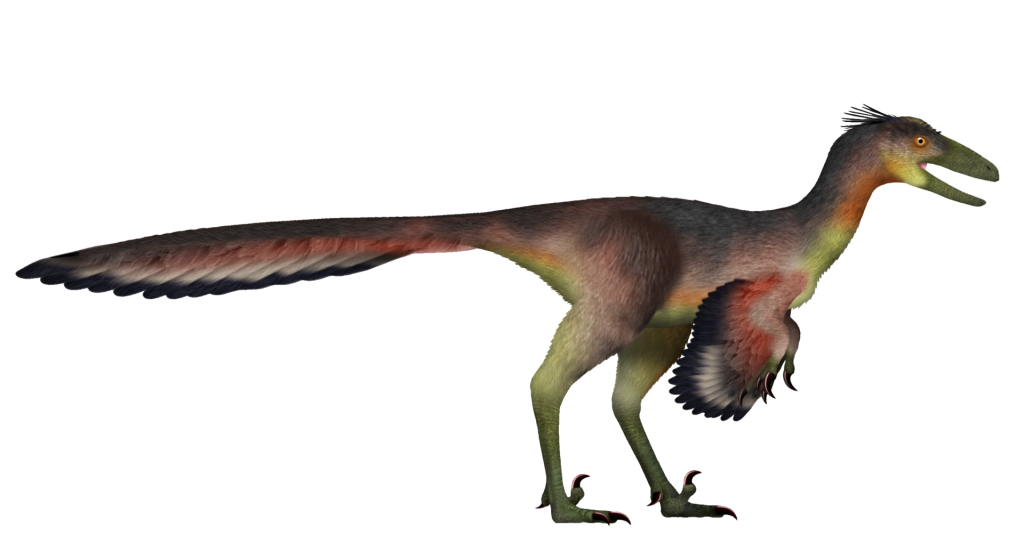
Because only skull bones are known, any picture of the whole animal leans on its better-known relatives.
Short description of Xenovenator
The skull roof is the heart of the story. Its frontals and parietals are massive, reaching up to 12 millimeters (about 0.47 inches) thick. On top, the roof is domed, rugose (roughened), and striated, while the frontals measure about 8 millimeters thick in between. Inside, CT scans reveal a dense cortex 2 to 3 millimeters thick around spongy, or cancellous, bone. The skull bones meet along strongly interdigitating sutures, and the joint between the two frontals zigzags in cross-section.
Farther back, the parietals form a triangular table, while the orbitosphenoids and laterosphenoids expand forward and downward to enclose the braincase. In 2023, the preserved specimen measured 92.3 millimeters long, 73 millimeters wide, and 56.3 millimeters high—direct caliper readings.
Nothing below the skull has turned up so far. Troodontids as a group had feathers and a large curved claw on the second toe, but none of that survives here. Any reconstruction of its body and posture is therefore speculative.

Size and Weight of Type Species
Only one published scientific estimate of body length exists for Xenovenator. In 2023, Aguillón-Martínez and Rivera-Sylva estimated about 8.5 feet (2.6 meters), but that figure is indirect. First, they reconstructed a total skull length of 344 millimeters (about 13.5 inches) by comparison with Saurornithoides, Gobivenator, and Zanabazar. Then they scaled body length up from the skull.
The 2026 naming paper gives no length or mass and instead counts Xenovenator among the large-bodied North American troodontids. Neither paper offers a height or weight.
Without a skeleton, the 8.5-foot figure is a rough guide, not a measurement. For comparison, the referred frontal CPC 2976 nearly matches the holotype’s, at about 60 millimeters (2.4 inches) along the midline.
The Dinosaur in Detail
What sets this dinosaur apart is a skull roof built like a helmet. In 2026, Rivera-Sylva and colleagues argued that its features suggest adaptation for intraspecific combat—fighting between members of the same species. Specifically, they proposed head-butting, an idea also put forward for dome-headed pachycephalosaurids and pachyrhinosaurin horned dinosaurs. By contrast, they found display less convincing. In their view, the dome’s low profile must have limited its effectiveness for show, and the bones seem overdesigned for it. Among the modern analogues they named are musk-oxen, cape buffalo, giraffes, bighorn sheep, and the helmeted hornbill.
If the dome served in fights, the team suggests, Xenovenator may be the first known non-avian paravian with a skull modified for same-species combat. Paravians form the broader group that includes both troodontids and birds. The authors also noted rugose skull roofs in other troodontines, hinting that such combat could have been widespread across Troodontinae. Despite a superficial resemblance to the pachycephalosaurids, they stress that Xenovenator lacks their derived traits. It has neither tuberculate (knobby) ornament nor large olfactory fossae, the hollows linked to the sense of smell.
The referred frontals complicate the picture, since they show less doming, less thickening, and weaker interlocking than the holotype. Accordingly, the authors weighed three explanations—a separate species, growth changes, or sexual dimorphism, meaning differences between males and females. For now, they kept all three in one species and suggested CPC 2976 might be a female, not a juvenile. More specimens and histology, the study of bone tissue, would be needed to test these ideas.

Relatives and a 2026 Revision
Its comparisons point in two directions. Xenovenator shares an L-shaped frontal–lacrimal contact and a forward-shifted supratemporal region with “Saurornitholestes” robustus. With Albertavenator, it shares a supraorbital shelf and tall nasal processes. Rivera-Sylva’s team tentatively referred robustus, known from one frontal from New Mexico’s Kirtland Formation, to Xenovenator. Later in 2026, however, paleontologists Steven E. Jasinski and Robert M. Sullivan gave it its own genus, Dinevenator. In their analysis, Albertavenator emerged as sister to X. espinosai, with Dinevenator at the base of a clade of robust troodontins. They also cautioned that the earlier comparisons leaned heavily on the referred frontal CPC 2976 rather than the holotype. In addition, they found the supratemporal shift “not as apparent” as claimed. Both studies place Xenovenator in a group of robust troodontins, although they disagree over where Dinevenator belongs.
Interesting Points about Xenovenator
- Its name means “strange hunter,” combining Greek “xenos” with Latin “venator,” and its species name honors Mexican dinosaur pioneer Luis Espinosa.
- Parts of its skull roof reach 12 millimeters (about 0.47 inches) thick, and its skull bones meet along strongly interdigitating sutures.
- Its describers suggest it may be the first known non-avian paravian with a skull modified for fighting members of its own species.
- The two published accounts of the holotype disagree on its discovery date, giving either summer 2000 or March 2007.
- Before its 2026 naming, the same braincase appeared in a 2023 paper as an indeterminate troodontid, possibly related to Latenivenatrix mcmasterae.
Dinosaurs from the Same Formation
Also known from the Cerro del Pueblo Formation (exact level relative to Xenovenator not known): the duck-billed hadrosaurids Coahuilasaurus, Velafrons, Tlatolophus, and Latirhinus, and the large ostrich-like ornithomimosaur Paraxenisaurus. Coahuilasaurus was a kritosaurin, while Velafrons and Tlatolophus were lambeosaurines—the crested duck-bills. Researchers first classified Latirhinus as a broad-nosed saurolophine, but later work moved it to the lambeosaurines. Paraxenisaurus, meanwhile, is known from the bones of several individuals. Published age estimates for the formation run from about 73.5 to 72.5 million years ago, late in the Campanian. As a result, these animals may not all have lived at the same time.
Xenovenator in its Natural Habitat
Xenovenator lived on a very low-gradient coastal plain at the edge of a delta that drained east into the ancient Gulf of Mexico. Its rocks record marshes, lagoons, and shallow seas, shaped by frequent sea-level changes and coastal storms. At La Parrita itself, the beds shift between shallow-marine, brackish, freshwater, and even dry-land conditions. Oysters point to brackish water, while one bed with gastropods, oysters, and wood fragments records an estuary. One layer even holds the ammonite Sphenodiscus together with isolated dinosaur bones.
Exactly what Xenovenator ate is unknown. The 2026 authors suggest that advanced troodontids such as Troodon and Stenonychosaurus probably did not take large prey. Their diets, the authors add, likely included plant matter. In addition, stable isotope studies suggest troodontid diets fell between those of dromaeosaurs and ornithischians.
While there is no direct evidence of how Xenovenator lived day to day, its describers read its skull roof as a sign of contests between rivals. The 2026 authors connect such features to sexual selection, which they argue was widespread among Late Cretaceous dinosaurs. The rocks have also produced crocodiles and freshwater turtles, along with ornithomimids, caenagnathids, dromaeosaurids, thescelosaurids, and unnamed nodosaurids and ankylosaurids. Unnamed horned dinosaurs—a centrosaurine and a chasmosaurine—also turn up in the formation. In 2024, Barrera Guevara and colleagues moved the horned dinosaur Coahuilaceratops, long reported from these rocks, to the younger Cerro Huerta Formation. That unit is tentatively dated to about 71.5 to 70.5 million years ago. Within that varied coastal fauna, Xenovenator is the first troodontid from Mexico known from bones rather than isolated teeth.
Frequently Asked Questions
It means “strange hunter,” from Greek “xenos” and Latin “venator.” The species name honors Mexican paleontologist Luis Espinosa.
It lived in the latest Campanian stage of the Late Cretaceous, around 73 million years ago.
A 2023 indirect estimate, scaled from skull length, suggests about 8.5 feet (2.6 meters) long. Neither height nor weight has a published estimate.
It was a troodontid theropod, which its describers placed in the subgroup Troodontini.
Its holotype came from La Parrita in the Cerro del Pueblo Formation, west of Saltillo in Coahuila, Mexico.
Its skull roof is thick, domed, and tightly interlocked, and its describers proposed that it served in head-butting contests.
Sources
The information in this article is based on various sources, drawing on scientific research, fossil evidence, and expert analysis. The aim is to provide a comprehensive and accurate overview of Xenovenator. However, please be aware that our understanding of dinosaurs and their world is constantly evolving as new discoveries are made.
- https://www.mdpi.com/1424-2818/18/1/38
- https://paleontologiamexicana.geologia.unam.mx/index.php/paleontologia/article/view/352
- https://www.mdpi.com/2813-6284/4/3/21
- https://www.mdpi.com/1424-2818/16/9/531
- https://doi.org/10.3390/d16070390
- https://rmcg.geociencias.unam.mx/index.php/rmcg/article/view/880
- https://www.usgs.gov/publications/velafrons-coahuilensis-a-new-labeosaurine-haddrosaurid-dinosauria-ornithopoda-late
- https://doi.org/10.1016/j.cretres.2021.104884
- https://ui.adsabs.harvard.edu/abs/2022JSAES.11403689S
- https://ui.adsabs.harvard.edu/abs/2020JSAES.10102610S
- https://stratigraphy.org/ICSchart/ChronostratChart2024-12.pdf
- https://doi.org/10.1016/j.palaeo.2015.10.020
This article was last fact checked: TheDinosaurs Team, 21-11-2026
Featured Image Credit: Connor Ashbridge, CC BY 4.0, via Wikimedia Commons
